Daniel sent us this one — he's working from home in Jerusalem with a ten-month-old, traffic noise coming through the window, and ADHD that makes background conversation absolutely shred his concentration. He's got a collection of white noise machines and the instinct is to stick one on the desk. But he's heard that's actually wrong. The real question is: where should they go, how do you coordinate multiple units without losing your mind, and is there a smarter way to do this whole thing than just buying more plastic boxes?

This is one of those topics where the intuitive answer is almost perfectly backwards. Most people think of a white noise machine the way they think of a speaker — put it near your ears, turn it up, problem solved. But that's not masking. That's just adding more noise to your noise.
The musical equivalent of trying to hide a spilled glass of red wine by spilling another glass of red wine directly onto your lap.
actually a surprisingly good analogy. The point of sound masking isn't to hear white noise. It's to make the unwanted sound unintelligible. You want the masking sound to arrive at the point where the unwanted sound originates, or somewhere between you and that source, so that by the time both sounds reach your ears, the unwanted one has been scrambled into texture.
The desk placement is basically building your acoustic defense in the wrong spot. You've fortified your own position but left the enemy's supply lines completely intact.
And this gets to something called the masking curve. The core principle is that a masking sound is most effective when it's physically closer to the noise source than to the listener. If you put the machine on your desk and the baby is crying in a bedroom thirty feet away, the cry travels through the air, bounces off walls, loses some high-frequency energy, but the intelligibility — the part your brain latches onto — remains largely intact by the time it reaches you. Meanwhile, you've got white noise blasting directly into your ears, which creates listening fatigue without actually solving the problem.
You're both annoyed and unhelped. The worst of both worlds.
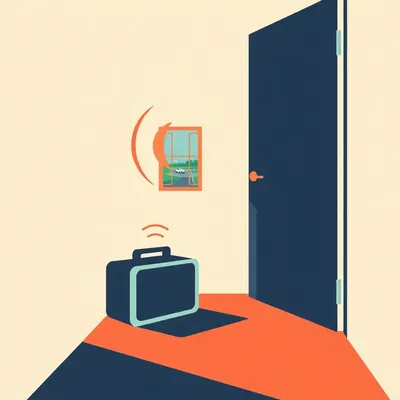
The worst of both worlds. Now, if you instead place that machine in the hallway outside the baby's door, the white noise saturates the air right at the source. The cry has to travel through that saturated space before it reaches you, and by the time it does, the sharp edges have been worn down. The sound is still there, but it's become texture rather than signal.
That distinction — signal versus texture — is the whole game, especially for someone with ADHD.
It really is. There's a neurological phenomenon called sensory gating deficit. Most brains automatically filter out irrelevant background sounds — the hum of a refrigerator, distant traffic, someone else's conversation. But ADHD brains don't gate as effectively. Background conversation in particular hijacks attentional resources because the brain keeps trying to decode the linguistic content. It's not that you want to eavesdrop. It's that your auditory system won't stop processing the words.
Like having a speech-to-text engine running in your head that you can't turn off.
That's exactly what it feels like, according to people who experience it. White noise works because it raises the noise floor to a level where those linguistic signals can't be extracted. The brain stops trying. And that's where the relief comes from — not from the sound itself, but from the cognitive load it removes.
We've established that placement matters more than proximity. But once you've got two machines in the right spots, how do you actually manage them without losing your mind? Because the prompt describes a two-source problem. Traffic from the window and baby from the bedroom. Two very different sounds, two different directions, two different acoustic profiles.
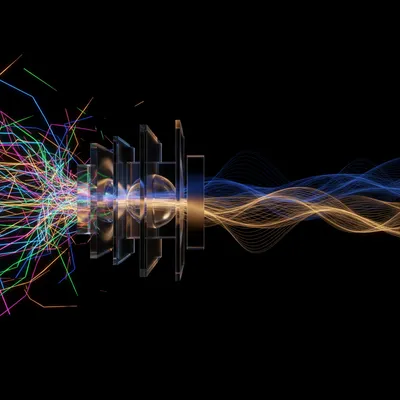
And this is where the physics gets interesting. Traffic noise is predominantly low-frequency. Think of that rumble you feel more than hear. Baby crying is concentrated in the mid-to-high frequency range — roughly two to four kilohertz, which happens to be exactly where human hearing is most sensitive. These two sounds require different masking strategies.
Why is low-frequency traffic harder to mask?
This goes back to work done by Harvey Fletcher and Wilden Munson at Bell Labs in the nineteen thirties. They mapped what are now called equal-loudness contours — basically, how sensitive the human ear is to different frequencies at different volumes. And the key finding is that at lower volumes, we're dramatically less sensitive to low frequencies. A fifty-hertz rumble needs to be physically much louder than a one-kilohertz tone for us to perceive them as equally loud. So when you're trying to mask traffic noise, you need more acoustic energy in those low frequencies than you'd expect.
Which most consumer white noise machines aren't really designed to deliver.
Most consumer machines are optimized for the frequency range of human speech — roughly five hundred hertz to four kilohertz. That's great for masking conversation or a baby crying. It's less effective for the kind of subwoofer rumble you get from a bus idling outside your window.
You might need different machines, or at least different settings, for different sources.
Or different placement strategies. For the traffic source at the window, the ideal placement is actually between the window and your work position, close to the window. You're creating what acousticians call a barrier effect — the masking sound saturates the air near the point of entry. For the baby in the bedroom, you want the machine in the hallway outside the door, or even inside the bedroom near the door, pointed away from the crib. The goal in both cases is to intercept the unwanted sound before it can propagate through your workspace.
Let's put some numbers on this, because I think people need a sense of what we're actually talking about in terms of volume.
There was a study published in the Journal of the Acoustical Society of America that looked at sound masking in open-plan offices. They found that masking sound delivered at forty-eight to fifty-two decibels at the listener's position reduced speech intelligibility by roughly sixty to eighty percent. Now, in a home environment, you can be even more effective because you're not dealing with dozens of talkers spread across a large floor plate. You've got one or two discrete sources.
Walk me through a concrete scenario. Someone's got a home office. The baby's room is down a short hallway. There's a window facing a street with moderate traffic. They've got two white noise machines. Where do they go, and how loud?
Machine one goes in the hallway, roughly four to six feet from the baby's door, positioned so the sound projects across the doorway rather than into it. You don't want to blast sound directly at a sleeping infant. Set it to around fifty-five to sixty decibels measured at the door. Machine two goes on the windowsill or a nearby shelf, facing the glass, at about fifty decibels. Now, here's the counterintuitive part: at your desk, the ambient sound level might only be forty to forty-five decibels. That's quiet enough to work comfortably, but the masking effect is still working because the unwanted sounds are being scrambled at their source.
The volume at your ears is lower than if you'd just put one machine on your desk and cranked it.
A desk-placed machine typically needs to hit fifty-five to sixty decibels at your ears to achieve the same masking effect, because it's competing with sounds that have already propagated through the space. And sixty decibels of continuous noise at your ears for eight hours is fatiguing. There's research showing that prolonged exposure to noise above fifty-five decibels can increase cortisol levels and contribute to stress, even if you don't consciously register it as loud.
Which is exactly the opposite of what we're trying to achieve here. The whole point is stress reduction.
And this connects to something the prompt mentions that I think is really important — the idea that being a safe parent involves managing your own stress. A parent who's been listening to sixty decibels of white noise all day, on top of the actual baby cries that do break through, is going to be more frazzled by evening. The placement strategy isn't just about acoustic efficiency. It's about preserving your own nervous system.
That covers the physics. Now let's talk about the practical reality of living with multiple machines — and whether there's a smarter way to do this than buying more plastic boxes.
The multi-unit coordination problem is real. If you've got two or three machines in different rooms, each with its own physical volume knob, you're going to be walking around adjusting things constantly. The baby goes down for a nap, you turn up the hallway machine. Traffic dies down in the evening, you turn down the window machine. For someone with ADHD, this is exactly the kind of friction that leads to the whole system being abandoned after three days.
Decision fatigue meets physical inconvenience. The machine in the hallway stays off because walking over there feels like a whole thing.
Then you're back to noise-canceling headphones, which the prompt specifically says they want to avoid. So the question is: how do you automate this?
Smart plugs seem like the obvious first step.
They're the cheapest entry point. A Wi-Fi smart plug — TP-Link Kasa, Shelly, whatever works with your ecosystem — can handle on-off scheduling for any dumb white noise machine. You set the physical volume once, tape over the knob if you need to, and then the plug controls power. The problem is that most white noise machines don't remember their volume setting after a power cycle. They reset to some default, or they come back on at full blast, or they just don't turn on at all because they have a soft power button.
You'd need to test your specific machine before committing to the smart plug approach.
You absolutely need to test this. Some machines, particularly the simpler analog ones with a physical on-off switch and a mechanical volume dial, work perfectly with smart plugs because they just resume at whatever position the dial is set to. The classic Marpac Dohm is actually great for this — it's got a physical switch and a mechanical dial. Power it through a smart plug, and it comes back exactly where you left it.
The Dohm is the one with the actual spinning fan inside, right?
Yes, and that's worth a quick detour because it connects to something people often get wrong about white noise machines. The Dohm uses a real physical fan that pushes air through adjustable vents. The sound it produces has natural variation — tiny fluctuations in pitch and volume that happen because it's a mechanical system, not a digital loop. Electronic machines like the LectroFan use a synthesized sound that's mathematically precise. That precision sounds cleaner, but it can actually be more fatiguing over long periods because your brain eventually notices the perfect repetition.
The fan-based machine is the vinyl record of white noise. The digital one is the CD. Imperfection is the feature.
And for ADHD brains in particular, some people report that the slight natural variation in fan-based white noise is less distracting than the sterile consistency of a digital generator. Though I should say this is highly individual — some people strongly prefer the electronic sound. There's no universal right answer.
The Dohm doesn't have any smart features. It's as dumb as a machine can be, in the best possible way.
And that's fine if you're pairing it with a smart plug for scheduling. But if you want volume control without walking over to the machine, you need something smarter. The SNOOZ, which came out in twenty nineteen, was the first consumer white noise machine with proper app control. It uses a real fan — so you get that natural analog sound — but it connects via Bluetooth and Wi-Fi, and you can adjust volume, set schedules, and even create fade-in and fade-out routines from your phone.
It remembers everything because it's always powered.
Right, no power-cycling issues. The SNOOZ stays connected and you can tweak it from your desk. There's also the Dohm Connect, which is the smart version of the classic Dohm, but it's locked into its own app ecosystem and doesn't play as nicely with broader smart home setups.
What does a practical hybrid setup look like? You've got a hallway and a window to cover. Most people aren't buying three SNOOZ units at a hundred dollars each.
The pragmatic recommendation is a mixed fleet. Put a SNOOZ on your desk or nearby — this becomes your adjustable unit that you can tweak throughout the day without getting up. Put a Dohm or a basic LectroFan in the hallway on a smart plug, set to a fixed volume that you've calibrated once. If you need a third unit for the window, another dumb machine on a smart plug. Total cost is maybe two hundred dollars, and you've got full control from your phone.
The scheduling piece?
This is where a smart home hub — Apple HomeKit, Home Assistant, whatever — really shines. You can create automations like: at seven AM, turn on the hallway machine. At nine PM, turn it off. If you're using the SNOOZ, you can also schedule a gradual volume ramp. The baby goes down for a nap at one PM, the hallway machine fades up to sixty decibels over thirty seconds. Nap ends at three, it fades back down.
That thirty-second fade is doing a lot of work. An abrupt change in the noise floor is itself distracting.
Sudden changes in ambient sound trigger an orienting response — your brain goes "what was that?" and diverts attention. A gradual fade avoids that. This is one of those details that sounds fussy but makes a real difference in practice.
We've covered the smart plug approach and the smart machine approach. But there's a third option that the prompt hints at — using multi-room speakers instead of dedicated white noise machines at all.
This is worth taking seriously. If you already have Sonos speakers, or Ikea Symfonisk, or even a bunch of Google Nest or Amazon Echo devices, you can use them to play white noise or pink noise tracks. The big advantage is synchronous control across multiple zones from a single app. You can group speakers, adjust relative volumes, and create scenes.
The downside being cost, if you don't already own them.
A single Sonos One is around two hundred dollars. That's two to three times the cost of a dedicated white noise machine. But if you already have the speakers, the marginal cost is zero. And the flexibility is much higher. You can play actual pink noise, brown noise, rain sounds, whatever works for your particular sensitivity profile.
Pink noise being... Because I know people throw these terms around.
White noise has equal energy per frequency — every hertz gets the same power. Pink noise has equal energy per octave, which means the higher frequencies are attenuated. It sounds deeper, more like a waterfall or heavy rain. Brown noise goes even further — it's sometimes called Brownian noise, after Brownian motion, not the color — and it's even more bass-heavy, like a low rumble. For masking traffic specifically, pink or brown noise can be more effective because they have more energy in the low frequencies where traffic lives.
Most dedicated white noise machines only do white noise. Or maybe they have a few preset sounds, but you can't fine-tune the spectral profile.
A multi-room speaker streaming from an app gives you essentially infinite variety. There are ten-hour pink noise loops on Spotify and Apple Music. There are apps like myNoise that let you customize the frequency profile. You can dial in exactly what works for your space.
The Sonos route is the Swiss Army knife, and the dedicated machine route is the specialized tool that does one thing really well.
That's the tradeoff. The dedicated machine is simpler — it just works, no app required once it's set up, no Wi-Fi dropouts to worry about. The multi-room speaker system is more flexible but introduces complexity. For someone with ADHD, that complexity might be energizing — fun to tweak and optimize — or it might be paralyzing. You have to know yourself.
I want to circle back to something you mentioned earlier about calibration, because I think this is where most people go wrong even if they get the placement right. How do you actually know if the volume is set correctly?
The intelligibility test. Here's the procedure. You put the masking sound on at your planned volume. Then you have someone — or a recording — produce the target sound at its normal level. A baby monitor works for this. You stand at your desk. If you can understand words, or identify the specific pitch contour of a cry, the masking is insufficient. Turn it up slightly. You're looking for the point where the unwanted sound becomes texture — you can tell something is happening, but you can't extract meaning from it.
The "just noticeable difference" threshold.
And you want to find the minimum volume that achieves that. Going louder doesn't improve masking — it just adds fatigue. There's a plateau effect. Once intelligibility is destroyed, additional volume provides no benefit.
For someone who lives alone and can't do the two-person version of this test?
Use a recording on your phone. Record thirty seconds of the traffic outside your window or a baby cry from a YouTube video. Play it back at a realistic volume from the location where the sound normally originates. Adjust your masking until the recording becomes unintelligible from your desk. It's not perfect, but it's close enough.
Let's talk about the always-on versus triggered debate. Because the prompt mentions both focus work and sleep, and those are different use cases.
They really are. For focus work during the day, especially with ADHD, I'm increasingly convinced that always-on is the way to go. The reason is that the transition itself is a cognitive event. If the white noise kicks on when the baby starts crying, your brain learns to associate the sound of the white noise with the baby crying. The masking sound becomes a signal that something is happening. That defeats the purpose.
Pavlovian conditioning, but in the wrong direction.
You don't want the white noise to mean "something is being masked." You want it to mean nothing at all. It should be as unremarkable as the hum of a refrigerator. And the way you achieve that is by having it on continuously during work hours, regardless of whether there's anything to mask.
The automation is time-based, not event-based.
Time-based, or presence-based. If you've got a smart home setup with occupancy sensors, you could have the masking system activate when you enter the office and turn off when you leave. But time-based scheduling is simpler and more reliable. Seven AM to seven PM, the system is on. You don't think about it.
For sleep, the calculus is different. Continuous white noise throughout the night works well for many people — it masks intermittent sounds like traffic or a neighbor's door slamming. But some people find that a gradual fade-out helps them transition into deeper sleep stages. The SNOOZ has a built-in fade timer. With a multi-room speaker system, you can use automation to gradually reduce volume over, say, thirty minutes.
There's also the baby-specific consideration. If the white noise in the hallway is helping the baby sleep — which it often does, because babies find continuous noise soothing — you probably want that running all night.
That's where a simple smart plug schedule is perfect. The dumb machine in the hallway runs from seven PM to seven AM, every day, no thinking required. The volume is locked in. It's set and forget.
Before we wrap up, let's distill this into a concrete plan you can implement this weekend. Someone's got a home office, a baby, traffic noise, and a collection of white noise machines. What do they actually do?
Step one: placement audit. Take every white noise machine off your desk. Place one between you and the primary noise source — in the hallway outside the baby's door, or inside the room near the door, angled away from the crib. If you have a second machine, place it near the window, between the glass and your work position.
Step two: calibration. Run the intelligibility test. Start with the hallway machine at about fifty-five decibels measured at the door. Adjust until you can't distinguish the pitch of a cry from your desk. For the window machine, start at fifty decibels and adjust until traffic becomes a low, indistinct texture.
Step three: automation. For machines that stay at a fixed volume, put them on smart plugs and create time-based schedules. Work hours on, sleep hours off, or whatever matches your routine. If you have one machine that you want variable control over — volume adjustments throughout the day — that's your candidate for a SNOOZ or another app-controlled unit. Or skip the dedicated machines entirely and use your existing multi-room speakers with a pink noise track, controlled through the speaker app.
Step four: commit to always-on during focus hours. Don't trigger the masking in response to noise. Make it a constant. Your brain will adapt to it as the new silence.
One thing I'd add that often gets overlooked: test different sound profiles. If white noise feels harsh or fatiguing after a few hours, try pink noise. If pink noise feels too rumbly, try brown noise for the traffic and white noise for the baby. The spectral content matters. This isn't audiophile nitpicking — the wrong frequency profile can make the difference between a system you use every day and one you abandon after a week.
There's also a question implied in all of this that we haven't addressed directly. Is there a purpose-built solution for home sound masking that isn't just consumer white noise machines or repurposed smart speakers?
There is, but it's not really aimed at consumers. Companies like Cambridge Sound Management — now part of Biamp — make professional sound masking systems for open offices. The QtPro system uses a network of small emitters installed in the ceiling that produce a precisely tuned masking sound. It's designed to cover thousands of square feet with uniform coverage. The sound is engineered to match the frequency response of human speech, so it's maximally effective at reducing intelligibility while being minimally noticeable.
The price tag?
Thousands of dollars, plus professional installation. It's complete overkill for a home office. But the principle is interesting — the emitters are distributed across the ceiling so the masking sound arrives from everywhere and nowhere at once. There's no single point source you can localize.
Which is actually the ideal. A masking sound that has no apparent source is the most effective because your brain can't attribute it to anything.
That's the direction consumer products will eventually go. I think in five years we'll see smart home systems that integrate sound masking as a first-class feature. Imagine a HomePod or Nest speaker that doesn't just play music and answer questions, but also monitors the acoustic environment and dynamically adjusts masking levels based on detected noise. Your home knows there's construction outside, so it subtly raises the noise floor in your office. The construction ends, it fades back down.
The acoustic environment managed as automatically as the thermostat.
And for people with sensory processing differences — ADHD, autism, misophonia — this would be genuinely transformative. Not just convenience, but cognitive accessibility built into the infrastructure.
Which brings us to a question worth sitting with. The prompt describes a situation where someone has accumulated multiple white noise machines over the years, trying to solve a problem that's really about placement and coordination more than hardware. How many people are out there with a drawer full of sound machines, thinking the next purchase will be the one that fixes things?
The marketing for these devices almost never explains the placement principle. It's always "place on your nightstand" or "perfect for your desk." The manufacturers are selling a product, not an acoustic strategy. And the strategy is what actually works.
The real upgrade isn't a better machine. It's better placement, better calibration, and automation that removes the friction.
Which is somehow both cheaper and more effective than buying another gadget. The best acoustic solution is mostly about where you put things and how you set them.
And now: Hilbert's daily fun fact.

In the eighteen-forties, residents of the Outer Hebrides produced a rich crimson dye by harvesting a specific lichen called Ochrolechia tartarea, which contains a compound called orcein. When fermented with ammonia — traditionally derived from aged urine — the lichen yields a deep red-purple color that was so prized it became known as cudbear, named after a Scottish chemist's mother, Cuthbert.
...right.
Where does this leave us? The prompt asked whether there's a better way to do sound masking beyond individual machines. The answer is yes — but it's not necessarily about different hardware. It's about treating your acoustic environment as a system rather than a collection of devices. Place machines where they intercept sound, not where you sit. Automate the on-off cycle so you never have to think about it. Calibrate for intelligibility, not loudness. And if you're starting from scratch and already have multi-room speakers, consider whether you even need dedicated machines.
The one thing I'd add is that this is worth experimenting with. The difference between a desk-placed machine and a properly positioned masking setup is not subtle. It's the difference between white noise being something you tolerate and something you forget is even there. And for someone trying to work while parenting, that distinction is everything.
Thanks to our producer Hilbert Flumingtop. This has been My Weird Prompts. If you want more episodes, we're at myweirdprompts.I'm Corn.
I'm Herman Poppleberry. We'll catch you next time.