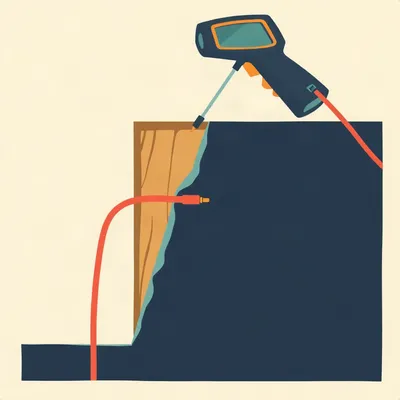
Daniel sent us this one — he's asking about the one thing that separates a successful weekend renovation from a trip to the emergency room. Knowing where electrical lines actually run in your walls. On one side, you've got dedicated tools — stud finders, cable detectors. On the other, some common sense about how wiring is supposed to be laid, and more importantly, how it actually gets laid when someone's in a hurry. He wants to know what to look for when buying a detector, what depths they work at, the common wiring patterns, and the failure modes — especially in Israeli construction where rushed work means the rules often get...

This is one of those topics where the gap between theory and practice isn't just academic — it's the difference between hanging a shelf and hanging a fire extinguisher next to the hole you just drilled. And the Israeli angle adds a whole layer of complexity that most English-language guides never touch.
Let's break this down into two parts: the tools and the patterns. What are we actually dealing with here?
The core problem is deceptively simple. Electrical lines in walls are invisible, but their paths follow predictable rules — unless someone broke them. And in a lot of construction, especially here, someone definitely broke them. So you need two complementary approaches. You need a detection tool that can peer through the wall, and you need enough pattern recognition in your head to know when the tool is lying to you.
The tool is the optimist. The pattern recognition is the pessimist who's seen things.
And they need to work together. A detector that says "all clear" means nothing if you're drilling in a spot where no rational electrician would have run a wire — and an irrational one absolutely would have.
Let's start with the tools. What are we actually buying when we buy a stud finder or a cable detector?
There are really three categories. First, you've got basic stud finders — these are primarily designed to find the wooden studs behind drywall, but many of them include a live AC detection mode. Then you've got dedicated cable detectors, which are specifically built to sense voltage through walls. And then you've got multi-scanners that combine both functions and add material discrimination — they can tell you whether they're seeing wood, metal, or a live wire.
The physics underneath these things — what's actually happening when you slide one across a wall?
Two completely different principles at work. Capacitive sensing is what stud finders use — they measure changes in the dielectric constant of the wall. The sensor creates an electric field, and when that field passes over something denser than the surrounding material — like a wooden stud or a metal conduit — the capacitance changes and the device beeps. AC voltage detection is entirely different. That sensor is picking up the fifty or sixty hertz electromagnetic field radiating from a live wire. It's passive — it's just listening for the hum of mains electricity.
One is feeling density, the other is hearing a magnetic field.
That's actually a perfect way to put it. And that distinction explains most of their failure modes. A capacitive sensor can't tell the difference between a wooden stud, a metal pipe, a bundle of wires in conduit, or a section of wall where the plaster is thicker. It just knows something changed. An AC sensor only works if current is actually flowing through the wire — if the circuit is off, or if it's a neutral wire carrying no load, the sensor hears silence.
Which means if you've turned off the breaker to be safe before drilling, your AC detector just became useless.
Right — and that's one of those gotchas that most people don't think about. The safest moment, electrically speaking, is exactly when your detector stops being able to find anything. So the workflow matters. You map the wall with the power on first, mark everything, then turn off the breaker and drill.
What about depth? How far can these things actually see?
This is where the specs get important and a little misleading. A standard capacitive stud finder — your basic thirty dollar model — can typically detect a stud through about one and a half inches of drywall. The deep-scan radar models, like the Bosch GMS 120 or the Zircon MultiScanner, can push that to about three inches for stud detection. But for live AC detection, the numbers drop significantly. Through standard drywall, most detectors can sense a live wire at about two inches. Through plaster, that drops to maybe one inch. Through plaster and lath, or double-layer walls, you might get half an inch or nothing at all.
Israeli walls are often plaster over block or plaster over hollow brick, not drywall.
Which changes everything. Plaster is denser and more variable than drywall. It can be anywhere from half an inch to two inches thick depending on the era and the quality of the work. And the substrate underneath — whether it's concrete block, hollow block, or brick — creates a much noisier baseline for the capacitive sensor. The device is trying to find small density changes against a background that's already dense and inconsistent.
I want to talk about false positives and false negatives because this is where people get hurt. What makes a detector lie to you?
False positives are annoying but usually safe. You mark a spot as dangerous and avoid it unnecessarily. Metal pipes, rebar in concrete, foil-backed insulation — all of these can trigger a live-wire warning on a capacitive sensor. Older Israeli apartments often have steel conduit, and a multi-scanner will light up like a Christmas tree over an entire wall because it's seeing metal everywhere and can't distinguish conduit from wire.
False negatives are the dangerous ones. The device says clear, you drill, and suddenly you're wondering if your will is up to date.
The most common false negative scenario is non-metallic conduit. In Israeli construction, plastic conduit is standard for anything built after about 1990. A magnetic or capacitive sensor can't see plastic at all. If the wire inside isn't carrying enough current to generate a detectable magnetic field — maybe it's a lighting circuit with LED bulbs pulling almost nothing — the AC sensor might miss it too. You've got a live wire sitting in invisible pipe behind two inches of plaster, and your detector sees nothing.
There was a case I heard about — someone in Tel Aviv using a basic thirty dollar detector on a plaster wall from the 1970s. The detector showed clear. They drilled straight into a live wire. The plaster was too thick, the wire was in metal conduit, and the combination meant the AC field was shielded and the capacitive sensor couldn't distinguish the conduit from the surrounding wall.
That's a perfect storm of failure modes. The metal conduit acts as a Faraday cage — it contains the electromagnetic field so the AC sensor can't detect it. And the capacitive sensor sees the conduit as just more dense material in an already dense wall. It's the electrical equivalent of camouflage.
Let's get specific about models and prices. If someone's standing in a hardware store right now, what should they actually buy?
The sweet spot for most homeowners is around eighty to a hundred dollars. The Bosch GMS 120 is probably the most reliable option in that range — it does stud detection, metal detection, and live AC detection, and it can handle plaster walls better than most competitors. The Zircon MultiScanner i520 is comparable. If you want to go deeper, the Zircon MultiScanner i700 has a radar mode that penetrates thicker walls, but it's around a hundred fifty dollars and still struggles with the same plaster limitations.
The thirty dollar no-name models?
They work fine for standard drywall if you're hanging a picture in a suburban American house built after 1990. For Israeli walls, they're a coin flip. The calibration is usually the weak point. Most detectors need a clear-wall calibration pass — you place it on the wall, it takes a baseline reading of what "empty wall" looks like, and then it alerts when something deviates from that baseline. If the wall has textured plaster, old paint layers, wallpaper, or inconsistent thickness, the calibration pass can fail silently. The device thinks it's calibrated, but it's actually locked onto a false baseline.
You're sliding it across the wall thinking it's working, and it's just...
Confidently wrong is the most dangerous state a detector can be in. And the cheaper models don't have the processing power to detect a failed calibration and warn you. The Bosch and Zircon models at least have some sanity-checking built in — if the baseline reading is too noisy, they'll indicate an error rather than giving you a false clear.
What about thermal cameras? I've seen people recommending those as a way to find wires.
Thermal cameras are a useful complement but they're not a standalone solution. A FLIR One, which attaches to your phone and costs about two hundred dollars, can detect hot spots on a wall surface. If a wire is under significant load — say, a space heater or an air conditioner is running on that circuit — the wire will heat up slightly and the thermal camera can see a warm line tracing its path. But here's the catch: the wire has to be drawing current, and enough of it to generate detectable heat. An idle wire, or a lighting circuit with modern LED bulbs pulling a few watts, will be at room temperature and completely invisible.
It works best when you deliberately load the circuit — plug in something power-hungry, turn it on, and then scan.
That's actually a smart technique. Before you start drilling, identify which breaker controls the room, plug a space heater into every outlet on that circuit, turn them all on for ten minutes, and then scan the walls with a thermal camera. The wires carrying that load will warm up enough to be visible. Then turn everything off, kill the breaker, and drill with confidence.
That's clever. It's also the kind of thing nobody actually does.
Which is why we're talking about it. The five minutes of setup saves you from the five hours in the emergency room.
Alright, let's pivot. Now that we know what the tools can and can't do, let's talk about what the walls are actually hiding. What are the patterns we should expect?
In an ideal world, wiring follows very predictable rules. Wires run vertically from outlets and switches up to the ceiling or down to the floor. They run horizontally at consistent heights — typically twelve to eighteen inches above the floor or six to twelve inches below the ceiling. And they never, ever run diagonally. This is codified in electrical standards worldwide because it creates safe zones — if you know that wires only run vertically and horizontally from visible fixtures, you can avoid them by drilling between those zones.
That's the theory. What's the Israeli practice?
The Israeli standard is SI 61439, which is based on the international IEC 61439. It specifies that cables should run in conduit, and the conduit should follow vertical and horizontal paths. But enforcement is... let's call it inconsistent. A 2023 study by the Israeli Standards Institute found that thirty percent of inspected renovations had at least one buried junction box — which is illegal and dangerous. And that's just the renovations they inspected. The actual rate in unpermitted work is almost certainly higher.
A buried junction box — for anyone who doesn't know — is when an electrician splices wires together, puts the splice in a junction box, and then covers it with drywall or plaster instead of leaving it accessible. It's a ticking time bomb because if the splice fails, you can't get to it without demolishing the wall.
It's incredibly common here. The logic is simple: the electrician needs to extend a circuit, the junction box would be ugly if left visible, so they just bury it. The homeowner never knows. Five years later, someone drills into it.
What are the other Israeli-specific failure modes?
There are four big ones. The first is the diagonal shortcut. An electrician needs to run a wire from a switch to a ceiling fixture. The correct path is straight up from the switch to the ceiling, across the ceiling, and down to the fixture. That uses more conduit and more wire. The shortcut is to run the wire diagonally through the wall directly from the switch to the fixture. It saves maybe ten meters of wire and half an hour of labor. It also creates a hidden diagonal hazard zone that no rational person would predict.
No detector is going to help you if you're drilling in a spot where you reasonably assumed no wire could be.
Pattern recognition is the only defense here. If you're drilling anywhere between a switch and a ceiling fixture, even if it's off to the side, you have to assume a diagonal run is possible. Especially in buildings where you know the construction was rushed.
Second failure mode?
The forgotten junction. This is the buried junction box we talked about. But there's a variant that's even worse — the splice with no box at all. An electrician twists wires together, wraps them in electrical tape, and plasters over them. No box, no protection, just bare splices in the wall. It's shockingly common in renovations where the original work was done without permits.
I've heard electricians call that the "Israeli handshake.
That's dark.
Third failure mode?
The reused conduit. This is specific to older buildings. An apartment built in the 1960s or 1970s will have steel conduit throughout. When it's renovated, the electrician may pull new wiring through the old steel conduit rather than installing new plastic conduit. The problem is that the old conduit may have sharp edges or rust inside, and the new wire's insulation can get nicked during the pull. Now you've got a live wire whose insulation is compromised, inside a grounded metal tube. The detector sees the conduit as metal — which it is — but can't tell you there's a damaged wire inside that's one vibration away from shorting to the conduit.
If you drill into that conduit, you're completing the circuit with your drill bit.
And your body.
Fourth failure mode?
The double layer. This is when a wall was originally plastered, and then later someone added drywall over the plaster instead of removing it. Now your wiring is at an unpredictable depth — it could be just behind the drywall, or it could be behind the drywall and the original plaster, or it could be embedded in the original plaster. Your detector is calibrated for standard drywall depth, and it's trying to see through two layers of different materials with different densities. The effective depth rating drops to almost nothing.
This is common in Jerusalem especially. Those old stone buildings with a century of renovations layered on top of each other.
Jerusalem is basically a geological formation at this point. You've got Ottoman-era stone, British Mandate plaster, 1960s conduit, 1990s drywall, and 2020s smart home wiring all in the same wall. Drilling into that without understanding the history of the building is archaeology with power tools.
With all these failure modes in mind, what can you actually do to protect yourself? Let's get practical.
First, buy the right tool. Get a detector with at least one and a half inches of depth rating and live AC detection. The Bosch GMS 120 at around eighty dollars is the sweet spot. Avoid the fifteen dollar no-name detectors — the false negative rate is too high to trust.
Map the wall before you even pick up the drill. Mark every outlet, every switch, every light fixture on that wall and the walls adjacent to it. Assume wires run vertically from every one of those points. If you have two outlets at the same height on the same wall, assume there's a horizontal run connecting them at that height. If you're drilling anywhere near a light fixture, assume a diagonal run from the nearest switch.
In Israeli construction, assume the worst. If the building was built after 1990, there's roughly a fifty percent chance the wiring is in plastic conduit — which means your capacitive sensor won't see it and you're relying entirely on AC detection. If the building was built before 1990, assume steel conduit but also assume the wiring has been modified at least once, probably without permits. Use the thermal camera technique if you can — load the circuit, scan for hot spots, mark them.
The belt-and-suspenders approach. Even after you've mapped the wall with your detector and your pattern recognition, take one more step. Turn off the breaker for that room. Use a non-contact voltage tester on your drill bit before you start drilling — just touch the tester to the bit. If it lights up, you're about to hit a wire. Then, as you drill, go slow. If you feel resistance that doesn't feel like plaster or block, stop. If you see sparks, you've already made a mistake, but at least the breaker should trip.
That non-contact voltage tester on the drill bit trick — I've never heard that before. It's clever.
It's a last line of defense. A non-contact voltage tester costs about ten dollars and it can sense live AC through the metal of the drill bit if the bit is close to a wire. It's not foolproof — it won't work with a masonry bit that has a carbide tip, and it won't detect a wire that's more than a few millimeters away — but it's one more data point before you commit to the hole.
Let's talk about one more technique that I think gets overlooked. The wall-tapping method.
It's surprisingly useful. A hollow block wall sounds different than a solid plaster wall, and both sound different than a wall with conduit running through it. It's not precise, but it can tell you where the studs or the block cavities are, which helps you build a mental map of the wall structure.
If you combine that with a strong magnet, you can find the screws or nails holding the drywall to the studs, which tells you where the studs are, which tells you where the wires probably aren't — because wires generally run alongside studs, not through them.
That's old-school but effective. A rare earth magnet on a string will stick to drywall screws through paint and plaster. Mark every screw you find, connect the dots vertically, and you've mapped your studs without any electronics at all.
We should also talk about what not to do. What are the common mistakes people make even when they have a detector?
The biggest one is trusting the detector too much. People treat it like a magic wand — wave it over the wall, it beeps or doesn't beep, and that's the final answer. But as we've covered, detectors have blind spots. The second mistake is not calibrating properly. If the detector asks for a clear-wall calibration, you need to find a spot on the same wall that you're reasonably sure has nothing behind it. Not a different wall. Not a spot near an outlet. The same wall, same material, same thickness.
If you can't find a clear spot?
Then you're calibrating on a known stud or a known empty cavity and mentally offsetting. Put the detector on a spot where you're confident there's a stud — like directly above a light switch, where the stud almost certainly is — and note the reading. Then move to a spot between studs and note the reading. Now you have a baseline for what "something" and "nothing" look like on that specific wall.
Another mistake I see is people drilling too fast. If you're drilling slowly and you hit something unexpected, you can stop. If you're going full speed with a hammer drill, you're through the conduit before you even register the resistance change.
The final mistake — and this one is painfully common — is assuming that because a room was renovated recently, the wiring must be up to code. Recent renovation in Israel often means the opposite. It means someone was in a hurry, probably working without permits, and almost certainly took shortcuts. A freshly painted wall is not evidence of quality work behind it. It's evidence that someone wanted the wall to look good quickly.
The nicest-looking walls hide the worst sins.
That should be embroidered on a pillow.
Let's zoom out for a moment. All of this advice — the detectors, the pattern recognition, the thermal cameras — it's all compensating for a fundamental problem. We don't know what's in our walls because nobody wrote it down.
This is the documentation gap. In commercial construction, there's something called a BIM model — a Building Information Model — that's essentially a 3D digital twin of the building with every pipe, every wire, every duct mapped in detail. In residential construction, especially in Israel, you're lucky if the electrician remembers which breaker controls which room.
As smart homes become more common, is there any movement toward digital wiring maps for residential buildings?
There are startups working on it. The idea is that during construction or renovation, you use a LiDAR scanner or even just a phone camera to capture the wall layout before the drywall goes up. That creates a permanent record of where everything is. But adoption is almost nonexistent in residential work because it adds cost and time with no immediate benefit to the builder.
The benefit accrues to the future homeowner who doesn't get electrocuted. But the builder doesn't care about that person.
That's the tragedy of construction incentives in one sentence. The person making the decision — the builder or the electrician — is optimizing for speed and cost. The person bearing the risk — the homeowner five years later with a drill in their hand — isn't in the room when those decisions are made.
There's also the longer-term trend. With wireless power transmission improving and battery-powered devices proliferating, do we eventually reach a point where in-wall wiring becomes less critical?
We're moving in that direction, but slowly. Wireless power — true wireless power, not inductive charging pads — is still in the research phase. There are systems that can beam power across a room using focused radio waves or ultrasound, but the efficiency is terrible and the safety concerns around beaming significant power through the air are unresolved. For the foreseeable future, wires in walls are still how buildings work.
For now, the advice stands. Spend the eighty dollars on a decent detector. Map your walls. Assume the worst about the person who built them.
If you're in an Israeli apartment built before 2000, double all of those assumptions. The combination of old steel conduit, undocumented renovations, and the cultural tendency toward creative shortcuts makes these walls uniquely treacherous.
That's a generous way to phrase it.
I'm a generous person.
Alright, let's pull this together into something someone can actually use. If I'm standing in my living room with a drill in one hand and a detector in the other, what's my checklist?
Step one: map everything visible. Mark every outlet, switch, and fixture on the wall and adjacent walls. Step two: calibrate your detector on a known-good spot on the same wall. Step three: scan the entire area you plan to drill, moving slowly and watching for any indication — even a flicker — of metal or voltage. Step four: if you have a thermal camera, load the circuit and scan for hot spots. Step five: mark your safe drilling zones based on the detector reading plus your pattern analysis. Step six: turn off the breaker. Step seven: test your non-contact voltage tester on a known live circuit to make sure it works, then test your drill bit before drilling. Step eight: drill slowly.
If anything feels wrong, stop.
Stop and reassess. The hole can wait. The wire can't be un-drilled.
There's something almost philosophical about this. You're trying to reconstruct the intentions of a person you've never met — the electrician who wired this wall, possibly decades ago — based on fragmentary evidence and a cheap sensor. It's like detective work, except the crime hasn't happened yet and you're trying to keep it that way.
That's exactly what it is. And the electrician's intentions may have been good, or they may have been "I want to finish this job before lunch." You have no way of knowing which. So you plan for the worst and hope for the best.
The detective metaphor works on another level too. A good detective doesn't rely on a single piece of evidence. They build a case from multiple independent sources. The detector is one witness. The pattern analysis is another. The thermal camera is a third. The magnet-on-a-string is a fourth. None of them is perfectly reliable on its own, but together they paint a picture you can trust.
When they disagree, that's when you pay the most attention. If your detector says clear but your pattern analysis says there should be a wire there, trust the pattern analysis. If your thermal camera shows a hot line that your detector missed, trust the thermal camera. Conflict between your tools isn't a nuisance — it's a warning.
It's the wall trying to tell you something.
The wall is always trying to tell you something. Most people just don't listen.
Alright, before we wrap, I want to touch on one more thing. The psychological aspect of this. There's a certain kind of person who buys a drill and suddenly feels invincible. The tool gives them confidence, and the confidence makes them skip the safety steps.
Power tools do something to the human brain. You hold a hammer drill and you feel like you can conquer anything. Walls, concrete, whatever. And that feeling is the enemy of caution. The most dangerous moment in any DIY project is the moment you think you know what you're doing.
The Dunning-Kruger effect with a masonry bit.
The people who are most careful are the ones who've already made a mistake and learned from it. Everyone else is operating on borrowed luck.
The advice we're giving today is essentially a way to borrow someone else's mistakes instead of making your own.
That's the hope. Learn from the guy in Tel Aviv who drilled into a live wire through a detector false negative. Learn from the Jerusalem renovation that uncovered a buried junction box the hard way. Learn from every electrician who took a diagonal shortcut and created a hazard zone that sat dormant for twenty years until someone hung a shelf in exactly the wrong spot.
If you're listening to this and thinking "that won't happen to me" — that's exactly what all of those people thought.
The wall doesn't care about your confidence level.
No it does not. Alright, let's look forward. As smart home technology evolves, is there any hope that this problem goes away? Some kind of standard for digital wiring documentation that survives across owners and renovations?
There are glimmers. The Matter smart home standard includes provisions for device discovery and topology mapping, but that's at the device level, not the wiring level. Some European countries are starting to require digital documentation for new residential construction — Germany's BIM mandate is slowly expanding beyond public infrastructure. But for existing buildings, especially in countries with... let's say informal construction cultures... the undocumented wall is going to be a fact of life for decades.
The chaos persists. But at least now we know how to navigate it.
Navigate it, map it, and respect it. The wall is not your enemy, but it's also not your friend. It's a stranger with secrets, and you're trying to learn those secrets without getting hurt.
That's a good place to land. If you're planning a renovation, spend the eighty dollars on a decent detector. It's cheaper than an ER visit or a fire. Map your walls. Assume diagonal shortcuts. Trust the pattern when the tool says clear. And drill like the wall is trying to tell you something — because it is.
Now: Hilbert's daily fun fact.

In the 1940s, a single surviving shipment of cinnamon bark from the Seychelles became the sole source for identifying a specific variety of Cinnamomum verum that produces unusually high levels of cinnamaldehyde — the compound responsible for cinnamon's characteristic heat — making it the chemical benchmark against which all cinnamon potency was measured for the next three decades.
...so somewhere there's a cinnamon archive with exactly one very important stick.
The Seychelles cinnamon hegemony. Didn't see that coming.
The Seychelles cinnamon hegemony.
This has been My Weird Prompts. If you want more episodes like this one, find us at myweirdprompts.com or on Spotify. We're back next week with something completely different. Until then, check your walls before you drill.