Daniel flew into Ben Gurion a few days ago and found a yellow sticker on his suitcase he'd never seen before. It said the bag was found open and secured by security officials. His first thought was the bag had been lost or tampered with. Everything was intact, but for a stretch there he was convinced the system had finally failed him. And that got him thinking — he's been flying a couple times a year for a decade and has never actually lost a bag. Which is remarkable when you think about it. You hand over a suitcase to a stranger at a counter, it disappears behind a rubber flap, and somehow it meets you on the other side of the world. He's seen the YouTube videos of handlers throwing bags onto carts. He's watched suitcases tumble onto conveyor belts. And he wants to know: is the baggage handling system actually good, or are we all just getting lucky? Is he being overly generous, or does this thing work?

Oh, this is a great one. And I want to start with the sticker, because it's not what Daniel thought it was.
I figured you'd pounce on that.
That yellow tag is not a sign the system failed. It's evidence the system worked. Ben Gurion has a specific security protocol — if a bag is found unlocked or triggers something on a scan, they open it, inspect the contents, and resecure it with that yellow sticker. The tag is the receipt. It says someone looked inside, found nothing concerning, and sent it on its way. Daniel's bag was never lost. It was just more interesting than he knew.
So his decade-long streak is intact.
Intact. But the fact that his first instinct was panic — that's the thing worth unpacking. He saw a sticker he didn't recognize and immediately assumed the worst. And I think that says something about how we perceive complex systems. We assume failure before we assume a hidden process we don't understand.
The sticker was doing its job and it scared him. That's almost a perfect summary of the whole baggage system. It works so well most of the time that any deviation from the invisible norm reads as catastrophe.
Right. So let's start with the scale, because Daniel's decade of success is actually the norm, not the exception. In twenty twenty-three, airlines checked about four point four billion bags globally. That's the SITA Baggage IT Insights number for twenty twenty-four. And the system mishandles roughly seven point six bags per thousand passengers. That works out to a ninety-nine point two four percent success rate.
Which sounds impressive until you do the math on the failure side.
Seven point six per thousand means over thirty-three million bags went astray in twenty twenty-three alone. That's a small city's worth of luggage.
So we're talking about a system that gets it right almost all the time and still manages to misplace thirty-three million things. Both numbers are true simultaneously.
And that tension — the impressive stat and the horrifying one sitting right next to it — that's the whole story. To understand whether that ninety-nine point two four percent number is good, we need to follow a bag from the moment you hand it over.
Alright. Walk me through it. I'm a suitcase. What happens to me?
You arrive at the check-in counter. The agent weighs you, prints a tag, and wraps it around your handle. That tag has a barcode — or increasingly an RFID chip — that encodes a ten-digit license plate number. That number is your entire identity for the next few hours. It links you to a passenger, a flight, a destination. From that moment on, every decision the system makes about you comes from reading that tag.
And who actually owns that tag?
The airline. But here's where it gets messy. The airline owns the tag, but the airport owns the conveyor infrastructure, and a third party — the ground handler — owns the people who actually load you onto the aircraft. Three different stakeholders, three different sets of incentives, and the bag has to cross all three without anyone dropping the thread.
So every handoff is a failure point.
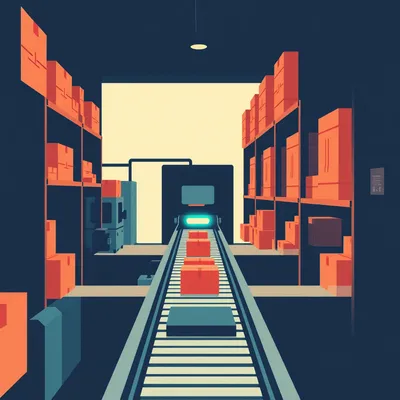
Every single one. The bag goes from the check-in counter onto a conveyor belt. That belt feeds into a sortation system — usually a tilt-tray sorter or a cross-belt conveyor. These things scan the tag at up to ten feet per second, decide which gate or carousel the bag needs to reach, and physically divert it onto the right path. The bag might travel miles of conveyor before it ever sees daylight.
And this is where Denver comes in.
Denver International Airport is the canonical example. Twenty-two miles of underground conveyor belts, a two hundred million dollar system. When it launched in nineteen ninety-five, it was a disaster — delayed the airport's opening by sixteen months. Bags got shredded. Bags got launched off the belts entirely. There's footage of suitcases flying into walls.
I've seen it. It looks like a demolition derby designed by engineers who'd never met a suitcase.
But here's the thing — that same system now handles thirty-five thousand bags per hour with ninety-nine point five percent accuracy. It took years of debugging, but they got it working. The Denver system is now one of the most reliable in the world.
So the technology matured. But what actually reads the tag? You mentioned RFID versus barcodes.
Barcodes are the old standard. They're cheap — about a penny per tag — but they have a fundamental problem. You need line of sight. The barcode has to be facing the scanner, and it can't be crumpled, smudged, or obscured by another bag. The read rate in real-world conditions is about ninety-five percent. Which sounds fine until you realize that five percent of four point four billion bags is two hundred twenty million bags that the system has to handle manually.
That's a lot of humans squinting at smudged stickers.
RFID solves this. The chip broadcasts a signal — no line of sight needed. Delta ran a pilot in twenty sixteen across eighty-four airports and got a ninety-nine point nine percent read rate. Their mishandling rate dropped by sixty to seventy percent. The technology exists. The bottleneck is adoption.
What's the cost difference?
About ten to fifteen cents per RFID tag versus one cent for a barcode. For an airline checking fifty million bags a year, that's millions of dollars in additional tag costs. And you need the readers installed at every touchpoint — check-in, sortation, loading, transfer, arrival. The IATA Resolution seven fifty-three, which came into effect in twenty eighteen, pushes for RFID tracking at every touchpoint. But it's voluntary. Adoption is uneven.
So we have a system that could be dramatically better, and the only thing stopping it is that the people who'd pay for the tags aren't the same people who'd reap the benefits.
That's the handoff problem again. The airline pays for the tag. The airport pays for the readers. The ground handler pays for the labor. Nobody owns the whole chain, so nobody has the incentive to optimize the whole chain.
Alright. So the bag gets sorted, it gets routed to the right gate. Then what?
Then it hits the tarmac. And this is where the YouTube videos come from. A narrowbody aircraft like a Boeing seven thirty-seven has a turnaround time of about twenty-five minutes. In that window, the ground crew has to unload arriving bags, load departing bags, refuel, restock catering, and push the plane back. The baggage handlers are working in extreme conditions — tarmac temperatures can hit one hundred twenty degrees Fahrenheit in summer, jet blast noise is around one hundred forty decibels. And they're loading bags into a cargo hold that's maybe four feet high, so they're crouching or kneeling the whole time.
So when Daniel sees a bag getting thrown, the context is a person who's been crouching in a metal tube for six hours, it's a hundred and ten degrees, the plane has to push back in eight minutes, and this is the forty-seventh bag they've loaded on this shift.
It doesn't excuse rough handling, but it explains it. And here's the surprising stat — only one point two percent of mishandled bags involve physical damage. Bags are surprisingly durable. Most damage actually comes from the mechanical sortation system — bags getting caught in conveyor junctions, snagged on edges — not from humans throwing them.
Wait. Only one point two percent of mishandled bags are damaged? So when a bag goes astray, it's almost never because someone broke it.
Almost never. The bag just goes to the wrong place. It's a routing problem, not a destruction problem.
So the system is rough but not destructive, and the failures are mostly about misdirection. That actually makes the problem more interesting. It's an information problem masquerading as a handling problem.
And that brings us to the second-order question. Is ninety-nine point two four percent actually good?
Compared to what?
Right. UPS claims ninety-nine point nine nine percent on-time delivery for packages. Amazon's internal metrics are even higher. By those standards, baggage handling looks mediocre. But context matters enormously. A package sits in a single carrier's network from pickup to delivery. One company, one tracking system, one set of software. A checked bag crosses multiple airlines, multiple airports, multiple countries, each with different systems, different software, different standards. The baggage system is a federation of independent networks, not a unified one.
So the fair comparison isn't UPS. It's more like... if you handed a package to UPS, who handed it to DHL at the state line, who handed it to the postal service at the border, and each handoff involved a paper tag and a prayer.
That's closer. And in that context, ninety-nine point two four percent starts looking impressive.
But there's another thing about that number. It counts bags that are delayed by even a few hours as mishandled. Daniel's real fear isn't a delay — it's the bag vanishing forever.
And that almost never happens. SITA data shows that ninety-seven percent of mishandled bags are returned within forty-eight hours. Only zero point five percent are never recovered. That's about one in two hundred mishandled bags, or roughly twenty-two million bags over a decade globally.
Twenty-two million bags that just... disappear. Where do they go?
Some end up at the Unclaimed Baggage Center in Scottsboro, Alabama. It's a fifty-thousand square foot retail store that buys lost luggage from airlines and sells the contents. They process about a million items a year. You can buy everything from laptops to wedding dresses to, I think, a live rattlesnake someone checked once.
Someone checked a rattlesnake.
People check all kinds of things. But the point is, the system is actually quite good at finding bags. It's bad at keeping them on the right path in the first place. Most bags that go astray are recovered quickly. The permanent loss rate is tiny.
So Daniel's fear — the bag that vanishes into the void — is statistically the least likely outcome. But it's the one we all fixate on.
Because the stakes are so high. When the system works, it's invisible. You land, you wait at the carousel, your bag appears, you leave. You don't think about the twenty-two miles of conveyor belts or the RFID reader that scanned your tag or the handler who loaded your bag in hundred-degree heat. The system succeeded so completely that it erased itself from your awareness.
And when it fails, you're stranded without clothes, toiletries, medication. The asymmetry is brutal. Ninety-nine point two four percent success means the average traveler experiences a mishandled bag once every one hundred thirty-two flights. For someone flying twice a month, that's about once every five to seven years.
Frequent flyers will hit it. And when they do, it feels catastrophic precisely because the system has trained them to expect perfection.
Which brings us back to the yellow sticker. Daniel's bag was never lost. It was inspected by security, resecured, and delivered exactly as intended. But because he didn't know that protocol existed, the sticker read as a warning. Something went wrong. When in fact, something went right — a security layer he didn't know about did its job.
That's the trust asymmetry. The system has layers we never see — security inspections, manual overrides, baggage reconciliation agents who match orphaned bags to their owners — and when one of those layers surfaces, we assume failure because we didn't know it was there.
It's like seeing a firefighter in your kitchen and assuming your house burned down, when actually they're just checking the smoke detector.
That's a very good analogy. And I think it gets at what Daniel's really asking. Is he being overly generous? I'd say no — the system does a remarkable job given the complexity. But the generosity is required because the system is opaque. You have to trust it because you can't see it.
I think we need someone who's actually been inside the machine to weigh in here.

Seven hundred and twelve.
...Pardon?
Bags I personally reunited with their owners. Six months at London Gatwick, nineteen ninety-eight. Baggage reconciliation agent. The job was you got a paper printout every hour — a dot-matrix printout — listing bags that had arrived but whose owners hadn't. You walked the carousels with a walkie-talkie, matching tag numbers to passengers who were still standing there looking lost. No RFID, no automated tracking. Just a man, a list, and a radio.
How did you even find them?
You learned to read the room. The person who's been standing at the carousel for forty minutes, not talking to anyone, just staring at the rubber flap where the bags come out. That's your person. You walk up, ask for their tag stub, match the number. Most of the time the bag was sitting on a cart fifty feet away — it had come in on an earlier flight and nobody had moved it to the right belt.
So the system was broken and you were the fix.
The system was the fix. The printout was the system. I was just the hands. And the point is, you're both being too kind to the ninety-nine point two four percent number. It counts bags that land on the same day but on a different flight as mishandled. If your bag lands in London and you're in Paris, that's in the stats as a failure — but you get it back that evening. The number you actually care about — bag never sees you again — is way lower. Maybe zero point zero five percent.
So the headline stat overstates the problem.
Massively. But it also hides how the system actually works. It's held together by duct tape and overtime. I watched a supervisor reroute a bag to Tokyo once because the barcode was smudged and the scanner read a three as an eight. The bag was on the belt for Tokyo. He caught it because he happened to glance at the routing screen and thought, that's odd, we don't have a Tokyo flight for another four hours. He ran out onto the tarmac and physically pulled the bag off the cart.
The automation failed and a human saved it.
That's the whole job. The machines get it right most of the time. When they don't, someone like me catches it. Or doesn't. And then the bag goes to Scottsboro.
How did you end up in that job?
I'd been working in a warehouse in Crawley and the supervisor said the airport paid better. It did, by about forty pence an hour. I quit after the iguana.
The iguana.
Passenger checked a pet iguana in a cargo crate. Crate wasn't latched properly. Iguana got out somewhere between the aircraft and the baggage office. Lived in the office for three days, eating the plants. We had a ficus in the corner — stripped bare by day two. Nobody could catch it. I handed in my notice on the Thursday.
Because of a loose iguana.
The iguana was fine. They found it sleeping in a filing cabinet. I just decided that was as good a moment as any to stop matching bags for a living. But the thing I learned — and this is what you're missing — is that the system works because humans intervene constantly. The ninety-nine point two four percent isn't automation succeeding. It's automation plus a guy with a walkie-talkie and a dot-matrix printer, or the modern equivalent. The machines are fragille. The human layer is what's resilient.
When we talk about RFID and AI sortation making things better, we're really talking about reducing the number of times a human has to run onto the tarmac and grab a bag.
You're talking about making my old job obsolete. Which is fine — it was a terrible job. But the system will never be fully automated, because the real world is messy. Bags get wet, tags tear, barcodes smudge, flights change gates. Someone has to handle the exceptions. And the exceptions are the whole game.
That's actually a really important point. The stats we've been quoting — the ninety-nine point two four, the zero point five percent permanent loss — those numbers exist because of the manual intervention Hilbert's describing. The system as designed is fragille. The system as operated is robust, because people fill the gaps.
That's the layer Daniel's yellow sticker revealed. Someone opened his bag, looked inside, decided everything was fine, and tagged it so he'd know. That's a human intervention in a supposedly automated system. It scared him because he didn't expect it, but it's exactly what makes the system work.
The sticker means someone did their job. Most of the time you never know.
Hilbert, do you still think about bags you couldn't match?
There was one. A green Samsonite hard-sheel. Arrived from Nairobi, tag said it was going to Glasgow. Owner never showed. We held it for ninety days — that was the policy — then it went to auction. I still wonder what was in it. Probably just clothes. But you never know.
A green Samsonite from Nairobi. And twenty-eight years later you still remember it.
You remember the ones that got away. The seven hundred and twelve you matched, those are just a number.
The real question for the future is whether we can make the system good enough that we don't need the Hilberts of the world running onto tarmacs. And I'm not sure we can. The IATA seven fifty-three resolution pushes for RFID at every touchpoint, but adoption is voluntary and uneven. Smaller airlines can't justify the infrastructure cost. And even with perfect tracking, you still have the handoff problem — the airline, the airport, the ground handler, each with their own systems and incentives.
Plus the physical reality. Bags will still get wet. Tags will still tear. Flights will still change gates at the last minute. The exceptions don't go away just because the tracking improves.
The question is whether we can get from ninety-nine point two four to ninety-nine point nine nine. And I think the handoffs are an irreduciable source of friction. You'd need a single unified system across every airline and every airport, and that's not happening.
The system is about as good as it's going to get, and it's held together by people like Hilbert who notice when a bag is going to Tokyo four hours early.
I think that's right. Which means Daniel's generosity is actually well-placed. The system is impressive, but not because it's a flawless machine. It's impressive because it's a messy federation of machines and humans that somehow works almost all the time despite having every reason not to.
The yellow sticker wasn't a failure. It was the system showing its work. And Daniel's decade-long streak isn't luck — it's the expected outcome of a system that's been quietly improving for thirty years, even if the improvements are invisible to passengers.
The Denver system that shredded bags in nineteen ninety-five now handles thirty-five thousand an hour. Delta's RFID rollout cut mishandling by two-thirds. The stats are trending in the right direction. But the system will always have edges — the smudged barcode, the unlatched crate, the iguana in the filing cabinet.
That iguana is going to haunt me.
The iguana was fine. It's the ficus I feel bad for.
Maybe the right response isn't overly generous. It's appropriately impressed with a caveat. The system is remarkable given the complexity. It's also fragille in ways most passengers never see. And when it works — which is almost always — it erases itself so completely that we forget it exists until a yellow sticker shows up and we panic.
The sticker was a reasurance. It just didn't look like one.
This has been My Weird Prompts. Thanks to our producer Hilbert Flumingtop, who apparently spent six months in nineteen ninety-eight personally preventing bags from going to the wrong continent.
If you enjoyed this episode, leave us a review wherever you get your podcasts — it helps. And if you've got a story about a bag that vanished, or a yellow sticker that scared you, or an iguana in a filing cabinet, email the show at show at my weird prompts dot com.
We'll be back soon.