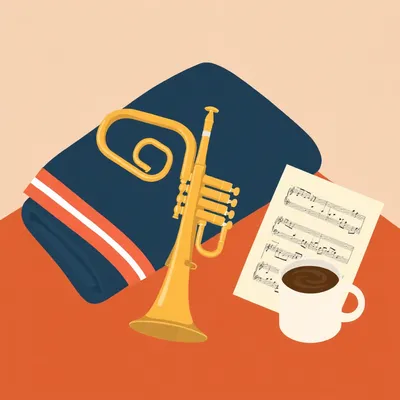
Daniel sent us this one — he downloaded an Android app called Horn Sounds, which is exactly what it sounds like, a library of obnoxious sirens and horns. And buried in there he found what the app calls the Wake-Up Call. He plays it, recognizes it's a bugle, and suddenly he's down a rabbit hole. First: do militaries still actually use a human being with a bugle to wake people up, or is it all recordings over loudspeakers now? And second, the practical one — if he bought a bugle and wanted to learn that specific wake-up melody reliably, how long would it take him? He's got little Ezra and Hannah at home, and he thinks they'd both appreciate dad being able to do this.

I love everything about this. A novelty soundboard app leads to a genuine question about military tradition, acoustic physics, and the neurobiology of adult skill acquisition. This is peak Daniel.
It's the kind of thing where you download an app to annoy people and end up questioning the relationship between analog resilience and modern life.
Right, and that tension is actually more relevant than ever. We're in this moment where everyone's quietly asking which pieces of technology they actually need, and which ones they just inherited because digital replaced analog by default. The bugle is a fascinating test case because it refuses to die.
Daniel's not asking in the abstract. He wants to know if he can learn the thing and wake up his family with it. Which is either deeply charming or deeply irritating depending on whether you're the one holding the bugle or the one being blasted out of bed.
I suspect Hannah's appreciation may have a shelf life. But let's take this seriously, because the questions are better than they look. First, is the bugle still a living instrument in military life, or is it just a recording of a dead tradition? And second, what's the actual timeline for a motivated adult to produce a recognizable Reveille?
That's the name of the wake-up call, by the way. We'll get there.
But before we dig into the history and the acoustics, I want to flag something about why this question lands differently now than it would have ten years ago. There's a quiet reassessment happening around analog technologies. We've spent three decades digitizing everything on the assumption that digital is always better, always more reliable, always the upgrade. And we're now discovering edge cases where that's just not true.
The bugle is the edge case that wakes you up at six in the morning.
No power source, no battery, no software update, no speaker that can blow out. It works in an EMP scenario. It carries a mile or more in open terrain. And the sound is instantly recognizable in a way that cuts through ambient noise differently than a recording does. There's something about a live brass instrument that a loudspeaker doesn't replicate.
Daniel's question is really two questions stitched together. One is about whether this thing still exists in the wild, and the other is about whether a normal person can acquire it as a skill without dedicating their life to it. And I think both answers are more interesting than most people would guess.
Let's start with what Reveille actually is. The word itself is French — it means "wake up," from the verb réveiller. And it began as a French military drum call, not a bugle call at all. Fifes and drums were the original battlefield communication system.
Which makes sense. You can't exactly shout orders across a battlefield.
And the drum call was a practical thing — it told soldiers it was time to get up, pack your gear, stand to. The US Army adopted it sometime in the early nineteenth century, but the version we know today — the bugle version — was standardized in eighteen seventy-four. That's when it became the twenty-four bar, roughly thirty-second melody Daniel heard in that app.
Eighteen seventy-four. That means the bugle version of Reveille is about a hundred and fifty years old. Which is somehow both ancient and not that ancient.
Here's what's interesting about that timing. By eighteen seventy-four, the bugle was already the standard field signaling instrument across most Western armies. It had replaced drums for a lot of tactical commands because the sound carries differently. A bugle call cuts through gunfire and wind in a way a drum can't.
Which brings us to the instrument itself. And this is where things get deceptive. The bugle looks simple — it's just a brass tube with a mouthpiece and a bell. No valves, no keys, no moving parts. You'd think that means it's easy.
It's the exact opposite. Because there are no valves, you can only produce notes that exist in the natural harmonic series of the instrument's length. That's five notes. Maybe six if you're very good. Every pitch change comes entirely from your embouchure — the shape and tension of your lips — and your breath control. There's no button to cheat with.
It's an instrument that punishes you for being slightly off. If your lip tension is wrong by a tiny margin, the note cracks or you get the wrong harmonic entirely.
That's why the question of whether militaries still use live buglers is more interesting than it seems. Because playing a bugle reliably, in all weather, at zero six hundred, is genuinely hard. So what most bases do now is play a recording over the loudspeaker system. The US Army still plays Reveille every morning on pretty much every base, but it's almost always a recording. However — and this is the part I didn't expect — live buglers are not extinct.
Where are they still breathing into actual brass?
A few places. The US Army Old Guard Fife and Drum Corps in Washington DC still uses live buglers for ceremonial duties. The US Navy still trains buglers at Naval Station Great Lakes. The UK's Household Cavalry uses live buglers for Reveille and Last Post. And then there's the Swiss.
The Swiss Army still trains and deploys live buglers for daily signals in some mountain units. And they're not doing it for ceremony. They're doing it because in alpine terrain, a bugle call carries farther than an electronic speaker. The acoustics of mountain valleys favor a live brass instrument over a PA system. It's a practical decision dressed up as tradition.
The Swiss are using nineteenth-century technology because it outperforms the modern alternative in a specific environment. That's deeply satisfying.
It's not just the Swiss being quirky. The US Army Field Manual twelve dash fifty, revised in twenty twenty-one, still includes bugle calls as authorized signals. The Army hasn't abandoned the concept. They've just mostly replaced the human with a recording. But as of twenty twenty-four, there were only about fifty qualified buglers in the entire active-duty US Army.
In an organization of nearly half a million people. That's not a corps, that's a endangered species list.
That number tells you everything about the tradeoff. Recordings are consistent, they don't get tired, they don't crack notes when it's cold. But a recording also can't adapt. A live bugler can adjust volume for conditions, repeat a call if there's confusion, and — this matters in certain scenarios — doesn't require electricity.
The bugle is simultaneously obsolete and irreplaceable. It's been replaced everywhere it's convenient to replace it, and kept alive everywhere the replacement falls short.
This is where the physics gets beautiful. The bugle's sound isn't just loud — it's structured in a way that our brains are wired to notice. The harmonic series it produces is the same mathematical sequence that shows up in everything from ancient Greek music theory to the resonant frequencies of a suspension bridge. When you hear those five notes, your auditory system processes them as a single coherent signal, not noise.
It's not just that it's loud. It's that the sound is shaped like a key that fits a specific lock in human hearing.
And that's why it cuts through ambient noise differently than a recording played through a speaker. A speaker reproduces the sound. A bugle is the sound. There's no compression, no digital-to-analog conversion, no frequency cutoff from a cheap PA driver. What you hear is the raw acoustic event.
Which explains why the Swiss are still doing this in the mountains. It's not nostalgia. It's signal-to-noise ratio.
That same principle applies to the military's relationship with the bugle more broadly. The instrument has been replaced functionally almost everywhere, but it's retained ceremonially almost everywhere too. Funerals, memorials, changes of command — those moments still demand a live bugler if one can be found. The recording is the backup, not the preference.
With only fifty qualified buglers in the entire active-duty Army, I'm guessing the backup gets used a lot.
There was a small crisis about this in twenty twenty-three. The Army acknowledged a serious bugler shortage. Funerals were being conducted with recorded Taps because there simply weren't enough musicians. Veterans' groups were not happy. It's one of those things where the recording is technically identical, but it's not the same thing, and everyone knows it.
There's a word for that tension but I can't think of it. The thing where the functional replacement does the job perfectly but still feels like a loss.
Walter Benjamin wrote about it — the loss of aura around a mechanically reproduced artwork. A recording of Taps played through a speaker at a funeral hits all the same frequencies, but the presence of the human being producing it in real time, with all the vulnerability that implies — the possibility of a cracked note, the visible breath in cold air — that's part of what makes the ritual work.
The bugle is a weird case where the old thing is worse in every measurable way except the one that actually matters.
That brings us to Daniel's second question. If he wants to learn this thing — the specific thirty-second melody, not become a virtuoso — what's the actual timeline? And this is where I get to debunk one of my favorite myths.
The ten thousand hour rule.
Which is nonsense. Anders Ericsson, the researcher whose work Malcolm Gladwell popularized, retracted the ten thousand hour claim himself in twenty sixteen. He said the number was an average across elite violinists and was never meant as a universal threshold for skill acquisition. But the damage was done. Everyone now thinks mastery requires a decade of monastic dedication.
Daniel is not signing up for a decade of monastic bugle dedication.
Not even close. For narrow, specific motor skills like playing a five-note melody on a brass instrument, the research points to twenty to thirty hours of deliberate practice for reliable performance. Deliberate meaning focused, with feedback, not just noodling around.
Twenty to thirty hours total. That's a Netflix series.
We've got a real-world case study on this exact question. There's a Reddit user — goes by bugle underscore boy underscore twenty twenty-three — who documented his entire journey learning Reveille from scratch. Forty-seven days of twenty-minute daily practice. That's about fifteen and a half hours total. By the end, he posted a recording. It wasn't perfect, but it was unmistakably Reveille.
Under sixteen hours to recognizable. That's the lower bound.
For most adult beginners, a recognizable Reveille takes four to six weeks of daily fifteen-minute practice. Reliable performance — no cracked notes, consistent tempo, can do it cold at six in the morning — that's eight to twelve weeks. And that's with no prior brass experience.
Which is faster than most people would guess, but still long enough that you can't fake it. You actually have to do the work.
The work is very specific. It's not about learning notes — there are only five. It's about building embouchure control and breath support. Your lip muscles need to develop strength and precision they don't currently have. It's like learning to whistle, except the instrument is a three-foot brass tube that amplifies every mistake.
What does the practice actually look like? Daniel's got a twelve-month-old. He's not locking himself in a soundproof booth for two hours a day.
This is where the practical advice gets useful. First, don't buy a brass bugle. Buy a plastic one. They cost twenty-five to forty dollars, they're more durable, and the embouchure requirements are nearly identical. The sound is slightly different — a bit brighter, less resonant — but for learning purposes it's perfect. Second, buy a practice mute. Fifteen to twenty dollars. It drops the volume dramatically.
Because otherwise Hannah's appreciation is going to evaporate approximately seven minutes into the first practice session.
The practice mute is a marriage-preservation device. Third, the specific technique to focus on is what brass teachers call the bugle embouchure — corners of the mouth tight, center relaxed. That's the muscle memory that determines whether you get a clean note or a sound like a goose being stepped on.
Daniel's looking at under fifty dollars and about two months of fifteen-minute daily sessions to be able to walk into Ezra's room and play an actual, recognizable Reveille.
Which is a impressive party trick. It's not just noise — it's a specific cultural artifact with a hundred and fifty years of history. Most parents' wake-up repertoire is "come on buddy time for breakfast." Daniel would be deploying a nineteenth-century military signal.
There's something about learning an obsolete skill that hits differently than consuming content about it. You can watch a hundred YouTube videos about bugle history and not get what fifteen minutes of trying to produce a clean note gives you.
That connects to something bigger about adult learning that most people get wrong. We treat skill acquisition as this all-or-nothing proposition — either you're training to be a professional or why bother. But there's a whole category of skills that are worth learning badly. You don't need to be a bugler. You just need to be able to play one specific melody well enough that a one-year-old and an architect are impressed.
The sweet spot of amateur competence. Good enough to delight, not good enough to perform at a state funeral.
Let me make this concrete for anyone who wants to actually do it. Step one, buy a plastic bugle — twenty-five to forty dollars online. Step two, download the sheet music for Reveille. The US Army Heritage Center has it free, public domain, no catch. Step three, fifteen minutes a day for eight weeks. That's it. That's the entire program.
The practice mute. Don't forget the practice mute. Fifteen dollars is cheap insurance against domestic insurrection.
The practice mute is non-negotiable. But here's the thing I keep coming back to. The bugle is a metaphor that Daniel stumbled into without realizing it. He downloaded an app full of digital horn sounds, and the one that grabbed him was the one that predates electricity.
The app is a museum of noises and the one he wants to make real is the oldest one in the collection.
That's not random. There's something happening culturally right now where people are reaching for analog skills as a counterweight to digital saturation. You spend all day in browsers and spreadsheets and messaging apps, and at some point your brain wants to make a physical thing happen in the physical world and hear the result with no screen involved.
Learning a bugle call is the opposite of consuming content. You can't passively absorb it. You have to put your face on something and push air through it until your lips ache, and then one day the note comes out clean and you made that happen with your body.
That connects you to history in a way that reading about history doesn't. When Daniel plays those twenty-four bars, he's making the same sequence of acoustic frequencies that a Union Army bugler made in eighteen seventy-four. Same embouchure, same breath control, same harmonic series. The physical act is identical across a hundred and fifty years.
There's a word for that kind of connection but it's not coming to me. The thing where doing the thing collapses the distance between then and now.
Embodied history, maybe. But the practical takeaway for listeners is broader than bugles. You don't need to learn Reveille specifically. Pick any simple analog skill — whistling a specific melody, learning a hand-drum pattern, memorizing a poem well enough to recite it from memory. Something that lives entirely in your body and doesn't require a device.
The common thread is that you're producing something rather than receiving something. And the timeline is almost always shorter than you think. A poem takes a week of casual repetition. A drum pattern takes a few afternoons. The barrier isn't difficulty, it's the assumption that learning things is for professionals.
That assumption is the real obstacle. We've outsourced so much competence to devices that we forget what it feels like to be the source of the thing. Daniel playing Reveille for Ezra isn't just a funny dad trick. It's a small act of reclaiming agency over the sounds in his own home.
Instead of pressing play on a phone, he is the wake-up call.
The question that lingers for me is whether the bugle survives another fifty years. Not as a recording — recordings will be around forever, they cost nothing to keep. I mean the actual instrument, the human being with the brass tube and the embouchure.
The semaphore flag question. Some technologies get preserved because they're still useful, some get preserved because they're beautiful, and some just vanish the moment nobody needs them anymore.
The bugle is in this weird middle ground. Functionally, it's been replaced almost everywhere. The fifty qualified buglers in the active-duty Army is a number that will probably go down, not up. But ceremonially, it's actually getting more valuable, not less.
Because scarcity increases ritual weight.
When you can get a recording anywhere, the live bugler becomes a deliberate choice. You're not doing it because it's the only option. You're doing it because you're saying something by choosing the human being over the speaker.
That shift from functional to ceremonial might be exactly what saves it. The bugle doesn't need to compete with the PA system on efficiency. It just needs to be irreplaceable in the moments where efficiency isn't the point.
Funerals, memorials, changes of command — those are growing, not shrinking. And the emotional weight of a live bugler at those events is the kind of thing that creates advocacy. Veterans' groups were furious about the recorded Taps situation in twenty twenty-three, and they made noise about it until the Army started addressing the shortage.
The bugle's future depends on people being willing to be bad at it for a while before they're good enough to matter.
Which brings us right back to Daniel. Every person who picks up a plastic bugle and learns Reveille in eight weeks is, in a very small way, keeping the tradition alive. Not as a museum piece, but as a living skill.
Daniel as a one-man bugle preservation society. I think he'd enjoy that framing.
Now, Hilbert's daily fun fact.
Hilbert: During the Cold War, researchers discovered that the brilliant blue iridescence of the Seychelles giant day gecko's skin comes not from pigment but from nanostructures in its scales that reflect only blue wavelengths — an optical trick also found in butterfly wings.
A gecko that dresses like a butterfly.
So if you want to try this yourself — plastic bugle, practice mute, eight weeks, fifteen minutes a day — the sheet music's free from the Army Heritage Center. And if you're not going to learn Reveille, learn something. A poem, a hand-drum pattern, a whistle. Something that lives in your body.
If you do learn Reveille, send us a recording. We want to hear what a thirty-second nineteenth-century military signal sounds like when it's played by someone whose primary qualification is being curious enough to try.
This has been My Weird Prompts. Thanks to our producer Hilbert Flumingtop. You can find us at my weird prompts dot com or email the show at show at my weird prompts dot com.
Until next time, may your wake-up calls be intentional and your practice mutes be functional.
Your embouchure never crack.