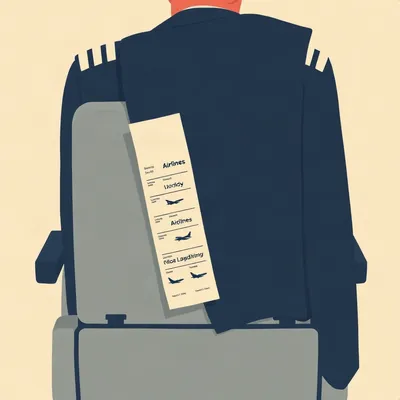
Daniel flew Athens to Tel Aviv on an Arkia Airbus A330, and the cabin crew were Portuguese. Not Israeli. Portuguese. Because the aircraft and crew were from a company called Hi Fly — a Portuguese operator that specializes in exactly this arrangement. Arkia wet-leased the whole package. The announcements were missing the usual "thank you for flying with Arkia" sign-off, and Daniel noticed. So he's asking two things. First, mechanically: when an airline wet-leases an aircraft and crew, is there a fixed team assigned to that contract, or do crews rotate in from a general roster? Second, the human side: what is it actually like to work for a company nobody's heard of, wearing a brand you don't belong to, with passengers who assume you're someone else?

And to answer that, we need to start with the business logic that made this flight happen in the first place.
Walk me through it.
After October twenty twenty-three, international carriers collapsed their Tel Aviv schedules. Just pulled out. The capacity vanished almost overnight. Arkia is — was — a short-haul operator. Their entire operational DNA is built around Eilat, the Red Sea, maybe some European charters on a narrowbody. They never intended to fly long-haul widebody routes. But suddenly there's demand surging and nobody to fly the planes. So they need capacity, they need it now, and they don't have a hundred million dollars to buy an A330, plus another year or two to train and certify crews on a type they've never operated.
A hundred million is the entry price for a new one?
Roughly. A new A330 lists north of that. You can get a used one for less, but you're still talking tens of millions, and then you've got to put it through maintenance, configure the cabin, hire and type-rate pilots and cabin crew who've never touched the airframe. That's not a quick fix. That's a multi-year capital project. But a wet lease from someone like Hi Fly — that's an overnight solution. You sign a contract, they position the aircraft, and you're selling tickets the next day. Zero capital expenditure, no crew training pipeline, no maintenance organization to build. You pay one rate and they hand you the aircraft, the crew, the maintenance, and the insurance. The four letters in ACMI.
Aircraft, crew, maintenance, insurance. The wet lease bundle.
Right. And Hi Fly isn't a charter airline in the vacation-package sense. They're not selling you a holiday to the Algarve. They're a pure ACMI provider. Their business is providing white-label airline operations to other airlines. Arkia sells the tickets, handles the fuel, the airport fees, the catering. Hi Fly does everything else. The aircraft wears Arkia's livery — or at least enough of it that passengers don't notice — and the crew makes announcements in Arkia's name.
So the business case is clear. But the question Daniel really wants answered is about the people inside the machine. The Portuguese cabin crew on his flight. Who do they actually work for, and how are they assigned?
They work for Hi Fly. Full stop. Their employment contract, their paycheck, their training, their seniority — it's all Hi Fly. Arkia has no employment relationship with them and, in most cases, no say in which specific crew members show up on any given flight. What Hi Fly maintains is a pool of type-rated pilots and cabin crew, mostly Portuguese as Daniel observed, and they roster those crews across their entire network based on availability, seniority, and regulatory constraints like flight time limitations.
So it's not a fixed team assigned to the Arkia contract for six months.
No, and that's the misconception most people have. You might imagine that when Arkia signs a wet lease, Hi Fly says "here are your four pilots and eight cabin crew, they're yours for the duration." That's not how it works. A Hi Fly pilot might fly the Arkia Tel Aviv rotation one week. The next week, they're deadheading to Fortaleza to operate a TAP charter. The week after that, they're on a Saudia Hajj operation out of Jeddah. The roster is fluid. The crews rotate through the entire network.
So the pilot shows up on Monday morning and checks the app to see whose logo they're wearing this week.
That's... not far off, actually. And it creates this fascinating identity dynamic. The crew wears Hi Fly uniforms — or sometimes, depending on the contract, the lessee's uniforms. They make announcements in the lessee's branding. They serve the lessee's catering, follow the lessee's service protocols. But their professional identity, their loyalty, their career progression — that's all with Hi Fly. The airline whose name is on the ticket is their customer, not their employer.
Which explains the missing "thank you for flying with Arkia" that Daniel noticed.
It's a small thing, but it's telling. The crew's mental model is "we are operating this flight for Arkia," not "we are Arkia." They're contractors. Skilled, professional contractors, but contractors. There's a subtle identity gap that shows up in those little moments — the announcement that doesn't quite land, the service that's competent but not warm. It's not rudeness. It's just... the boundary between who signs the paycheck and whose name is on the bulkhead.
Let me poke at the rostering model a bit more. Hi Fly has A330s, A340s, and they famously picked up two A380s back in twenty eighteen. That's three different widebody types. A pilot type-rated on the A330 isn't automatically qualified on the A340 or the A380. So is the pool segmented by type rating?
It has to be. A type rating is specific to an aircraft variant — or at least a family. The A330 and A340 share a common type rating, so a pilot qualified on one can fly the other with some differences training. The A380 is a separate type rating entirely. So Hi Fly's pilot pool is segmented by the aircraft they're qualified on. But within that segment, the rostering is still fluid. An A330-rated crew could be assigned to any of Hi Fly's A330 contracts — Arkia, TAP, whoever's leasing that tail that week.
And the cabin crew? They're not type-rated the way pilots are, but they're trained on specific aircraft configurations, door operations, safety equipment locations.
Right. Cabin crew get aircraft-specific training, but it's broader. A cabin crew member qualified on the A330 can work any A330 in the fleet regardless of the lessee. The variation is in the service protocols — what meal service Arkia wants versus what TAP wants, what the announcements script says, which uniform to wear. That's all contract-specific briefing material, not a separate certification.
So you could have a cabin crew member who does Tel Aviv on Monday, Fortaleza on Wednesday, and Jeddah on Friday, and each flight has different branding, different announcements, different service standards.
And different passenger expectations. That's the part that gets psychologically interesting. On the Arkia flight, passengers are mostly Israeli. They expect a certain style of service — direct, informal, maybe a little brusque in a way that Israelis read as warm. On the TAP charter, it's Portuguese passengers who expect something different. On the Saudia operation, it's a completely different cultural context. The crew has to code-switch constantly, and they're doing it while representing a brand they don't actually work for.
I want to sit with the Saudia example for a second, because it illustrates something about the employment structure. Saudia ended a Hi Fly contract in twenty twenty-three over a maintenance dispute — an MRO facility in Israel was involved, and that became politically complicated. When that contract ended, the crews who had been operating those flights didn't lose their jobs. They just got reassigned to other Hi Fly contracts. Because they were never Saudia employees. The dispute was between two companies, and the workers were insulated from it.
That's the structural advantage of the ACMI model for the workers, actually. Your employer is Hi Fly, not the airline whose name is on the plane. If one contract ends, you're not laid off — you're rostered onto something else. The downside is that you have no stability in your schedule or your routes. You go where the contracts are. One month you're flying the same route pattern and building a routine. The next month, the contract shifts and you're somewhere completely different.
So the rostering model is fluid. But what does that fluidity actually feel like when you're the one in the uniform?
Let me paint the picture from the crew perspective. You're based in Lisbon or Porto. Hi Fly calls you with a rostering assignment. You might deadhead on a positioning flight to wherever the aircraft is parked — maybe Tel Aviv, maybe somewhere in Brazil, maybe Saudia Arabia. You show up, you do your pre-flight briefing with a crew you may or may not have flown with before. You put on the uniform for whatever airline has leased the aircraft that day. You review the service protocols for that specific contract. You board, you smile, you make announcements in the lessee's branding. The passengers assume you work for the airline whose name is on their ticket. They ask you questions about destinations you've never visited, about the airline's frequent flyer program you know nothing about, about the connection policy at a hub you've never set foot in.
"What's the lounge like in Lisbon?" "I have no idea."
And you can't say that. You have to improvise. You're performing a role, and the role is "Arkia cabin crew member" or "TAP cabin crew member" or whoever. For the duration of the flight, you are that airline. Then you land, you hand the aircraft over, you deadhead home or to the next positioning, and the next day you might be someone else.
That sounds exhausting in a way that goes beyond the normal fatigue of long-haul flying.
It is. And there's some research — well, there's been qualitative work on this, crew surveys, industry white papers — suggesting that ACMI crew members report higher rates of what they call "identity fatigue." It's not a clinical term, but it describes the cognitive load of constantly switching brand identities. Traditional airline crew build a professional identity around their employer. Emirates crew are Emirates crew. Delta crew are Delta crew. There's pride, belonging, a sense of team. ACMI crew don't get that. Their employer is invisible to the public, and the brand they perform is temporary.
The hotel industry has the same dynamic. You check into a Marriott, the staff wear Marriott uniforms, the branding is Marriott, but the hotel might be owned by a real estate trust and managed by a third-party operator. The front desk staff work for the management company, not for Marriott. Nobody thinks about it because the brand layer is seamless.
And at thirty-five thousand feet, it's the same model. The airline you fly is increasingly a marketing front-end. The actual operation — the aircraft, the crew, the maintenance — may be run by a company you've never heard of. The brand on the tail is becoming a thin layer of paint over a complex industrial subcontracting network.
That's a big claim. Is this actually growing, or is Hi Fly a niche player in a niche corner of aviation?
It's growing. The post-pandemic pilot shortage accelerated it. Airlines that can't staff their own flights turn to ACMI providers. Route volatility does the same thing — if you don't know whether a route will be profitable in six months, you don't buy an aircraft for it. You wet-lease. And the ACMI providers have gotten more sophisticated. Hi Fly, SmartLynx, Avion Express, Titan Airways — there's a whole ecosystem of companies whose entire business model is being the invisible operator behind someone else's brand.
So the worker experience we're describing — the identity switching, the lack of belonging, the constant roster churn — that's not a weird edge case anymore. It's becoming a normal career path in aviation.
And it has upsides that we shouldn't ignore. For crew who want variety, it's a dream. You're not flying the same five routes for thirty years. One week Tel Aviv, next week Recife, next week Jeddah. You see the world in a way that a single-airline career never offers. For pilots, you might build hours on a widebody much faster than you would at a traditional carrier, because ACMI operators are often hiring when the majors aren't. It can be a career accelerator.
The tradeoff is you never build the crew family that long-haul airline people describe. You're always the temporary worker. You don't have a regular captain you fly with, a purser who knows how you like your coffee, the inside jokes that come from years on the same route.
And passengers pick up on that, even if they can't name it. The complaint you sometimes hear — "the crew seemed cold," "the service felt impersonnal" — that's often not a training failure. It's that the crew has no emotional connection to the brand they're representing. They're professionals doing a job, and they're doing it well, but the warmth that comes from genuine belonging isn't there.
There's also a regulatory dimension here that I want to understand. The crew hold Portuguese licenses, because Hi Fly is a Portuguese operator. But whose operational control are they under when they're flying for Arkia?
It depends on the contract structure. In a standard wet lease, the lessor — Hi Fly — operates the aircraft under its own Air Operator Certificate. So the crew are operating under Hi Fly's AOC, Hi Fly's procedures, Hi Fly's safety management system. The lessee — Arkia — is essentially a customer buying capacity. But there are variations. A damp lease, for example, is aircraft and maintenance but no crew — the lessee provides its own crew. And some wet lease arrangements are structured so the lessee's AOC is used, with the lessor's crew operating under the lessee's operational control. The regulatory lines can get blurry.
Which raises questions about who's responsible when something goes wrong. If there's a safety incident on an Arkia flight operated by Hi Fly, who does the investigation point at?
The operator whose AOC the flight was conducted under. In most wet leases, that's the lessor — Hi Fly. But the lessee still has reputational exposure. The passenger bought an Arkia ticket. If something happens, the headline says "Arkia flight." The fact that Hi Fly was operating it might appear in paragraph four, if at all. So the lessee has every incentive to ensure the lessor is maintaining standards, even if they have no direct operational control.
That's the brand risk of the white-label model. You're renting someone else's operation and putting your name on it. If they're excellent, you get the credit. If they're not, you get the blame.
The passenger rarely knows the difference. Daniel's point exactly — if you didn't know the business details, you'd assume it was a regular Arkia flight. The Airbus A330 is an Airbus A330. The seat is a seat. The safety demo is a safety demo. The brand on the tail and the announcements are the only visible markers, and those are controlled by the lessee.
I'm thinking about the crew on Daniel's specific flight. The missing "thank you for flying with Arkia." Was that a crew that was just... tired of the identity performance? Or was it a crew that was actually better at maintaining the boundary than most?
That's a interesting question. The standard service script for a wet lease usually includes the lessee's branding throughout — "on behalf of Arkia," "thank you for flying with Arkia," the full package. If that was missing, it could be simple oversight. A crew that's flying their fourth different contract in two weeks might just forget which script they're supposed to be running. But it could also be a crew that's consciously or unconsciously maintaining a boundary — "we are Hi Fly, we are operating this flight, but we are not Arkia, and we're not going to pretend we are."
That boundary might actually be healthier, psychologically, than full brand absorption.
Which is the perfect segue to something I want to bring in — because Hilbert has been sitting there with a look on his face that suggests he has thoughts on this exact question.

Air Atlantique. Nineteen ninety-seven.
Wait, the freight operator?
Mostly freight. But they had a passenger wet-lease division. Package holiday charters, mostly. I was a flight attendant for about eighteen months between other things. We'd get rostered onto contracts operating for Greek charter companies, Spanish ones, occasionally a UK tour operator that needed extra capacity. You'd show up at the crew room, they'd hand you a uniform with someone else's logo on it, and you'd go be that airline for the day.
What did that actually feel like?
Weird. But not in the way you'd expect. The weirdest part wasn't the passengers thinking I worked for someone else. It was that after a few weeks on a contract, I started to believe it myself. You do the safety demo in their livery. You read their script. You smile at their logo on the bulkhead. You answer questions about their destinations — badly, at first, then with something that starts to sound like confidence. Your brain just... adopts the brand. You catch yourself saying "we" about an airline you have never actually been employed by.
Method acting for a living.
That's exactly what it was. And then the contract ends and you get reassigned to a different operator, and you have to un-learn it. New uniform, new script, new logo, new "we." After about the third switch, you stop fully absorbing any of them. You develop a kind of... callus. You're polite, you're professional, but there's a distance. The passengers sense it. They just don't know what they're sensing.
The missing "thank you" on Daniel's flight — that might not have been a mistake. It might have been a crew that had learned to keep the boundary.
Could be. Or they just forgot. Both things happen. I forgot the closing announcement entirely on a flight to Rhodes once. Just... didn't do it. Nobody noticed except the purser, who gave me a look. But passengers don't know what announcements they're supposed to hear. They only notice when something feels off.
The psychological absorption you're describing — saying "we" about an airline you don't work for — that's the inverse of what we were just discussing. We talked about crews maintaining a boundary. You're saying the boundary can dissolve without you noticing.
It dissolves because the job requires it to dissolve. You can't do the work properly if you're constantly thinking "I don't actually work for this airline." The passengers need you to be the airline. So you become it, temporarily. And then you un-become it. It's not sustainable over a whole career. The people I knew who stayed in ACMI long-term — and there weren't many — they were the ones who figured out how to perform without absorbing. They were good at the surface and empty underneath. Which sounds worse than I mean it to.
No, I think that's exactly right. The skill is being convincing without being sincere. And that's a strange skill to have to develop for a job that's supposed to be about hospitality.
The industry doesn't talk about it. The training is all about service standards and safety procedures. Nobody sits you down and says "by the way, you're going to feel like a fraud for the first six months, and then you'll stop feeling anything." You just figure it out.
Did you keep anything from that period? Uniform pieces, memorabilia?
I have a safety card from the Greek contract. It's in a box somewhere. The Greek text has a typo in the brace position instructions. Drove me crazy every time I looked at it.
The typo is what you remember.
The typo is what I kept.
That brand-absorption thing Hilbert described — it really gets at the heart of what's changing in aviation. We're moving toward a world where the brand on the tail and the person in the uniform have less and less to do with each other. The ACMI model is growing. The pilot shortage is getting worse, not better. Route volatility isn't going away. The conditions that make wet leasing attractive are structural, not cyclical.
The question is whether passengers will start to care. Right now, they mostly don't. If the flight is safe, on time, and reasonably comfortable, the employment structure behind it is invisible. But as the model spreads, the seams might start to show more often. The missing announcement. The crew that seems slightly disconnected. The service that's competent but not warm.
There's a further implication. If the pilot shortage worsens, ACMI operators may become the primary employers of flight crew, with traditional airlines becoming pure sales and marketing organizations. The white-label airline could become the default, not the exception. You'd have a situation where most pilots and cabin crew work for companies the public has never heard of, and the airlines are essentially brands with a revenue management system and a website.
The airline becomes a travel agency that also paints its logo on someone else's aircraft.
That's the extreme version. We're not there yet. But the trajectory is visible. Hi Fly and its competitors aren't a weird niche — they're the leading edge of a structural shift in how airlines organize labor and capital.
Daniel's flight from Athens was a regular seat on a regular A330, booked through a regular airline website. And almost none of the passengers knew that the aircraft, the pilots, and the cabin crew belonged to a Portuguese company that most of them had never heard of. That's not a glitch in the system. That's the system working exactly as designed.
This has been My Weird Prompts. Thanks to our producer, Hilbert Flumingtop.
If you have a weird promt of your own, email the show at show at my weird prompts dot com. We'll be back soon.