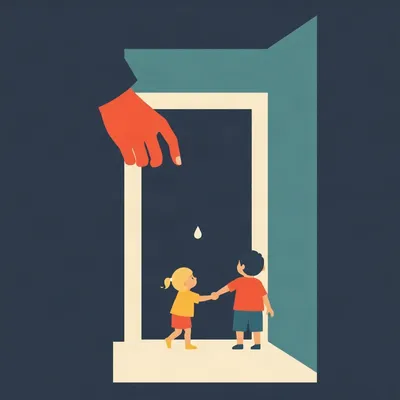
Daniel wrote in with a whole tangle this week. He went to art school, his partner went through a prestigious architecture program here in Israel, and she has what he calls a collection of craft supplies. Recently he found his own thing: engraving. He thought he'd found a passionate co-artist in the house. Instead, sometimes he watches her watching him with the Dremel and thinks, she doesn't get this. And he's asking three things. One, is there a documented phenomenon where artists feel creatively threatened by an unexpected fellow artist under their own roof? Two, what about the subtle one-upmanship in craft circles? And three, how have engravers been viewed by people who work in pigment? Are we the coarse sign makers, crudely ablating material instead of finely crafting compositions? He wants the unexpected power dynamics in art and craft communities.

He's asking whether that's the category he's been slotted into by someone who went to architecture school.
Right. The question isn't about the Dremel. It's about who gets to sit at the art table.
So today we're digging into the psychology and sociology of creative households and craft hierarchies.
And I want to flag something up front. Daniel frames this as his partner not getting it. But the prompt leaks a little. He says he thought he'd find a passionate co-artist, and instead he found someone watching him. That's not necessarily dismissal. That could be threat. Or guilt. Or all three.
The home is supposed to be the one place where your creative identity isn't up for review. You go to a gallery, you're being judged. You post online, you're being compared. But the kitchen table, that's supposed to be safe. So when a partner's art practice starts pressing on that identity, it doesn't feel like external competition. It feels like the floor moving.
And the three threads Daniel pulled together, the couple dynamic, the craft hierarchy, the engraver versus painter divide, they're really one question wearing three coats. Who gets to call themselves an artist, and who decides?
Let's start with the couple, because that's the part that's actually documented. There's a study from nineteen ninety-two, a woman named Zerbe, looking at creative collaboration in artistic couples. And what she found is that the romantic ideal, two artists inspiring each other in the studio, is real but it's only half the picture. The other half is rivalry. Sometimes it's productive rivalry, people pushing each other. Sometimes it's corrosive. But the key finding is that the home becomes a stage for comparison in a way that no other relationship does.
Because you can't leave the work at the office.
You can't. If you're a painter married to a painter, every canvas in the house is a scoreboard. And the comparison isn't even about quality most of the time. It's about legitimacy. Whose practice is the real one? Whose gets the serious space, the good light, the uninterrupted hours?
And in Daniel's case, there's an asymmetry that makes it stranger. She's the established professional. He's the newcomer to engraving. So the threat might be running in both directions at once, just silently. He might feel like his hobby is being judged as lesser. She might feel like her professional craft is being encroached upon by someone who just picked up a Dremel and started having fun.
That's the part most coverage misses. Everyone assumes the amateur is the one who feels threatened. But professional artists can be deeply unsettled by an amateur who's enjoying themselves, because the professional has turned art into obligation and the amateur is out there playing.
There's a line in the prompt I keep coming back to. He mentions her collection of craft supplies. Not her practice. Her collection. Dormant materials. And then he's over there with a Dremel, actively using a tool. That's a recipe for something.
The dormant supplies are potential, and potential is a guilt generator. Every unused brush, every unopened pad of paper, it's a small accusation. And when someone else in the house starts making things, it activates that guilt. She might not be looking at him thinking, that's not art. She might be looking at him thinking, why am I not doing that?
So the look he's reading as dismissal might actually be her own discomfort with her unused creative side. Which doesn't make it easier for him, but it does change what's actually happening.
The psychological mechanism underneath all of this is social comparison theory. Creative identity is tied to a sense of uniqueness and mastery. You're not just someone who makes things. You're someone who makes this kind of thing, in this way, better than most. When a partner suddenly demonstrates competence in a nearby domain, it triggers the comparison machinery. And one of the most common defensive responses is devaluation.
What she does is different, not better.
That's the line. And people deploy it without even knowing they're doing it. The partner's work gets filed under craft, or hobby, or decoration. Not because it is those things, but because calling it those things protects the other person's claim to the word artist.
And Daniel's partner is an architect. That's a professional creative class with licensing and a title. He's an engraver. That's a hobbyist category in most people's mental filing system. So the power imbalance isn't just personal. It's structural.
Before we go structural, let me sit with the couple dynamic one more minute, because there's a nuance here I think matters. The Zerbe work suggests that the healthiest artistic couples are the ones who can tolerate the rivalry without resolving it. Not couples who never compete, but couples who compete and then go make dinner together. The competition doesn't have to be corrosive. It can be the thing that keeps both people sharp.
So the question isn't how do we stop the threat, it's how do we live with it without it turning into a silent scoreboard.
And that's harder than it sounds, because silence is the default. Most couples don't talk about creative rivalry. They let it leak out in small ways. The tone of voice when someone says, oh, you're doing that now? The way a partner's work gets a quick nod while a friend's work gets a long look.
The Dremel doesn't help. It's loud. It's aggressive. It throws sparks. If she's working in pencil and paper, and he's over there with a power tool, the sensory experience alone says, this is different from what I do.
And that connects directly to the second thread, the craft hierarchy. Because within craft communities, there's a quiet but relentless sorting mechanism. Fine art positions itself above craft. Painting above pottery. And within craft, hand work is often seen as more pure than tool-based work.
So Daniel with a Dremel is at the bottom of at least three ladders at once. He's a hobbyist, not a professional. He's doing craft, not fine art. And he's using a power tool, not his hands.
The tool itself carries connotations. A brush says finesse, sensitivity, the individual hand. A Dremel says industrial labor. It's a rotary tool. It was designed for grinding and cutting and polishing. It shares a lineage with the machine shop, not the atelier. So when someone watches you engrave with a Dremel, part of what they're seeing is a guy doing a small machining job, not a guy making art.
Which is unfair, because hand engraving with a burin is one of the most demanding disciplines in the history of art. But the Dremel flattened that perception. It made engraving look like routing.
And that perception has deep roots. Let's go back to the Renaissance, because this is where the engraver versus painter divide gets formalized. In the guild system, engravers and painters were separated. Engravers were often classified with goldsmiths and metalworkers. Painters were classified with, well, painters. The guilds controlled who could practice what, where they could sell, what materials they could use. And engraving was largely reproduction work.
Engravers were the photocopiers of the Renaissance. They took a painting and made a hundred prints of it. That was incredibly valuable, it's how images traveled, but it meant the engraver was seen as a technician, not a creator. The painter had the vision. The engraver had the plate.
And the language of art criticism has never quite shaken that. The word coarse shows up in historical criticism of engraving. Coarse line work. Coarse handling. The implication being that engraving is a blunt process, literally cutting into metal, as opposed to the fine layering of pigment.
Which is absurd if you've ever looked at a Dürer engraving. The man was doing things with a burin that most painters couldn't do with a brush. But the category was already set. Engraver meant laborer. Painter meant artist.
Dürer is actually the perfect counterexample, because he was both. He painted, and he engraved, and he understood that the engraving was its own art form, not just a reproduction service. But he was an exception. The guild structure and the market structure kept most engravers in the reproduction lane.
And reproducibility was the original sin. A painting is unique. There's one of them. An engraving produces multiples. And in a market that values scarcity, multiples mean lower status. It's the same logic that still makes a print cheaper than a painting, even when the print is technically more demanding.
That logic is still alive in craft fairs versus gallery exhibitions. At a craft fair, you get makers. At a gallery, you get artists. Same hands, same materials, different label. And the label isn't assigned by skill. It's assigned by social networks, by who went to which school, by who knows which curator.
So when Daniel says his partner went to a prestigious academic program, that's not a biographical detail. That's a power dynamic. She has the credential. He has the Dremel. And the entire history of art says the credential wins.
But here's where it gets interesting. The modern craft movement has been pushing back on this hierarchy for decades. The maker movement, the rise of mixed media, the way galleries have started showing ceramics and fiber art and, yes, engraving. The categories are blurring.
And tools like the Dremel are part of that blurring. A hundred years ago, engraving required an apprenticeship and a set of burins and years of practice. Now you can buy a rotary tool for sixty dollars and start engraving glass on your kitchen table. That's democratization, but it's also destabilization. Because if anyone can do it, then the gatekeepers lose their power.
Which is exactly why the gatekeepers resist it. The word maker exists to keep the word artist protected. If you're a maker, you can sell at the craft fair. If you're an artist, you can show at the gallery. And the difference is not the work. It's who vouched for you.
Daniel's partner, as an architect, sits in a professional creative class. She has a license. She has a title. She has a body of work that's recognized by institutions. His engraving is a hobby, in the way the word hobby is used to mean, not serious.
And the prompt asks about power dynamics in art and craft communities. This is the one nobody wants to talk about. The power isn't about who makes better work. It's about who controls the labels. Who gets called artist. Who gets called maker. Who gets called hobbyist. Those labels are enforced through social networks, through galleries, through schools, through the casual comments at dinner parties.
Oh, you're doing a little engraving now? That's nice.
That's the sound of a label being applied. And once the label is on, it's very hard to get off. Because the person applying it has the social standing to make it stick.
So let's bring this back to the home, because that's where Daniel lives. He's at the kitchen table with a Dremel. She's an architect with a collection of craft supplies. The structural hierarchy says she's the professional creative, he's the hobbyist. But the moment he starts actually making things, the hierarchy gets uncomfortable. Because he's not asking permission. He's not waiting for a credential. He's just doing it.
That's threatening in a way that's hard to articulate. It's not that she's worried he'll be better than her. It's that he's demonstrating that the credential isn't the only path. You can just pick up a tool and make something. And if that's true, then what was all the schooling for?
That's a question nobody asks out loud.
No, it stays under the surface. It comes out as, she doesn't get this. Or, he's just playing with a power tool. Both people protecting themselves from the bigger question.
I want to push on something. Daniel says he thought he'd find a passionate co-artist in the house. That's an expectation, and it's a heavy one. Because it assumes that her creative identity should naturally extend to his medium. But why would it? She's an architect. Her medium is space and structure and light. His is metal and glass and abrasion. They're both creative, but they're not the same language.
That's a fair point. The expectation of shared enthusiasm can be its own kind of pressure. He wants her to get it. But maybe she doesn't need to get it. Maybe she just needs to not dismiss it. Those are different things.
Maybe the discomfort he's reading isn't dismissal. Maybe it's her own complicated relationship with her dormant craft supplies. She's watching someone activate a creative practice while hers sits in boxes. That's not about him at all.
The Zerbe study would call that a projective dynamic. Each person is seeing their own anxieties in the other person's practice. He sees her watching and thinks, she thinks I'm coarse. She sees him working and thinks, I should be doing that. Neither of them is actually talking about what's happening.
Because talking about it would mean admitting that the art table is contested space. And nobody wants to have that conversation at the kitchen table.
Let me shift us to the historical piece, because Daniel asked directly how engravers have been viewed by pigment artists. And the answer is, for most of history, as a service profession. Engravers reproduced paintings. They made book illustrations. They made maps. They made heraldic devices. They made signs.
Coarse sign makers.
That phrase is doing a lot of historical work. Because sign making was a trade. It was manual labor. You lettered a shop front, you cut a brass plaque, you engraved a tombstone. It was skilled work, but it wasn't art. The pigment people, the painters, they were the ones with the vision. The engraver was the one with the steady hand.
The steady hand was undervalued precisely because it was steady. A painter could be inspired. An engraver had to be precise. Inspiration is romantic. Precision is mechanical. So the engraver got slotted as a machine before machines even existed.
That's a sharp way to put it. The engraver was the machine. And when machines actually arrived, when lithography and photography showed up, the engraver's role collapsed. Suddenly the reproduction work could be done by a chemical process, and the engraver was left with the sign work and the plaques.
Which is where the Dremel lives. It's a tool that descended from that world. The trophy shop, the sign shop, the memorial plaque. It's not a tool that came out of the fine art world. So when Daniel picks up a Dremel, he's picking up a tool with a working-class history. And that history is part of what his partner might be seeing.
The modern maker movement has tried to reclaim that history. There's a whole aesthetic now around the honesty of tools, the beauty of process, the dignity of the handmade. But the fine art world still largely looks at a Dremel and sees a garage tool.
Which is funny, because the same fine art world will pay six figures for a sculpture that was made with an angle grinder. The tool isn't the problem. The context is. Put the angle grinder in a gallery and it's art. Put it in a garage and it's a hobby.
Context is the entire game. And context is controlled by the people who own the labels. The curator, the critic, the professor, the architect. Daniel's partner is one of those people. Not maliciously, just by position. She's been trained to see certain things as art and certain things as craft. And the Dremel is in the craft box.
But here's the thing about boxes. They leak. The more people pick up Dremels and make beautiful work, the harder it is to keep the box closed. The maker movement, the online craft communities, the way people share process videos now, it's all eroding the gatekeepers' power. Not eliminating it, but eroding it.
That erosion is threatening to the people who built their identity on the gate. If anyone can be an artist, then what does it mean to be an artist? That's the question underneath the one-upmanship in craft circles.
The one-upmanship is real, and Daniel's right to flag it. In craft circles, there's a constant quiet negotiation about who's serious and who's dabbling. Who sells at the good fair. Who gets the teaching gig. Who gets the feature in the magazine. And it's not about skill, mostly. It's about access and presentation and who you know.
I've seen it in the medical world, actually. The same dynamic. Who gets called doctor, who gets called nurse, who gets called practitioner. The labels do the work of sorting before anyone looks at the actual competence.
In craft, the sorting is brutal because the stakes feel low but the identity stakes are high. If you're a potter and someone at the fair calls you a maker, that's fine. If they call you a hobbyist, that stings. If they ask if you sell on Etsy, that's a whole other conversation.
The Etsy question is the modern version of the guild system. It's a way of asking, are you a real artist or are you just selling things online? And the answer determines whether you get taken seriously.
Daniel is walking into a world where the labels are already loaded. He's an engraver, which historically means sign maker. He uses a Dremel, which means power tool, which means industrial. He's doing it at home, which means hobby. He's got every label stacked against him. And then he looks up and sees his partner, who has every label stacked in her favor.
He wonders why she doesn't get it.
She might get it more than he thinks. She might get exactly what it means for him to be doing this, and that's what makes her uncomfortable.
Hilbert: The word coarse. I spent a year hand-lettering shop fronts in Tel Aviv, early two thousands. Gold leaf on glass, the whole thing. And the woman I was with, she was a painter, oils on canvas, and she called it decoration. Like I was hanging curtains.
That's the hierarchy in one word.
Hilbert: She tried to use my lettering brushes once. Wanted to see if it was as easy as I made it look. She couldn't pull a straight line to save her life. Her hand shook, the paint went everywhere, and she said the brushes were defective. The brushes were fine. They were good brushes. She just didn't know that the line comes from the shoulder, not the wrist.
That's the thing about sign work. It looks simple because it's legible. Everyone can read a sign, so everyone thinks they can make one. But the precision is brutal. One wrong stroke and the whole thing's ruined.
Hilbert: I engraved brass plaques too. Had a little pantograph setup. And the people who ordered plaques, they never said, oh, you're an artist. They said, can you have it by Thursday. But they paid. And the painter girlfriend, she never sold a canvas the whole time we were together.
The market has its own way of sorting.
Hilbert: She does calligraphy now. I saw it online. Calligraphy. After telling me my lettering was decoration. I don't know whether to laugh or send her a bill for the brushes she ruined.
I'd laugh.
Hilbert: The thing Daniel's feeling, the threat, it's probably mutual. He thinks she's looking down on the Dremel. She's probably looking at him and thinking, he found his thing and I'm still staring at boxes of supplies I never open. That's the part nobody says. The threat isn't about the work. It's about who's actually doing the work.
The one who's doing it is the one with the power.
Hilbert: I still have the engraving tool. Not the pantograph, that was the shop's. But the hand piece, the little one for brass. It's in a box somewhere. Daniel's welcome to borrow it, if he can stand the noise. It's louder than the Dremel and it throws more chips. But it'll cut a cleaner line on brass.
The noise is part of it, isn't it. You can't do this quietly. It announces itself.
Hilbert: That's why the pigment people don't like it. You can paint in silence. Engraving sounds like work. It sounds like a trade. And that's what bothers them.
The sound of someone not asking permission.
Hilbert: Something like that.
Here's the open question I keep circling. Can creative couples ever truly share a domain without rivalry? Or is some tension just built in, and maybe even useful?
The Zerbe work suggests the tension is normal. The question is whether it's generative or corrosive. And that depends on whether the couple can talk about it. Most can't. So it goes underground and comes out as small comments and loaded looks.
As tools like the Dremel keep getting cheaper and more accessible, the line between craft and art is going to keep blurring. That's already happening. The question is what happens to the word artist when anyone can claim it.
I don't think the word disappears. I think it just stops doing the gatekeeping work it used to do. Which is probably a good thing for people like Daniel, and a hard thing for people who built their identity on the gate.
Daniel's partner might not get engraving. But maybe the real question is whether she needs to. Maybe the discomfort is part of the process. His discomfort, her discomfort, both of them sitting with the fact that there are two creative people in the house and only one of them is currently making things.
The other one is watching. Which might be the most creative thing she does all week.
That's a generous read.
I'm feeling generous.
Thanks to Hilbert Flumingtop for producing. This has been My Weird Prompts. If you want to send us a prompt, email us at show at my weird prompts dot com.
We'll be back soon.