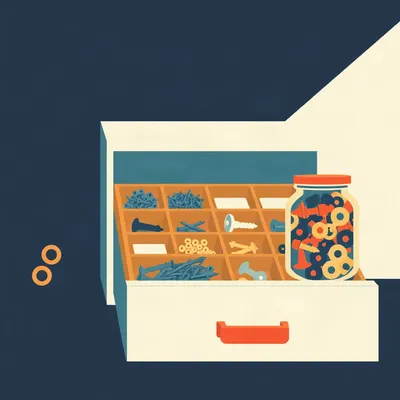
Daniel's been staring at a gap. He's got industrial shelving with uprights spaced fifty-eight centimeters apart, center to center, and he wants to mount a pegboard in that space — sixty centimeters wide, one or two meters tall, standard one-centimeter hole spacing. Simple. Except he can't find anyone in Israel who'll sell him one piece cut to those dimensions. He's run through the options: find an industrial supplier who'll cut a single sheet, build some kind of horizontal strut adapter to bridge the gap and hang an IKEA SKÅDIS, or give up on metal entirely and drill his own plywood. The real question isn't how to hang a pegboard. It's what type of business actually sells this thing, and how you convince them to sell you exactly one.

And this is one of those problems where the technical part is trivial but the purchasing channel makes you want to throw things. Daniel knows exactly what he needs. He could sketch it in thirty seconds. The material exists — perforated metal sheet with one-centimeter holes is a standard industrial product. The problem is that the businesses stocking it are set up to sell pallets, not single sheets, and the moment you ask for one, you're not a customer anymore. You're an interruption.
The SKÅDIS is the red herring that makes this worse, because it's almost right. The current IKEA Israel listing has it at fifty-six centimeters wide. That leaves a two-centimeter gap on each side between the pegboard edge and the upright. Daniel said he's spent an embarrassing amount of time with small brackets trying to bridge that gap.
Two centimeters. That's the width of your thumb, and it's enough to make a standard product completely useless for his application. He'd need to fabricate custom adapter plates — essentially little metal ears that bolt to the uprights and extend inward to catch the SKÅDIS mounting holes. At that point you're designing and sourcing a custom bracket system to avoid designing and sourcing a custom pegboard. The cure is worse than the disease.
So let's break down why this simple request turns into a saga. The core tension here isn't technical — it's a purchasing channel problem. And it's universal for makers outside the US, where the Amazon Prime expectation of infinite SKUs and free two-day delivery is a geographic anomaly. In most of the world, including Israel, the industrial supply chain is still B2B-first. The moment you want one of something from a supplier that sells by the hundred, you enter a negotiation, not a transaction.
And Israel makes this particularly sharp because the market is small — about nine and a half million people. Niche SKUs just don't get stocked. If you need a sixty-by-two-hundred-centimeter perforated metal panel with one-centimeter hole spacing, there might be exactly one business in the country that has it on the shelf, and they're not set up for walk-in retail. They sell to factories that order twenty sheets at a time.
Daniel's framed this as three options, plus an unspoken fourth that he's probably already considered. Let's start with the one he spent the most time on: finding an industrial supplier to cut one piece.
Option A. And this is where the minimum order quantity problem really bites. Standard perforated metal sheets in Israel — the kind you'd find at suppliers in the Tel Aviv industrial zone or out near Bar Lev — are typically a hundred twenty by two hundred forty centimeters. A full sheet with one-centimeter holes runs somewhere between two hundred and four hundred shekels, depending on thickness and whether it's steel or aluminum. Daniel doesn't want the full sheet. He wants a sixty-by-two-hundred strip cut out of it.
Which means he's not asking for a product. He's asking for a service.
He's asking them to take a sheet they could sell whole, cut a third of it off, and sell him the remainder — while they eat the offcut as waste, tie up their shear or laser cutter for a job that nets them maybe fifty shekels, and run a sales process built for invoices of a thousand shekels and up. Their business model doesn't have a line item for "cut one piece for a guy who walked in."
The offcut is the silent killer here. If they cut a sixty-centimeter strip from a hundred-twenty-centimeter sheet, they're left with another sixty-centimeter strip. Can they sell that? Maybe, if someone else walks in wanting exactly that size. But they can't count on it, so they price it as waste. And they don't want to eat waste on a fifty-shekel job.
So what you get, if you walk into one of these places cold and ask for a single cut piece, is either a flat no or a quote that's deliberately absurd — five hundred shekels minimum order, or they'll sell you the full sheet and you can do what you want with it. They're not being difficult. Their pricing model literally doesn't accommodate you.
Which brings us to Option B — the horizontal strut idea. Daniel's thought was to mount some kind of horizontal bar or panel across the uprights, then attach an IKEA SKÅDIS to that. Essentially building an adapter plate that bridges the two-centimeter gap.
The challenge here is that you're now sourcing something even more niche than the pegboard. What Daniel's describing is essentially a piece of aluminum or steel L-channel or flat bar, fifty-eight centimeters long, with pre-drilled holes at the right spacing to match both the uprights and the SKÅDIS mounting points. That's not a shelving product. That's a structural extrusion, and finding a single two-meter length of the right profile in Israel means tracking down a distributor who stocks something like eighty-twenty or Bosch Rexroth aluminum framing profiles and will sell you a cut piece.
And those distributors exist, but they're the same kind of B2B operation. You call them and they say "which company are you with and what's your project budget." You say "I need one bar" and there's a pause.
A long pause. Meanwhile the cost-to-effort ratio is spiraling. By the time you've sourced the channel, had it cut, drilled the mounting holes, bought the fasteners, and attached the SKÅDIS, you've spent three afternoons and probably two hundred shekels on hardware — for a solution that still leaves you with a fifty-six-centimeter pegboard when you wanted sixty.
Which is Option C — plywood.
And this is the one Daniel's resisting because he thinks it'll look less professional. Let's examine that honestly. A sixty-by-two-hundred-centimeter piece of six-millimeter plywood at Ace or Home Center in Israel runs about fifty to eighty shekels. You can have it cut to size right there. Drilling one-centimeter-spaced holes is tedious but completely doable with a drill press and a template — you can make a template from a scrap of acrylic or even hardboard, and once you've got it, you just step and repeat.
The real downside isn't aesthetics. It's load-baring capacity. A drill mount — especially with a hammer drill hanging on it — puts a lot of weight on a small number of holes. Over time, plywood holes can oval out or the wood can split along the grain. For light-duty storage like tilting bins and a tape dispenser, it's functionally fine. For heavy tools, metal is better.
But the "clean look" concern is solveable. Paint the plywood. Use a metal-look laminate. Sand the edges and hit it with a few coats of grey enamel and from three feet away nobody can tell it's not steel. Or — and this is where it gets interesting — use the plywood as a template and have it cut in metal.
Which is the hidden fourth option. Laser cutting services.
This is the one that bypasses the industrial supply chain entirely. In Israel there are dozons of small laser cutting shops — you find them on platforms like Cut2Size, in local Facebok groups, or just by searching for laser cutting services in the Tel Aviv area. These shops are set up for one-off jobs. Their whole business model is "send us a file, we'll cut it and ship it." You design a sixty-by-two-hundred-centimeter panel with one-centimeter hole spacing in Fusion 360 or even Inkscape, export it as a DXF file, upload it, and get a quote.
What kind of cost are we talking?
For a single piece of two-millimeter steel or aluminum in that size, with that many holes — because the laser has to make thousands of individual cuts — you're probably looking at a hundred fifty to three hundred shekels for material plus cutting. Lead time is three to seven days. The catch is you need to provide a CAD file, which means you need to be comfortable drawing a rectangle with a grid of circles. It's not hard, but it's a skill barrier.
And a DXF file turns a custom part into a commodity. That's the key insight. The laser cutter doesn't care that your design is weird. The machine reads the file and cuts what it says. There's no negotiation, no minimum order quantity that matters — the shop is optimized for ones and twos. You're not asking them to do something unusual. You're asking them to do exactly what they do all day.
The per-hole cost is where this gets interesting. If you've got a grid of one-centimeter holes at one-centimeter spacing across a sixty-by-two-hundred-centimeter panel, that's roughly sixty holes per row, two hundred rows — twelve thousand holes. The laser has to pulse for each one. That's a lot of machine time, and it's why some shops might quote higher than you'd expect. The workaround is to specify larger holes — say, six millimetres — which the laser can cut faster, or reduce the density. You don't actually need every hole. You need holes where you're mounting things.
So we've covered the options. But the real question Daniel asked is: how do you actually get someone to sell you this thing? Let's say you've decided to go the industrial supplier route. What's the playbook?
The psychology of convincing an industrial supplier to sell you one unit — this is a negotiation, not a purchase. And there are specific tactics that work. First: call, don't email. You need a human to override the system. An email from an unknown address asking for one cut piece goes straight to the trash. A phone call — especially in Hebrew, if you can manage it — gets you to a person who can make a judgment call.
Second: lead with the full story. Don't say "do you sell pegboard." Say "I have industrial shelving, I need one piece cut to sixty by two hundred centimeters, I know this is a small job, I'm happy to pay a premium for the service." You're signaling that you understand their business model and you're not expecting retail pricing.
Third — and this is the most effective one — offer to buy the full sheet and have them cut it. You pay for the whole hundred-twenty-by-two-hundred-forty sheet, they cut your sixty-centimeter strip, and they keep the offcut. This changes the transaction from "sell me a service you don't offer" to "sell me material and keep the waste." Now they're making their normal margin on the sheet, plus whatever they charge for the cut, and they still have sixty centimeters of saleable material left over. You've turned a loss into a win for them.
That probably pushes the cost to four or five hundred shekels for what should be a fifty-shekel piece of metal. But you get exactly what you want, and you haven't burned a relationship with a supplier you might need again.
Fourth tactic: ask for the remnant pile. A lot of metal suppliers have a scrap bin or a rack of offcuts from previous jobs. These are pieces they can't sell as full sheets and they're happy to move for cheap. You might not find exactly sixty by two hundred, but you might find something close enough that they'll trim to size for a small fee. The phrase you want is "yesh lachem sha'arim" — do you have remnants.
Fifth: the friend-of-a-friend approach. If you know anyone with a business account at a metal supplier — a contractor, a fabricator, someone who orders regularly — ask them to add your piece to their next order. The supplier sees a normal bulk order from an existing customer with one weird line item. They'll cut it without thinking twice.
And this points to the broader lesson. The B2B-to-consumer gap is a feature, not a bug. Industrial supply chains are optimized for repeat buyers with predictible demand. A one-off buyer is a disruption — you're sand in the gears of a machine designed for bulk. The workaround isn't to try harder to fit into that machine. It's to find businesses whose model already accommodates one-offs.
Which means the answer to "what type of business sells this" is counterintuitive. It's not the business that stocks it. It's the business that makes it.
Right. A metal supplier stocks perforated sheet but won't cut it for you. A laser cutting service doesn't stock it but will cut anything you send them. A makerspace doesn't sell metal at all but will give you access to the tools to make it yourself. A small fabrication shop — the kind that builds custom gates and railings — has the shear and the material and will do a small cash job if you catch them at the right moment.
The Israel-specific context matters here too. Daniel mentioned this is a recurring pattern — slightly offbeat purchases turning into inexplicably complicated challenges. That's partly market size. With nine and a half million people, the number of customers for a sixty-centimeter custom pegboard is... Daniel. Maybe one other guy. No retailer is going to stock that SKU. And import friction makes it worse — shipping a single sheet of pegboard from Europe or the US costs more than the product, customs adds paperwork, and minimum order quantities from overseas suppliers are even higher.
So the workaround becomes: don't find a distributor who stocks the finished product. Find a local fabricator who can make it from raw material. Israel has a surprisingly dense network of small metalworking shops — the kind of places that do laser cutting, CNC folding, welding. They're not retail. They don't have storefronts. But they'll take a DXF file and a credit card and ship you a part.
There's a makerspace in Tel Aviv called Workshop — it's one of several — that offers metal cutting as a service. You can walk in, use their equipment, or pay them to do it. That's the kind of channel Daniel's looking for. Not a store. A place with machines and people who know how to run them.
And that brings us to the aesthetic versus function tradeoff. Daniel's worried plywood will look less professional against his steel shelving. I understand the impulse — you've invested in industrial storage, you want it to look cohesive. But in a workshop context, function often trumps form, and the plywood option has a hidden advantage: it's modifiable. If you drill a hole in the wrong place, you fill it and drill another one. With metal, you're stuck with your mistakes.
The hybrid approach might be the sweet spot. Use laser-cut steel for the visible section — the part where the drill mount goes, the part you see when you walk up to the unit — and plywood for the rest, painted to match. Or use the laser-cut steel for the whole thing and accept that it'll cost three hundred shekels and take a week. That's the price of bypassing the industrial supply chain.
And honestly, three hundred shekels for a custom-sized, professionally-cut steel pegboard with perfect hole spacing is not a bad deal. Daniel probably spent more than that in time and brackets trying to make the SKÅDIS work.
There's a deeper point here about the gap between what you can buy and what you can have made. Most people default to buying — they search for the product, can't find it, and conclude it doesn't exist. But the product does exist. It just doesn't exist as a stocked SKU. It exists as a capability. The laser cutter can make it. The sheet metal supplier has the material. The gap is in the transaction, not the manufacturing.
And that gap is where the interesting economy lives. The side-hustle fabricator who runs a laser cutter in his garage. The metal shop that does small jobs for cash. The makerspace that rents machine time. These aren't anomalies — they're the emerging default for anyone who needs one of something. As more people set up home workshops and need custom parts, the workaround economy grows to meet them.
Daniel's pegboard is a small problem, but it's a perfect case study in how industrial purchasing actually works when you're not a factory. The skill isn't product knowledge — Daniel knows exactly what he wants. The skill is channel discovery. Finding the right type of business, and then navigating the social layer on top of the transaction.
The social layer is the part that doesn't show up in any catalog. It's knowing to call instead of email. Knowing to offer to buy the whole sheet. Knowing the Hebrew word for remnants. Knowing that the security guard at the industrial park probably knows which shop does small jobs after hours.
Which is where this gets interesting in a way Daniel probably didn't expect. The most efficient purchasing channel might not be a business at all. It might be a person.
I think Hilbert has thoughts on this exact point.

You're all overcomplicating this.
The trick isn't convincing a supplier to sell you one piece. It's finding the guy who runs the laser cutter at night as a side hustle. Every industrial park in Israel has one. He works at the shop during the day, runs his own jobs after hours, doesn't have a website, doesn't have a minimum order, and he'll cut your pegboard while he's cutting his own projects.
I found mine by asking the security guard at the industrial park who fixes his car.
I was a purchasing agent for a small manufacturer in the Negev — we made custom agricultural equipment, spray booms, that kind of thing. My job was sourcing single pieces of specialized metal for prototypes. Exactly Daniel's problem, but I was doing it twenty times a week. And after about six months I stopped calling suppliers entirely.
The suppliers were fine for bulk orders. But for one-offs, the real supply chain was the night shift. The guy who runs the laser cutter from seven to midnight, cash only, no invoice. He's faster, he's cheaper, and he doesn't ask why you only want one.
How did you find him the first time?
The security guard. I told you. I was trying to get a bracket cut — weird shape, single piece — and every shop I called quoted me a minimum of fifteen hundred shekels. I was standing outside smoking and the guard asked what I was doing there every week. I told him. He said "talk to Motti in unit twelve, he does small jobs after eight." Motti cut my bracket for a hundred shekels while I waited.
After that I brought the guard coffee every time. Best supply chain investment I ever made.
The security guard as supply chain intermediary. That's not a joke — that's actually the insight. The person who sees every truck that comes in, every worker who stays late, every light that's on after hours. They know the informal economy of the industrial park better than any purchasing manager.
They know who's behind on their mortgage and looking for side work. They know which shop just bought a new laser and has capacity. They know who got fired and took a set of keys with them.
Daniel doesn't need a supplier. He needs Motti. And Motti doesn't advertise. You find him through the guard, or the guy at the hardware store, or the mechanic who welds on the side. That's the channel.
So the purchasing channel isn't a business type at all. It's a social graph.
It's always been a social graph. The catalog is just what they show you when they don't know you.
That's... I mean, it's completely right and completely invisible if you're approaching this from the consumer side. You search online, you find nothing, you assume the thing doesn't exist. But it exists — it's just not listed. The listing is a relationship.
The listing is Motti's phone number in the guard's contact list.
And if you don't have the guard?
You find the guard. Or the equivalent. Every neighborhood in Israel has a guy who knows a guy. The guy who runs the small hardware store, the guy who fixes washing machines, the contractor who's been working the same industrial zone for twenty years. You ask them. Not "where can I buy this" — "who do you know who could make this."
Different question, different answer.
Daniel's original framing — "what type of business sells this and how do I convince them" — is almost the wrong question. The right question is "who has the machine and is willing to run it for cash."
Yes.
That works for a pegboard. Does it scale?
It scaled to a factory making spray booms. We built the whole prototype line through Motti and two other guys the guard introduced me to. When we needed a hundred units, we went back to the suppliers with a purchase order. But for ones and twos? The night shift.
I still have a bracket Motti cut for me. It's in a box somewhere.
The informal economy as a parallel supply chain that's faster, cheaper, and more flexible than the formal one — but completely invisible to anyone who doesn't know how to access it. That's the real lesson here.
It raises a bigger question. As more people work from home and set up small workshops, the demand for one-off industrial parts is going to grow. Will the formal supply chain adapt and start serving ones and twos? Or will the workaround economy — the makerspaces, the laser cutting services, the Motti network — become the permanent solution?
I think the workaround economy is already becoming the default for a certain class of buyer. The laser cutting services are getting more visible — they're on Facebook, they're on comparison sites, they're building storefronts. The makerspaces are multiplying. The gap is still there, but the bridges are getting sturdier.
Daniel's pegboard is a small problem. But it's a microcosm of a shift that's happening whether the industrial supply chain likes it or not. The gap between industrial and consumer supply chains is a gap that someone will eventually fill. Until then — find the guard.
Or learn to draw a DXF file and upload it to a laser cutter. That's the other path to the same outcome. One is social, one is technical. Both bypass the purchasing channel problem entirely by going around it.
The cutting-room floor detail I can't stop thinking about: a standard perforated metal sheet with one-centimeter holes at one-centimeter spacing — if you actually count them out across a full hundred-twenty by two-hundred-forty sheet, you're looking at something like twenty-eight thousand holes. The punch tool that makes those is a work of engineering in itself.
The open question I keep coming back to: is the security-guard-as-supply-chain-intermediary strategy replicable, or is it a one-off that depends on local knowledge and a lot of luck? If you dropped into a new city tomorrow and needed a custom pegboard, could you find Motti?
I suspect you could, but it'd take a week of asking the wrong people before you found the right one. And that week is the cost you don't see when you're used to Amazon.
Thanks to our producer Hilbert Flumingtop for keeping us grounded in how things actually work on the ground.
This has been My Weird Prompts. Find us at my weird prompts dot com — that's my weird prompts dot com. We'll be back soon.