By the time Daniel asked about running a fine-tune on an AMD card, you could still hear the fans from the hallway.

That's the thing about being Early Adopter of the Year three years running. You learn what the fan sounds like.
We'll get to the ask. Herman, tell him what he actually asked this time.
I've read it. Twice.
So Daniel wants to revisit ASR and AI dictation, because about a year ago he made a prediction he's now less sure of. He said dedicated ASR models would eventually go extinct. Why build a transcription model and then a second model to clean up its output, when you could hand audio straight to a multimodal language model with a system prompt and get polished prose on the way out.
And it didn't happen that way.
Both approaches are still shipping, both are still getting better, and a third category showed up in the middle — models whose entire job is to take a raw transcript and turn it into something a human would actually want to read. So Daniel isn't asking us to make another prediction. He's asking us to test the instinct. What does the evidence from the last two years actually show about accuracy, latency, hallucination, cost, local hardware, and whether word error rate is even the right thing to be measuring.
And his instinct, which I think is worth stating plainly before we get into it, is that dedicated ASR plus a specialized cleanup step might be the architecture that survives.
That's the thing to test. So let's start with what actually changed.
What changed is that this stopped being a two-horse race. It's a three-layer stack now, and people keep arguing about layer two in isolation.
Name them.
Layer one, the dedicated acoustic models. NVIDIA's Parakeet TDT family, the Whisper derivatives, the Conformer encoders. Layer two, the audio-capable multimodal LLMs. Qwen2.5-Omni, IBM's Granite-speech, Phi-4-multimodal. These are the models that listen and follow an instruction at the same time, which is the thing Daniel's prediction was built on.
And layer three is the one I find interesting.
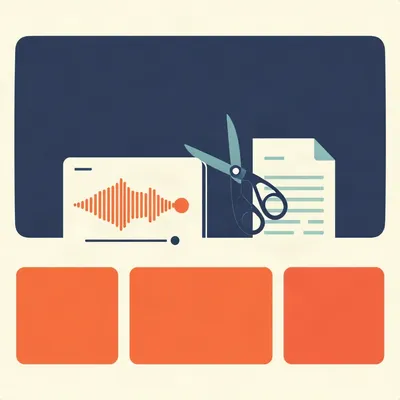
Layer three is new, and it's the part almost nobody predicted. Explicitly specialized post-processing models. The clearest example is Superwhisper's S1-mini, which shipped in August. It is not a transcription model at all. It takes raw ASR text in and gives clean, formatted text out.
So somebody looked at the argument that a multimodal LLM could both hear and format, and their answer was to sell you two models instead of one.
Which sounds like going backwards, until you look at why.
The central tension here — and I want to get this out early because it frames everything — is that the prediction wasn't wrong so much as incomplete. The LLM-decoder models do win on raw accuracy. The top four English entries on the Open ASR Leaderboard are all Conformer encoder paired with an LLM decoder. That part of Daniel's reasoning held up.
It held up. What he didn't price in was what it costs to run them.
And that's where the cascade, the boring old two-stage pipeline, is quietly winning.
On device. On modest hardware. Yes. And there's a meta-problem sitting on top of all of it that we should flag now rather than at the end, which is that the field is still building the metrics to answer Daniel's question. Word error rate is under active attack from several directions.
Actively attacked. That's not a figure of speech.
It's not. And there is no head-to-head benchmark that compares audio-to-formatted-text against ASR-plus-normalization on the same dictation task. It doesn't exist yet.
The best place to start is the leaderboard.
The Open ASR Leaderboard is the closest thing this field has to a scoreboard. Sixty-plus systems, eleven datasets. As of last October, its headline conclusion is a split verdict, and they wrote it out almost verbatim. Conformer encoders paired with LLM decoders achieve the best average word error rate but are slower, while CTC and TDT decoders deliver much better real-time factor.
Which is two different crowns.
Two different crowns, and they knew it. The model they refuse to declare a winner is the whole story.
Walk me down the top of the table.
NVIDIA Canary Qwen 2.5B. Twenty-five billion parameters, five point six three percent average word error rate. That's the best English number on the board.
Best number, and what does it run at?
Four hundred and eighteen times real time. Meaning it transcribes a minute of audio in about a seventh of a second on the hardware they tested.
That sounds fast.
Hold that. IBM Granite Speech, the eight-billion version, five point seven four percent at a hundred and forty-five times real time. Granite Speech three point three, the two-billion, six percent at two hundred sixty. Microsoft Phi-4 Multimodal Instruct, six point zero two at a hundred and fifty-one.
All four of those are Conformer plus LLM decoder.
Every one. That's the top four. Daniel's architecture does win the accuracy column.
And then?
Then NVIDIA Parakeet TDT 0.6B v2 sits fifth. Six point zero five percent word error rate. Three thousand three hundred eighty-six times real time.
Say the gap again.
Four tenths of a percentage point of word error rate. Between fifth place and first.
For an eight-fold difference in speed.
Between eight and twenty-three, depending on which of the four you compare it against. Same accuracy, within noise, and it's not close on latency.
So the model with the best accuracy is running at a hundred and forty-five to four hundred times real time, and the model that's four tenths of a point worse is running at three thousand three hundred.
And there's a v3 now, released August of last year. Six point three two percent, thirty-three thirty-two times real time. Six hundred million parameters. Twenty-five European languages. Runs on as little as two gigabytes of RAM. There's a GGUF build for local C plus plus inference, so you can run it on a laptop CPU without a graphics card.
Two gigabytes.
For the whole model. It's six hundred million parameters and it's competitive with things that are four times its size, and it's running on hardware you already own.
What is RTFx, for the people who skipped the paper?
Real-time factor. How many seconds of audio you can process per second of wall clock. So three thousand three hundred means you can transcribe an hour of audio in about a second. Four hundred means about nine seconds for that same hour. Both are faster than real time. Only one of them lets you do it while the person is still talking.
Or on a device that isn't plugged into a wall.
Or in a live dictation loop where the text has to appear as you speak. This is the mechanism behind the split, and it's worth understanding because it's not a temporary gap that better training closes. LLM decoders are autoregressive. They generate one token at a time, and they're reasoning about context as they go, which is why they handle domain vocabulary and messy audio better. TDT decoders are non-autoregressive. They emit the whole sequence in a fixed number of steps. They're fast because they don't deliberate.
Fast because they don't think about it.
That's the trade. And you can't get one property without giving up some of the other. This is an architectural fork, not a maturity gap.
Okay, so that's the acoustic layer. Layer three.
S1-mini. Superwhisper shipped the S1 family in August, and S1-mini is the open-weights one. It's a point-six-billion-parameter text normalizer, fine-tuned from Qwen3 point six, Apache licensed, English only. Quantized it's about four hundred sixty-two mebibytes.
Four hundred and sixty-two.
It fits on a phone.
So on one side we have a six-hundred-million-parameter acoustic model that needs two gigabytes and runs at thirty times real time, and on the other side a four-hundred-sixty-megabyte normalizer, and together they cost less than the RAM Chrome is using right now.
That's the whole architectural implication and I think it's the most important thing in this episode. You can now build a fully local dictation pipeline out of Parakeet plus S1-mini, and it will run on modest hardware, offline, with no API calls.
What does it actually do, this normalizer?
You feed it the raw transcript, and you also feed it a control line. Three fields. Styling, structure, context.
Meaning you tell it what register you want, how to lay it out, and what you're talking about.
Styling is things like formal or casual. Structure is whether you want bullets or paragraphs. Context is the bit I like — you tell it what the content is for. So the same raw transcript, cleanly transcribed as a message to a colleague, comes out as a message to a colleague. As a meeting note, it comes out as meeting notes.
So the formatting decision is separated from the transcription.
Deliberately. And it performs. On a held-out set of seven thousand five hundred nineteen cases, ninety-four point eight percent token accuracy and an eleven point six percent text-edit error rate. Greeting-line detection ninety-nine point three. Sign-off detection ninety-seven point nine. Exact email addresses ninety-two percent. Degenerate output under one percent.
Email addresses at ninety-two percent is the one I'd notice. That's the thing dictation gets wrong that ruins your afternoon.
It's the highest-value failure class and they measure it separately, which tells you they know.
Now here's the part where I want to push on Daniel's framing, because he asks whether there's a benchmark comparing the two approaches head to head, and the answer is no. There isn't one.
There isn't. And this is not us being lazy about looking. There is no single benchmark that puts audio-to-formatted-text generation against dedicated ASR plus text normalization on the same dictation task. The closest things that exist are ContextASR-Bench, which is about contextual ASR and not formatting, and Talk2Agent, which measures whether task-critical information survives a voice interface, which is also not formatting quality.
So both sides are being scored on different exams.
On different exams, by different people, with different rubrics. And that's before we get to the fact that the vendor benchmarks in this space — the Superwhisper numbers included — are run by the companies selling the thing. Directional, not authoritative.
But accuracy and speed aren't the whole story, because there's a failure mode that changes the calculus.
Hallucination.
And this is where the end-to-end story gets uncomfortable. Whisper's average hallucination rate on non-speech benchmarks is thirty-one point three one percent.
Baseline. And you can cut that to two point four four percent with an intervention they call activation projection — you're projecting activations away from a direction associated with hallucinated output. But baseline is thirty-one.
On non-speech. On audio that isn't a person talking.
And it gets worse in specific places. There's a cross-linguistic study that found Whisper produces what they describe as pathological hallucination on Indian-accented speech, with a non-monotonic insertion-rate spike to nine point six two percent at large-v3. Non-monotonic meaning it gets worse as the model gets bigger.
The larger model hallucinates more.
On that accent, yes. And under masking, it enters catastrophic repetition loops — eighty-six percent of fifty-one thousand seven hundred ninety-seven insertions in that study came from those loops. The same study found explicit LLM decoders produce thirty-eight times fewer insertions.
Wait. So the LLM-decoder architecture is better here?
Materially better, on that specific failure. And the Irish benchmark, BlasBench, found all Whisper variants exceed one hundred percent word error rate through insertion-driven hallucination. Over a hundred percent, because you can emit more wrong words than the correct reference contains.
That's the number that should stop people. A hundred percent WER is supposed to mean total failure, and this is worse than total failure because it's confident.
Confidently inventing.
Which changes the architecture question, because the cascade has an intervention point and the end-to-end model doesn't. If your ASR stage starts hallucinating under noise, you can gate it, project it, fall back to a smaller model, detect the repetition loop. If a single multimodal model goes wrong, you have no seam to put your hand on.
That's a structural advantage and I don't think it's temporary. You can't gate a model that's doing the transcription and the formatting in one forward pass, because there's no clean place to ask whether the transcribing part is lying.
And there's a second thing here, which is that hallucination is worst exactly where dictation users live. Accents, noise, non-speech. Somebody dictating a shopping list in a car.
Somebody dictating in a car is a person speaking into a device in a machine that is generating noise, which is not a scenario the benchmark suite was designed around.
Now the noise data, because I want the honest version of this.
Parakeet degrades too. Six point three four percent word error rate clean, eleven point six six at signal-to-noise ratio zero, nineteen point eight eight at minus five.
So it roughly triples in bad conditions.
It does. That's a real weakness and I'm not going to spin it. But — and this is the distinction I'd draw for Daniel — a model that gets worse in noise is different from a model that invents content in noise. Parakeet in noise produces more wrong words. Whisper in noise produces sentences you never said.
One of those you can correct.
One of those you can correct by reading it. The other you might not notice, because it's fluent.
And fluent is worse. A wrong word is a wrong word. A fabricated paragraph is a fabricated paragraph that reads like something you meant.
Superwhisper's own framing of S1-mini is the clean statement of the other side of this trade. Their line is that S1-mini is ruthlessly obedient. It will never add content you did not say, correct facts, soften profanity, flag what you are talking about, or rewrite your dialect.
They're selling the absence of a feature.
They are selling the absence of a feature, which is exactly right, because the feature they're declining to ship is the one that silently changes what you meant. A multimodal model told to produce polished paragraphs has no such constraint. None. Its system prompt says make this readable, and it will make it readable, and part of making it readable is making a judgment about what you probably meant.
And those judgments are usually right.
Usually. That's the problem. It's right often enough that you stop checking, and wrong often enough that it matters.
So how do researchers measure the trade? Because I want to know whether anybody is even scoring the right thing.
This is the metric collapse and it's the most interesting research story of the last year. Word error rate is being actively challenged from several directions at once. One paper found that word error rate agrees least with human judgment among all the metrics they tested — least, out of everything they put in the study. They recommend character error rate plus a semantic distance measure instead.
Least out of everything.
And the reason is that WER treats every lexical deviation as equally costly. Substituting one word for a synonym is the same penalty as dropping a negation. If you're transcribing a legal contract, those are wildly different errors and WER scores them identically.
Because it's counting, not reading.
It's counting. Talk2Agent came at it from the agent side. They measured whether task-critical information survives a voice interface, and their projection improved correlation with human judgment by zero point two four six over WER and CER, on thirty-two hours of real human speech.
So the metric they invented correlates meaningfully better than the metric we've been using for a decade.
Meaningfully better. And SHALLOW is the first benchmark that categorizes hallucination along axes — lexical, phonetic, morphological, semantic — instead of collapsing it into a single number. Because inventing a word that sounds like the right word and inventing a sentence that means something different are not the same failure.
And the leaderboard itself says it. A single metric is not enough.
They put it in the paper. The people running the scoreboard are the ones telling you the scoreboard is insufficient.
So what's the gap? What is nobody measuring?
Nobody is measuring intelligent dictation fidelity. Whether the model that formats beautifully also silently alters what was said. As of today there is no published benchmark that scores that trade-off. The nearest proxies are semantic metrics and hallucination benchmarks, and neither one is asking the question.
So a tool could be producing gorgeous text that isn't yours, and the field has no score.
It could. And to be fair, some of the results favor the end-to-end approach. There's a benchmark called PolySpeech-100 that found open-source end-to-end models outperform cascade systems on heavy dialects, and their argument is that processing the audio directly preserves paralinguistic cues and prosody that get thrown away when you transcribe to text and then work on the text.
Which is a real argument. The prosody doesn't survive the first pass.
It doesn't. And then ContextASR-Bench found Qwen2.5-Omni seven-billion achieved a thirty-nine point nine percent relative WER reduction against Whisper-Large-V3 in contextless settings. Substantial.
With a caveat.
Some models in that same benchmark demonstrated severe hallucination, repeating entities that were provided in the context while ignoring the audio input entirely.
Repeating the words you gave it.
Repeating back what you told it to expect, while not actually listening. That's the worst possible failure and it's invisible from the outside.
So the evidence does not point one way.
It does not. And I want to be clear that I'm not going to pretend it does. On heavy dialects, end-to-end wins. On contextual vocabulary, end-to-end wins. On accents, on noise, on non-speech, on latency, on local hardware, cascade wins. Those are all real results from real studies and they don't reconcile into a single verdict.
There's one more dataset I want, because it cuts against both of us.
The dysarthric speech benchmark.
Severe dysarthria.
Over fifty-one percent word error rate for every system tested. Every one. Commercial ASR, multimodal LLM, all of it. Mild dysarthria is one to two percent for the leaders. And the paper's conclusion is that there is no multimodal LLM advantage over conventional ASR under default settings.
So at the hardest end of the problem, the architecture question doesn't matter. Both approaches fail equally badly, and they fail because the underlying task is hard, not because one of them is a worse idea.
Which is a useful corrective. There's a version of this conversation where the host announces that the cascade won. It didn't. It won some columns.
So what does the future look like? Converging, specializing, coexisting?
Specializing by constraint. That's what the evidence supports. LLM decoders win where accuracy matters most and latency and cost don't — batch transcription, offline processing, archive work. TDT models win on device and in real time. Post-processing models win on formatting fidelity. They're not converging, because the constraints that shaped each of them are different constraints. You can't converge a design that exists to be three thousand times real time with a design that exists to reason about context.
And the prediction that one would replace the other was wrong because the constraint set wasn't the same.
Wasn't the same when Daniel made it, and isn't the same now. The technology didn't fail to arrive. It arrived in three places instead of one.
So if you were building a dictation tool today.
Cascade. Non-autoregressive acoustic model, specialized normalizer, both local. That's what the evidence points at for accurate, responsive, and customizable, and especially for the modest-hardware part of what Daniel asked.
Customizable cuts the same way.
And I'll say why, because it's the argument I'd make to Daniel directly. With a cascade you can swap either half. You can fine-tune the acoustic model on your own vocabulary without touching the formatting logic. You can rewrite the control line for the normalizer without retraining anything. With a fused end-to-end model, customizing the output style means poking at the same weights that decide what words were said.
Which is the whole thing, isn't it. The cascade's two stages fail separately.
They fail separately, they can be improved separately, and you can inspect the seam between them. That's worth more than four tenths of a point of word error rate.
I agree with all of that and I want to make the case for the other side anyway, because I don't think we've earned the conclusion yet. The cascade's advantage depends entirely on the metrics holding. If WER agrees least with human judgment, then we have been optimizing the acoustic model against a number that doesn't match what a person would call correct. The two-stage pipeline could be winning on the wrong scoreboard, for years, and neither stage would notice.
That's fair.
The normalizer is judged on token accuracy and edit distance. Also counting metrics. So the architecture we're recommending is the one that wins on the counting metrics, and the counting metrics are the ones under attack.
Also fair. And I don't have a clean answer to that, which is part of why I'd rather describe this as where the evidence points than where the truth is.
It's not about the words. It's about what the words leave behind. The ones you didn't say. The ones it heard anyway. Whisper. Perceived, not transcribed. For the silence between sentences, and the sentence the model invented there. Ask for Whisper at a counter that does not exist. Whisper. Some of it you said.
Did he just say the thing you said?
"The ones it heard anyway." That was my line from four minutes ago. Word for word.
Let's keep going before I think about that.
Cascade versus end-to-end is mixed on heavy dialects. That's in the record. And the honest summary of Daniel's whole question is that the evidence is partial on the thing he most wants to know, because nobody has built the test.
To be fair to the end-to-end side, in the cases where it wins, it wins for a reason. Paralinguistic cues. Prosody. Things that are destroyed by the first pass through a text bottleneck. If you're trying to capture how somebody said something and not just what they said, the cascade has already thrown that information away before the normalizer sees it.
And if you're dictating a shopping list in a car, how they said it is not the part you need.
Correct. Which is constraint again. Different jobs, different winners.
There's another thing I want to put in the record. The professional-vocabulary result.
Qwen 2.5 Omni 3B at twenty-four point three percent overall WER on professional-domain vocabulary, against Whisper Small at ten percent.
Which is a different framing than "multimodal LLMs are better at transcription."
Much different. On general speech it's competitive — on LibriSpeech test-other, Qwen2.5-Omni matches Whisper-large-v3. On domain-specific vocabulary it falls apart, and domain vocabulary is precisely what people dictate.
Drug names, product codes, client names. The stuff you'd want a custom vocabulary for.
Precisely the stuff a fine-tune is supposed to fix, and precisely the stuff a general multimodal model has no reason to know.
Herman, you've been quiet.
I've been listening.
Hilbert. You've been sitting there the entire episode.

I have. And you're both talking around the obvious thing, which is that nobody in that leaderboard is solving the part that actually matters.
Go on.
The word isn't the unit. The sentence isn't the unit. The unit is the moment somebody says "scratch that" and the thing hears "scratch that" and types the words "scratch that." Every one of those models gets the words right. The person reading it gets annoyed anyway.
So your point is that the error is in the layer nobody's benchmarking.
My point is I've been running a dictation setup for eleven months on a machine I built myself, because I have four of these things in the loft and I got bored. You know how many times it's been wrong about a word? About ninety. You know how many times I've had to stop and fix something? Four thousand. The four thousand aren't errors. They're decisions.
Okay, explain the four thousand.
It's a machine about the size of a shoebox. Twelve gigabytes of memory, a fan I replaced twice. It runs one model to hear and one model to clean. Been running since November. My sister-in-law asked me to look at her medical letters, so I did, and every time it hit a drug name it did exactly what any of these would do. It heard something close and wrote it down and moved on. That's not the problem.
What's the problem?
The problem is the cleanup model. It's reading the transcript and it decides a sentence is a sentence. So it puts a period. And when I said "no, wait, that's a question for Doctor," the model gave me a full stop. So I've spent four months editing period placement, because I decided one afternoon that I wanted it to get that right, and I built a little script that reads the output and flags every period at the end of a line. Then I went through and changed the ones that were supposed to be question marks. Then I decided the script should just make the decision, so I wrote a rule. Then I kept writing rules.
How many rules?
Two hundred twelve.
Two hundred twelve rules for punctuation.
It's a fine thing to have. It's a document. I keep it on the desk. My brother looked at it and said it reads like a man arguing with his own dictation, and I said it is.
So after eleven months and twelve gigabytes, what does the setup actually do?
It sits there and it writes things down. Same as the first week. I'm the one who got worse.
Hilbert.
The two-hundred-twelfth rule is about the word "sorry."
Right.
It's about when I say "sorry" because the phone rang and when I say "sorry" because I'm changing the sentence before it. The model can't tell. It's a good model. It just can't tell. Neither can you, if I say it flat enough.
So the machine hears words and the human hears intent.
The machine hears words. I trained the machine to also hear intent by writing two hundred twelve rules, and I'm no closer. That's the entire business about your leaderboard. Four tenths of a point of word error rate.
You're saying the benchmark is asking the wrong question.
I'm saying I could improve my setup by four tenths of a point tomorrow and I wouldn't notice. I'd notice if it stopped putting periods where I breathe.
So what would you actually measure?
Time. How long until a person reads the output and stops editing. That's the metric. It has nothing to do with words.
That's actually the metric nobody's publishing.
It's not publishable. You can't run it at scale. But that's the number. And every hour people spend on word error rate is an hour not spent on it.
There's a version of this where you've just described the fidelity problem we've been circling.
I described it badly then. It's about whether the sentence means what the person meant. Periods and commas are half of that. So are "sorry" and "no, wait." None of those are transcription errors. The model heard every word right.
So the cascade wins the word game and loses the meaning game.
The cascade wins the word game. And the other one, the one that does everything at once, it just plays the meaning game without telling you. At least the cascade puts the seam where I can see it. I've been staring at that seam for eleven months.
You'd still build the cascade.
I'd build the cascade and I'd publish the seam. That's the paper somebody should write and nobody's writing it. Two hundred twelve rules.
Where does that leave us?
It leaves us with the honest answer to Daniel's question, which is the cascade, with the caveat that the metrics that justify it are still being built. Non-autoregressive acoustic model, specialized normalizer, both local, both swappable. That's what the evidence leads to today for a tool that's accurate, responsive, customizable, and runs on a modest machine.
With the caveat that the evidence leads there partly because we've been measuring the wrong things, and the moment we measure the right things, the leaderboard may reorder.
May reorder. And the test that would settle it doesn't exist. Nobody has put audio-to-formatted-text against ASR-plus-normalization on the same dictation task, and nobody has scored whether the beautifully formatted output silently changed what the speaker said.
Which means the answer to "which is more accurate" might be the wrong question until the field builds the instrument to ask it.
That's where I'd leave it. Not a verdict. A direction.
Thanks to Hilbert Flumingtop, who runs the desk two hundred twelve rules at a time.
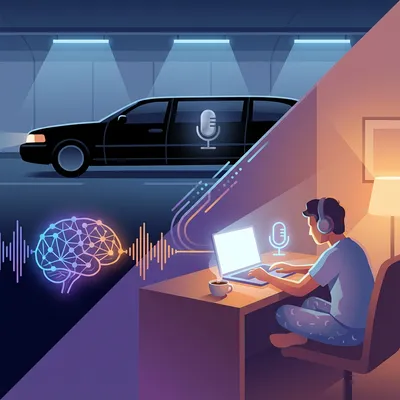
If you want more of this, try episode fifty-seven, From Lawyers in Limousines to Developers in Their PJs; episode ten, How ASR Went From Frustration To ... Whisper Magic; and episode seven, Building Custom ASR Tools. This has been My Weird Prompts.
Send us your own prompt on Telegram at t dot me slash MWP listener bot. We'll be back soon.