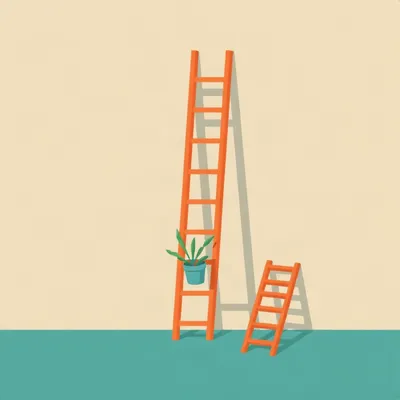
Coworking memberships grew twelve percent globally this year, but daily utilization — people actually showing up — dropped eight percent. More people are paying for the key than ever. Fewer are walking through the door.

That's from the NomadApp two thousand twenty-six coworking report, and it's one of those statistics that just sits wrong the longer you look at it. The infrastructure for human connection is expanding. The behavior is contracting. It's like we're building more gyms while the population gets less fit — the supply and demand curves are moving in opposite directions, and that usually signals something broken in the incentive structure.
Which brings us to what Daniel sent. He's been thinking about a version of the freelance economy that doesn't get talked about enough — the skilled professional who's financially successful, running a viable business from anywhere, but operating in complete professional isolation. An economic island. Good money, good clients, zero serendipitous encounters with people who do what they do. His question is: what's the actual cost of that, and what do you do about it if you're living it?
The numbers back up that this isn't just a vibe. Robert Half's remote work data from this year shows seventy-four percent of companies are hybrid or fully remote. Remote work has won. But only thirty-one percent of remote workers say they feel strongly connected to a professional community outside their direct employer. We traded connection for flexibility, and the bill is coming due.
The paradox Daniel's pointing at is this: remote work is more viable than it's ever been, the tools are better, the acceptance is universal — and yet the people thriving in it are, in a very specific way, more alone. Not lonely in the emotional sense necessarily. Alone in the professional sense. No hallway conversations. No one to run an idea past who isn't a client.
That's the tension we want to trace through this whole thing. The infrastructure for connection exists — coworking spaces, online communities, conferences, Slack groups. The utilization data says we're not using it. The question is why, and what the long-term cost actually looks like.
Before we get into the cost, I want to sit with the "why" for a second, because I think there's something deeper than just bad habits.
When you work in an office, community is ambient. It's in the air. You don't have to choose it, schedule it, or pay for it separately. It's just there — the person at the next desk, the lunch crowd, the meeting you wander past and stick your head into. Remote work decoupled community from the work environment, and now you have to actively opt into every single interaction. That's a cognitive load people underestimate.
The office bundled work and community into a single package. You showed up to one place and got both. Remote work unbundled them, and now you have to purchase them separately — with time, with money, with intention. And intention is a finite resource. By the time you've managed your clients, your projects, your invoices, your software stack, your retirement planning — the idea of also intentionally managing your professional social life feels like a second job.
Which is why the coworking membership ends up in the drawer. Buying it was the intention. Using it requires a second intention, every single day. And intention fatigue is real.
What does an economic island actually look like day to day? Picture someone — let's call her Maya. She's a UX researcher, six years of experience, fully booked. She works from her apartment, communicates with clients through email and the occasional Zoom. Her income is solid. Her network, though, consists entirely of people who pay her. She hasn't had an unplanned conversation with another UX researcher in fourteen months.
Nothing in her setup is broken. That's the unsettling part. The clients are happy, the invoices go out, the portfolio grows. She could do this for another decade and never once hear someone in her field say, "oh, we tried that — here's what actually happened.
Let me give you a concrete example of what that costs. I know a freelance data analyst — been at it seven years, great clients, steady work. Last year he quoted a project at what he thought was a premium rate. The client accepted immediately. He felt great about it for about three days, until he happened to be on a Zoom call with two other analysts he'd gone to college with. Someone mentioned their rate, and it was forty percent higher than his. He'd been underpricing for years and had no idea, because his only pricing signal was whether clients said yes.
Clients will almost never tell you you're too cheap. They'll just happily pay the below-market rate and hope you never figure it out.
That's the blind spot problem. But it goes deeper than pricing. The same analyst had been using a data visualization workflow that was three years out of date. Not because he was lazy — because he'd optimized his process and it worked fine. He just never saw that the rest of the field had moved on to a completely different toolchain that was faster and produced better outputs. He was efficient in a dead-end workflow.
That's the thing about professional monoculture. Your clients aren't going to tell you your tools are outdated. They hired you because you're the expert. If you tell them you're using Tool X, they assume Tool X is state of the art. There's no feedback loop.
That's the structural gap Robert Half's data is pointing at. The thirty-one percent who feel connected to a professional community — those are the people with access to what I'd call idea friction. The unplanned collisions. The "hey, can I run something by you" that happens in a hallway, not in a scheduled thirty-minute block with an agenda.
I like that. It's the opposite of what every productivity system optimizes for.
And that's the core problem. The economic island model is hyper-efficient at converting hours into billable work. But the breakthroughs in most careers don't come from billable hours. They come from the senior engineer who pulls you aside and says "here's how this actually works," from overhearing someone in a different industry describe a problem that maps perfectly onto yours, from the cross-pollination that happens when fields collide by accident.
There's a great example of this from the history of science that I think about a lot. The polymerase chain reaction — PCR, the technique that revolutionized molecular biology and made COVID testing possible — Kary Mullis came up with the idea while driving to his cabin on a Friday night. But the key insight that made it workable came from a conversation he had with a colleague in a completely different field, someone who worked on DNA synthesis. They were just talking. No agenda, no scheduled meeting. That conversation would never happen in the economic island model.
That's a perfect example. And Mullis wasn't looking for a breakthrough. He was just in an environment where ideas could collide. The economic island eliminates those collisions by design.
The cost isn't that Maya feels lonely. She might be perfectly happy. The cost is that she's starving her own innovation pipeline and won't notice for years.
And the gig economy's structure makes this worse, not better, because every hour she spends at a meetup or a conference is an hour she's not invoicing. The math punishes the very thing that would keep her sharp.
Which is where we have to look at the incentives next. Because if the rational economic choice is to stay isolated, this isn't a personal failing. It's a design flaw.
Let's look at the incentives directly. Freelancers live and die by billable hours. Every hour spent at a meetup, on a coffee chat, at a coworking space — that's an hour with no line item on an invoice. The math is brutally simple: networking is unbillable.
It's not just that it's unbillable. It's that the payoff is invisible. You go to a conference, you have twelve conversations, and then... No new client. No immediate revenue. Three months later, one of those conversations leads to a project, but by then you've forgotten the connection even existed.
That's the deferred ROI problem. And it's why the NomadApp data is so revealing. Global coworking memberships grew twelve percent year-over-year — people recognize they need something. But daily utilization dropped eight percent. They're paying for the key and leaving it in the drawer.
Which kills the "build it and they will come" theory of community. The infrastructure is there. The behavior isn't following.
space trend report for this year confirms why. The fastest-growing segment of flexible workspace isn't individual memberships — it's enterprise hybrid solutions. Companies renting blocks of desks for their distributed teams. Coworking has become a corporate real estate play.
The solo freelancer walks into a space that was pitched as community, and finds it's actually a satellite office for three different startups. Everyone's on headphones. Nobody's looking for serendipity.
Which is a complete inversion of the WeWork narrative from twenty-fifteen through twenty-nineteen. Back then, coworking was sold as a lifestyle — community managers, happy hours, the promise that you'd find your next collaborator at the kombucha tap. The WIS report on office vacancies tells the real story: coworking is driving the first vacancy decline in years, but it's enterprises absorbing that space for hybrid teams, not solopreneurs seeking connection.
The freelancer who joins a coworking space to fix isolation walks into an environment that wasn't designed for them anymore. The economic incentives of the space itself have shifted toward bigger tenants.
That brings us to what I think is the central mechanism here — the collaboration tax. Every hour spent on non-billable community-building is an hour not earning. If you bill a hundred and fifty dollars an hour, a two-hour meetup costs you three hundred dollars in opportunity cost. Most freelancers can't justify that when rent is due.
Here's where it gets interesting. Granovetter's weak ties theory — nineteen seventy-three, still the foundational paper on how opportunity actually moves through networks — shows that the best opportunities come from acquaintances, not close friends. Your close friends know the same people you know. Your weak ties open doors to entirely different networks.
Here's the part most people miss. Granovetter's insight wasn't that collecting weak ties is valuable. It's that weak ties must be activated. The handshake at the conference does nothing. The follow-up email three days later, the coffee six weeks later, the collaboration two years later — that's where the value lives.
The freelancer who goes to one conference, collects forty LinkedIn connections, and never follows up has done the equivalent of buying a gym membership and never going. Which, fittingly, is exactly what the coworking utilization data shows.
The activation step is where the collaboration tax really bites. Following up takes time. It's not billable. The payoff might arrive in eighteen months. The freelance brain — optimized for this week's invoices — treats that as a luxury.
Can I push on the activation piece for a second? Because I think there's a skill gap here too, not just a time problem.
Most freelancers were never trained in network maintenance. If you came up through traditional employment, your network was partially managed for you — colleagues, managers, clients, vendors, they all just showed up in your work life. You didn't have to learn how to cultivate weak ties because the weak ties were ambient. Now we've thrown people into a world where network cultivation is a core professional skill, and nobody taught them how to do it.
The follow-up email after a conference — what do you even say? "Nice meeting you, let's keep in touch" is functionally useless. It's the professional equivalent of "how's the weather." Most people don't know how to activate a weak tie because they've never had to.
The skill is: identify something specific from the conversation, offer something of value — an article, a tool, a connection to someone else — and propose a concrete next step. "You mentioned you're wrestling with client scoping. I just read a piece on statement-of-work templates that might help. Want me to send it over, and we can hop on a fifteen-minute call next week if it's useful?
That's a protocol, not a personality trait. And that's exactly the kind of thing that nobody teaches freelancers. The economic island doesn't just isolate you — it prevents you from developing the skills that would end the isolation.
Which loops back to idea friction. The hallway conversation you didn't have, the "oh, we solved that last year" you never heard, the cross-industry insight that never collided with your problem — those are the invisible costs. They don't show up on a balance sheet because they're absences, not expenses.
The longer you operate in that bubble, the harder it is to even know what you're missing. You don't know that your rate is twenty percent below market because you never talk to peers. You don't know that your workflow is outdated because you never see how anyone else works. The isolation doesn't just starve innovation — it creates blind spots in your own business.
The rational short-term choice — maximize billable hours, skip the meetup, stay heads-down — produces a long-term deficit that's nearly impossible to measure until it's too late. The ROI of weak ties is real, it's documented, and it's completely invisible in the month-to-month freelance P-and-L.
We understand the mechanism. But what happens when you live in that bubble for years? The knock-on effect get uglier. I think of it as professional monoculture.
Meaning what — you're only talking to clients, never to peers?
Your clients are in different industries, different roles. They don't know what a fair rate is for what you do. They can't tell you that your workflow is three years out of date. And they have no incentive to give you honest feedback — you're the expert they hired. So you develop pricing blind spots, skill stagnation, and this creeping sense that you're fine, everything's fine, while the field quietly moves on without you.
You don't know what you don't know. And the structure of the work ensures you never find out.
The digital nomad hubs were supposed to solve this. Lisbon, Bali, Medellín — all those places where freelancers cluster. And they do create weak ties. You meet people constantly. But here's the catch: the "tourist freelancer" dynamic means you network with everyone except relevant peers in your own field. You're a UX researcher, you meet a crypto founder, a yoga instructor who does copywriting on the side, a dropshipper. Interesting conversations, zero professional cross-pollination.
Because the common ground is geography and lifestyle, not craft.
The weak ties are there, but they're not activated toward professional growth. You're collecting contacts, not building a peer network.
There's an irony here that's worth naming. The nomad hubs promise serendipity — the chance encounter that changes everything. But serendipity requires some shared context. Two UX researchers bumping into each other at a Chiang Mai coworking space — that's serendipity, because they have a craft to collide around. A UX researcher and a dropshipper? That's just two people in the same time zone.
The hubs don't filter for craft. They filter for lifestyle. So you get maximum diversity of profession and minimum depth of professional connection. It's the opposite of what a conference does, where everyone shares a domain but comes from different geographies and contexts.
What actually works? Daniel mentioned conferences as a possible answer.
Conferences can work, but only if you treat them as infrastructure, not events. Most freelancers treat conferences as lead-generation — scan the room for prospects, collect business cards, leave. That's a waste of the conference fee. The better protocol: choose conferences where at least thirty percent of attendees do work similar to yours. Set an extraction goal before you arrive — three follow-up calls scheduled before you leave the venue. Treat the conference fee as a capital investment with a specific return target, not a discretionary expense.
You're not there to find clients. You're there to find the three people who'll tell you what you're doing wrong.
That's the framing. And it flips the entire economics. A two-thousand-dollar conference fee plus travel looks insane if it's a networking expense. If it's professional development infrastructure — the equivalent of what a company would spend keeping an employee current — it starts looking reasonable.
Conferences are expensive and infrequent. What about something more sustained?
The micro-community model is the highest-ROI option I've seen. Six to twelve people in the same field, meeting weekly or monthly, structured agenda. Fifteen minutes of personal check-in, thirty minutes of real problem-solving. Someone brings a client situation they're stuck on, someone else shares a pricing framework they're testing, someone demonstrates a workflow improvement. It's modeled on mastermind groups and the "pod" structure that's become standard in creative industries.
It replaces the serendipity you lost. The hallway conversation becomes a scheduled forty-five minutes, which isn't as romantic, but it's more reliable.
The Indie Hackers community and MicroConf have been doing versions of this for solo founders for years. Those are the closest existing models at scale. Small, intentional peer groups that explicitly address isolation. The people in those groups report better pricing decisions, faster skill development, and — this is the part that gets overlooked — earlier warning on industry shifts.
Because when you're alone, you notice a trend six months late. When you're in a group, someone else spots it in week two and brings it to the meeting.
That's where the comparison to traditional professions gets uncomfortable. Law and medicine mandate continuing education and peer consultation. You can't practice medicine in isolation — there are formal requirements for staying current, for peer review, for consultation on complex cases. Freelancing has none of that. The market doesn't reward it in the short term, so the market doesn't produce it.
Which means the freelancer has to build their own professional development infrastructure from scratch, on their own dime, with no external requirement forcing them to do it. And the collaboration tax is sitting there the whole time, whispering that this hour could be billable.
None of what we're describing solves the collaboration tax. The ROI of community-building is real, it's documented in Granovetter's work and decades of follow-up research, but it's deferred. You invest now, you benefit in eighteen months. How do you justify that when rent is due next week?
I think the only honest answer is: you treat it like any other non-negotiable business expense. Software subscriptions, insurance, accounting — those don't generate revenue this week either, but you'd never cancel them. Professional community has to sit in that same category. It's infrastructure, not a luxury.
That reframe is the hardest part. Because software subscriptions show up as a line item. Professional isolation doesn't show up anywhere — until your rates are stale, your skills are dated, and you've missed the shift that everyone else saw coming.
There's a psychological dimension here too. When you cancel a software subscription, you feel it immediately — the tool stops working. When you skip professional community for six months, nothing breaks. The cost is silent and cumulative. Our brains are terrible at responding to silent, cumulative costs.
That's exactly the problem. The feedback loop is too long. By the time you feel the pain of isolation, you've already been isolated for years. It's like high blood pressure — you don't notice until the damage is done.
How do you shorten the feedback loop? How do you make the cost visible before it's catastrophic?
I think the peer group model does that naturally. When you meet with six other freelancers every week, you get a constant stream of small data points — someone's rate went up, someone's trying a new tool, someone just lost a client to an industry shift you hadn't heard about. The feedback arrives in weeks, not years.
It's an early warning system disguised as a social hour.
And that's the reframe that makes the collaboration tax bearable. You're not paying three hundred dollars in opportunity cost for a coffee chat. You're paying an insurance premium against professional obsolescence.
Let's get concrete. Four things you can do starting tomorrow. First: schedule professional development time as a non-negotiable line item. Block two hours every Friday. Bill it to yourself at your own rate, and protect it like a client meeting.
Making the collaboration tax visible and budgeted, instead of this vague guilt you carry around.
Second: join or form a peer accountability group. Four to eight freelancers in your field. Meet weekly for forty-five minutes — fifteen of check-in, thirty of structured problem-solving. Someone brings a pricing question, someone demos a workflow, someone's stuck on a client situation and needs fresh eyes.
That's the highest-ROI investment because it converts weak ties into regular productive contact. Instead of hoping for serendipity, you're manufacturing it on a schedule.
Third: when you attend a conference, set an extraction goal. " Find three people doing similar work and schedule follow-up calls within forty-eight hours. Granovetter's insight was that weak ties only work if activated. The handshake is step zero, not step one.
Fourth: use coworking spaces strategically, not habitually. Go the same day every week, sit in the same area, introduce yourself to the regulars. Consistency beats intensity. The utilization data shows sporadic attendance never converts into connection — you have to be predictable enough that people recognize your face.
None of these require a personality transplant. They're protocols. Time-boxed, specific, and the expected ROI is measurable — better pricing information, earlier trend detection, faster problem-solving. The cost is a few hours a week and the discipline to treat community as infrastructure.
These tactics work at the individual level. But I want to leave you with a bigger question. Is the economic island model actually sustainable at scale, or are we building systemic fragility into the whole thing?
That's the question that keeps me up. If everyone is an island, who trains the next generation? The gig economy has no equivalent of the senior engineer who pulls you aside and says "here's how this actually works." There's no informal mentorship layer at all.
Because mentorship is unbillable. It's the ultimate collaboration tax — you're giving away expertise to someone who isn't paying you, and the payoff to your own career is years away, if it ever arrives.
I worry this creates a compounding problem. The current generation of senior freelancers learned their craft in offices, surrounded by mentors they didn't have to schedule. When they retire, the knowledge they carry doesn't transfer. The next generation — the one that's been fully remote from day one — never absorbed it in the first place. We're looking at a potential knowledge cliff.
That's the systemic fragility. Each individual freelancer is making a rational choice to optimize for billable hours. But the aggregate effect is that the informal knowledge transfer mechanisms that kept entire professions healthy are quietly dissolving.
The AI piece makes this more urgent, not less. One person plus AI agents already functions like a small team. As those tools improve, solo freelancing becomes even more viable — which means the isolation problem intensifies. space report confirms this trend is accelerating. The solutions we build now — peer groups, intentional networking, community infrastructure — those aren't optional add-ons. They're going to be critical infrastructure for the future of work.
The question Daniel's really asking isn't "should I network more." It's "what infrastructure am I building to ensure I'm not an island five years from now.
The goal isn't to rebuild the office. Nobody wants to go back to the cube farm. It's to build the connective tissue that remote work stripped away, without rebuilding the cage.
The coworking utilization stat we opened with tells the whole story. The doors are unlocked. The space is there. The question is whether we walk through them, and what we do once we're inside.
Now: Hilbert's daily fun fact.
Hilbert: In the nineteen twenties, marine biologists working off the coast of Honduras attributed a complex series of whale vocalizations to a previously unknown species of baleen whale. Fifty years later, the recordings were reanalyzed and found to be a blue whale population with a regional song dialect — the first evidence that whale songs vary by geography, not just species.
The whales had accents.
I respect that.
This has been My Weird Prompts. Thanks to our producer Hilbert Flumingtop for the fact-checking and the cetacean linguistics. If you enjoyed this, leave us a review wherever you listen — it genuinely helps. Send your own weird prompts to show at my weird prompts dot com.
I'm Herman Poppleberry.
I'm Corn. Go build your infrastructure.