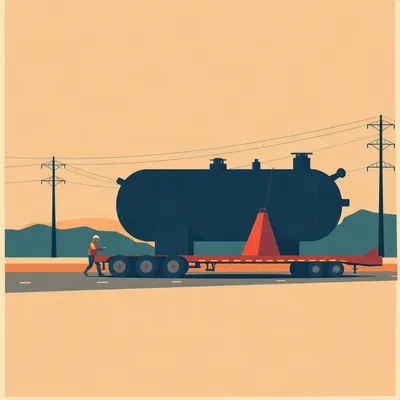
Daniel's friend asked him why not every airport can do transatlantic, and Daniel took a swing at it — runway length, widebody clearance on taxiways and ramps — then he stopped and said, there's got to be more. He's right. The stuff you can't see from the terminal is where this actually gets decided.

And transatlantic is the hardest case. Seven-plus hours, heavy fuel loads, overwater regulations, international border crossings — it's the full stress test. If an airport can't do transatlantic, calling it international is mostly a paperwork designation.
So today we're building the full picture. What it actually takes for an airport to go from domestic to intercontinental. We'll start with what Daniel already guessed — runway length — and then go way beyond it.
The way I think about this is three layers. Physical infrastructure — runways, taxiways, gates. Regulatory infrastructure — ETOPS, customs, security. And operational infrastructure — fuel, crew, maintenance, ground handling. Any one of these can kill a route, and they all have to work together.
Let's start with the layer everyone sees. Runway length is the first gate, and the numbers are bigger than most people realize. A Boeing 787-9 at maximum takeoff weight — about two hundred fifty-four thousand kilograms — needs roughly three thousand meters, call it ten thousand feet, for takeoff at sea level on a standard day.
And that's under ideal conditions. Take that same 787 to Denver on a hot summer day — hot and high, thinner air, less lift — and the takeoff distance jumps thirty to fifty percent. Suddenly you need twelve, thirteen thousand feet. Most regional airports in the U.S. top out at six to eight thousand feet. They're not even in the conversation.
So runway length alone eliminates a huge number of airports right out of the gate.
But here's where it gets interesting — even if you've got the length, you might not have the strength. Every runway has a pavement classification number, a PCN rating. It tells you how much weight the pavement can handle, and it's not just about total weight — it's about how that weight is distributed through the landing gear.
A 737 sits on a single-bogie gear — two wheels per strut. A 787 has twin-bogie gear — four wheels per strut, but the weight concentration is different. The pavement has to handle that specific loading pattern.
Right. You can have a ten-thousand-foot runway that's rated for a 737's gear configuration but would crack under repeated 787 landings. The asphalt just isn't thick enough, the sub-base wasn't engineered for it. And fixing that means rebuilding the runway — not resurfacing, rebuilding. Hundreds of millions of dollars.
So you clear runway length and pavement strength. Now you've got to get the airplane from the runway to the gate.
This is where the FAA's aircraft group classifications come in. They run from Group One through Group Six, based on wingspan and tail height. A 737 is Group Three — wingspan under thirty-six meters. A 787 is Group Five — wingspan around sixty meters. The design standards for each group are completely different.
How different?
Group Five requires taxiways at least seventy-five feet wide. Group Three only needs fifty feet. The separation between the runway centerline and the parallel taxiway — for Group Five, that's four hundred feet. For Group Three, it's three hundred. And the ramp clearances — the space between parked aircraft and any obstacle — those jump dramatically.
So an airport built for 737s and regional jets has taxiways that are too narrow, too close to the runway, and ramp areas where a 787's wingtip would clip the fuel truck.
And retrofitting this is brutal. Widening a taxiway means moving runway and taxiway lighting, possibly relocating signage, sometimes re-grading the safety areas. It's tens of millions per taxiway. And you might need to do several.
Then there's the gate itself. The jet bridge on a 787 connects to a door sill about sixteen feet off the ground. A 737's door sill is closer to ten feet. Many regional jet bridges can't reach that high, and even if they can, the bridge might not articulate properly around the wider fuselage.
Ground power is another one. Widebodies need different voltage and way more cooling capacity for the air conditioning. A 737 ground power unit isn't going to cut it. The airport has to invest in compatible equipment, and that equipment has to be maintained and available — you can't just borrow one from the next gate over if it breaks.
And this brings us to a case study that ties a lot of this together. Manchester-Boston Regional Airport in New Hampshire — runway nine thousand four hundred feet, could physically handle a 767, but it has no customs facility, limited fuel truck capacity, and the gates aren't configured for widebodies. The tarmac is only part of the story.
Manchester's a perfect example of the gap between what's physically possible and what's operationally real. You could land a 767 there in an emergency. You couldn't run a scheduled transatlantic service.
So runway length is the first gate — but even if you clear that, you've got a whole maze of physical infrastructure waiting.
And physical infrastructure is only half the story. The other half is written in regulations and spreadsheets.
Let's talk about ETOPS. I know it stands for Extended-range Twin-engine Operations, and I know it's about how far a twin-engine plane can fly from a diversion airport. But how does that constrain the airport itself?
This is the part most people miss. ETOPS isn't just about the airplane — it's about the entire route network. For transatlantic, the aircraft has to stay within a hundred and eighty minutes of a suitable diversion airport at single-engine cruise speed. That means every airport along the route corridor has to be ETOPS-certified as a diversion field — including the origin airport.
So even if you're not planning to divert, your departure airport has to meet diversion standards?
In many cases, yes — because the ETOPS segment starts the moment you're beyond gliding distance from the departure airport. And a diversion airport needs specific things. Category C or D firefighting capability — that means a certain foam capacity, a certain number of vehicles, a certain response time. It needs an instrument landing system — ILS Category One or better. It needs runway lighting for low-visibility operations. And it needs to be able to handle the aircraft weight, which circles right back to the pavement classification.
How many domestic airports have Category C firefighting?
Most regional airports are Category A or B — designed for aircraft under ninety feet long. A 787 is over two hundred feet long. The foam requirements and vehicle count jump substantially. And you can't just buy a bigger fire truck and call it done — the airport's operating certificate has to be amended, the firefighting index recalculated, the training program updated. It's a regulatory process, not a shopping trip.
Then there's customs. Any airport receiving international flights needs a Federal Inspection Station — a CBP facility with officers, agricultural inspection, and sterile corridors that separate arriving international passengers from domestic passengers.
Building an FIS costs five to twenty million dollars. And that's just construction. Then you need CBP officers staffed during your operating hours — and CBP doesn't just send officers wherever an airport wants them. They have to approve the facility, certify the security layout, and commit to staffing. If your airport wants to run one transatlantic flight a day arriving at two in the afternoon, CBP has to agree to keep officers there for that window.
And if the flight is delayed?
That's where it gets ugly. If the customs facility is only open four hours a day and your flight arrives late, the passengers sit on the plane until CBP can process them — or the flight diverts to an airport with a full-time FIS. This has actually happened at smaller airports that tried to launch international service.
So you've got firefighting requirements, customs requirements, security requirements — all of which require ongoing staffing, not just one-time construction.
And none of it is free. The airport has to recover these costs somehow — usually through landing fees and passenger facility charges. But if you're only running a few flights a week, the per-passenger cost becomes astronomical. That's the chicken-and-egg problem.
Let's get to fuel, because this is the one that surprised me when I started reading about it.
It's the killer nobody sees. A 737 on a domestic hop takes on maybe fifteen to twenty thousand pounds of fuel. A 787 on a transatlantic run needs sixty to eighty thousand kilograms — that's somewhere around a hundred thirty to a hundred seventy-five thousand pounds. It's not just more fuel — it's a different order of magnitude.
And the airport's fuel farm was built for the smaller number.
Right. Regional airports size their fuel storage based on their typical traffic — a fleet of 737s and regional jets. A single widebody refueling can drain their entire Jet A supply. And it's not just Jet A — transatlantic flights typically use Jet A-1, which has a lower freezing point for the cold temperatures at altitude. The fuel farm needs separate storage, separate filtration, separate delivery systems.
How does the fuel actually get to the aircraft?
Two ways. Fuel trucks — big tanker trucks that drive up to the wing — or a hydrant system, where fuel is pumped through underground pipes to a pit in the ramp, and a smaller cart connects the pit to the aircraft. Hydrant systems are faster and can deliver higher flow rates, but they're enormously expensive to install — you're trenching the entire ramp area.
And most regional airports use trucks.
Most regional airports use trucks sized for 737s. A widebody fuel truck is a different vehicle entirely — higher capacity, higher pumping rate, different filtration. And you probably need two or three of them, because one truck can't carry enough for a full transatlantic load, and you need redundancy in case one breaks down.
So the airport buys new fuel trucks, expands the fuel farm, adds Jet A-1 storage and filtration — what's the price tag on all that?
Easily several million dollars before you've pumped a single gallon. And then there's the fire suppression system around the fuel farm. Insurance underwriters have their own airport classification system — if your fuel farm isn't rated for widebody fueling operations, the airline can't get hull coverage for a diversion there.
Wait — the insurance company?
Oh yeah. Insurance underwriters maintain their own airport classification system, completely separate from the FAA's. They rate airports based on firefighting capability, fuel storage safety, runway condition, approach aids — and if your airport doesn't meet their standard for widebody operations, the airline's hull insurance won't cover an incident there. No insurance, no scheduled service — the airline's risk management team won't sign off.
That's a whole other layer of constraints we haven't even mentioned. It's not just the regulator — it's the insurance market acting as a de facto regulator.
And it's completely invisible to passengers. You never see the insurance underwriter's checklist. But it's as real as the runway length.
Let's talk about crew and maintenance. A transatlantic flight needs augmented crew — three or four pilots for the long duty day. What does the airport need to support that?
Crew rest facilities, for one. If a crew times out — reaches their legal duty limit — they need a place to rest before they can fly again. That means the airport needs hotel availability nearby, transportation, and ideally some kind of crew lounge at the airport itself. If there's no suitable hotel within a reasonable distance, the airline has to factor that into their scheduling.
And maintenance?
This is a big one. If a 787 has a mechanical issue at a small airport, the parts probably aren't there. The airport's maintenance provider is set up for 737s and regional jets — they don't have Trent 1000 engine line maintenance capability, they don't have the specialized tooling, they don't have the trained technicians. Parts have to be flown in — which adds days of delay.
And every day the airplane is sitting on the ground, it's not making money.
Airlines plan their maintenance carefully. Widebody aircraft cycle through major hubs where the maintenance infrastructure exists. If you're operating a 787 into a secondary airport, you either need to preposition parts and personnel — expensive — or accept the risk of extended downtime if something breaks. Most airlines won't accept that risk for a thin route.
So we've got physical infrastructure, regulatory requirements, fuel logistics, crew support, maintenance capability — and all of this has to exist before the first flight ever boards. How does any airport break into this?
They usually don't — not without help. This is why transatlantic service concentrates at major hubs. The infrastructure is already there, the costs are amortized across hundreds of daily flights, and the regulatory approvals are long-established.
But there are exceptions. Shannon, Prestwick, some of the secondary European airports that Norwegian and other low-cost long-haul carriers experimented with.
Shannon is a special case — it has U.S. Customs and Border Protection preclearance, which means passengers clear U.S. immigration before they even board. That's a massive competitive advantage, and it exists because of decades of investment and a bilateral agreement between the U.S. and Irish governments. Most secondary airports can't replicate that.
Prestwick?
Prestwick survived for years on military charters and the occasional transatlantic diversion. It has a long runway — nearly ten thousand feet — and it's often clear when other Scottish airports are fogged in. But scheduled transatlantic service has come and gone. The infrastructure is there for diversions, but sustaining a scheduled route is a different equation.
The low-cost long-haul experiments — Norwegian, WOW Air, French Bee — they tried to make secondary airports work. What happened?
Mixed results. Norwegian flew 787s into airports like Providence and Hartford — airports that had the runway length but not much else. They invested in some infrastructure, negotiated customs staffing, made it work for a while. But when the economics tightened, those routes were the first to go. The cost of maintaining the infrastructure for a few weekly flights just didn't pencil out.
The airport is stuck. They can't justify the investment without guaranteed demand, and airlines can't commit to routes without the infrastructure.
That's the chicken-and-egg problem in a nutshell. And it's why most transatlantic growth happens at existing hubs — the infrastructure is already sunk cost. A new route at JFK or Heathrow doesn't require a new customs facility or a wider taxiway. It just needs a gate slot.
What about cargo? Does that change the equation?
Cargo is different — no customs hall for passengers, no jet bridges, no crew hotels. But you still need the runway length, the pavement strength, the fuel infrastructure, and the firefighting category. And cargo operators are even more sensitive to costs than passenger airlines. If the landing fees don't work, they'll go somewhere else.
Even cargo doesn't necessarily unlock the infrastructure for passenger service.
It can help — a cargo operation might justify upgrading the fuel farm or the firefighting category, and once that's done, passenger service becomes more feasible. But it's not automatic. The passenger-specific requirements — FIS, sterile corridors, gate compatibility — still have to be addressed separately.
Let's pull back for a second. If I'm an airport director at a regional airport with a nine-thousand-foot runway, and I want to attract transatlantic service, what's my first move?
Honestly? You probably don't. You look at the business case and realize the numbers don't work. But if you're determined, you start with a feasibility study — what's the actual demand in your catchment area? Are passengers already driving to a hub two hours away? Then you talk to CBP about what it would take to staff an FIS, you talk to the fire department about upgrading to Category C or D, you assess your fuel farm capacity, and you start costing out taxiway widenings.
Then you present that number to the airline.
The airline says, what's my guarantee? If we launch this route and it doesn't perform, we're pulling out in six months — and you're left holding the bag on all that infrastructure investment. Most airports can't take that risk.
The airports that do make it work — what's their secret?
Usually a combination of geography, subsidy, and niche demand. Shannon has preclearance and a strong Irish-American tourism market. Keflavik in Iceland works because it's perfectly positioned as a connecting hub between North America and Europe, and Icelandair has built their entire business model around it. Some airports get state or regional subsidies to underwrite the infrastructure — essentially, the government bets that the economic development impact will outweigh the cost.
That bet doesn't always pay off.
It often doesn't. There's a graveyard of secondary airports that spent millions on international facilities and never got the flights they were promised.
Hilbert.

I spent six months in two thousand three as a logistics coordinator for a fuel farm expansion at a regional airport in upstate New York. We were trying to attract a seasonal 767 charter to Ireland. The fuel farm was built for 737s — we had to add two thirty-thousand-gallon tanks, new filtration for Jet A-1, and a hydrant cart that cost more than my house.
How much was the hydrant cart?
Two hundred forty thousand. In two thousand three dollars.
That's a specialized piece of equipment. High flow rate, filtration built in, explosion-proof everything.
The charter ran for two summers and then pulled out. The customs facility was only open four hours a day and passengers were missing connections in Dublin. CBP wouldn't extend the hours without a guaranteed flight schedule, and the airline wouldn't guarantee the schedule without extended hours. Stared at each other for six months and then the airline walked.
The airport was left with a fuel farm sized for an operation that no longer existed.
Still there. The tanks are empty but they never removed them. The hydrant cart got sold to an FBO in Texas for forty thousand dollars. I know because I signed the bill of lading.
This is what I mean about the hidden layers. Everyone talks about runway length, but the fuel thing is the killer. A 737 takes on maybe fifteen thousand pounds of fuel. A 767 takes on eighty thousand. That's not just more fuel — it's a different fuel delivery system, different storage, different safety zones.
We had to redo the entire fire suppression system around the fuel farm because the insurance company wouldn't cover a widebody fueling operation with the old setup. New foam system, new containment berms, new emergency shutoff valves. The insurance underwriter sent an inspector who spent three days on site. He found a crack in the containment berm from nineteen eighty-seven and made us replace the whole section.
The insurance angle is something we touched on — but hearing it from the ground level, it's not just a checkbox. It's an inspector walking the site, finding a crack in a berm, and holding up the entire project.
That inspector was named Kowalski. I still remember his face. He had a clipboard and zero sense of humor. But he was right — if that berm had failed during a fuel spill, the environmental cleanup would have bankrupted the airport authority.
This is the thing — every one of these constraints exists for a reason. The firefighting category exists because widebody accidents are bigger accidents. The customs sterile corridor exists because a passenger can't just wander from an international arrival into the domestic baggage claim. The fuel farm safety zones exist because eighty thousand pounds of Jet A-1 is a bomb if something goes wrong.
None of it is arbitrary.
None of it is arbitrary. But the cumulative effect is a barrier to entry that's almost impossible for smaller airports to overcome without outside help.
Where does that leave us? A bunch of interlocking constraints that make transatlantic service a high-stakes gamble for any airport that isn't already a hub.
The landscape is shifting. You've got long-haul low-cost carriers like Norse Atlantic and French Bee experimenting with secondary airports — but they're being very selective. They're not going to airports that need everything built from scratch. They're going to airports that already have most of the infrastructure and just need a few upgrades.
The next frontier might not be runway length at all. It could be sustainable aviation fuel infrastructure — SAF requires entirely new storage and blending facilities. Airports that can't handle SAF may find themselves locked out of future long-haul routes, because airlines are under increasing pressure to reduce their carbon footprint, and SAF is the main lever they have for long-haul.
SAF is a whole separate challenge. It's chemically similar to Jet A-1 but it's produced from different feedstocks, it has different storage requirements, and it typically needs to be blended with conventional fuel. The blending infrastructure doesn't exist at most regional airports, and building it is another multi-million-dollar project.
The infrastructure gap might actually be widening, not closing.
That's the direction it's heading. The airports that can afford to keep upgrading will pull further ahead, and the ones that can't will fall further behind. It's not a story of convergence — it's a story of divergence.
Next time someone asks why their local airport can't fly to London, you can tell them it's not just the runway. It's the fuel farm, the customs hall, the fire truck, the insurance policy, and about a dozen other things you never see.
If you really want to ruin a dinner party, start explaining ETOPS diversion requirements.
I think the dinner party was already ruined when you brought up pavement classification numbers.
Fair point.
One thing from the research that didn't quite fit anywhere else — there's a specific requirement for the runway-to-taxiway separation distance that changes based on the aircraft group. For Group Five, it's four hundred feet from the runway centerline to the parallel taxiway centerline. For Group Three, it's three hundred. That hundred-foot difference means the entire airfield geometry has to be rethought — you can't just widen the taxiway, you might have to move it.
Moving a taxiway means re-grading the safety area, relocating all the lighting and signage, possibly adjusting the instrument landing system critical area — it cascades.
Everything in this topic cascades.
That's really the thesis of the whole episode, isn't it? You pull one thread and the whole sweater comes apart.
We've been talking about the constraints that keep domestic airports from going transatlantic. The open question I'm left with is whether the long-haul low-cost model can actually break this pattern — or whether the infrastructure barriers are simply too high for anyone who isn't already inside the fortress.
I think we'll see a few more experiments — airports that are close to the edge, that need one more upgrade and a customs staffing commitment to make it work. But a wave of new transatlantic airports? I don't see it. The costs are too high, the risk is too concentrated, and the airlines have too many other options.
Thanks to Hilbert Flumingtop for producing — and for the story about the hydrant cart that cost more than his house.
This has been My Weird Prompts. If you enjoyed this, leave us a review wherever you listen — it helps other people find the show.
We'll be back soon.