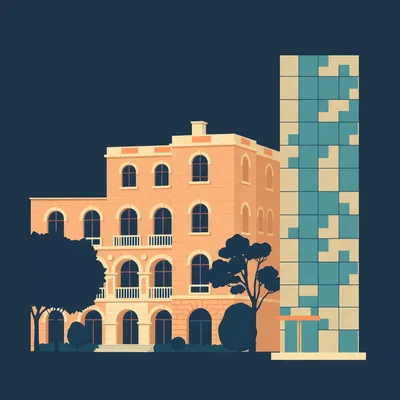
Daniel sent us this one — he wants us to talk about the J Tower on Jaffa Street. One of the first high-rise developments in Jerusalem's city center, broke ground on the vertical building spree that's now reshaping the whole entrance to the city. And he's asking us to dig into the actual development history, what this building means, what it represents. There's something almost totemic about a single tower that kicks off a transformation, and I think that's what we're meant to wrestle with here. So where do we start?

I want to start with what it actually is, because I walked past this thing for years and never really looked at it. J Tower, sometimes called J Tower Jerusalem, sits at the corner of Jaffa Street and Nordau Street, right near the Mahane Yehuda market. It's twenty-three stories, residential, completed around two thousand seventeen, developed by a company called J Tower Limited. But here's what grabbed me when I started digging — the architect was Yigal Levi, and the building was designed to echo the stepped profile of Jerusalem stone terraces, but in a modern glass-and-steel vocabulary. That tension between ancient and contemporary is baked into the facade.
It's not just a glass box. It's trying to gesture at something.
It's trying. Whether it succeeds is a separate question, but the intent is there. The building uses Jerusalem stone cladding on the lower levels and transitions to glass and aluminum as it rises. The idea was to ground it in the local vernacular at street level and then let it become more contemporary as it reaches upward. It's a layering strategy.
Which is a very Jerusalem compromise. You can't just plunk down a Dubai-style tower in a city with three thousand years of stone architecture and expect nobody to notice. So you do the architectural equivalent of wearing a kippah to your secular cousin's wedding — you nod to tradition at the entrance, then do whatever you want higher up where fewer people are squinting.
That's exactly the tension. And it matters because J Tower was one of the first to attempt this hybrid language at real scale. Before it, Jerusalem's high-rises were mostly hotels or institutional buildings — the Crowne Plaza, the Leonardo, the various government complexes. J Tower was among the first purely residential towers to push above twenty stories right in the city center corridor. It broke a psychological barrier.
What was the actual timeline? When did it break ground, when did it finish?
The planning approvals go back to around two thousand nine, two thousand ten. Construction started in earnest around two thousand thirteen, fourteen, and it was completed and occupied by two thousand seventeen. About four years of active construction, which for a Jerusalem project is practically lightning speed. You have to understand, this is a city where archaeological discoveries can halt a foundation dig for months. They found a Byzantine-era mosaic under a parking lot on Jaffa Street a few years ago. Every shovel of dirt is a potential museum exhibit.
The fact that it got built at all, on time, is itself notable. What's in the building now? I know there was a lot of talk about short-term rentals.
Yeah, this is where the story gets interesting. The building has about a hundred and forty residential units, and for a long time a significant portion — I've seen estimates around thirty to forty percent at the peak — were being used as Airbnb rentals. It became a symbol of the whole short-term rental boom in Jerusalem. But the numbers have been declining. The municipality cracked down on unlicensed short-term rentals, and the economics have shifted. There's less arbitrage available for hosts now.
Declining from what to what?
Hard to pin exact current numbers without access to the platform data, but the trajectory is clear — fewer active listings now than in twenty eighteen, nineteen, when it was at its peak. Some owners have shifted back to long-term rentals, some have sold. The building's rental profile is normalizing, for better or worse.
The commercial space? The ground floor?
This is the part that I find genuinely puzzling. The building was designed with commercial space on the lower levels — retail, office, the kind of mixed-use ground-floor activation that makes a street feel alive. But from what I understand, a lot of that commercial space has sat empty or been used for development advertising rather than actual businesses. You walk past and instead of a café or a shop, you see renderings of other projects, billboards for future towers. It's a building that sells other buildings.
That's a remarkable image. A tower whose ground floor exists to advertise more towers. It's not a building, it's a recruitment poster for a skyline that hasn't arrived yet.
That's the philosophical layer, right? J Tower is simultaneously a real building with real residents and a kind of speculative placeholder. It was built to prove that high-rise residential could work in this location, to establish a beachhead. The commercial space wasn't immediately viable because the critical mass of residents and foot traffic hadn't materialized yet — the building was, in a sense, too early. So the empty storefronts became ad space for the future that J Tower itself was supposed to usher in.
The building as its own lobby. It's waiting for the city to catch up to it.
Which is now happening. If you walk along Jaffa Street toward the western entrance to the city, the skyline is transforming. You've got the new business district around the Central Bus Station, the Gateway project with its multiple towers, the light rail running through the middle of all of it. J Tower was the scout. It arrived before the army.
Let's talk about the symbology for a second, because I think that's what the prompt is really driving at. A single high-rise on Jaffa Street — Jaffa Street, of all streets. This is the historic artery that runs from the Old City walls to the western hills. It's been the main commercial spine of Jerusalem for over a century. And the first major residential tower lands there, not in some suburban ring, but right on the historic main street. What does that say?
It says the city is renegotiating its relationship with verticality. For decades, Jerusalem had an unofficial height limit, driven partly by planning policy and partly by a cultural consensus that the city's skyline should be low, stone, and dominated by domes and bell towers rather than glass rectangles. The British Mandate actually codified this — they required Jerusalem stone cladding on all new buildings in nineteen eighteen, and there was a strong presumption against tall buildings that might compete with the sacred landmarks.
The skyline as a theological statement. You don't build higher than the churches and mosques and synagogues. The vertical dimension belongs to God.
And that held, more or less, for decades. Even when taller buildings started appearing — the Hilton, the various towers on King George — they were hotels, temporary residences, not permanent homes. J Tower was different. It said, people are going to live up there, permanently, in the sky, looking down on the city rather than up at it.
There's a power reversal in that. Historically, in Jerusalem, the high ground was holy ground. The Temple Mount, the Mount of Olives, the hills around the city — those were the elevated places, and they were either sacred or strategic. Living above the city was not a thing regular people did. J Tower inverts that. It puts the penthouse above the steeple.
It does it on Jaffa Street, which is named for the port city that connects Jerusalem to the outside world. Jaffa Street has always been the cosmopolitan corridor, the place where Jerusalem looks outward. The light rail runs down it now, but for centuries it was the route pilgrims took from the port to the holy sites. So placing the city's first major residential high-rise on Jaffa Street is symbolically loaded — it's the modern, global Jerusalem asserting itself on the same axis that once carried crusaders and merchants and immigrants.
The pilgrim road becomes the developer's corridor. Same path, different vertical ambition.
The units in J Tower weren't cheap. We're talking about luxury apartments, many of them purchased by investors rather than owner-occupiers — hence the Airbnb phenomenon. The building was marketed heavily to overseas buyers, diaspora Jews who wanted a pied-à-terre in Jerusalem, a foothold in the holy city that they could visit once or twice a year and rent out the rest of the time.
Which brings us to the ghost tower question. We've talked about this before in the context of Jerusalem's luxury high-rises — buildings that are full of apartments but empty of neighbors. Is J Tower a community or a collection of investment vehicles?
I think it's a bit of both, and the balance has shifted over time. When the short-term rental boom was at its peak, you'd have had a rotating cast of tourists cycling through, which is not the same thing as neighbors. But as the Airbnb numbers have declined and more units have converted to long-term rentals or owner occupancy, a more stable community has probably formed. I don't have census-level data on this, but anecdotally, buildings like this tend to follow that trajectory — speculative at first, then gradually settling into genuine residential life.
The building ages into being a real place. It earns its reality over time.
Which is a very Jerusalem story, actually. The city is full of layers that started as one thing and became another. The J Tower of two thousand twenty-six is not the J Tower of two thousand seventeen. It's accumulating history, accumulating residents who actually live there, accumulating the wear and tear that makes a building feel inhabited rather than staged.
Let's go back to the architecture for a minute. You mentioned Yigal Levi, the stepped profile, the Jerusalem stone at the base transitioning to glass above. Does it work? I mean, as a piece of design, not just as a compromise strategy.
I think it's a competent building. It's not going to win international design awards, but it's not offensive either. The massing is reasonably well-handled for a twenty-three-story tower on a relatively narrow site. The stone-to-glass transition is a bit literal — it's basically saying "here is where the Jerusalem part ends and the global part begins" — but literal isn't necessarily bad. It's legible. You understand what the architect was doing.
The musical equivalent of a key change that announces itself.
It's not subtle. But Jerusalem is not a subtle city. It's a city of bold gestures and stark contrasts. A building that wears its compromises on its facade might actually be more honest than one that tries to resolve everything into a seamless whole.
Like a person who tells you their contradictions upfront instead of pretending to be consistent. There's a kind of integrity in that.
The location is significant. It's a few minutes' walk from Mahane Yehuda, which is the beating heart of Jerusalem's food and nightlife scene. It's on the light rail line, so you can get to the Old City or to the Central Bus Station in minutes. It's at the threshold of the city center, right where Jaffa Street starts to widen into the entrance corridor. In urban planning terms, it's a gateway site.
It's not just any high-rise. It's the high-rise that you see as you enter the city from the west. It's the first thing that says, you're not in a village anymore, you're in a city that builds upward.
That's a contested message in Jerusalem. There are plenty of people who don't want that message. They want Jerusalem to remain low, stone, horizontal — a city that spreads across hills rather than puncturing the sky. The preservationist impulse is strong here, and for good reason. The city's visual character is unique and valuable.
The counterargument is that horizontal sprawl has its own costs. If you can't build up, you build out, and then you're eating into the green hills around the city, extending infrastructure, increasing car dependency. A dense corridor along the light rail line is arguably more sustainable than single-family homes spreading into the Judean hills.
That's the density argument, and it's a strong one. The light rail corridor from the Central Bus Station through the city center to the Old City is one of the most transit-rich strips in the country. Building residential density there makes planning sense. The question is whether luxury towers are the right form of density, or whether you need a mix of housing types at different price points.
J Tower is not affordable housing. Nobody was ever confused about that.
No, it was positioned as premium from day one. The marketing materials emphasized the views, the finishes, the proximity to the market and the cultural scene. It was selling a lifestyle — the urban Jerusalemite, walking to the shuk for fresh produce, hopping on the light rail, living in a glass tower with a view of the hills. It's a compelling pitch.
It's also a pitch that's fundamentally about Jerusalem as a normal city, not just a holy site. That's the subtext of all of this, isn't it? Building a luxury residential high-rise on Jaffa Street is a bet that people want to live in Jerusalem for Jerusalem, not just for proximity to the Western Wall. It's a bet on the city's secular, commercial, everyday life.
Yes, and that bet has been controversial. There's a long-standing tension in Jerusalem between its identity as a spiritual center and its identity as a functioning metropolis. Every new tower, every new commercial development, every new café or bar is a data point in that argument. J Tower is a pretty emphatic data point.
It's not alone anymore. You mentioned the Gateway project — that's multiple towers, much larger in scale. The entrance to the city is being reimagined as a kind of high-rise district. J Tower was the proof of concept.
The proof of concept is a good way to put it. Developers watch each other. If the first tower fills up and makes money, the second and third become much easier to finance. J Tower demonstrated that there was demand — from investors, from renters, from short-term visitors — for high-rise living in this location. It de-risked the entire corridor.
The building's development history is really the story of a market being created. Before J Tower, you couldn't point to a successful example. After J Tower, you could.
The timing mattered. It came online right as the light rail was opening — the first line began operating in twenty eleven, and J Tower was under construction during those early years. The light rail made the corridor accessible in a way it hadn't been before. Suddenly you could live on Jaffa Street and commute anywhere along the line without a car. That changed the development calculus.
The train arrives, the tower rises. Infrastructure and real estate, dancing their eternal dance.
It's not a coincidence. Transit-oriented development is one of the most predictable patterns in urban economics. Build the train, and the towers follow. Jerusalem's light rail has been a development engine for the entire corridor.
Let's circle back to something you mentioned earlier — the empty commercial space, the ground floor as advertising gallery. That's stayed with me. It's such a strange condition for a building to be in. It's finished, it's occupied, people live there, but at street level it's still not quite present. It's like a person who's dressed for a party but hasn't left the house yet.
It raises the question of what the building owes the street. A tower that doesn't activate the ground plane is taking more from the urban fabric than it gives back. You get the density, you get the residents, but you don't get the café, the corner store, the dry cleaner — the small-scale commercial life that makes a street feel like a place rather than a corridor.
Is that a temporary condition or a structural problem?
I think it's partly temporary — as the surrounding area densifies and more residents move in, the retail economics improve and those spaces will eventually fill. But it's also partly a design problem. Some of these ground-floor commercial spaces in residential towers are configured in ways that don't work well for small businesses. The ceiling heights might be wrong, the street frontage might be too narrow, the loading access might be awkward. It's not just about demand; it's about whether the spaces are actually usable.
The building might have been designed for a kind of urban life that it can't actually host. The gesture toward mixed use was sincere, but the execution didn't quite land.
Which is a common story with pioneering projects. The first building of a new typology often gets some things wrong that later projects learn from. J Tower's commercial space problem may end up being a lesson that improves the next generation of Jerusalem high-rises.
The building as pedagogical sacrifice. It teaches by failing slightly.
I wouldn't even say failing. It's more like it's incomplete. The vision was for a mixed-use vertical neighborhood, and parts of that vision are still waiting to be realized. The residential part works. The commercial part is a work in progress. The building is still becoming itself.
There's something almost poignant about that. A building that's been standing for nearly a decade and still hasn't fully arrived. It's like it's in an extended adolescence.
Maybe that's appropriate for Jerusalem, a city that's been under construction for three thousand years and is still not finished. J Tower is just the latest layer in a city that's always in the process of becoming something else.
The eternal incompletion of Jerusalem, now expressed in curtain wall and reinforced concrete.
I want to mention one more thing about the development history. The land J Tower sits on was previously occupied by lower-rise commercial buildings — shops, offices, the kind of two- and three-story structures that lined Jaffa Street for much of the twentieth century. The tower didn't rise from a vacant lot. It replaced something. And that replacement is itself a significant act in a city where every demolition carries historical weight.
What was there before? Do we know?
I don't have a detailed record of the specific businesses, but the area was part of the commercial fabric of Jaffa Street — small retailers, some offices, the kind of mixed-use low-rise that characterized the street before the current wave of redevelopment. Nothing architecturally landmark, but part of the urban grain. The tower erased that grain and replaced it with a single vertical object.
Which is the classic high-rise tradeoff. You get more density, more housing units, more efficient land use — but you lose the fine-grained texture of the low-rise street. You trade complexity for height.
Whether that's a good trade depends on your values. If you prioritize housing supply and transit accessibility, it's probably a good trade. If you prioritize the preservation of the historic streetscape and the small-scale commercial ecosystem, it's probably a bad one. Jerusalem contains multitudes of opinions on this.
The building doesn't get to choose its critics. It just stands there, being tall, being glass, being a symbol whether it wants to or not.
Symbols accumulate meaning over time. When J Tower was first proposed, it was controversial. There were objections from preservationists, from neighbors, from people who felt it was out of scale with the area. Now, less than a decade after completion, it's already part of the landscape. The controversy has faded. The building is just there, part of the city's visual vocabulary.
That's how it works, isn't it? The outrageous becomes the familiar, and then the familiar becomes the beloved, and then someone proposes something even taller and the cycle starts again. The Eiffel Tower was hated when it went up. Now it's the symbol of Paris.
I'm not sure J Tower is the Eiffel Tower of Jerusalem. But the principle holds. Cities absorb their controversies. The next generation grows up with the skyline as it is and can't imagine it any other way.
Let's talk about the view. One of the selling points of J Tower was always the panorama — you can see the hills, the Old City, the Knesset, the whole sweep of Jerusalem from the upper floors. There's something about seeing the city from above that changes your relationship to it.
The elevated perspective is powerful. From street level, Jerusalem is a maze of stone alleys and sudden plazas and unexpected vistas. From twenty-three stories up, it resolves into a coherent whole. You see the topography, the way the city drapes itself across the hills, the relationship between the old and new quarters. It's a different kind of understanding.
It's also a detached understanding. You're above the city, not in it. You're observing rather than participating. There's a reason we talk about ivory towers and lofty perspectives — height implies distance.
That's the paradox of the residential high-rise. It promises urban living — walkable, connected, in the thick of things — but it also offers escape from the street. You can go up to your apartment and look down on the city from a position of comfortable remove. It's urbanism with a mute button.
The city as landscape painting. You get to frame it in your window and hang it on your wall.
Which is a very contemporary way of relating to place. We want to be connected but not too connected, immersed but with an exit strategy. The high-rise apartment is the architectural expression of that ambivalence.
J Tower, specifically, amplifies that because it's in such a dense, intense part of the city. Mahane Yehuda is chaotic and loud and fragrant and crowded. Jaffa Street is a river of pedestrians and light rail cars and honking taxis. To live above all of that, to have it spread out beneath you like a diorama, is to have a fundamentally different experience of the neighborhood than someone living in a ground-floor apartment on the same block.
The vertical dimension creates different classes of urban experience, even within the same building. The person on the second floor hears the street. The person on the twenty-second floor sees it. Same address, different city.
That's a beautiful way to put it. Same address, different city.
I've been thinking about what J Tower means for Jerusalem's future. The city is growing. It needs housing. The question is whether the growth happens through towers like this, concentrated along transit corridors, or through sprawl into the surrounding hills. J Tower is an argument for the first path. It says, we can accommodate growth within the existing urban footprint, we can go up instead of out, we can be a dense modern city without sacrificing the green landscape that surrounds us.
The counterargument, which I think you'd hear from a lot of Jerusalemites, is that towers like this change the character of the city in ways that sprawl doesn't. Sprawl preserves the historic core. It keeps the Old City skyline dominant. It maintains the visual primacy of the stone architecture that makes Jerusalem Jerusalem. A ring of high-rises around the city center creates a different kind of city — maybe a more sustainable one, maybe a more economically dynamic one, but undeniably a different one.
That's the genuine dilemma. There's no easy answer. Both paths have costs. The question is which costs we're willing to bear.
J Tower doesn't answer that question. It just asks it, in steel and glass, twenty-three stories high.
It's been asking it for nearly a decade now. The building is a question mark made of architecture.
I want to go back to something you said about the building being a proof of concept. If J Tower proved the concept, what's the concept? What's the model of urban life that it's selling, and who's buying it?
The model is the globalized urban professional — mobile, often with connections to multiple countries, values proximity to culture and commerce, comfortable with density, probably doesn't have five children. It's a demographic that exists in Jerusalem but isn't the city's dominant population. The city's demographic center of gravity is more traditional, more religious, more family-oriented, and those populations tend to prefer different housing types — larger units, more bedrooms, often ground-level access or low-rise buildings.
J Tower is serving a niche. It's not the future of all Jerusalem housing. It's the future of a specific segment.
Right, and that's important because the discourse around these towers often frames them as the inevitable future of the city, as if everyone will eventually live in high-rises. That's not realistic and it's not desirable. What's more likely is a diversification of housing types — towers for some, low-rise for others, with the mix varying by neighborhood and demographic.
The city as portfolio, not monoculture.
And J Tower is one asset class in that portfolio. It serves a need. It houses people who want that lifestyle. It's not the answer for everyone, and it was never meant to be.
It's a highly visible asset class. It dominates the skyline in a way that the low-rise neighborhoods don't. And visibility shapes perception. People see J Tower and think, this is what Jerusalem is becoming, even if most Jerusalemites will never live in anything like it.
The skyline lies. It exaggerates the importance of the tall buildings and hides the vast low-rise fabric that actually houses most of the population. J Tower is a small fraction of Jerusalem's housing stock, but it occupies an outsized place in the visual imagination.
Which is part of why the prompt asked about this building specifically. It's not just a building. It's a symbol. It stands for something — a particular vision of Jerusalem's future, a particular bet on what the city should be.
Symbols are worth examining because they shape the conversation. If J Tower is the symbol of Jerusalem's development future, then the conversation is about luxury, about global capital, about the vertical city. If a different building were the symbol — say, a mixed-income housing project, or a preservation-sensitive infill development — the conversation would be different. The symbol matters.
Who chose this symbol? Was it the developer?
All of the above. The developer chose to build it. The market chose to buy it. The media and the public chose to notice it. A symbol is co-created. J Tower became iconic because it was first, because it was tall, because it was on the main street, because it was controversial — but also because people kept talking about it, photographing it, pointing at it, writing about it. The building didn't declare itself a symbol.
The building as collective projection. We pour meaning into it, and then we argue about the meaning we poured.
That's architecture in a nutshell. Buildings are just buildings until we start telling stories about them. And Jerusalem tells more stories than most cities. Every stone has a narrative. J Tower is just the newest stone.
I wonder how the building will read in fifty years. Will it be the quaint early example of a typology that became ubiquitous? Will it be the controversial outlier that never quite fit in? Will it be the beloved landmark that preservationists fight to protect?
All three are possible. The life cycle of architectural reputation is unpredictable. The Victorian townhouses that we now consider charming were once considered monotonous spec-builders' trash. The Brutalist buildings that were reviled in the nineteen eighties are now being landmarked. J Tower's meaning will evolve.
It's still accumulating its story. The building is young. It hasn't had time to become whatever it's going to become.
That's the strange thing about writing about a building that's less than a decade old. You're writing the first draft of its history. You don't know how the story ends. You're just describing the opening chapters.
Which is fitting, actually. Jerusalem is a city of unfinished stories. Every building is a draft. Every layer is a revision. J Tower is just the latest edit.
I think that's a good place to land. The building is significant not because it's perfect, not because it's universally loved, but because it was first. It broke ground, literally and metaphorically. It asked the question that the city is still answering.
The question is: what kind of city does Jerusalem want to be? J Tower is one possible answer, standing on Jaffa Street, waiting to see if the city agrees.
Now: Hilbert's daily fun fact.
Hilbert: In the fifteen nineties, an astronomer in the Caspian basin recorded what he believed was a new star appearing near the constellation Cassiopeia. Modern radio astronomy has identified the remnant of that event as a supernova whose shockwave is still expanding at roughly eight million miles per hour — which means that in the time it takes to say this sentence, the debris cloud has traveled the distance from Earth to the Moon and back.
a lot of miles.
We've been talking about a building, and Hilbert just reminded us that the universe is exploding at eight million miles an hour. Perspective is a funny thing.
It does put twenty-three stories in context, doesn't it?
To wrap up — J Tower is going to keep accumulating meaning as the city around it transforms. The entrance to Jerusalem is changing fast, and in twenty years this building may look modest compared to what comes next. The question is whether the street-level life catches up to the skyline ambition, and whether the building ever gets its café.
I'll be watching. Thanks to our producer Hilbert Flumingtop for keeping us in line, and thanks to everyone listening.
This has been My Weird Prompts. Find us at myweirdprompts dot com, and if you've got thoughts on Jerusalem's skyline — or any skyline — we'd love to hear them.
Until next time.