Daniel's been prying open the lid on how the internet actually works, and he's hit two terms that get thrown around but rarely get the tour they deserve: Points of Presence and internet interconnection points. He wants to know what they are, how they function in the path a packet takes from client to server, and why these interconnection points are so often structured as non-profit societies or associations in what is otherwise a fiercely commercial industry. And then the big one — how critical are they, really, to keeping the whole thing connected?

This is one of those topics where the physical reality is so much stranger than the metaphor. Everyone talks about the cloud. The cloud is a marketing term for someone else's computer in a building you've never seen. And the junctions where those buildings connect to each other are these Points of Presence and Internet Exchange Points. They're real places. You can walk into them. Well, you can't, they have biometric scanners and mantraps, but the point is they exist.
So the cloud is a warehouse in Ashburn, Virginia.
Several warehouses. And Amsterdam, and London, and Singapore. Let's start with the Point of Presence. A PoP is simply a physical location where a network provider has installed equipment — routers, switches, servers — to connect to other networks and to end users. Every ISP, every content delivery network, every cloud provider maintains PoPs distributed geographically. The density of those PoPs determines how close they can get to you, which directly sets your latency floor.
So if my ISP has a PoP in my city, my packets don't have to travel two hundred miles before they even reach the internet proper.
Your packet goes from your home router to the ISP's access network, which aggregates neighborhood traffic, and then hits the regional PoP. That's the first real routing decision point. The router there looks at the destination address and decides — does this packet stay on our network to another customer, or does it need to leave? If it needs to leave, it's heading toward an interconnection point.
Which brings us to the IXP.
An Internet Exchange Point is a shared switching fabric where multiple networks connect to exchange traffic directly. The distinction matters — a PoP is one network's presence. An IXP is the neutral meeting ground where many networks' PoPs interconnect. Think of a PoP as a private office and the IXP as the convention center where everyone rents a booth and runs cables between them.
That's good, because the cables are real. Inside an IXP, you have a giant Ethernet switch — or more accurately a fabric of switches — and each member network runs a fiber connection from their router to that fabric. Once connected, they can exchange traffic with any other member who agrees to peer with them. The peering agreement is the handshake. The IXP provides the physical table where the handshake happens.
So let's trace a packet. Daniel asked us to look at every hop.
Alright. You're in Berlin, you request a video from a server in Frankfurt. Your packet leaves your apartment, hits your ISP's local access concentrator, arrives at the ISP's Berlin PoP. The router there says — this destination is on a content provider's network, not ours. So it forwards the packet onto the ISP's backbone toward an IXP where that content provider is present. At the IXP, the packet crosses from your ISP's router, through the IXP switch fabric, into the content provider's router. Then it travels through the content provider's internal network — their own PoPs — until it reaches the server in Frankfurt. Each hop adds latency. The IXP is the interchange where the packet changes autonomous systems.
And the reason that interchange exists at all is economics.
That's the core of it. Without IXPs, every network would have to buy transit from a Tier 1 provider to reach every other network. Transit is expensive — you're paying for access to the entire global routing table. Peering at an IXP is often settlement-free — two networks agree to exchange traffic directly, no money changes hands, because both benefit. The IXP charges a port fee for the physical connection, but that's cost-recovery, not a per-bit transit charge. For a medium-sized ISP, peering can cut their transit bill by thirty to fifty percent.
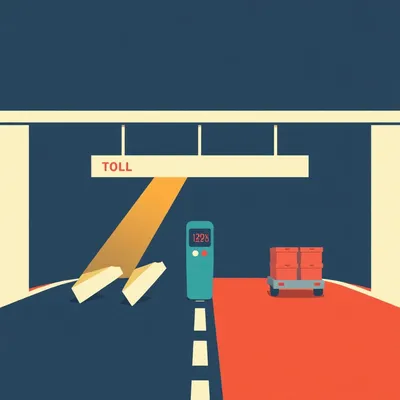
So the IXP is the off-ramp that lets you avoid the toll highway.
And it makes the internet faster, because the path is shorter. Traffic that peers locally in Amsterdam doesn't have to go through London or Frankfurt first. That's why IXP density in a region correlates directly with internet performance and cost. Places with underdeveloped IXP infrastructure — parts of Africa, parts of Asia — pay more for worse connectivity because local traffic often has to leave the continent and come back.
Alright, let's anchor this in something concrete. AMS-IX.
The Amsterdam Internet Exchange. Founded in 1994, it's now one of the largest IXPs in the world. Over nine hundred connected networks. Peak traffic exceeding twelve terabits per second. It operates from multiple data centers in the Amsterdam metro area using a distributed switch fabric — dark fiber connecting the switches across locations so the whole thing behaves as a single logical switch. A network can connect at any of those data centers and still reach every other member.
Twelve terabits per second. That number means nothing to a human brain.
It's roughly the entire Library of Congress every few seconds. And here's the thing Daniel flagged — AMS-IX is a non-profit association. It's not a company with shareholders. Its members are the networks that connect to it, and they govern it collectively. They elect a board. The fees cover operating costs and infrastructure investment. Any surplus gets reinvested or used to reduce fees.
That seems almost perverse in an industry where everything else is a quarterly earnings call.
It's not perverse, it's the only structure that works for this particular function. An IXP is a shared resource that competing networks all depend on. If it were owned by one network — say a large incumbent ISP — that owner would have every incentive to favor its own traffic, degrade competitors' performance, or extract monopoly rents. The non-profit association model solves the trust problem. No single member controls the switch. Everyone gets the same port options, the same service level. The governance is transparent because the members are the governance.
It's a condominium association for the internet's nervous system.
With slightly less arguing about the landscaping. The members collectively own the infrastructure that they all need but could never agree to let any one of them control. The association structure wasn't some high-minded ideal — it was practical. In the early days, these networks didn't trust each other. They were competitors. The only way they'd agree to plug into the same switch was if nobody owned the switch.
So the non-profit label doesn't mean amateur hour.
Far from it. AMS-IX, LINX in London, DE-CIX in Frankfurt — these are among the most critical pieces of internet infrastructure on the planet, and they're all member-owned associations. The non-profit structure is the reason they can be neutral and the reason they've scaled. Commercial IXPs exist too — Equinix runs a massive peering platform — but the association model dominates the largest exchange points.
Let's talk about the fabric. Daniel mentioned federated links, and that's essentially what we're describing.
The distributed switch fabric. Modern IXPs don't operate from a single switch in a single data center. They span multiple data centers in a metro area, connected by dark fiber. The fabric presents as one logical switch. A network connects at the data center closest to them, and the IXP's internal fiber ring carries traffic to wherever the destination network is connected. This is exactly the federated model — individual links that collectively form a single switching domain. It's the same architectural principle as the public switched telephone network's interconnection model, just with packets instead of circuits.
But that distributed architecture also creates a vulnerability. If the IXP is a single logical switch, it's a single point of failure.
It is, and the industry knows it. In 2021, AMS-IX suffered a DDoS attack on its route server — the server that distributes routing information to all members so they can discover each other. The attack took the route server offline, and networks that relied on it lost their peering sessions. Traffic still flowed through backup transit paths, but performance degraded significantly. The outage demonstrated both the vulnerability and the resilience — the internet didn't break, but it got slower and more expensive for a few hours while traffic rerouted.
A route server is basically the IXP's phone book.
When you connect to an IXP, you could manually set up peering sessions with every other network — that's bilateral peering. But that doesn't scale when there are nine hundred networks. The route server automates it. You peer with the route server, and it tells your router about all the other networks available. One peering session instead of nine hundred. The DDoS took down the phone book, and suddenly nobody knew who else was in the room.
Which brings us back to the non-profit question, because the route server is a perfect example of why neutrality matters. If a commercial entity ran that route server, they could prioritize certain networks in the phone book.
Or charge for better placement. Or degrade a competitor's routes. The association model removes that incentive. The route server is run for the benefit of all members equally. The board is elected from the members, so if the route server isn't performing, the people who use it can replace the people running it. That accountability loop doesn't exist in a commercial silo.
Alright, let's complicate the picture. Not all peering is settlement-free and not all interconnection happens at IXPs.
Right. There's a whole spectrum. At one end, you have settlement-free peering at an IXP — two networks of roughly equal size agree to exchange traffic because it's mutually beneficial. At the other end, you have paid transit — a smaller network pays a larger one for access to the entire internet. In between, you have paid peering, where one network pays another for direct interconnection, often with a service level agreement attached. Netflix does this with major ISPs. They pay for direct connections to ensure their video traffic doesn't get congested at settlement-free peering points.
So Netflix is essentially buying a VIP lane into the ISP's network.
And building their own CDN PoPs inside the ISP's data centers. Netflix's Open Connect program places caching appliances directly in ISP networks. When you stream Stranger Things, you're probably pulling it from a server that's physically inside your ISP's PoP, not from a Netflix data center across the country. That's a PoP strategy taken to its logical extreme — get as close to the user as possible, even if it means putting your hardware on someone else's property.
Which makes the non-profit IXP model even more interesting, because it sits alongside these fiercely commercial arrangements. The same ISP that charges Netflix for paid peering is also a member of a non-profit IXP where it peers settlement-free with a university network.
And that mix is healthy. The IXP provides a neutral baseline — the public square where anyone can show up and interconnect. The commercial arrangements layer on top for specific needs. If every interconnection were a private commercial negotiation, the internet would fragment into walled gardens. The IXPs keep it open.
Let's talk about what happens when IXPs don't exist. You mentioned Africa.
The statistics are stark. In many African countries, a significant portion of local internet traffic has to travel to Europe and back because there's no local IXP to exchange it. Two ISPs in the same city might exchange traffic via a transit provider in London or Marseille. That adds a hundred milliseconds of latency and costs real money in transit fees. The Packet Clearing House, which tracks IXP development globally, has been pushing for years to establish local IXPs in underserved regions. Every new IXP in a developing market demonstrably reduces local internet costs and improves performance.
A hundred milliseconds is the difference between a video call feeling natural and feeling like a satellite delay.
And it's pure waste. The fiber is there. The routers are there. What's missing is the neutral meeting point and the governance structure that lets competitors trust it. That's the non-obvious bottleneck — it's not technology, it's organizational. You need a legal framework where competing ISPs can collectively own and operate a shared resource without any of them capturing it.
So the internet's physical layer is partly an engineering problem and partly a trust problem.
Always has been. The early IXPs were literally a bunch of network engineers from competing companies meeting in a pub to figure out how to share a switch. LINX was founded in 1994 by a group of ISPs who were tired of routing UK traffic through the United States. They found a neutral location — Telehouse in London's Docklands — and set up a switch. The governance was informal. Handshake agreements. The association structure formalized something that had already been working on trust.
The pub and the carrier hotel. And the carrier hotel is what most PoPs and IXPs physically are — a data center that exists specifically because it's where the fiber meets. Buildings like Telehouse in London, Equinix in Ashburn, One Wilshire in Los Angeles. These are not glamorous places. They're concrete boxes full of humming equipment and diesel generators. But they're the most important buildings in the global economy that nobody outside the industry has heard of.
One Wilshire. That's the building in LA where something like a third of transpacific fiber lands.
It's an unremarkable office tower from the outside. Inside, it's one of the densest concentrations of network interconnection on the planet. Hundreds of networks have equipment there because that's where the submarine cables come ashore and that's where everyone else is. The value isn't the building — it's the fact that everyone is already there. It's a gravity well for fiber.
Which is the same dynamic that makes IXPs work. Once enough networks are in the room, everyone else has to be there too.
Network effects, literally. The value of an IXP scales with the square of the number of connected networks. The big IXPs are big because they're big. It's self-reinforcing, which is also why the non-profit model matters — if a commercial entity controlled that gravity well, they could extract enormous rents.
So the non-profit association is a structural check on a natural monopoly.
And it's worked remarkably well. AMS-IX has been running for over thirty years. LINX for about the same. They've scaled from a few megabits to multiple terabits without changing their fundamental governance model. The technology has changed completely — from FDDI rings to gigabit Ethernet to hundred-gigabit ports — but the association structure is the same.
Let's go back to the packet path for a moment. Daniel asked us to focus on PoPs and interconnection points, but I want to make sure we're clear on what a PoP actually contains.
A PoP is essentially a network's local equipment room. At minimum, you've got a router that speaks BGP — Border Gateway Protocol — to exchange routing information with other networks. You've got switches to aggregate connections. You've probably got servers if you're a CDN or cloud provider — caching content, running virtual machines. You've got power redundancy, cooling, physical security. A large provider like Google or Cloudflare might have PoPs in a hundred or more locations worldwide. Each one is a point where they can hand off traffic to local ISPs or peer at a local IXP.
And the density of those PoPs is what determines whether your YouTube video buffers.
It's the primary factor. Google has PoPs in virtually every major metro area globally. When you watch a YouTube video, your traffic is almost certainly being served from a Google cache inside your ISP's network or at a nearby PoP, not from a data center in Mountain View. The content has been pre-positioned close to you. That's the entire CDN strategy — replicate content to the edge, serve it locally, avoid the long-haul network.
The edge being a PoP in a carrier hotel in your city.
Or increasingly, inside your ISP's own facilities. The line between PoP and CDN cache and IXP gets blurry at the edge. A single building might house an ISP's PoP, a Google cache, a Netflix Open Connect appliance, and an IXP switch fabric, all interconnected with fiber patches. That building is the internet, physically, for everyone in the region.
Daniel asked how important these things are. I think the answer is: they are the internet. Without PoPs, networks can't reach users. Without IXPs, networks can't reach each other efficiently. Everything else is just cables between these points.
And the internet's resilience depends on there being many of them. Redundancy is built into the routing system — BGP will find another path if one IXP goes down. But that only works if alternative paths exist. In a region with only one IXP, that IXP is a single point of failure for local connectivity. Which is why internet resilience advocates push for at least two IXPs per market. The cost of a second exchange is small compared to the cost of an outage.
Let's talk about the switch fabric itself for a moment. What does a modern IXP actually look like at the hardware level?
It's a collection of high-port-density Ethernet switches, typically from vendors like Arista or Cisco, arranged in a spine-leaf architecture. Member networks connect to leaf switches. The leaf switches connect to spine switches that form the core fabric. The whole thing is designed so that any port can reach any other port with minimal latency. The distributed fabric across multiple data centers is connected by dark fiber — literal strands of glass that the IXP either owns or leases on long-term contracts. The route servers are typically Linux servers running BGP daemons — Bird or Quagga or similar. Nothing exotic. The magic is in the architecture and the neutrality, not in proprietary hardware.
Dark fiber being fiber that's been laid but not lit — no equipment on either end.
The IXP lights it with their own optics. That's important because it means they control the link end to end. They're not buying a managed wavelength service from a carrier. They own the path, which means they control the latency, the redundancy, and the upgrade cycle. When traffic grows, they swap the optics for faster ones. No contract renegotiation, no carrier telling them it'll be six months.
Which is exactly how the big content companies approach their own backbone networks.
Indefeasible rights of use. They buy the right to use a fiber pair for twenty years and then they light it themselves. It's the only way to guarantee control over your own destiny. The IXPs do the same thing at metro scale — dark fiber rings around Amsterdam or London connecting their distributed fabric.
So the non-profit association is out there buying twenty-year fiber leases.
Doing it with the pooled fees of its members. The port fees at a major IXP range from a few hundred to a few thousand euros per month depending on the speed. Multiply that by nine hundred members and you've got a substantial capital budget. The association model doesn't mean underfunded. It means the funding is transparent and the spending is accountable to the members.
Alright, I want to circle back to something you mentioned earlier about the early days of LINX. Pub meetings and handshake agreements. It's hard to square that with twelve terabits per second and distributed switch fabrics.
The scale is different but the trust problem was the same. In 1994, a handful of UK ISPs realized they were paying transit providers in the US to exchange traffic with each other. British traffic going to a British website was crossing the Atlantic twice. They found a neutral location, put in a switch, and agreed to peer. The pub was where they held member meetings because none of them had conference rooms. The informality was a feature — it kept things from getting too corporate, too captured by any one player.
Now the member meetings are probably in hotel ballrooms with catering.
But the governance is still one-member-one-vote. The board is still elected. The association is still a non-profit. The polish changed, the principle didn't.
Hilbert: The keys were in the ignition of a Ford Transit van, not in the server rack.
Go on.
Hilbert: Late nineties. I was a junior network engineer for a small ISP out of Manchester. We connected to LINX — the London Internet Exchange — and I drew the short straw to drive the peering router down to Telehouse in Docklands. It was a Cisco 7200 bolted into a rack-mount case. I got there at two in the morning, signed in, wheeled it up to the cage, and realized the rack keys were still in the van. Which I'd parked four blocks away because Telehouse had about six spaces and they were all taken.
You're in the carrier hotel at two in the morning with a router you can't install.
Hilbert: Sat on the floor next to it for forty minutes until the shift engineer took pity and lent me a set of allen keys to pop the side panel off the rack. Not exactly the designed procedure. But I got it in, got the fiber patched, and by four AM we were peering.
What did peering mean for a small ISP in Manchester in the late nineties?
Hilbert: It meant we stopped paying British Telecom for transit to reach other UK ISPs. Our monthly transit bill dropped by about sixty percent. The port fee at LINX was a few hundred quid. The math was not subtle. And the member meetings were in a pub near Liverpool Street station. I went to one. Twenty people, all engineers, arguing about switch port allocations and whether the route server should run Bird or something else. No suits. No PowerPoint. Just people who needed each other's traffic and didn't want to pay a third party to carry it.
That's the non-profit model in its raw form. A bunch of competitors who trust each other just enough to share a switch, and not enough to let any one of them own it.
Hilbert: The association structure wasn't idealistic. It was the only thing anyone would agree to. Level 3 would never let BT run the exchange. BT would never let Level 3 run it. So nobody ran it — the members ran it collectively. The legal form followed the trust boundary. The trust boundary was about twelve inches wide.
Now those same associations are running multi-terabit distributed fabrics across metro areas.
Hilbert: Same model, bigger numbers. The thing that's changed is what happens at the edge. The hyperscalers — Google, Amazon, Microsoft — they're building so much private infrastructure that they're starting to bypass IXPs for a lot of their traffic. Direct fiber connections between their data centers and the major ISPs. Private peering in carrier hotels that never touches the public exchange fabric. The IXP is still there for everyone else, but the biggest flows are moving to dedicated interconnects.
That's the question, isn't it? As the hyperscalers build their own private internet, does the neutral exchange model still matter as much?
Hilbert: It matters for everyone who isn't a hyperscaler. Which is most of the internet. Universities, content companies, gaming platforms, smaller ISPs, enterprise networks — they all still need a neutral place to interconnect. The IXP is the public option. And public options matter most when the private ones are consolidating.
The IXP as a public utility.
Hilbert: Run as a member co-op. Which is a strange thing to find at the center of the global internet, but there it is.
It does make me wonder about the scaling limits. If traffic keeps growing and the hyperscalers keep pulling their biggest flows off the exchange, does the IXP model eventually become a safety net for the long tail rather than the core of internet interconnection?
I think it already is, in some markets. But that safety net is load-bearing. If the IXP disappeared tomorrow, the long tail of networks would be back to buying expensive transit, and the internet would get slower and more expensive for everyone who isn't Google or Amazon. The IXP is the thing that keeps the internet from becoming a two-tier system.
In developing regions, the IXP is even more critical because the hyperscalers haven't built out their private infrastructure yet. The local IXP is often the only way for local networks to exchange local traffic without paying international transit fees. Every new IXP in an underserved market is a direct economic intervention — it makes internet access cheaper and faster for everyone in the country.
The non-profit association model isn't a historical curiosity. It's an active tool for internet development and a structural check on consolidation. Not bad for a bunch of engineers who started meeting in a pub.
The next time your packet crosses the internet, remember it probably passed through a PoP and an IXP — and that IXP might be run by a non-profit society of competing networks who somehow agreed to share a switch thirty years ago and are still sharing it today.
Thanks to Hilbert Flumingtop for producing, and for the van keys story we didn't know we needed.
This has been My Weird Prompts. If you want to dig into the infrastructure that keeps your packets moving, we're at my weird prompts dot com. Send us your questions, your obscure networking terminology, your locked server rack stories.
We'll be back soon.