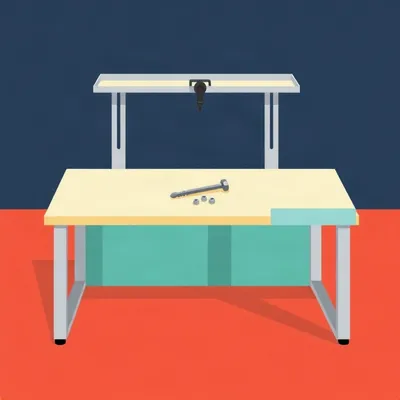
Daniel's prompt this week is a purchasing guide for a first workbench in a small Jerusalem apartment. He and Hannah have been doing enough DIY, crafts, and small electronics repair that the dining room table has become a liability. He picked up a Stanley engraver's vice recently, he's opening up electronics to swap button batteries and fix components, and he wears glasses, so he wants lighting and magnification when the thing is set up. Hannah fixed a table leg last week and does paper crafts. They're not heavy-duty users. The main value is having a surface where damage doesn't matter. And he's explicit about the tension: they want something that folds away tidily, but they've bought plastic products from Qatar that disintegrated, and they want something well made that won't fall apart after a year.

So let's start with what this table actually needs to do, because the category is not what most people picture when they hear workbench.
Right. Daniel's not asking about a Sjöbergs cabinetmaker's bench with a tail vise and dog holes. He's asking about a stowable work surface.
The category is closer to a folding workbench or a portable hobby bench. And the engineering problem at the center of it is simple to state and hard to solve: the more compact and foldable something is, the more likely it is to be flimsy. Rigidity and collapse are fighting each other.
And he's got three use cases that pull the spec in different directions. Engraving and small electronics need stability, light, magnification, and a way to hold small parts still. Paper crafts and light cutting need a flat sacrificial surface with edge access. General household repair, like a table leg, needs clamping surface and enough weight capacity to hold something awkward while you work on it.
His instinct about the plastic products from Qatar is a real signal, by the way. Material choice and joint design are the leading indicators of whether a foldable bench survives a year. Plastic folding tables fail at the joints, not the top. The top is usually fine until a leg snaps off at the hinge.
So the question is what to look for in the specs, what's useful versus nice-to-have, which brands are well made, and how to avoid the year-one disintegration.
Let's dig into the stability problem first, because that's where most compact benches fail.
A foldable bench's rigidity comes from its locking mechanism and joint design, not just the material. You can have a steel frame and still get wobble if the locks are friction fits.
Look for positive locking. Cam locks, over-center latches, bolted cross-braces. Something that snaps or threads into a fixed position and stays there. Plastic detents are the enemy. A plastic detent is a little bump that holds a leg in place until it wears down, and then the leg flops.
And the test is simple. If you push a chisel or turn a screw and the bench moves, it's worse than no bench. You'll compensate with your off hand, and that's how you slip and gouge something.
Weight is the counterintuitive part here. A light bench is easy to stow, but it moves when you work. The solution is either mass, a heavy steel or dense hardwood base, or a design that clamps to something already stable.
For a small apartment, the clamp-on option deserves more attention than it gets. A bench that clamps onto the dining table and then stows in a closet can be more stable than a standalone folding bench, and it stows smaller. The tradeoff is you need a table you're willing to clamp to.
Daniel's dining table is exactly the thing he's trying to protect, so a clamp-on bench needs a sacrificial layer between the clamp and the table. A scrap of leather or a thin piece of plywood. But once that's sorted, the dining table becomes the mass. It's already heavy and stable.
Then there's the work surface material. This is where the Qatar plastic experience maps directly onto the bench world.
MDF is flat and cheap, but it swells with moisture and it can't take a screw well. You drive a screw into the edge of MDF and it splits. Plywood is better. Solid wood, beech or maple, is best for a sacrificial top you can drill into and resurface.
The material to avoid is particleboard with melamine veneer. That's the one that disintegrates if it gets wet or if a joint pulls out. It's basically compressed sawdust with a thin plastic skin, and once the skin is breached, the whole thing starts crumbling.
And that's the failure mode Daniel described. A plastic product from Qatar that disintegrated was probably not solid plastic. It was likely a thin shell over particleboard or a hollow core, and once a joint failed, moisture got in and the whole thing came apart.
So the top material is one of the two biggest predictors of durability. The locking mechanism is the other. If you get those two right, the rest is details.
Vise and clamping. Daniel already has the Stanley engraver's vice, which is a good little tool. The bench needs a way to mount it. Either a built-in vise jaw, a removable mounting plate, or enough overhang and thickness to bolt a vise through.
For electronics specifically, a small vacuum vise or a Panavise-style base is more useful than a heavy woodworking vise. The Panavise has an articulating ball head and a small jaw set, and it bolts to a base plate. You can clamp the base plate to the bench or screw it down.
The Stanley engraver's vice is similar in spirit. It's a small ball-joint vise meant to hold small parts at odd angles for engraving or fine work. The bench just needs to give it a solid anchor point.
Lighting and magnification is where most compact benches fail outright. They don't have a mounting point for a task light, and they don't have a grommet for an articulating arm.
Look for a bench with a built-in power strip, or at least a way to clamp a task light to the edge. Magnification is usually a separate purchase. A desk lamp with a built-in magnifier lens works, or a headband magnifier for hands-free work.
The bench needs a stable edge or a grommet to mount an articulating arm. If the edge is thin or rounded, the clamp won't hold. If the top is hollow, the clamp will crush it.
Height and ergonomics matter more than people think. A folding bench is often lower than a dining table. For electronics and engraving, you want the work close to eye level. If the bench is too low, you hunch over it, and after an hour your neck and back are done.
Check the working height and consider whether you'll be standing or sitting. A bench at sitting height is fine for electronics if you have a good chair. A bench at standing height is better for cutting and planing. Most folding benches land somewhere in between and serve neither perfectly.
Storage and footprint. Measure the folded dimensions, not just the open ones. A bench that folds to four inches thick can slide behind a door or under a bed. A bench that folds to twelve inches thick may not fit anywhere useful.
And check the weight. If it's too heavy to move easily, it won't get stowed. That's the whole point of a folding bench. A bench that's a hundred pounds and folds flat is still a hundred pounds you have to wrestle out of a closet every time.
So that's the problem space. Now let's get into the brand landscape, because the market splits into three tiers and they're not all aimed at Daniel.
Premium is Sjöbergs, Veritas, and the traditional European bench makers. Solid wood, heavy, not foldable. They last generations, but they're not what Daniel's asking for. A Sjöbergs bench is a piece of furniture that weighs two hundred pounds and lives in a workshop.
Mid-range is where the folding benches live. Keter, Black and Decker Workmate, Worx Pegasus. Steel frames, folding legs, designed for light DIY. The Workmate is the classic reference point. It's been in production since nineteen seventy-two, which is remarkable for any tool.
The Workmate clamps, it folds, and it's widely available used. The original ones were cast aluminum and steel, and they were rigid. The newer ones are lighter and less rigid, but they're still a known quantity, parts are available, and the clamping mechanism is useful.
The Workmate's clamping top is the clever part. The two halves of the top slide together to act as a vise. You can hold a door on edge, clamp a pipe, or squeeze a small part while you work on it. For a small apartment, it folds flat and can be used as a vise, a sawhorse, or a work surface.
The Keter folding bench is plastic and steel, lighter duty, but it stows easily and it's cheap. The Worx Pegasus is similar, with a clamping top and fold-out legs. Both are fine for light work, but they're not going to feel like a real bench.
Budget is the generic plastic folding tables and no-name benches. These are the ones that disintegrate. Hollow-core tops, plastic locking mechanisms, particleboard with a thin veneer. If it says heavy-duty and doesn't list a weight capacity or a frame material, walk away.
The Workmate question is worth settling, because it's the most common recommendation for a first folding bench and it's not perfect. The newer ones are lighter and less rigid than the original. The original had a cast aluminum frame and a thick plywood top. The new ones have a stamped steel frame and a thinner top.
But for Daniel's use case, it's still a strong candidate. It folds flat, it clamps, it's widely available, and it's cheap enough that you don't feel precious about drilling into it. The clamping top means he can mount the Stanley vise between the jaws and get a stable work surface without bolting anything down.
If he goes used, the vintage Workmates are better built. The ones from the seventies and eighties have a reputation for outlasting their owners. The downside is they're heavier, and the folding mechanism is stiffer.
Alternatives to a dedicated bench. A folding table with a sacrificial top works for light crafts and cutting. Get a cheap folding table, put a sheet of MDF or plywood on top, clamp it down, and use that as the work surface. When the top gets chewed up, replace it.
That's the sacrificial top strategy, and it's underrated. The folding table provides the structure, and the sheet of plywood takes the damage. You can drill into it, cut on it, spill glue on it, and when it's ruined, you spend twenty dollars on a new sheet.
A kitchen cart or a rolling tool cart with a butcher-block top can serve as a bench that rolls away. It's not foldable, but it's mobile. If Daniel has a corner where a cart can live, it may be more useful than something that has to be unfolded every time.
A wall-mounted folding bench, a drop-leaf design, is another option if he has a wall he can drill into. It folds down from the wall, gives a solid work surface, and folds up out of the way. The catch is installation, and in a rental apartment, drilling into the wall may not be an option.
The clamp-on option deserves a closer look for electronics and engraving specifically. A small clamp-on bench or a portable electronics workstation, like a Panavise base with a folding board, may be more useful than a full workbench.
These are designed for exactly the kind of work Daniel describes. Small, detailed, needing magnification and lighting. The Panavise clamps to the edge of a table, holds a small board or a part at eye level, and the whole thing fits in a drawer when he's done.
For electronics repair, the work surface is often the least important part. What you need is a stable holder for the device, good light, and magnification. A clamp-on vise on the dining table with a sacrificial mat underneath covers most of it.
What to avoid. Plastic folding tables with hollow-core tops. Benches with plastic locking mechanisms. Anything where the top is particleboard with a thin veneer. These are the products that fail after a year.
Also avoid benches that are too light to stay put. If you have to hold it with one hand while you work with the other, it's not a bench. It's a tray.
The apartment-specific angle is the part most buying guides miss. In a small Jerusalem apartment, the bench needs to live in the space between set up and stowed. The best bench is the one you'll actually set up and use, not the one that's theoretically perfect but too much hassle to deploy.
Consider a bench that lives on a balcony or in a closet and comes out for projects, rather than one that's permanently in the way. The folding time matters. If it takes ten minutes to set up and ten to break down, it won't get used.
Durability signals. Look for steel or aluminum frames, bolted joints rather than riveted or welded plastic, replaceable tops, and a warranty longer than one year. If the manufacturer doesn't list the weight capacity or the material of the frame, that's a red flag.
A bench that's rated for three hundred pounds and has a steel frame is likely to last. A bench that says heavy-duty with no numbers is not. The numbers are the honesty. If they won't tell you what it's made of or how much it holds, they're hiding something.
The misconception to clear up here is that a heavier bench is always better. In a small apartment, a bench that's too heavy to move easily won't get stowed, so it defeats the purpose. The goal is stability during use and easy stowage after.
The second misconception is that you need a dedicated workbench for electronics repair. A clamp-on vise, a task light, and a magnifier on a dining table can work for small repairs, as long as you protect the table.
And the third is that plastic folding tables are fine for light DIY. They wobble, they crack, and they disintegrate, especially in humid climates or with UV exposure. Daniel's experience with plastic products from Qatar is a common failure pattern, not a fluke.
So the decision framework is this. For the bench itself, look for positive locks, a steel or aluminum frame, and a top that's plywood or solid wood. Avoid particleboard with melamine veneer and plastic locking mechanisms.
For the workholding, the Stanley vice he already has is the right tool for engraving and small parts. The bench needs to give it a stable anchor point. For electronics, a clamp-on Panavise-style base may be more useful than a full bench.
For lighting and magnification, plan on separate purchases. A desk lamp with a magnifier lens or a headband magnifier, plus a clamp-on task light. The bench just needs a stable edge to clamp them to.
For the apartment, think about the folded dimensions and the deployment time before you think about the open dimensions. A bench that folds to four inches and sets up in two minutes will get used. A bench that folds to twelve inches and takes ten minutes will become a shelf.
And for the brand question, the Workmate is the safe answer for a first folding bench. It's not the best bench, but it's the best-known quantity, it clamps, it folds, and it's cheap enough to modify without guilt.
If he wants something sturdier, the vintage Workmates are better built. If he wants something lighter, the Keter or Worx Pegasus will do. If he wants something that lasts generations, he's looking at a Sjöbergs, and he's not folding it.
The door idea is the wildcard here. A solid-core door is the ideal workbench top for a small apartment. It's flat, heavy, cheap, and you can drill into it.
Wait. A door.
A solid-core door. Not a hollow-core interior door. A solid-core door is a slab of wood, usually with a particleboard or MDF core and a wood veneer, and it's flat to within a fraction of a millimeter. You can get one at a salvage yard for under fifty dollars.
And the idea is you put it on sawhorses.
Two sawhorses, a solid-core door on top, and you have a workbench that's as flat as anything you'll buy, heavy enough to stay put, and it stows as two flat pieces. The door leans against a wall, the sawhorses fold up, and the whole thing takes up almost no floor space.
That's not a workbench. That's a door on sawhorses.
It's a workbench. It's been a workbench for decades. Cabinetmakers have used door slabs as bench tops for as long as there have been door slabs. The flatness is the thing. A door is manufactured to be flat, and a solid-core door is heavy enough that it doesn't bounce when you work on it.
I'm picturing this in Daniel's apartment. A door leaning against the wall behind the couch.
He could paint it. He could put a sheet of hardboard on top as a sacrificial layer. He could drill dog holes into it. He could mount the Stanley vise to the edge. It's the most customizable bench top he can get for the money.
And when Hannah wants the dining room table back, the door goes behind the wardrobe.
The door goes behind the wardrobe, the sawhorses fold up next to it, and the dining room table is a dining room table again. That's the system.
I think what Daniel's actually asking for is not a bench. It's a system. A folding table or a door on sawhorses, a clamp-on vise, a task light, a magnifier, and a sacrificial mat. All of it lives in a closet and comes out when needed.
And that's the open question. Is the best bench for a small apartment actually a bench, or is it a system? Because the market doesn't sell the system. The market sells benches, and then you buy the light and the magnifier and the vise separately, and you hope they all work together.
The market gap is real. The current options are either cheap and flimsy or expensive and heavy. There's not much in the middle that's compact, durable, and stowable.
Hilbert: You're both using the word bench and I keep hearing table.
Go on.
Hilbert: I worked a summer at a furniture restoration shop in eighty-seven. Tiny back room, no space for a proper bench. The owner asked me to build something that folded. I built it out of scrap oak and a pair of old door hinges. Lasted twenty years.
What kind of hinges?
Hilbert: That's the thing you both missed. The hinge. A cheap hinge develops play. Once a folding bench has play in the hinge, it's done. You can tighten the locks all you want, but the hinge is where the wobble lives.
So what's the right hinge?
Hilbert: Piano hinge. Or a heavy-duty cabinet hinge. Not butt hinges. Butt hinges are for doors that swing, not for benches that fold. A piano hinge runs the whole length and spreads the load. That's what I used. I still have the hinges.
The hinge is the joint that most folding benches cheap out on. They put a couple of small hinges on the ends, and those hinges take all the load when the bench is open.
Hilbert: And they wallow out. The screw holes get loose, the pin gets sloppy, and then the whole thing rocks. You can have the best locking mechanism in the world, but if the hinge has play, the bench is a table.
A table.
Hilbert: A table. It stands there and it holds things, but you can't work on it.
So the hinge is the third predictor of durability. Locks, top material, and hinges.
Hilbert: And the best bench for a small apartment is one you build yourself out of a solid-core door and a pair of sawhorses. You can customize the height and the top, and it stows as two flat pieces.
Hilbert, you're agreeing with Herman about the door.
Hilbert: I've used the same door for thirty years. It's been a workbench, a desk, and a dining table.
A dining table.
Hilbert: Put a tablecloth on it. Nobody knows.
The aesthetics of a door in a Jerusalem apartment.
Hilbert: It's a flat slab of wood with a veneer. It's not a door once you put it on sawhorses. It's a table. The doorknob hole is the only giveaway, and you can fill that with a grommet and run your lamp cord through it.
That's actually clever.
Hilbert: The doorknob hole is a built-in cable management port. Think about it.
The door as workbench top has another advantage. The height. A door is about eighty inches long and thirty inches wide. On sawhorses, that's a work surface that's longer and wider than most folding benches, and you can set the sawhorse height to whatever you want.
Hilbert: I set mine at thirty-eight inches. Standing height for a man my size. For electronics, you'd want it lower, or you'd sit on a stool.
And when you're done, the door leans against the wall and the sawhorses fold flat. It's a system, not a bench.
Hilbert: It's a door. And it's the best bench I ever had.
The solid-core door idea solves the stability problem by using mass. A solid-core door weighs sixty or seventy pounds. It doesn't move when you push a chisel. And it solves the stowage problem by being flat. It doesn't fold, but it leans.
The tradeoff is the sawhorses. Cheap sawhorses wobble. You'd need the kind with positive locks, not the plastic folding kind with friction joints.
Hilbert: That's the other thing. Buy good sawhorses. Steel, with locking braces. The sawhorse is the bench's legs. If the legs wobble, the bench wobbles.
So the door system is a solid-core door, two good steel sawhorses with locking braces, and a sacrificial layer on top. The whole thing costs less than a mid-range folding bench and it's more stable.
And it stows as two flat pieces. The door behind a wardrobe, the sawhorses in a closet.
Hilbert: Three pieces if you count the sacrificial top. But that's just a sheet of hardboard. You can slide it under a bed.
I'm coming around on the door. But it's not foldable. Daniel asked for something that folds away tidily.
Hilbert: It leans away tidily. Same thing.
It's not the same thing, but it's close. The footprint when stowed is the same or smaller than a folded bench. The door is flat against a wall, the sawhorses are flat in a closet.
And the setup time is the same. Two sawhorses out, door on top, done. That's faster than unfolding most benches.
Hilbert: That's what I'm saying. The folding bench is a compromise. The door is a bench that happens to stow flat.
The question is whether Daniel wants to build something or buy something. The door system requires sourcing a solid-core door from a salvage yard and finding good sawhorses. The Workmate is a single purchase.
Daniel's an open source developer. He might enjoy the door project.
Hilbert: It's not a project. It's two sawhorses and a door. You set it up once and you're done.
The customization is the appeal. He can drill the door for the Stanley vise, add a grommet for the lamp cord, set the height for sitting or standing, and replace the top when it gets damaged.
If he moves to a bigger apartment, the door is still a door. Or a table. Or a bench.
Hilbert: I told you. Thirty years.
The open question for me is whether the best bench for a small apartment is a bench at all, or a system. A door on sawhorses, a clamp-on vise, a task light, a magnifier. All of it lives in a closet and comes out when needed.
As more people work from small apartments and do light DIY and electronics repair, the market for compact, durable, stowable workbenches may grow. The current options are either cheap and flimsy or expensive and heavy. There's a gap in the middle.
If you've found a compact workbench that actually lasts, tell us about it. Email us at show at my weird prompts dot com.
This has been My Weird Prompts. Thanks to our producer, Hilbert Flumingtop.
We'll be back soon.