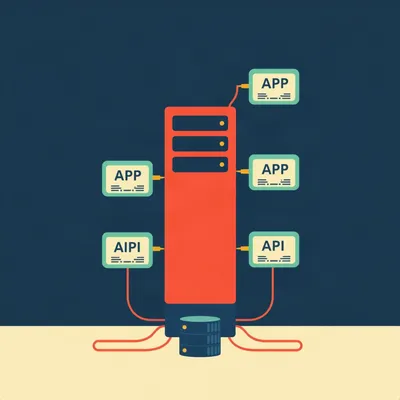
Here's the question that stuck with me all morning. Two servers. Same GPU. Same weights. Same request. Different answer.

And nobody changed the model.
Nobody changed the model. That's the part that bothers me.
Well, Daniel's thought experiment. He wants three providers, identical hardware, identical VRAM, identical weights, and the only difference between them is the inference engine underneath. One's running vLLM, one's running SGLang, one's running TensorRT-LLM. And the customer can't pick which one they get.
He wants to know if that's a footnote or a first-order decision. Whether the engine is just an execution layer you can swap out, or whether it changes the speed, the cost, and the answers the model gives.
Three dimensions. Performance, output quality, and operational efficiency.
And then the practical one underneath all of it. If you're an ordinary developer picking a provider, how much should you actually care what engine they're running, versus just worrying about hardware, price, and whether the thing stays up.
Right, so before we argue about whether engines differ, we have to say what an engine is.
Because it isn't the model and it isn't the GPU.
It's everything in between. The software layer that loads a trained checkpoint, takes your request, and turns it into generated tokens. The model is the weights. The engine is the machinery that runs them.
And it's a foggy layer for most people. You rent an endpoint, you send a prompt, tokens come back. Nobody shows you what's in the middle.
Which is exactly why the experiment is worth doing. All three engines now share the same baseline feature set. Continuous batching, paged KV cache, prefix caching, quantization down to FP8, INT8, INT4, speculative decoding, tensor and pipeline parallelism. That feature gap closed over 2024 and 2025.
So the brochure features stopped being the difference.
The features stopped being the difference. What separates them now is architecture. The question isn't whether an engine supports batching. It's how it schedules, how it caches, and how it executes when the batching gets heavy.
Which is a much harder thing to put on a pricing page.
Much harder. And one note on the model name before we go further. DeepSeek Flash 4 isn't a real artifact. The closest thing is DeepSeek V4 Flash, which shows up as a supported model in SGLang's repo.
Doesn't matter for the experiment, though.
Doesn't matter at all. These findings are model-agnostic. You could run them on anything.
So the engine is the layer between the weights and the tokens. Let's get under the hood, because the three of them solve the same problem three different ways.
Start with vLLM, because it set the template everybody else builds on. PagedAttention, Kwon and colleagues, SOSP 2023.
That's the one that treats the KV cache like operating system memory.
Exactly like it. The cache gets chopped into sixteen-token pages instead of one contiguous block per sequence. Before that, you were wasting something like forty percent of your VRAM on fragmentation. Fragmentation drops to under four percent.
Let me make sure I've got the analogy right, because it's a good one. It's like the difference between allocating a fixed-size parking spot for every car that might ever show up, versus a valet system that parks them wherever there's room and keeps a map.
That's almost exactly it. The old way reserved a contiguous block sized for the worst case, so a request that only needed four hundred tokens still held a slot big enough for four thousand. PagedAttention hands out pages on demand and the map is the page table. Same physical VRAM, way more concurrent sequences fitting inside it.
And what's running the show on top of those pages?
A Python scheduler with pluggable attention backends. FlashAttention-2, FlashInfer, xFormers, take your pick. The coverage is the other half of the story. Four hundred plus model architectures. NVIDIA, AMD ROCm, Google TPUs, Gaudi, plain CPU.
So vLLM is the generalist.
The generalist, and the one that made the whole category serious. Now SGLang takes a different cut. RadixAttention, Zheng and colleagues, NeurIPS 2024. Instead of caching prefixes per sequence, it builds a radix tree.
A trie.
A trie over every cached KV page in the system. So instead of one system prompt getting reused, it finds the longest common prefix across all prior sequences at once. On few-shot work, or anything branchy where requests share bodies of text, SGLang claims to eliminate seventy to ninety percent of the prefill compute.
That's a lot of compute to be throwing away for free.
It's a different data structure, and it shows. The other thing SGLang does is constrained decoding. JSON, regex, grammars. That lives in the scheduler, not bolted on top as a wrapper.
So a provider running SGLang gives you structured output as a first-class citizen.
As a first-class citizen, yes. And the expert parallelism for very large mixture-of-experts models is where SGLang has been strongest. That's the DeepSeek-R1 and V3 scale.
Which is why they list the V4 Flash models in their repo.
That's exactly why. Then there's TensorRT-LLM, and this is where the story has changed.
The compiled engine.
Historically, yes. It compiled the model into a hardware-specific engine file. Aggressive operator fusion, kernels auto-tuned to your exact GPU, CUDA graphs capturing the whole forward pass. NVIDIA-only territory.
Play to the metal.
And here's the update that changes the argument. TensorRT-LLM 1.2 removed the TensorRT backend entirely. PyTorch is now the only execution backend, and the engine-build command line is gone.
So the compiled-kernels-beat-Python story is, in part, history.
Which matters because a provider selling you on TensorRT-LLM today may not be running the thing people mean when they say TensorRT-LLM.
You're buying the reputation.
You may be buying the reputation, yes. So let's get to why one of these can be faster on the exact same silicon. Three mechanisms. First, kernel fusion and auto-tuning calibrated to the specific card. Second, CUDA graph capture, which kills CPU-side launch overhead. Five to ten microseconds per launch, which sounds like nothing until you're running at low batch and it's a real fraction of your step time.
And third?
Scheduler overhead. vLLM's Python scheduler costs you two hundred to five hundred microseconds per step at high concurrency. SGLang pushes more of that down into C++ and CUDA. At one request, nobody notices. At a few hundred concurrent, that's your throughput.
Okay. So they differ architecturally, and they differ for reasons you can name. Now the part I want, which is what happens when you load them.
The single most important finding in all of this. There is no universally fastest engine. The winner changes with the load.
That's the sentence, Herman.
One model, one H100, Llama 3.1 8B across all three. At batch one, the three of them are within four percent of each other. A hundred and fifty-eight tokens per second, a hundred and fifty-three, a hundred and fifty-two. Basically a tie.
Which is what you'd predict if the engine were plumbing.
And the moment you add concurrency, the tie breaks. At concurrency thirty-two, TensorRT-LLM leads on time to first token. Two hundred thirty-five milliseconds against vLLM's five hundred fourteen.
Same hardware.
Same hardware, same weights. Then you push to saturation and vLLM peaks highest. Five thousand three hundred thirty-three tokens per second against SGLang's five thousand two hundred thirty-five and TensorRT-LLM's four thousand eight hundred thirteen.
So the ranking flipped twice on one benchmark.
Flipped twice. And the L40S benchmark on Qwen3 32B from late August makes it sharper. At concurrency sixty-four, TensorRT-LLM ran thirty-seven percent higher throughput than vLLM. Three hundred forty-two tokens per second versus two hundred forty-five.
And then long context?
Long context is where it gets ugly. Eight thousand token inputs. TensorRT-LLM did double the throughput and finished time to first token in eight point six seconds. vLLM took sixty-three point eight seconds. SGLang sixty-eight point six.
Seven and a half times.
Seven and a half times, on identical weights, for the same prompt.
So if you're the customer and your provider happens to be the vLLM one, your long-document summarizer is unusable and you have no idea why.
And you can't change the engine. That's the scenario.
Now flip it. Who won the low-concurrency latency in that same suite?
vLLM. Eight hundred thirty-four milliseconds to first token at concurrency eight. SGLang two thousand twenty-nine, TensorRT-LLM two thousand five hundred forty-one.
So TensorRT-LLM is seven and a half times faster when you're full and eleven percent slower when you're quiet.
That's the actual shape of it. And SGLang quietly had the most consistent inter-token latency in the whole suite. Sixty point six to seventy-seven point eight milliseconds across every concurrency level.
The one that never wins the headline.
Never wins the headline, and it's the one that never falls over either. Which, for a product, is worth something.
Cost. Because that's the dimension a provider actually prices on.
RunInfra derived it from Modal's rates. H100 at three ninety-five an hour, L40S at one ninety-five. vLLM came out at fifteen point eight cents per million output tokens on fp8. SGLang seventeen cents. TensorRT-LLM twenty-two point eight cents on bf16.
And the L40S?
Roughly double the cost per token versus the H100. Hardware beats engine on cost.
Every time?
At that level, yes. But here's the one that made me sit up. Same test, quantization format mattered more than engine did. AWQ or GPTQ against FP8 on vLLM gave a forty-three percent throughput gain. Three hundred forty-nine against two hundred forty-four.
So you're benchmarking engines and the format underneath is the bigger lever.
Which is a humbling result if you build your whole purchasing decision on the engine logo. And then there's TensorRT-LLM's operational bill, which doesn't show up in tokens per second at all. Change the model, the quantization, the sequence length, or the GPU, and you rebuild the engine. Build times run from five minutes to over two hours.
So you need a CI pipeline and versioned artifacts.
You need a CI pipeline and versioned artifacts, and that's people, not GPUs. That's the bit that shows up in someone's week.
The one number I keep thinking about is that forty-three percent. You could do everything right on engine selection and lose more than that by picking the wrong weight format.
Right. The engine is the variable in the experiment, but it isn't always the biggest lever in the system.
Now the piece that surprised me and I suspect will surprise most people listening. Identical weights do not guarantee identical answers.
This is the thread I'd never have thought to pull. There's a 2026 paper out of CISPA. Holding weights, decoding settings, and hardware constant, and changing only the backend, benchmark scores moved by up to sixteen point six percentage points.
Sixteen point six points.
DeepSeek R1 Distill Qwen 7B on GSM8K. Seventy-eight point four seven percent on the transformers reference implementation. Sixty-one point eight seven percent on Ollama. Same weights.
What's driving the gap? If the weights are the same, something's changing them.
Two categories, and they're very different in character. The first is correctable engine defaults. Ollama force-prepends a BOS token, and applies a hidden repetition penalty of one point one. That penalty alone was worth eleven point six seven points on that benchmark. Turn it off, and it comes back.
So most of the headline is a default nobody documented.
Most of the headline is a default nobody documented, and that's the honest read. The paper surveyed two hundred distinct inference engines, and thirty-five thousand machine learning papers, and found the inference stack is almost never reported.
The layer that changes the answers is the layer nobody writes down.
That's the finding. The second category is optimization-induced numerical drift. Prefix caching, CUDA graphs, kernel tie-breaking, FP32 versus FP16 accumulation. No single layer is broken. The drift compounds as you go deeper into the network.
And that half is much smaller?
Much smaller. Sub-one-point in most ablations. On L40 cards the total spread was actually slightly wider, up to seventeen point two percent. And jailbreak vulnerability of DeepSeek R1 moved eight point nine points by engine alone.
The safety number moved too.
There's a second study out of Linz that crossed three models, five frameworks, six benchmarks, four generation modes. Even under greedy decoding, backend accounts for roughly thirty-nine percent of the variance a practitioner sees out of the box.
Out of the box being the important qualifier.
Out of the box, yes. Because a lot of that is the defaults again. Per-item disagreement hit forty-eight percent on StereoSet and forty percent on TruthfulQA for Llama 3.2 1B. And the effects were more pronounced on factual benchmarks than on bias ones.
Which is backwards from what I'd have guessed. You'd expect the vibes-y stuff to be fragile and the factual stuff to be stable.
The opposite. Accuracy questions have a narrow band of right answers, so a small nudge in the logits flips the answer. Bias questions have a lot of equally plausible answers, so the nudge doesn't change much.
That actually makes sense. Now let's do determinism, because that's the part I've been waiting for.
Thinking Machines Lab, Horace He, September 2025. The popular explanation is that concurrency plus floating point makes inference nondeterministic. That explanation is incomplete. The forward pass has no atomic adds in it, and it's run-to-run deterministic. What it isn't is batch-invariant.
Say that in English.
The same prompt produces different logits depending on how big the batch around it is. And batch size changes with how many other people are using the server, which is weather. So you send the identical request twice and get different numbers out.
How different?
They sampled Qwen3 235B a thousand times at temperature zero on "Tell me about Richard Feynman." Eighty unique completions.
Out of a thousand, at temperature zero.
Eighty. And they were identical for the first hundred and two tokens, then diverged. One run said Queens, New York. Another said New York City.
Temperature zero is not deterministic. That's worth putting on a poster.
It's the single most quoted line about inference that people get wrong.
So what does the fix cost? Because there's always a fix and there's always a cost.
Sixty-one and a half percent slower on Thinking Machines' original batch-invariant kernels. SGLang shipped it in September of 2025 and got the average slowdown down to thirty-four point three five percent. Range of twenty-four point four to forty-six percent depending on the workload. CUDA graphs claw back about two point eight times on top of that.
A third of your throughput for a guarantee.
A third of your throughput. vLLM shipped the flag for it, and there's a footnote: async scheduling is on by default and can still break invariance. And fused MoE kernels are still non-invariant in some open issues.
So the switch exists and doesn't fully deliver yet.
Exists and doesn't fully deliver. Which is honestly where a lot of this sits.
Deployment-level reproducibility. This is the study that made me want to do the episode.
Priyansh Bhatter, vLLM 0.25.0, Qwen3.5 9B, GSM8K. Fresh vLLM deployments matched only fifty-nine to sixty-four percent of outputs. Identical weights, identical GPU, identical config.
Not close to identical.
And the obvious suspect was batching, so they capped batch at one, eight, and thirty-two, and the three behaved identically. Batching was not the cause. Then they took two containers and had them share the same compiled autotune cache.
And?
Thirteen hundred nineteen outputs. Thirteen hundred nineteen identical matches, across different H100s.
So the variable is the autotune state.
The compile and autotune state, not the sampler. And the FP8 W8A8 path had zero divergences across thirteen thousand one hundred ninety comparisons, which is its own quiet finding about quantization.
If I'm a developer reading that, the interesting bit is the accuracy held.
Accuracy held within zero point three five points. Verdict flips about one percent of the time. But the text churn is around forty percent. So the answer is usually the same and almost never the same words.
Which is fine for chat and fatal for an audit trail.
Fatal for an audit trail. And that's the split I'd draw for Daniel. Two effects, two completely different remedies. The performance differences are large but visible. You benchmark your own workload and you know. The quality differences are occasionally double digits in the lab, usually sub-one-point in practice, and completely invisible unless you go looking.
And they compound on long chains of reasoning. Which is where people are actually deploying these now.
Where they're actually deploying them. That's the bit that should worry a team that runs evals.
Here's what I keep coming back to. Daniel asks how much attention an ordinary developer should pay to the engine, and the honest answer is less than you'd think, unless you're doing one of a few specific things.
The work where the answers have to be the same every time.
Evals, reinforcement learning rollouts, anything regulated or auditable. If your job is to produce a number that someone else can reproduce, the engine is not a footnote. It's the thing.
And if you're shipping a chat product, then hardware, price, and whether the provider stays up will swamp it.
But there's a catch, which is the piece that makes the whole thought experiment slightly unreal.
Which is that the customer can't see it.
Two hundred distinct engines in the survey. The stack is rarely reported in papers. So a provider dashboard says "H100, eight billion parameters, four dollars a million tokens," and it does not say vLLM.
Most don't say anything.
So the advice "benchmark your own workload" runs into the fact that you often can't tell which engine you're benchmarking.
You can measure the outcome. You can't measure the cause.
The deployment gap. Research validates on one stack and ships on another, and the stack isn't recorded on either end.
Which is exactly why Daniel's framing is good. Hold the weights constant, hold the hardware constant, and the thing you can't see is the thing that moved the number.
Herman. One thing I want to put to you, since you're the one who reads the papers. Is the engine becoming less of a differentiator over time?
I think so, on the performance axis. The features converged. TensorRT-LLM gave up the compiled backend. And every difference we cited is operating-point-dependent, which means it's the kind of difference a provider can engineer around once they know it matters.
So the axis moves.
It moves to determinism guarantees and operational simplicity. Which are the two things you cannot fake with a benchmark chart.
The benchmark chart is exactly what can't be faked.