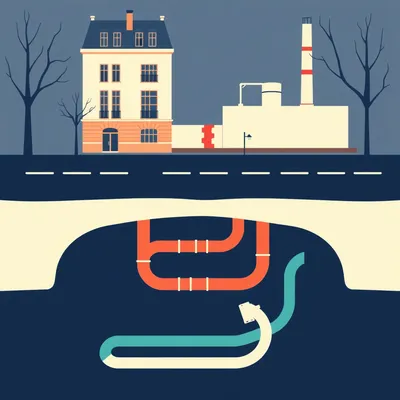
So we're paying for the energy, and then paying again to move the heat off the back end. That's the shape of it, isn't it.

That's most of the story in one line.
Daniel's been reading about waste heat. The pitch is that it's the world's largest untapped energy source. He wants the scale first. How much of the world's energy ends up as heat, and how much of that could actually be put to work. Then the practical half. District heating in Copenhagen, in Stockholm, the idea of data centers as suppliers. What makes the same heat valuable in one city and useless a hundred kilometers away. How much weight temperature carries, distance, pipes, thermodynamics.
And then the forward question.
And then the one that decides the whole thing. Whether this can ever be a serious slice of global efficiency, or whether the physics caps it lower than anybody wants to admit.
This is the rare sustainability topic where the headline number and the honest number are two different numbers, and the gap between them is the entire episode.
Into it.
So before we go anywhere, we need to separate three things that get blurred constantly. How much heat is dumped. How much could theoretically be recovered. And how much is actually worth recovering.
Which is three numbers, and people quote the biggest one.
Everybody quotes the biggest one. Here's the first version. A study out of Oxford in 2016, Firth and Zhang and Yang, put it at somewhere between forty-nine and fifty-three percent of all global input energy across scenarios to 2030. About half of what the world consumes comes out as waste heat on the other side.
And the second version.
Danfoss will tell you nearly two-thirds. They put it out last year, and they're still projecting up to fifty-five percent being wasted by 2030. UNDP has a version of the same number, roughly thirty-seven percent of primary energy converted to useful energy.
So which is it.
It's definitional, Corn. That's the thing. The Oxford figure is counting specific streams. Exhaust, effluent, cooling water you can point at. Danfoss is counting the conversion losses inside the plant. The heat that never made it out of the generator in the first place. Both are real. One is hotter and closer to a pipe. The other is diffuse and inside a wall.
So they're counting different things and calling them the same word.
That's what the sector has never fully fixed. Now the part I actually want listeners to hold onto. The Oxford study gives a theoretical recovery potential of eleven to twelve percent of input. And an economic potential, meaning the heat where it's worth running a pipe, of six to nine percent.
So half becomes heat, and six percent becomes money.
That's the whole episode. Eleven percent at best, six percent if you're honest about cost.
And the six percent isn't a failure of engineering. It's a receipt for the second law.
That's the right way to put it. So let's do this in order. Temperature first, because temperature is destiny. Then the two cities that built the pipes and the market. Then the data centers walking in with their own surplus heat. Then the money and the limits.
Start with temperature. I've read just enough to be dangerous about Carnot.
So the useful work you can pull out of a heat source depends on how much hotter it is than the cold side you're rejecting to. Hot on one end, cold on the other, big gap means real power. Lukewarm on one end and lukewarm ambient on the other means almost nothing useful comes out.
And most of the heat we throw away is lukewarm.
Sixty-four to sixty-five percent of it is below a hundred degrees Celsius. That's hot enough to scald you and useless for doing work, because the temperature difference you're working with is tiny. So that entire bucket, the biggest bucket, contributes almost nothing to the theoretical recovery potential.
What's in the bucket that does contribute.
The medium band, a hundred to three hundred Celsius. That's where sixty-three percent of the recoverable potential sits. And then above three hundred, the high-temperature stuff, is over twelve times smaller in total volume than the low-temperature pile. But it contributes almost as much recoverable potential, because it's concentrated and practical to recover.
So somebody running a furnace they could tap is sitting on more real value than an entire city of lukewarm water.
That's the inversion. Now watch where it shows up. Power generation accounts for forty-two to forty-five percent of all waste heat globally. It's the biggest waster by a mile. But it's only eight to ten percent of the theoretical recoverable potential. Because somewhere around half its input leaves as lukewarm heat. Cooling towers, condensers, steam that's already given up.
The biggest source is the worst target.
The power plant is not where the money is, even though it's where the heat is. Meanwhile industry is only fourteen or fifteen percent of the waste heat, but it's twenty-seven to twenty-nine percent of the recoverable potential. Because industrial heat is hotter. Roughly forty-four percent of industrial waste heat is recoverable, against the low single digits for the low-temperature pile.
So the sector doing the cleanest math is the one nobody thinks of.
Department of Energy has had a version of this forever for industry. Twenty to fifty percent of industrial energy input lost out exhaust, cooling water, hot surfaces. That's the number that's had recovery equipment bolted onto it for decades. It's the least glamorous and the most real.
And the thing the pipes actually want, the district heating networks, what temperature do those run at.
Historically seventy to a hundred Celsius. That's a lot of pipes and a lot of heat loss on the way. And the waste heat you're collecting is typically available at thirty to sixty. So there's a gap. The heat pump closes it. You spend electricity to lift the temperature from lukewarm to hot enough to leave the building.
Which sounds like spending energy to save energy.
It's not a paradox. A heat pump moves more heat than the electricity it consumes, so you come out ahead. But the ratio depends on the gap you're spanning and how much the electricity costs. That electricity number is going to come back. Hold onto it.
And the distance part, which nobody mentions until they try it.
In the Oxford framing, the economic potential being two-thirds of the theoretical is mostly distance and cost. Theoretical means the heat is there. Economic means the heat is there and the customer is close enough to run a pipe without the entire business eating itself in steel and heat loss.
Heat doesn't want to travel. Every meter of pipe is a radiator working against you.
Which is why the whole conclusion is going to be about density and proximity. You can't ship this. You have to build next to it. Now. Thermodynamics sets the ceiling. Copenhagen and Stockholm show what happens when a city decides to build the pipes anyway.
The pipes have been there a while in Copenhagen, right.
Denmark built its first waste-to-energy facility with heat recovery in 1903. In Frederiksberg. This is not a green-tech startup story. It's a hundred-and-twenty-year-old municipal habit.
And the coverage today.
District heating serves ninety-eight to ninety-nine percent of buildings in Copenhagen and Frederiksberg. The transmission system is around a hundred and eighty kilometers feeding twenty-one distribution networks. HOFOR operates roughly three thousand kilometers of distribution pipe. Larger Copenhagen heat demand is thirty-eight petajoules. Waste-energy plants cover about thirty-two percent of that. And that thirty-eight petajoules is roughly a quarter of Denmark's total heating demand.
Thirty thousand kilometers of pipe under one metro area. That's a public utility with the same cultural weight as the water supply.
Which is the point. It's not a pilot project there. And the emblem of it is CopenHill. Amager Bakke. Four hundred and seventy million euros, designed by Bjarke Ingels. Up to four hundred thousand tonnes of waste a year. There's a ski slope on the roof and an eighty-five meter climbing wall on the facade.
A ski slope on a waste incinerator. It's the most honest building in Europe.
And it imports waste. From the UK, from Italy, from the Netherlands. Countries pay Copenhagen to take it, and the heat comes out free.
I was going to say I'd ski it, but I'd take four hours to reach the first turn.
The building has no interest in accommodating you. Now, the part that surprised me. The industry heat on the Copenhagen side is actually the smaller piece. The industrial surplus heat is real but relatively limited. There's a project in Køge, CP Kelco, seven megawatts of industrial excess heat recovered through heat pumps and exchangers.
So the waste stream is the base load and industry is the garnish.
That's the shape. The incinerators run day in, day out, so they're the foundation. Industry comes and goes.
Stockholm took a different route.
Stockholm Exergi runs about three thousand kilometers of network to over eight hundred thousand residents. The city's heat is ninety-eight percent renewable and recycled. And they built the first real market for this. Open District Heating, launched in 2014.
A market. So a data center can sell to the utility.
Anybody with surplus heat. Data centers, supermarkets running refrigeration, industry. You sign up. Stockholm Exergi invests in the pipe connection to your building. You invest in the heat pump on your side. Setup takes six to nine months. Over thirty data centers connected.
And how do you price a heat stream that arrives whenever the servers are warm.
That's the elegant bit. Contracts are temperature-indexed. There's ODH Call, where you commit to an agreed capacity, and ODH Spot, where you deliver whatever you've got and get paid on the spot price. And the payment varies with the ambient temperature, because the value of that heat varies with the weather. Warm winter means the utility needs less, cold snap means it's worth more.
So you've built a commodity market for other people's waste.
The utility likes it because data center heat is steady. Servers run around the clock. The head of the program put it as: data centers run day and night, so the heat production is even and stable, and a district heating company likes that. Steady is what base load wants.
Give me the size of it. How much is actually flowing through this.
Right, and this is where it gets interesting because the numbers disagree. Raven has a report from last year saying over a hundred gigawatt hours from twenty suppliers, heating around thirty-one thousand modern apartments.
And the other number.
Energi, the Swedish trade outlet, in August, says a hundred and thirteen gigawatt hours delivered in 2025. But they say it's about one percent of the supply and it heats around eleven thousand apartments.
Those are not the same claim. Same heat, different apartment count.
I don't have an explanation for the gap. The units of heat roughly agree. Thirty-one thousand versus eleven thousand apartments is a factor of three, and somebody's counting differently. The newer source, the Swedish trade press, is probably closer to the ground, but I'm not going to pretend I know which is right.
So the program is real, it's growing, and it's about one percent of the city's heat.
One percent. That's the honest number. And it's still worth doing, because it's one percent of one of the biggest heating systems in Europe for free.
Which is smaller than the way this gets talked about.
The AI data center story is the newest version. IEA puts data centers at four hundred and fifteen terawatt hours in 2024, about one and a half percent of global electricity. Projection is to go from four hundred and sixty terawatt hours up past a thousand by 2030, and thirteen hundred by 2035 in the base case.
And nearly all of that comes back out as heat.
Nearly every unit of energy a data center consumes becomes heat. That's not an inefficiency, it's arithmetic. The building has no demand for that heat. So it has to dump it or sell it. Danfoss has run the numbers for the US: if data center power quadruples between 2023 and 2030, the waste heat generated could supply thirty-three percent of America's combined residential and commercial heating demand.
A third of the country's building heat, sitting under the floors of the server farms.
In theory, and only if the off-takers exist next door. IEA estimates recovered data center heat could cover up to ten percent of Europe's space heating demand by 2030. That's the realistic band.
And what does it look like when somebody actually does it.
Tianjin. The Wuqing Qingshu Science Park. They recover heat from two data centers about four hundred meters away. First winter, average heat cost dropped around sixty percent against local commercial district heating. Payback under three years.
Four hundred meters. That's the whole distance.
And that's the Tianjin lesson more than the technology. The data centers were built next to the customers.
So the interesting race isn't who can recover heat. It's who can build a customer next to a server.
Exactly that. Now, the money. McKinsey says at least thirty-one hundred terawatt hours of feasible waste heat goes uncaptured, and recovery could save up to a hundred and forty billion euros a year globally. That's comparable to the value of the EU's entire natural gas import bill.
That's a real number. Why isn't it all being recovered.
Because the social number and the utility's number are not the same number. And here's the policy lever that decides it. Stockholm Exergi's man on this, Michael Gullberg, has said some utilities simply can't make data center heat pay, and the deciding factor is the electricity tax.
Say the number.
Thirty-six öre per kilowatt hour on the power that drives the heat pumps. He's called for a targeted cut on the energy tax for power used in heat pumps. That's the crux. The heat is free. The pumps are not.
So the project's profitability turns on a tax line, not on the flow of heat.
That's the whole point. It's a policy detail wearing a physics costume. And there's a structural flaw underneath it too. Seasonal mismatch. Stockholm can absorb data center heat in autumn, winter, spring, because the networks are running and the demand is there. In summer, the waste incineration keeps running, because you can't turn off a waste stream, and the heating demand is gone. Spare capacity in every season except the one where the network is starved.
You either let the heat off somewhere it's wasted, or you store it by the season.
Pit thermal storage is the proposal. Big insulated pits of hot water under the ground. That's real and being built in Denmark. But storage is capex, and the honest answer is that it moves the problem rather than solving it.
Can it scale. Daniel's last question.
Partly, and the limits are as interesting as the potential. Warm sources at thirty to sixty degrees can't do work; heat pumps can lift them but they cost electricity. Seasonal mismatch is permanent. Distance eats most of the theoretical recovery when you cost a pipe. The economic figure, six to nine percent of input, is the realistic ceiling for the next few decades. The theoretical, eleven to twelve, is what you get if you ignore the infrastructure. And most of the waste heat will always be lost, because it's lukewarm and far away.
The headline is two-thirds. The prize is six.
The six is the honest target. You get it by finding the hot streams and building the customer next to them.

A hundred and ten millimeters.
That's the pipe. The crematorium exhaust runs through a hundred and ten millimeter line, and that's the one he used.
Used for what?
The pool. The municipal pool in the town, about two hundred meters from the crematorium. The exhaust goes through a heat exchanger before it goes up the stack. The pool is heated off it.
Somebody put a heat exchanger on a crematorium.
About eleven years ago. The engineer on it, fellow called Prusak, ran the lot. He was going to put it on the old line, but the old line was eight-five, so he ripped it out and put in a hundred and ten. He said the eight-five line would starve the exchanger and the pool would run cold in February.
Did it work?
It runs. Fourteen degrees across the heat exchanger is the number he used to talk about. That's the sweet spot, he said, because the pool pumps can move the loop without cavitating and the exchanger stays clean enough. Every time I've been in that building he mentions fourteen degrees. He mentions it like it's weather.
The crematorium is heating a swimming pool.
The crematorium heats the pool, and the pool has a waiting list for the six-thirty in the morning slot. People show up at six in the morning in a swimming costume in the dark because the water is warm. They think it's the pool. It's the exhaust.
What do they think is heating the water.
They think it's the boiler. There's a gas boiler in the plant room for backup, and Prusak refuses to acknowledge it. He calls it a personal insult. He's the only man I've ever met who hates a backup boiler as much as a man.
He's not wrong to hate it, the boiler is what makes the heat pump look bad on the days it doesn't need help.
The boiler is there and it doesn't run, and Prusak keeps a log of the days it runs. It fills a page every year or so.
You were going to connect the reptile house.
I consulted on a zoo. They wanted to pull the heat off the reptile house and send it to the cafe and the gift shop. I went and looked at the reptile house, and I came back and I said no.
Why no?
Reptiles are unreliable. The whole idea of the reptile house is that the temperature is exactly controlled and the animals don't move. If you pull the heat out of the enclosure you're pulling from the thing you're trying to keep steady. The cafe would get hot and the snakes would get cold.
That's a serious engineering objection.
I wrote it up. Sixty pages, with a heat balance. I still have it in a drawer at home. My sister-in-law brings it up at every family dinner. She thinks it's a hobby.
Is it?
The crematorium pool is a hundred and ten mil, fourteen degrees, six-thirty in the morning, and a waiting list. You people talk about district heat like it's a utility or a grant scheme. The pipes start where nobody's looking. Somebody died, and then somebody swam.
Somebody swam. I'll take that.
There's a commercial thing buried in that, actually. In a town like that, the customer and the heat source are on the same street, and the load profile lines up. The municipal pool wants heat at six in the morning. The crematorium has heat around the clock. That's the exact matching problem Stockholm is trying to solve with a spot market. Prusak solved it with a hundred and ten millimeter pipe and a grudge against a boiler.
The theoretical number is twelve percent. The realized number is a pool with a morning list.
The piece of the research I never got to use. The Oxford study notes there's basically one previous global quantification of waste heat ever done. Forman and colleagues in 2016. Twenty-sixteen. One paper on the whole planet's waste heat, before the Oxford group did theirs.
That's why the headline is fuzzy. You've got a hundred and twenty years of pipelines under Copenhagen and one global estimate of how much heat exists.
The pipeline is older than the number. That's the order of things here.
Where does that leave it. The definitional gap stands. Half the world's energy or two thirds of it, it depends on what you count, and any policy that picks one has already chosen its answer.
Stockholm's own figures don't agree with each other on apartment counts, the electricity tax is a policy lever masquerading as a physics problem, and the summer mismatch means even a well built network sits idle for a quarter of the year.
The data centers are still the wild card. The load is growing faster than the pipes. A thirty-three percent of US building heat figure only matters if somebody builds the customer next door, and right now the customer is usually somewhere else.
The six to nine percent is the realistic ceiling, and the bigger the headline number gets the more that ceiling looks like the whole story.
The world's largest untapped energy source is the one we've already decided not to use. Not because we can't, but because the travel costs more than the fuel.
That's the gap.
Hilbert Flumingtop produces this, and he does it while we talk. For more along these lines, there's episode eleven, How Does Fine Tuning Work Anyway; episode twelve, The AI Breakthrough; and episode ten, How ASR Went From Frustration To ... Whisper Magic. This has been My Weird Prompts.
Our website is my weird prompts dot com, where the archive is.
We'll be back soon.