Daniel sent us this one — he and his wife have been renting for a decade, and storage in small apartments has been, in his words, the biggest pain point besides the rental market itself. He's been using IKEA bins and IVAR shelving, but he's hit the wall: discontinued lines, mismatched dimensions, the slow drift toward chaos that happens when nothing's actually standard. He's done the math, and for his upcoming move in Israel, industrial Eurobox storage comes out cheaper than IKEA. He's looking at about sixty bins, and he wants to know how to approach a vendor for a system quote, and what dolly gear actually works for moving stacked Euroboxes around. So where do we even start?

The thing that jumps out at me is that he's run the numbers and industrial came out cheaper. That's not what most people expect. The mental model is that IKEA is the budget option and anything "industrial" is for warehouses with forklifts. But once you factor in longevity and interoperability, the math flips.
The IKEA model is basically planned obsolescence for plastic bins. They discontinue a line, your lids don't fit anything else, and suddenly you're the curator of a museum of orphaned containers.
That's not a conspiracy theory — it's their actual product strategy. IKEA refreshes storage lines every three to five years. KUGGIS was discontinued in twenty twenty-three, and anyone who'd built a system around those bins was left with lids that fit nothing else and bins that didn't stack with the replacement line. SAMLA has been more stable, but there's no guarantee. The dimensions aren't built to any external standard. They're built to IKEA's internal catalog, and when the catalog changes, your compatibility evaporates.
The question becomes: what's the alternative that doesn't do this to you every five years?
That's where the Eurobox system comes in. The actual standard is DIN EN thirteen one ninety-nine. It defines a family of reusable plastic containers with standardized external dimensions built around two core footprints: six hundred by four hundred millimeters, and four hundred by three hundred millimeters.
The key word there is "standardized." Not "our proprietary ecosystem." Not "compatible within our brand." Standardized across manufacturers.
A Eurobox from Schoeller Allibert in Germany will stack perfectly with one from Utz in Switzerland, or from a local Israeli supplier like Keter's industrial division. The six hundred by four hundred millimeter footprint is the same one used for standard Euro pallets — four of these boxes fit exactly on a twelve hundred by eight hundred millimeter pallet. The system was built for supply chains, but the interoperability trickles down to the home user in a way that's genuinely transformative.
It's the storage equivalent of switching from proprietary printer cartridges to a universal standard. You're not locked into one company's product roadmap.
That's the thing the prompt is really getting at. He's been renting for ten years. He'll probably rent for a few more. Every move is a stress test for your storage system, and a system built on proprietary bins fails that test eventually. A Eurobox bought in twenty twenty-six will fit shelving bought in twenty thirty-six. The standard doesn't change.
Let's talk about what he actually has right now. Sixty IKEA bins of roughly forty cubic centimeters each.
Forty cubic centimeters?
I wondered about that too. I think he meant forty centimeters per side — so roughly forty-by-forty-by-forty. That's sixty-four liters per bin. Sixty of those gives you about three thousand eight hundred liters of storage volume. Which is a lot of stuff to move.
Okay, that makes much more sense. So we're talking about a serious storage operation. Not a few bins in a closet. This is wall-to-wall shelving with labeled boxes, an actual inventory system. He mentioned videography gear, hobby equipment, architectural storage for his wife. These aren't bins of seasonal decorations. These are things you access regularly.
Things with specific dimensional requirements. Videography gear doesn't just get tossed in a bin. The beauty of the Eurobox system is that because the footprint is standardized, you can mix depths. A six hundred by four hundred by two hundred millimeter box for flat items, a six hundred by four hundred by three hundred for bulkier gear. They all stack because the footprint doesn't change.
Let's get into the actual cost comparison. In Israel right now, twenty twenty-six, a SAMLA forty-five liter bin from IKEA costs about twenty-five shekels. A comparable Eurobox — same capacity, six hundred by four hundred by three hundred twenty millimeters — costs about thirty-five to forty shekels. So at first glance, IKEA is cheaper per bin.
That's the trap. That's the number that makes people fill their carts at IKEA.
Because you're not buying a bin. You're buying a bin plus a lid, and IKEA lids crack. The SAMLA lid is polypropylene, and after a few years of being opened and closed, especially if the apartment isn't climate-controlled, the plastic gets brittle. The tabs snap off. Suddenly your stackable bin isn't stackable because the lid won't stay on, and IKEA may or may not sell replacement lids for that exact model by the time you need them.
The Eurobox lid?
Typically high-density polyethylene or polypropylene with a much thicker cross-section. It's designed for warehouse use — being slid on and off hundreds of times, stacked under load, cleaned with industrial solvents. For a home user, it'll outlast the contents. And here's the other hidden cost: shelving. IKEA IVAR is pine. It's charming, it's affordable at about two hundred shekels per unit, but each shelf is rated for about thirty kilograms. A commercial wire shelving unit with the same floor footprint supports a hundred twenty to two hundred fifty kilograms per shelf, and the price is comparable — a hundred fifty to two hundred fifty shekels for heavy-duty versus two hundred for IVAR that will sag under the weight of sixty-four liters of books or tools.
The per-bin cost is higher, but the per-liter cost over ten years is lower because you're not replacing broken bins, orphaned lids, or sagging shelves.
There was a case I came across — someone in Tel Aviv replaced forty IKEA bins with thirty Euroboxes in the six hundred by four hundred by three hundred millimeter size. They saved about fifteen percent on the initial purchase, not even counting longevity, and gained about twenty percent more usable volume because the Euroboxes stack more efficiently. IKEA bins often have tapered sides for mold release during manufacturing, which means you lose volume at the bottom. Euroboxes are designed with near-vertical walls specifically to maximize internal volume for a given footprint.
The tapered side thing is one of those details you never notice until you're trying to fit a rectangular object into a bin that's smaller at the bottom than the top. It's like a storage version of the Truman Show — everything looks fine until you realize the geometry is lying to you.
The interlocking ridges on Euroboxes are designed to prevent lateral shifting when stacked. IKEA bins rely on friction and lid design, which works fine until it doesn't. Euroboxes have molded ridges on the lid and base that mechanically lock into the box above and below. You can stack them four or five high and push the stack from the side without it shifting.
Which brings us to the moving problem. If you've got sixty bins stacked four high, you've got fifteen stacks. How do you move them?
This is where most people assume you need a pallet jack, and that's where they give up on the whole idea. A standard pallet jack needs a pallet, and a pallet won't fit through a standard apartment doorway. But there's a whole category of equipment designed specifically for Eurobox handling that's much more apartment-friendly.
The Eurobox dolly.
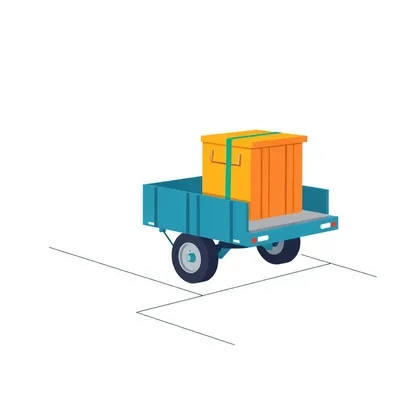
The standard one has a six hundred by four hundred millimeter platform — exactly the footprint of the large Eurobox. It's a low-profile wheeled platform with a raised lip that prevents the box from sliding off. Companies like Wanzl make the Dolly six hundred, rated for a hundred fifty kilograms. That's enough for four stacked forty-five-liter boxes, fully loaded. You tilt the stack slightly, slide the dolly under the bottom box, secure it with a strap, and now you've got a mobile tower of storage that rolls through hallways and fits in an elevator.
A hundred fifty kilos on four wheels. That's a lot of trust in a small piece of equipment.
It's designed for grocery distribution centers. It's absurdly overbuilt for home use. The wheels are polyurethane, non-marking, each rated for about forty kilos. The frame is welded steel. The thing will outlast you.
The alternative for someone who doesn't want a dedicated dolly?
A sack truck — what Americans call a hand truck — with a six hundred millimeter wide base plate. You can fit two or three stacked Euroboxes on it if you secure them with a ratchet strap. The advantage of the dedicated dolly is the lip that locks into the box base. With a hand truck, the boxes can slide sideways if the strap isn't tight enough. For moving day, I'd recommend the dolly. For occasional repositioning within the apartment, a hand truck is fine.
He's got his boxes, he's got his dolly. But before any of that, he has to actually buy the things. And that's the part of the prompt that I think is most practically useful — how do you approach an industrial supplier as a home user and not get laughed off the phone or quoted retail markup?
The dynamic is that these suppliers are used to B2B. Their default assumption is that you're ordering for a warehouse, a hospital, a logistics center. When a home user calls and says "I'd like to buy some boxes," the instinct is to treat it as a retail inquiry and point them to a distributor that marks everything up thirty percent.
You have to speak their language.
You have to present yourself as a small but serious buyer. And the key tool is a bill of materials. You don't call and say "I need about sixty storage bins." You send an email with a spreadsheet that specifies exact part numbers, quantities, and dimensions. "I need twenty units of Eurobox six hundred by four hundred by three hundred twenty millimeters, HDPE, with hinged lids. Fifteen units of six hundred by four hundred by two hundred millimeters. Four shelving units at two thousand by one thousand by six hundred millimeters, five shelves per unit, rated for two hundred fifty kilos per shelf." When you present it as a system specification rather than a shopping list, the vendor's brain switches from retail mode to fulfillment mode.
It's the difference between walking into a restaurant supply store and saying "I need a pot" versus "I need a twenty-quart stainless steel stockpot with an aluminum-clad base." One of those gets you the consumer price. The other gets you the professional nod.
There's a second tactic: ask for a system price, not per-unit pricing. Say "I'd like a quote for a complete storage system — shelving, bins, and lids — as a single package." Vendors are much more willing to discount a bundle than individual line items. You can typically get ten to fifteen percent off by packaging it this way. And if your order is substantial — sixty-plus bins qualifies — mention the total volume upfront. "I'm looking at approximately sixty bins across three sizes, plus four shelving units." That signals bulk without saying "I'm a warehouse.
The prompt mentions he found a surprising number of sites when he googled Eurobox systems in Israel, some of which seemed targeted at home users. So maybe he's not as much of an outlier as he thinks.
There's a growing niche of what I'd call "industrial chic" home storage. People who've been burned by IKEA's planned obsolescence enough times and are looking for something that lasts. In Israel specifically, there are suppliers like Mivtachim and Tamar Storage Solutions that do mostly B2B but have started seeing enough home-user inquiries that they've adapted. Keter Plastic, which is an Israeli company, has an industrial division that produces Euro-standard containers. They're best known for consumer-grade garden furniture, but their industrial line is the real thing.
Keter is one of those companies that's quietly enormous in a category nobody thinks about. They're the Samsonite of plastic.
Because they're local to Israel, their pricing is competitive. The prompt also mentioned that coastal humidity is a factor. HDPE Euroboxes are essentially impervious to moisture. IKEA particleboard bins — not so much. If you're in Tel Aviv or Haifa, within a few kilometers of the sea, that humidity will warp particleboard over time. HDPE doesn't care.
Let's talk about the long-term vision here. He said the aspiration is to own a home eventually. The shelving might need to be reconfigured. The bins stay. How does the Eurobox system adapt to that?
This is where the modularity really shines. Euroboxes aren't tied to a specific shelving system. You can put them on wire shelving, on Europanel wall rails, in built-in cabinetry, or just stack them on the floor. If you move from a rental where you had a two-meter-tall shelving unit to an owned apartment where you want built-ins under a window, you can reconfigure. The boxes don't care. The six hundred by four hundred millimeter footprint is the constant.
The shelving itself can be cut down or expanded. Wire shelving uprights come in standard lengths, and you can usually cut them with a pipe cutter if you need a custom height. Try doing that with IVAR without it looking like a woodshop accident.
There's also the Europanel system — a wall-mounted grid of horizontal rails that accept brackets. You mount the rails to the wall studs, clip in shelf brackets at whatever height you want, and lay Euroboxes directly on the brackets. No uprights taking up floor space. It's popular in workshops and garages, but it works beautifully in apartments where floor space is at a premium.
The wall becomes the shelving unit. That's a compelling idea for a small apartment.
It's future-proof in a way that consumer systems aren't. If you buy Europanel rails in twenty twenty-six and add more in twenty thirty-six, they'll fit. The rail profile doesn't change. The box footprint doesn't change. You're buying into an ecosystem designed for industrial continuity, not retail churn.
The opposite of IKEA, in other words. IKEA's business model depends on you coming back. The Eurobox business model depends on you never needing to come back.
Which is exactly why it's cheaper over a ten-year horizon. I want to address a few misconceptions, because I think they're what stop people from making this switch. The first is that industrial storage is ugly. Gray plastic boxes on metal shelves — it sounds like a warehouse. But Euroboxes come in a range of colors now. Black, translucent, even some muted blues and greens. And with fabric covers, labels, and thoughtful arrangement, it can look intentional. There's a whole aesthetic movement around "visible storage" where the system itself is the design feature.
The exposed-brick of home organization.
I'd call it the exposed-conduit of home organization, but yes. The second misconception is weight. People assume industrial plastic is heavy. A forty-five-liter Eurobox weighs about one point five kilograms empty. A SAMLA of the same capacity weighs about one point three. The difference is negligible. You're not hauling around steel crates.
The third misconception is the pallet jack problem, which we've already addressed with the dolly.
You don't need a forklift. You need a hundred-fifty-shekel dolly with four wheels and a strap.
Let me circle back to something you mentioned earlier about the vendor conversation. What about negotiation? If he's ordering sixty bins plus shelving, he's probably spending somewhere in the neighborhood of three to four thousand shekels. That's real money. Is there room to negotiate?
There is, and the leverage is the bundle. Most industrial suppliers have standard discount tiers based on order volume, but those tiers are designed for B2B quantities — pallets, not boxes. Sixty bins is below the typical bulk threshold, but it's still a meaningful order. The approach I'd recommend is to get quotes from two or three suppliers — Mivtachim, Tamar, maybe a Keter industrial distributor — and then go back to the preferred one and say "I've got a quote from a competitor at X. Can you match it if I bundle the shelving?" You're not bluffing; you've actually done the legwork. Suppliers in Israel, in my experience, are willing to negotiate on a complete system in a way they wouldn't on individual bins.
The "complete system" framing does a lot of work here. It transforms you from a retail customer into a project.
There's one more tactic: ask if they have overstock or discontinued colors. Industrial buyers care about color consistency across orders. If a supplier has a pallet of dark gray boxes that don't match the rest of their inventory, they'll often discount them heavily. For a home user, who cares if your storage boxes are dark gray instead of light gray? You're not matching a corporate brand palette.
Unless you are. In which case, you have bigger problems than storage.
The final piece I want to touch on is the actual moving-day logistics. He's got sixty Euroboxes. He's got a dolly. What does the move look like?
This is where I have opinions. I run what I call a miniature fulfillment center in my apartment. Shelf numbers, box numbers, open-source inventory software. When I moved, the system paid for itself. Every box had a label with a QR code. I scanned it, my phone told me which shelf it went on, and I was unpacked in an afternoon.
That's the pallet-moving system you've talked about — borrowing commercial standardization for domestic use.
The Eurobox system is the physical substrate for that. If every box is the same footprint, you can plan your shelving layout before you even see the new apartment. You know the dimensions. You know how many footprints fit along each wall. You can show up on moving day with a floor plan that says "shelving unit A goes here, shelves at heights forty, eighty, and one-twenty centimeters, boxes labeled B through F go on shelf two.
The dolly lets you move three or four boxes at a time from the truck to the shelving unit. No individual trips with one box in each hand. You load the dolly at the truck, roll it to the shelving, unload directly onto the shelves. The whole operation is linear.
The other thing is that Euroboxes stack securely in a moving truck. The interlocking ridges do the work. You can stack them four or five high against the truck wall, strap them in, and they'll ride without shifting.
I want to talk about sizing strategy for a minute, because "sixty bins" is a quantity, not a specification. The key is to measure what you're storing and match the box depth to the contents. Videography gear — a camera body with a lens attached is maybe fifteen centimeters tall. You don't need a thirty-two-centimeter-deep box for that. You'd use a six hundred by four hundred by two hundred millimeter box, which gives you plenty of height for foam inserts and dividers. Hobby equipment might need deeper boxes. Architectural drawings and plans might need the shallowest boxes — one hundred twenty millimeters — laid flat.
The beauty is that all three depths stack together because the footprint is identical. You can have a tower with a shallow box at the bottom, a medium box in the middle, and a deep box on top, and it's stable.
There's an online tool called the Eurobox Calculator that lets you input your available floor space and it'll tell you how many boxes of each size you can fit. It's designed for warehouse planning, but it works perfectly for apartment layouts. You measure your wall lengths, subtract door swings and windows, and the calculator spits out the optimal configuration.
I'm going to predict that within five years, someone launches a direct-to-consumer Eurobox brand with nice marketing photos and a Shopify store, and suddenly it's a lifestyle category. "Industrial storage for the modern home." And the early adopters who were buying from Mivtachim in twenty twenty-six will feel very smug.
It's already starting. There are boutique organizers in Tel Aviv and Berlin who spec Eurobox systems for high-end apartment buildouts. They pair the boxes with custom millwork — cabinets designed around the six hundred by four hundred footprint, with pull-out shelves sized for Euroboxes. It's elegant when it's done well.
The prompt mentioned that his wife is an architect. I imagine she has opinions about how storage looks.
That's where the integration potential gets interesting. Euroboxes can be concealed behind cabinet doors, or they can be the visible system. If she's thinking about the long-term home they want to own, she can design built-ins now that accommodate the Eurobox footprint, and when they move, the boxes come with them and slot into the new built-ins. It's a portable storage system with a custom housing that changes to fit each space.
That's a different paradigm from "buy shelves, fill them with bins, repeat." It's treating the bins as the permanent asset and the shelving as the disposable layer.
Which inverts the usual relationship. Most people spend money on the shelving and cheap out on the bins. The shelving is the furniture; the bins are the consumables. But if you flip that — invest in standardized bins and treat shelving as replaceable infrastructure — you get a system that survives moves, renovations, and changes in floor plan.
Let's pull this into something actionable. If you're the listener with a tape measure and a dream of organized shelves, what's your Monday morning checklist?
Step one: measure your stuff, not your space. Figure out what categories of items you're storing and what box depths they need. Step two: calculate how many boxes of each size you need. A Eurobox Calculator or just a spreadsheet will do this. Step three: measure your available linear wall space and figure out how many six hundred by four hundred footprints you can fit. That tells you your shelving configuration. Step four: build a bill of materials — exact part numbers, quantities, and a note that says you're requesting a system quote. Step five: send it to two or three suppliers and ask for bundled pricing. Step six: when you get quotes, negotiate. Mention competitor pricing. Ask about overstock colors. Ask if they'll throw in lids at no extra cost if you're buying sixty-plus bins.
Step seven: buy the dolly before moving day and test it. Don't discover that your hallway has a lip that the wheels can't handle while you're under time pressure. Load three boxes onto it, wheel it around your current apartment, make sure it navigates your doorways and elevator.
The dolly is one of those things that seems like an afterthought but is actually load-bearing, literally and metaphorically. A bad dolly makes the whole system feel clumsy. A good one makes you feel like a logistics professional.
There's something satisfying about rolling a tower of perfectly stacked boxes through a hallway. It's the domestic equivalent of a well-executed pit stop.
I want to address one more thing before we wrap up the practical section. The prompt mentioned that he's surprised by how many Eurobox suppliers seem to be targeting home users. I think what he's seeing is the early edge of a shift. The rental crisis isn't just an Israeli phenomenon — it's global. People are renting longer, moving more often, and living in smaller spaces. The consumer storage industry hasn't caught up. IKEA is still selling systems designed for the assumption that you'll live in one place for five years and then buy new stuff. The Eurobox approach is designed for the reality that you'll move four times in a decade and your storage needs to survive all of it.
It's the difference between storage as furniture and storage as infrastructure.
Infrastructure is boring until you need it to work. Nobody thinks about their plumbing until it fails. Nobody thinks about their storage system until they're staring at a pile of mismatched bins that don't stack and a moving truck idling outside.
The prompt is essentially asking: how do I make sure I'm never in that position again? And the answer is: buy into a standard that was designed for continuity, not churn.
There's a philosophical dimension here worth naming. Consumer culture is built on planned obsolescence. Not just in electronics, but in the physical containers that hold your life. Your storage bins get redesigned, your lids get discontinued, your shelving dimensions shift by two centimeters so the old brackets don't fit the new uprights. It's not a conspiracy; it's just that the incentives point toward incompatibility. A company that makes its bins compatible with competitors' bins is leaving money on the table. A company that makes its new bins incompatible with its old bins is creating repeat customers.
The industrial world doesn't work that way. If a logistics company buys ten thousand Euroboxes and the manufacturer changes the dimensions, they lose the account and probably get sued. The standard is the product. The plastic is just the delivery mechanism.
When a home user buys into the industrial standard, they're essentially freeloading on the stability that the B2B market demands. The manufacturer can't discontinue your bin size because Schoeller Allibert's biggest customer is a pharmaceutical distributor that has three hundred thousand of them in circulation. Your sixty bins are irrelevant to their product roadmap, which means your sixty bins will be available forever.
Freeloading on industrial stability. That's the entire thesis in four words.
It applies beyond storage. It's why I buy commercial-grade kitchen equipment. It's why some people buy ex-police vehicles. The B2B market demands durability and continuity in a way the consumer market actively avoids.
Let's bring this back to the specific situation. He's moving soon. He's got sixty IKEA bins that he's probably going to retire. What's the transition plan? Does he buy Euroboxes now and move with them, or does he move with the IKEA bins and switch later?
I'd say buy now and move with the Euroboxes. The move is the stress test. If you're going to invest in a system designed to survive moves, you want to use it for the move. Pack directly into the Euroboxes. Stack them on the dolly. Roll them onto the truck. At the new apartment, roll them off the truck and onto the shelving. You've just eliminated the unpacking step for anything that lives in storage.
The boxes are the permanent home for the items. They travel from shelf to truck to shelf without being opened.
That's the operational model that warehouses use. The bin is the storage unit. It moves through the supply chain intact. The only difference is that your supply chain is a rental truck and an apartment building elevator.
I'm thinking about the videography gear specifically. If you've got foam inserts cut to fit a Eurobox, and that box lives on a specific shelf, and you need to grab it for a shoot, you pull the box, take what you need, put it back. When you move, the box goes on the dolly, onto the truck, onto the new shelf. The foam inserts don't get unpacked and repacked. The organization survives the move intact.
That's the holy grail of moving. Usually, a move is a reset. You pack everything into cardboard boxes, you unpack everything at the other end, and you spend three months figuring out where things go. With a standardized bin system, the organization is persistent. The bins are already organized. You're just relocating them.
That changes the emotional experience of moving. Instead of chaos followed by slow re-emergence of order, you get continuous order with a brief interruption for transport.
I want to touch on one more practical detail: lids. Eurobox lids come in several styles. There's the standard flat lid that sits on top and locks with clips. There's the hinged lid that attaches to the box and flips open. There's the sliding lid that runs in grooves. For home use, I'd recommend the flat lid with clips for most boxes — it's the most secure for stacking and moving. Hinged lids are convenient for boxes you access frequently, but they add complexity and cost. Sliding lids are great for under-bed storage but less common.
The clips are important. Not all Eurobox lids come with clips. Some are just friction-fit. For moving, you want clips. A friction-fit lid will pop off if the stack shifts during transport. A clipped lid stays on.
The clips are typically a separate SKU. When you're building your bill of materials, make sure you spec lids with clips, or order clips separately. They're cheap — maybe two shekels each — and they're the difference between a secure stack and a lid popping off in the elevator.
To recap the procurement strategy: bill of materials with exact part numbers, system quote rather than per-unit pricing, two or three competitive quotes, ask about overstock colors, spec lids with clips, and bundle the shelving. And for moving: Eurobox dolly with a six hundred by four hundred platform, test it before moving day, strap the stack, and roll.
The long-term vision: the bins are the permanent asset. The shelving is adaptable. When you eventually buy a home, the bins slot into whatever configuration the new space demands, whether that's wall-mounted Europanel rails, built-in cabinetry, or freestanding wire shelving.
I think there's an open question here that's worth sitting with. Will the rental market ever force a standardization of home storage? Or will consumers always be stuck with disposable systems because the incentives point toward churn?
I think we're seeing the early stages of a shift. The "prosumer" storage market — people buying industrial equipment for home use — is growing because the pain of the consumer model is becoming more visible. Social media has made it easier to discover alternatives. Ten years ago, if you wanted Euroboxes, you had to know someone in logistics. Now you Google "Eurobox Israel" and you get a dozen suppliers with Hebrew-language websites and home-user pricing pages.
The information asymmetry is collapsing. The secret is out.
Once enough home users adopt the standard, we'll see brands emerge that specifically target that market. Eurobox Home, or whatever they call it. The boxes won't be different — they'll be the same six hundred by four hundred footprint from the same factories — but the branding and the buying experience will be consumer-friendly. We're not quite there yet, but we're close.
The listener who makes the switch now is an early adopter. In five years, they'll be the person at the dinner party explaining that they've been doing this for ages.
Their storage will still work. That's the real flex.
Alright, let's pull this into some concrete takeaways.
First: before you buy anything, measure your floor space and calculate how many six hundred by four hundred millimeter footprints you can fit. Use an online Eurobox calculator or just graph paper. Know your layout before you place an order.
Second: when you contact vendors, present a bill of materials and ask for a complete system quote. Mention the total volume — sixty-plus bins — to signal that you're a serious buyer even though you're a home user. Bundle the shelving, bins, and lids into a single package for the best discount.
Third: invest in a Eurobox dolly with a six hundred by four hundred millimeter platform and a strap. Test it with three stacked boxes before moving day. Make sure it handles your doorways, your elevator, and any thresholds.
Fourth: spec your box depths to your actual contents. Shallow boxes for flat items, deep boxes for bulky gear. Mix and match depths on the same footprint. And order lids with clips — don't learn that lesson the hard way.
The upfront investment is real. You're probably spending three to four thousand shekels on the full system. But if you're moving every two or three years, that pays for itself in two moves — not just in money, but in time, frustration, and the quiet satisfaction of a system that works.
You never have to stand in an IKEA aisle staring at a wall of bins wondering if the lids from your old ones will fit the new ones.
That alone is worth the premium.
And now: Hilbert's daily fun fact.
Hilbert: In eighteen twelve, the French geodesist Jean-Baptiste Biot measured the length of a seconds pendulum in the Turkmen city of Merv — modern-day Mary — as part of an effort to define the meter by a universal physical constant rather than a fraction of the Earth's meridian. The measurement came to nine hundred ninety-three point seven millimeters, differing from the Paris standard by nearly six and a half millimeters due to the difference in gravitational acceleration at that latitude. The modern equivalent — a laser interferometer gravity meter — can detect a change in local gravity equivalent to a single millimeter of elevation, meaning a modern surveyor could replicate Biot's entire expeditionary measurement from a single spot in under an hour without ever leaving the lab.
Biot dragged a pendulum to Turkmenistan and got a number that was six millimeters off, and now we can do it with a laser from a desk chair.
The expedition probably took six months. The laser takes six seconds. I'm not sure whether to be impressed or depressed.
This has been My Weird Prompts. Thanks to our producer Hilbert Flumingtop for the daily fact and for keeping the show running. If you've made the switch to industrial storage — or if you're thinking about it and have questions — we'd love to hear from you. Send us a note with your setup, your spreadsheet, your dolly recommendations. We might feature it in a future episode.
Find us at myweirdprompts dot com, or wherever you get your podcasts. We'll be back next week.
Until then, may your boxes stack and your lids never crack.