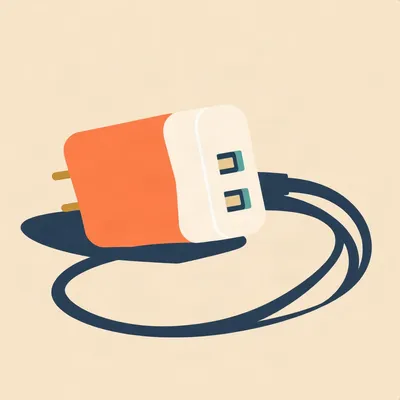
The Europlug is rated for two and a half amps. Two and a half. And Daniel is running a jigsaw on it.

Which is the whole problem in one number, really. It's a connector that was never designed to carry that kind of load, plugged into a socket that was never designed around it, and somehow everybody just lives with it.
Right. Daniel wrote us a long one this time. He wants to talk about plug types, and specifically a hardware pet peeve he's had since he started importing European appliances into Israel. They arrive with ungrounded two-pin Europlugs, and they do fit into Israeli three-pin sockets and the universal outlets you find on some PDUs here. But the fit is bad. Not catastrophic, just bad. A marginal grip that he mostly tolerates, except on power tools. Jigsaws, corded drills, a high-powered Dremel. On those, a shaky connection is distracting. His words, roughly: if you accidentally yank a bit too hard, it's going to pull straight out of the wall.
And he's not wrong to be bothered by that.
He also remembers we talked about Commando plugs, the industrial locking connectors, and he points out those are mostly for three-phase gear and some of them are enormous. So he sees a huge gap between the shaky two-pin Europlug and the good stuff on a building site. His proposed fix is to re-terminate Europlugs onto Israeli plugs. He says the ground pin does nothing, which is true on these appliances, but you get three points of contact instead of two. He's open to basically any idea for a more solid connection. He's even bought a couple of industrial plugs to experiment with. But he names the trade-off himself. Once you re-terminate, you lose casual portability. And he's been using IEC cables in his home office lately, and he thinks serious appliances need a robust mechanical connection if they can't be locked.
That's a lot of ground, and I think the interesting thing is that every one of those instincts is basically correct.
So where do we even start with this.
We start with the fact that this isn't really about electricity at all. It's about mechanical contact force. A plug is a mechanical interface first and an electrical one second. The electrons only get to move because two pieces of metal are being held against each other with enough force and enough overlap to make a low-resistance joint. If the grip is marginal, the joint is marginal, and everything downstream of that is just physics playing out.
Which means the design of the pins is the whole story.
It's most of it. And there are three tiers worth walking through. At the bottom you've got the Europlug, CEE 7/16. In the middle you've got the Israeli Type H, which is SI 32, and the IEC 60320 couplers, the kettle-lead family. And at the top you've got IEC 60309, Commando, CEEform, the building-site stuff. The Europlug sits at two and a half amps. The middle tier sits at ten to sixteen. Commando goes up to eight hundred.
That's a strange ladder. The bottom rung isn't a smaller version of the top rung. It's a completely different philosophy.
The Europlug isn't a scaled-down power connector. It's a compromise connector for double-insulated appliances that don't need earth. And that's where we should dig, because the marginal fit Daniel experiences isn't a defect. It's the design working as intended.
So the fix he's proposing is real, but before we get to it, we need to understand why the thing fits badly in the first place.
And it fits badly by design, Corn. EN 50075 defines the Europlug as rated for two and a half amps at two hundred fifty volts. That's it. That's the number. It exists for low-power Class II appliances, the double-insulated ones, the ones that don't require a protective-earth connection. So it's not that the manufacturer cheaped out. It's that the standard was written for a different job than the one Daniel is asking it to do.
Okay, but two and a half amps is almost absurdly low. A hair dryer pulls more than that.
A hair dryer pulls a lot more than that, which is why a hair dryer doesn't come with a Europlug. The pin geometry is where it gets interesting. The pins are nineteen millimeters long. There's a nine-millimeter conductive tip, four millimeters in diameter, with a rounded end. Then there's a ten-millimeter flexible insulated shaft that's no more than three point eight millimeters in diameter. And then the part that actually matters: the two pins are not parallel. They converge slightly. The centers are seventeen to eighteen millimeters apart at the tip, and eighteen to nineteen millimeters apart at the base.
So they splay out as they go in.
They splay out, and the elasticity of those converging pins is what provides the contact force. That's the mechanism. The pins are springy on purpose. They're designed to flex outward and grip whatever they're pushed into.
Which is clever if you're trying to fit one plug into a dozen different socket standards across Europe.
That's exactly what it's for. And here's where it gets specific to Daniel. Israeli Type H sockets have five-millimeter round holes, centers spaced nineteen millimeters apart. That gives you a minimum inter-hole distance of fourteen millimeters. The converged Europlug pins are thirteen point five millimeters apart at minimum. So the pins have to flex outward to grip. There's a half-millimeter of interference, and that interference is the entire contact force.
Half a millimeter.
Half a millimeter, and the Wikipedia entry on the Europlug actually says this quietly: the design allows it to grip the socket despite its smaller pin width. That's the marginal grip. It's not a bug. It's the mechanism working at the edge of its tolerance.
Which explains why Daniel's experience is inconsistent. Sometimes it feels fine. Sometimes it feels like the plug is just resting in there.
And the dimensional variance in the real world makes it worse. The Museum of Plugs and Sockets measured actual Israeli sockets, not the spec, the real ones. Older SI 32 sockets have round holes of four point three to four point six millimeters. A newer 2013 socket had five point two millimeter slots. And a new-model SI 32 plug had pins of four point one millimeters diameter and about seventeen point eight to eighteen point three millimeters long, which the museum describes as marginally thinner and shorter than specified in SI 32.
So the socket got bigger and the plug got smaller, and nobody coordinated.
Nobody coordinated. Put a four-millimeter Europlug pin into a five point two millimeter socket hole and you've got a one point two millimeter gap per pin. That's not a grip. That's a suggestion.
That's the part people miss. It's not that the Europlug is badly made. It's that the socket and the plug were designed decades apart for different loads and the tolerances never lined up.
And that's before you get to the compliance problem, which is where Daniel's plan runs into friction. EN 50075 requires Europlugs to be non-rewirable and permanently attached to a cord or appliance. Anything else is non-compliant. A factory Europlug is a moulded, sealed unit. There are no screws. There's nothing to open.
So the moment he cuts one off, he's not modifying a Europlug. He's removing it.
And he's doing something the standard explicitly forbids. Now, that's not illegal for a homeowner in his own workshop. People do it all the time. But there's no such thing as a rewireable Europlug, and that's on purpose. It's a throwaway interface.
Okay. But the ground pin thing. He says the ground pin does nothing, and I think he's right, but I want to make sure we get the reason right.
He's right, and the reason is that Europlugs are only designed for Class II double-insulated devices that do not require a protective-earth connection. So the appliance, by design, has a two-core flex. There's no earth conductor in it. If you re-terminate that flex onto an Israeli Type H plug, the earth pin is electrically dead. It's connected to nothing.
It's a mechanical ground, not an electrical one.
It's a mechanical ground. You're buying a three-point mechanical interface, and the third point is doing nothing but holding the plug in place. Which is worth saying clearly because it changes what Daniel is actually buying. He's not buying earthing. He's buying retention force.
And there's a counterpoint worth naming here, because the Israeli plug he wants to move to has its own problem.
It does, and it's a real one. Worldstandards dot eu calls Type H among the most dangerous ones in the world, and the reason is that the prongs are not insulated and the sockets aren't recessed. If a Type H plug is pulled halfway out, its prongs are still connected to the socket. There's no shroud, no insulation partway up the pin. So you can absolutely touch a live conductor if you're careless.
The good stuff has its own shock risk.
The good stuff has its own shock risk. That's not a reason not to do it. It's a reason to know what you're trading. Daniel would be moving from a connector that falls out too easily to one that doesn't fall out but exposes live metal if it's halfway pulled. Neither is perfect. You're picking which failure you'd rather have.
The Israeli plug is rated sixteen amps, though. That seems like the actual prize.
Sixteen amps at two hundred fifty volts, three round four point five millimeter pins. So there's a real power rating jump. And there's history behind why the rating changed, which explains a lot about why the fit is so inconsistent. The old flat-pin SI 32 was rated only ten amps. In the early nineteen eighties, the rating was arbitrarily increased to sixteen amps in order to power electrical equipment imported from Europe. Those are the words from a trade supplier, Morvan Trading. But the original flat-pin design could overheat at higher loads, so a round-pin plug was introduced in nineteen eighty-nine with sockets that accept both types. As of two thousand, only the round-pin version should be sold.
The standard was playing catch-up with the appliances coming in.
Reactively. And that's why the tolerances are so loose. It's a standard that got patched rather than designed. Which brings us to the second half of Daniel's problem, which is that all of this matters more on a jigsaw than on a phone charger.
That's the part where I actually get the pet peeve as something more than aesthetic annoyance. He's not just bothered by the wobble. He's bothered because the wobble is happening on a motor.
On a motor, and on a motor the moment of connection is the worst possible moment to have a high-resistance joint. A stationary induction motor has no back-EMF opposing the supply, because it isn't spinning yet. So for a fraction of a second at startup, it draws five to eight times its running current. A saw running at thirteen amps can momentarily draw far more than that. And if the plug is loose, the resistance is highest exactly when the current is highest.
That's the failure cascade.
Voltage drop starves torque. The motor bogs, the tool lacks power, and the cord and plug get hot because the current is above what the connection can carry. Underperformance means motors struggle to reach full speed or bog down easily, and that overheats them and shortens their life. So Daniel's discomfort on a jigsaw isn't just distraction. It's a real electrical stress point. A loose connection is a hot connection, and a hot connection on a motor that needs to spin up fast is a compounding problem.
It's self-reinforcing, isn't it. The heat degrades the contact, which raises the resistance, which raises the heat.
It's a slow spiral. This is also where I'd push back on the idea that the plug is the only variable. A high-resistance connection can be the plug, the socket, or the interface between them. If the socket is old and worn, you can re-terminate the plug perfectly and still have the problem.
Which is the thing Daniel is going to run into. He fixes the plug, and he might be fixing half the problem.
Half the problem, maybe less.
That's the mechanism, and that's why it matters on a motor. Now, the question Daniel actually asked is what to do about it. And he's got three options on the table. Re-terminate to an Israeli plug. Build a dedicated plug strip for a sturdier connector. Or find a middle ground.
The middle ground is where I'd spend most of our time, because it's the answer he's already been circling without naming it. IEC 60320. The kettle lead.
He says he's been using IEC cables in his home office lately.
That's the right instinct, because IEC 60320 is the ecosystem that actually fills the gap. The C13, C14 pair, the classic kettle lead, is rated ten amps in the IEC standard and fifteen amps in the UL standard for North America. The bigger one, C19 and C20, is rated sixteen amps in IEC and twenty in UL, which matches the Israeli sixteen-amp socket rating exactly.
The C19 is the one that would actually match.
For a workshop, yes. C19 is the one that lines up with what an Israeli socket is rated for. And here's the part that matters for Daniel's problem. IEC 60320 is explicitly a non-locking standard, but the standard defines withdrawal forces, testing procedures, and minimum insertion cycles. It's not vague about retention. Interpower publishes the withdrawal-force test: the C13 connector must release a C14 inlet gauge, with all three pins, at fifty newtons of force to prevent damage to equipment. And each contact must hold a one point five newton gauge for three seconds to ensure safe, reliable contact design.
Fifty newtons is a real number.
Fifty newtons is about five kilos of pull on a connector. That's a standardized, measurable retention force. Compare that to the Europlug's marginal grip, which isn't really specified as a retention force at all. It's just the product of spring tension and dimensional variance.
The IEC ecosystem gives him a defined number.
It gives him a defined number, and then if he wants more than that, the locking add-ons exist. SCHURTER has the V-Lock interlocking system, which is specifically for preventing unintentional removal of power. Schaffner has a locking system with a tensile force of typically three hundred newtons. And Interpower sells connector locks, tool-free and locking-screw versions, that secure cordsets to IEC 60320 power inlets to prevent accidental power interruption.
Three hundred newtons. That's a completely different category from anything a Europlug can do.
It's a different category. And that's the answer to Daniel's question about middle ground. The middle ground isn't a connector between the Europlug and Commando. It's the IEC 60320 ecosystem with a locking add-on. And it's the natural ded