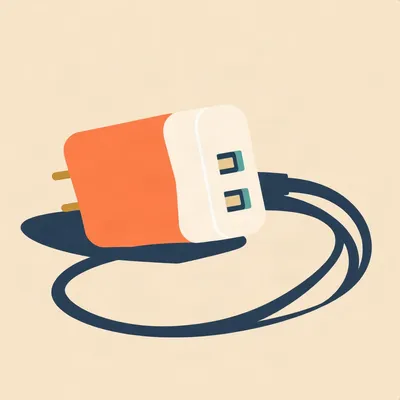
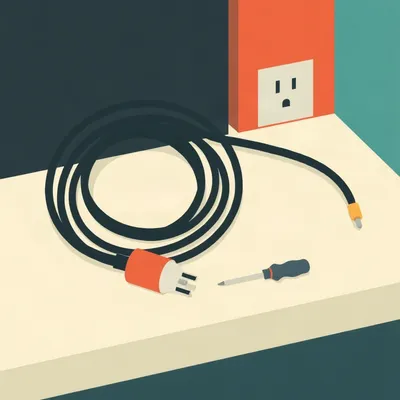
A box of forty power supplies, none of them labelled, and exactly one that fits — and the whole reason that box exists is that an entire industry could not agree on a tube.

Two dimensions. That's what it comes down to. An outer diameter and an inner diameter, and the fact that nobody could standardise them for fifty years.
Which is more or less what Daniel wrote in about. He's been doing his own connections and home networks for years, and he says the things you end up needing over and over are almost never the things you sit down and actually learn properly. He puts IEC connectors in that bucket — he's been meaning to memorise them and still mixes up C13 and C14. His own method for a mystery barrel head is probably most people's: find the one with the right voltage, then try them until something fits. He knows there are reference charts with interior and exterior dimensions, and he knows those charts assume a caliper. So he wants the landscape, plus some rules of thumb for the next time any of us is digging through the box.
Excellent. — this is one of those topics where the theory is thin and the practice is daily.
So let's start with what a barrel jack actually is, and why the dimensions are specified the way they are.
Coaxial power connector is the proper name. You've got a hollow cylindrical sleeve on the outside and a single pin down the middle — two contacts, no more. The female side, the one mounted on the device, is the jack. The male side on the cable is the plug. And the gender convention is backwards from what people expect. What determines it is the inner contact. If there's a pin sticking out, it's a plug. If there's a socket to receive that pin, it's a jack.
And the size is written as a multiplication.
Outer diameter times inner diameter. So the one everybody owns is five point five by two point one millimetres — that's the sleeve bore at five point five, the centre pin at two point one. Some higher-power plugs carry a third number, the centre pin diameter, and that shows up on laptop bricks where the pin graduates rather than staying straight. But for ninety-five percent of what's in the box, it's two numbers.
Neither of those numbers tells you the voltage.
Nothing on the connector tells you the voltage. That's the whole disease. You can't look at a barrel plug and know whether it's carrying five volts or nineteen, and you can't know which contact is positive. The outer terminal is usually ground and the inner is usually the positive rail — centre positive, they call it — but that's a convention, not a physical property. There's nothing in the geometry stopping a manufacturer from wiring it the other way. Centre negative is uncommon, and it is very real, and it's how you kill a pedal.
So two connectors of different sizes can carry identical power, and two connectors of identical size can carry entirely different power.
Correct. And that's before we get to the standards bodies, which is where this gets fun.
Standards bodies are where everything gets fun.
The first attempt is IEC 60130-10, nineteen seventy-one. Five connector types. Type A covered the five point five millimetre barrel at both two point one and two point five inner diameters, with an optional screw lock. Type B was six millimetres outer, same two inner options. Type C was the little three point eight by one point one. Type D, six point three by three point one. Type E, three point four by one point three. Top voltage across the whole scheme: thirty-four volts DC.
Five types, one whole standard, and the box still exists.
Because nobody adopted it uniformly. Then in Japan you get EIAJ RC-5320A, published the first of March, nineteen ninety-two, and still valid today. This one's clever. Five sizes, each tied to a voltage range. EIAJ-01 is two point three five outer, zero point seven inner, nought to three point one five volts. EIAJ-02, four point oh by one point seven, three point one five to six point three. EIAJ-03, four point seven five by one point seven, six point three to ten point five. EIAJ-04, five point five by three point three, ten point five to thirteen point five. And EIAJ-05, six point five by four point three, thirteen point five to eighteen.
So the voltage is encoded in the mechanical size.
That's the design philosophy, and it's good. Higher voltage means a physically larger plug, so a larger plug will not go into a smaller jack. You can't accidentally put the eighteen-volt supply into the three-volt device, because it doesn't fit. All five are nine point five millimetres long, all rated two amps, and they're colour-coded by the insulating material so you can tell the near-identical ones apart. That's the famous yellow ring.
And the DIN attempt?
DIN 45323, eighty-two, two sizes — five point oh by two point oh, and six point oh by one point nine eight, one of them rated thirty-four volts at three amps. Withdrawn now.
Three standards. One from each of the three industrial powers of the twentieth century. And the result is a box of forty power supplies.
The lines from Wikipedia on this are brutal and they're accurate. It says new sizes will quite possibly continue to appear and disappear. And it names the reason — a manufacturer may use a new size specifically to discourage third-party power supplies, either for technical reasons or to force use of their own accessories, or both.
So it's not even engineering drift. It's a lockout with a barrel on the end of it.
It's a business model that happens to look like a connector.
Give me the sizes that actually matter in the real box.
Five point five by two point one is king. Guitar pedals, Arduino boards, CCTV cameras, routers, the majority of commercial DC supplies you've ever owned. Five point five by two point five is the next one down — less common, chosen when you want slightly more current and a bit more mechanical ruggedness. The Miniware TS100 soldering iron runs on it, that's the classic example. Then three point five by one point three, or the near-identical three point five by one point three five, which is the second family overall and lives on compact devices and low-voltage gear.
And the five point five family has a trap in it.
The best trap in the entire topic. A two point one plug will fit into a two point five jack. Loosely. It'll go in, it'll make contact, it will probably work. But a two point five plug will absolutely not fit a two point one jack, because the centre pin is too big for the socket. So the failure is one-directional. That asymmetry is the whole thing.
"Works but resets randomly" is the sound of a two point one plug in a two point five jack.
That's it exactly. The loose fit means intermittent contact, and intermittent contact on a DC line under any real current means arcing. And people chase that fault for weeks. They'll swap the power supply, they'll reflash the firmware, they'll blame the router. The problem is four-tenths of a millimetre of slop.
You have a case. I can hear you sitting on a case.
There's a documented industrial failure that I think about — a five point five by two point five plug substituted into a five point five by two point one jack. That's a zero point four millimetre gap. Intermittent arcing over the life of the run delaminated a pad on the circuit board and heat-distorted the housing. Ruined a batch valued at forty thousand dollars.
Forty thousand dollars, from a connector that felt like it went in.
It did go in. That's the horror of it. The plug seated. It looked right. It passed whatever quick test was done at the time and it failed slowly, thermally, over weeks.
Okay. Daniel wants rules of thumb, so let's give him rules of thumb. What's the actual workflow when you're standing over the box?
The label on the device is not optional. Voltage, current draw, and polarity. If the device has no label and you have no manual, you find the manual.
And if you can't find the manual?
Then you have a paperweight and a story.
Harsh.
It's true, though. Match the voltage exactly. Don't go up and don't go down. Too high will kill components outright, too low and the device misbehaves in ways that look like software faults — brownouts, resets under load, that sort of thing. For current, the supply has to be able to deliver at least what the device draws. A supply rated for more current is generally safe, because the device takes what it needs and no more. A supply rated for less is the risk — it overheats and the voltage sags under load.
That one trips people up because the instinct is the opposite. "This brick is bigger, it'll fry my thing."
The instinct is wrong. The device pulls current, the supply doesn't push it. It's not a hose.
Then polarity. Then size.
Verify polarity before anything else. Centre positive is the overwhelming default, but check, because reversing it burns the device. Wikipedia's line on this is about as blunt as a reference work gets — "use of the wrong power supply may cause severe equipment damage or even fire." And then the final check is the fit itself. If the plug is loose in the jack, it's the wrong size and you don't use it. Not "it'll do for now." You don't use it.
Now — measuring without a caliper. Which is the part of Daniel's question I have the least satisfying answer to.
So do I. I want to be honest here. The general principle is that you're matching outer diameter, inner diameter, and barrel length, and confirming voltage, polarity and current. What I could not find a solid source for is the specific tricks — the drill-bit gauges, the paper and tape methods, the whole folk-remedy aisle. I'm not going to sit here and invent them.
Which is the right call.
Some of them may work fine. I don't have anything I'd stake the episode on. A caliper is the correct tool and costs less than one of the power supplies in the box. The fact that nobody owns one is precisely why the box got to be the size it is.
The box is a monument to not buying a twelve-dollar tool.
It is.
Alright. Now the other half of Daniel's question, and the part he openly admits to being confused by.
IEC 60320.
So Daniel's been meaning to memorise these for years and still mixes up C13 and C14. Is there a rule, or is this just more chaos?
There's a rule, and it's a good one, and almost nobody knows it. The standard sheet for the appliance inlet is always one higher than the sheet for the corresponding cable connector. That's it. So the inlet that sits in the back of the computer — the one with the three pins sticking out at you — is the higher number, C14. And the connector on the end of the cable that plugs into it, the one with the holes, is the lower number, C13.
So odd is the cord, even is the equipment.
That's the mnemonic. Odd is the cord connector, which is female. Even is the appliance inlet, which is male. C13 female on the cable, C14 male on the computer. C15 female on the cable, C16 male on the appliance. C19 female on the cable, C20 male on the server. Once you've got that, you never get it wrong again.
Say that again, because I want to hear whether it survives me nodding along.
The inlet sheet is one higher. Odd numbers are cords. Even numbers are the sockets built into equipment. C13 is the kettle lead. C14 is the hole in the machine.
Right, and the "kettle lead" is the thing that nearly everyone says and it's wrong.
It's wrong in the way that matters. C13 and C14 are rated to a maximum pin temperature of seventy degrees Celsius. Real electric kettles run hotter than that, so they need C15 and C16, which are the same shape but rated to a hundred and twenty degrees. And here's the safety trap. The C16 inlet has a ridge on it that physically stops a C13 going in. The C15 connector has a matching valley cut into it, so a C15 will happily fit a C14 inlet. So the compatibility runs one way.
Meaning —
Meaning an electric kettle cord can be used to power a computer, but an unmodified computer cord cannot be used to power a kettle.
That sentence is the entire episode and we're only two-thirds through.
It's the cleanest one-line statement of the problem I've ever read. And it's not a trivia point. Somebody who's moved house and is short one cord in the kitchen will absolutely try the computer cord on the kettle. It will not go in, and the reason it won't go in is that some standards committee in the seventies decided that particular mistake should be physically impossible.
That's a standard doing its job. Depressing that it's the exception rather than the rule.
The dimensions on C13 and C14 are ten amps under the IEC rating, fifteen under UL in North America, pin spacing fourteen millimetres horizontal by four vertical. Earthed, polarised. It's on your PC, your monitor, your printer, your server, your switch, your instrument amp.
What else should people recognise on sight?
C5 and C6 is the cloverleaf — people call it the Mickey Mouse connector, three little round pins. Two point five amps IEC, thirteen under UL, and it's on a lot of laptop power bricks. C7 and C8 is the figure-eight, or infinity, two point five amps, audio and video gear, double-insulated supplies. And then C19 and C20, which is the one people get wrong in the other direction — sixteen amps IEC, twenty under UL, on enterprise servers, UPSes and PDUs. It is not interchangeable with C13 and C14 and it will not fit either.
There's an unearthed variant in there too, isn't there.
C17 and C18. Same shapes as C13 and C14 but with no earth. A C18 inlet will accept a C13 connector, which is slightly unnerving, but a C14 inlet will not accept a C17, because the C17 has a keyway that blocks it. It's the same one-way logic as the kettle.
And the thing that shocks people about all of it — no pun intended — is that none of these are keyed for voltage.
Correct. IEC 60320 couplers are not keyed and not colour-coded to indicate voltage. The connector will fit the socket. Whether the socket is the right voltage for the appliance is entirely on the user, and it depends on where in the world you are. The connector is standardised. The mains behind it is not.
So the standard solves the mechanical problem and leaves the electrical one exactly where it was.
It solves the problem of "which plug fits which hole." It is completely indifferent to whether you should be joining them.
That's the connecting thread across both halves of this, actually. Barrel jacks and IEC couplers are the same failure of imagination. They standardise the shape and leave the meaning unspecified.
And the shape-standardisation mostly failed anyway on the DC side. The EIAJ scheme was the only one that tried to bind shape to meaning, and it's the one nobody outside Japan adopted.
Then someone at the desk has been waiting a while.
Hilbert: They're all correct. I've got about a hundred of them.
A hundred.
Hilbert: Roughly. A hundred and six, if I count the ones in the shed, which I do. I ran a repair desk for a school district for eleven years. Two hundred and forty laptops, and every single one of them had a power brick with a barrel connector on it, and every brick had a little yellow tip taped to it with a label maker.
And they all fitted each other.
Hilbert: No. That was the point. They were deliberately different from each other. The district bought three hundred and twelve machines in one order in the spring, and the supplier shipped them with four different power supplies because there was a shortage on one of the part numbers. Four different barrel sizes across one purchase order. Same model laptop.
Same machine, four plugs.
Hilbert: Same machine. So we labelled them. That was it. That was the entire solution. Little blue tip, little blue label on the bottom of the laptop. Anything that went into the repair cupboard without a tip came back with a piece of tape on it. That's what happened in the real world. Nobody measured anything. We just made sure the label matched.
And the hundred and six you own.
Hilbert: A hundred and six tips. I kept the tin when the contract ended. Doesn't cost anything to keep a tin.
What was the yellow for?
Hilbert: Five point five by two point five. The blue was two point one. There were two sizes in that district and about four hundred cables, and we lost exactly one machine in eleven years because somebody found a cable in a drawer with no tip on it.
One machine.
Hilbert: It was a cart machine. Reset every time a kid wheeled it over a door threshold. We couldn't reproduce it standing still. My boss kept testing the supply on a bench and it read perfect every time — because it was perfect at rest. It wasn't until we watched it get rolled that we worked it out. Loose plug, held by gravity, moved when the cart moved.
The two point one in a two point five.
Hilbert: The loose one. Took us the better part of two terms to figure it out, and the fix at the end was a piece of blue tape. That one's the reason I kept the tin.
The tin is documentation.
Hilbert: The tin is the paper trail. There's no standard coming. Somebody measured it once, in a workshop, and the tin is the standard now.
There's a clean ending to this and it's not going to be a satisfying one. Will the chaos ever be tamed? IEC 60130-10, EIAJ RC-5320A, DIN 45323. Three standards, decades of committee time, and the honest summary is that they largely failed. New sizes keep appearing and keep disappearing, and per Wikipedia, at least one of the reasons they appear is outright lockout — a manufacturer picking a fresh diameter specifically so your old supply doesn't fit.
So no. The box survives. The incentives that create the box are still in place, and they're stronger than any standard has been.
And the IEC odd-even rule is the sort of thing that could save enormous amounts of confusion, but only for the people who happen to have heard it once.
Which is why we said it twice.
The thing I'll take out of today is Hilbert's tin, actually. We spent the episode on the theory, and the working answer in the field was a label maker and a colour code that one man remembers. Next time you're standing over your own box, you'll know why it exists, what's actually at stake — remember the plug that looked like it fitted and cost forty thousand dollars — and the one asymmetry that explains most of the mystery. Two point one in a two point five fits badly. Two point five in a two point one doesn't fit at all.
And if you enjoy this sort of thing, please leave us a review wherever you get your podcasts. It helps other listeners find us. Our producer is Hilbert Flumingtop. This has been My Weird Prompts.
The human-AI collaboration podcast. We'll be back soon.