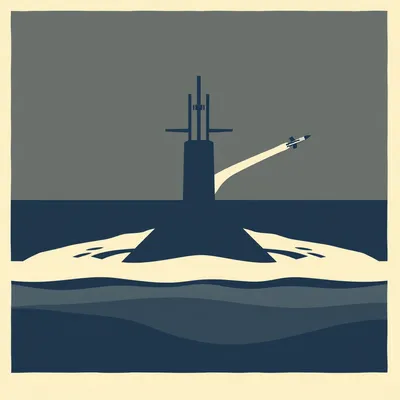
Imagine waking up knowing you won't see the sun for the next ninety days — and you're sharing a four-hundred-foot tube with a hundred and thirty other people who also signed up for this. So Daniel sent us this question about what daily life is actually like aboard a submarine. He points out that countries like Israel are believed to always keep at least one submarine at sea as a deterrent, which means there are people spending significant stretches underwater in service of their country. The core question is: how do these sailors stay sane when they can't see the sun and they're operating in a confined space? And is there a hard human limit to how long someone can stay submerged, regardless of the submarine's technical endurance?

The submarine is the ultimate paradox of military engineering. A nuclear submarine can generate its own oxygen through electrolysis of seawater, it can make its own fresh water, and its reactor can run for decades without refueling. Technically, a Virginia-class boat could stay submerged for its entire twenty-to-thirty-year service life. But the humans inside it? Completely different story.
The machine can outlast the crew. That's the tension.
And the numbers back this up fast. The US Navy's Ohio-class ballistic missile submarines — these are the strategic deterrent boats, the ones carrying twenty-four Trident II D5 missiles — they patrol for seventy to ninety days at a stretch. The UK's Vanguard-class boats do similar durations. France's Triomphant-class runs comparable cycles. And then there's Israel's Dolphin-class, which are diesel-electric with air-independent propulsion — those are rumored to stay out for fifty-plus days, though the Israeli Navy reportedly caps patrols at around thirty days specifically for crew psychological health.
That's an explicit acknowledgment of the human limit, right there.
It really is. And that's a navy that knows exactly what it's asking of its people. Compare that to fast-attack submarines — SSNs — which do shorter patrols, typically thirty to sixty days, but the missions are more dynamic. They're hunting other submarines, gathering intelligence, inserting special forces. The crew's stress profile is different. It's not the slow-burn endurance test of a deterrent patrol; it's bursts of high-intensity focus punctuated by long stretches of boredom.
What actually breaks first? You mentioned the reactor can run for decades. The oxygen generators are fine. The water makers are fine. What fails in the human body when you take away sunlight for months?
Sleep is the first casualty, and everything else cascades from there. Submarines don't run on a twenty-four-hour day. They run on an eighteen-hour cycle — six hours on watch, six hours of maintenance and training, six hours off. That sounds manageable on paper, but your body's circadian clock is calibrated to roughly twenty-four hours. When you force it onto an eighteen-hour rhythm, you're creating a state of perpetual jet lag. And there's no natural light to reset the clock.
No sunrise to tell your brain it's morning.
The suprachiasmatic nucleus — that's the master clock in your hypothalamus — it relies on blue-spectrum light hitting the retina to synchronize. Without that signal, your melatonin production drifts. You get sleepy at the wrong times, you're wide awake when you should be sleeping. The US Navy ran a study in twenty-nineteen that found sixty-seven percent of submariners report clinically significant sleep disturbance during patrols. That's two out of three crew members.
Sixty-seven percent. So the majority of the crew is walking around with fragmented sleep for months.
They're averaging five to six hours of sleep per twenty-four-hour period, and that sleep is fragmented. It's not one solid block. They're grabbing naps between watch rotations, between maintenance periods, between drills. There's a study from twenty-fourteen — the USS Wyoming, an Ohio-class SSBN, tracked crew melatonin levels across a seventy-seven-day patrol. Melatonin levels dropped forty percent by day thirty and didn't recover until two weeks after they returned to port.
Two weeks to reset. So even when you're back on land, your body is still underwater.
Melatonin isn't just about sleep. It's involved in immune function, in mood regulation, in cellular repair. When you suppress it for months, you start seeing secondary effects. Vitamin D deficiency is the obvious one — after about sixty days without sunlight, your body's vitamin D stores are basically depleted. The body starts pulling calcium from bones to compensate. The Navy now mandates six hundred international units of vitamin D supplements daily, but that doesn't fully replace what your skin produces from sun exposure.
Bone density loss. On a submarine. How significant are we talking here?
It's slow, and it's not like these guys are coming back with osteoporosis, but it's measurable. Think of it like an accelerated version of what happens to astronauts in microgravity. On the ISS, astronauts lose about one to two percent of bone density per month in weight-bearing bones. Submariners aren't dealing with microgravity, obviously, but the vitamin D deficiency combined with the confined environment — where you're not exactly running marathons — creates a similar, milder effect. A study out of the Naval Submarine Medical Research Laboratory tracked bone density markers in crews before and after seventy-day patrols and found measurable decreases in calcium absorption efficiency. It rebounds eventually, but during the patrol itself, you're essentially running a deficit the whole time.
The body is slowly cannibalizing itself while you're down there.
In a very literal sense, yes. And then you layer on the psychological stressors. Here's something most people don't understand about submarine duty — even during peacetime, the crew is operating in a combat-ready state. The boat is constantly listening, constantly hiding, constantly aware that it's a primary target. That hypervigilance doesn't switch off.
Because you can't step outside for a breather.
You can't step anywhere. There's a concept called the iceberg principle in submarine psychology. Ninety percent of the crew's anxiety is invisible — it's about family back home, about a sick parent, about a kid's school play they're missing, about a spouse who's struggling. But none of that gets expressed because the operational environment demands emotional suppression. You can't have a breakdown in the sonar shack.
There's no communication with home during a patrol, right?
SSBN crews get something called family grams — short, screened text messages, maybe fifty words, transmitted periodically. No real-time communication. No phone calls. You don't know if your wife's surgery went well until days later. That's a unique form of psychological torture that surface sailors don't experience in the same way. Surface ships get email, they get port calls, they get satellite phone access. The submariner gets fifty words every few days, and even those are screened by command.
You're not just isolated physically — you're isolated from the emotional rhythms of your own life.
That's the part that catches people off guard. You can prepare for the confinement. You can prepare for the work schedule. But the specific agony of knowing your kid took their first steps three weeks ago and you're finding out through a fifty-word message that's been reviewed by an officer — that's a unique form of helplessness.
You've got sleep deprivation, vitamin deficiency, bone density loss, emotional suppression, and zero contact with your family. That's the baseline. And then there's the sensory environment.
The sensory environment is relentless. Constant background noise — fifty-five to sixty decibels, which is about the level of a conversation in a restaurant. But it never stops. Fans, pumps, ventilation, sonar pings echoing through the hull. Your brain never gets silence. There's a phenomenon called auditory habituation where you stop consciously noticing it, but your nervous system doesn't. Cortisol levels stay elevated.
The smell is its own thing. Diesel, amine from the CO2 scrubbers, recycled air that's been through the lungs of a hundred and thirty people, cooking oil from the galley, and the accumulated odor of a hundred and thirty bodies that are showering once every few days because fresh water is technically unlimited from the water makers but hot water is rationed.
No private space either.
Even the captain's stateroom is six by eight feet. Junior enlisted sailors sleep in racks stacked three high in a shared berthing area, with a curtain for privacy. Your rack is your only personal space in the entire world for months. It's about the size of a coffin — roughly six feet long, three feet wide, maybe two feet of vertical clearance. You've got a reading light, a small locker, and that's it. And new submariners — they're called cranks in the US Navy, sparkers in the Royal Navy — they spend their first thirty days working eighteen-hour days in the galley. It's a deliberate hazing mechanism.
The Navy intentionally hazes new submariners?
It's framed as qualification training and team integration, but functionally, yes. The idea is that shared suffering builds cohesion. You put the new guy through the hardest job on the boat — scrubbing pots, hauling supplies, working brutal hours — and if he makes it through, he's part of the tribe. It's not sadistic; it serves a purpose. But it also means that the first thirty days of a patrol for a new submariner involve acute physical stress on top of everything else.
How does that work in practice? I mean, if you're already sleep-deprived and vitamin-deficient, and now you're adding eighteen-hour days of physical labor — doesn't that push people past the breaking point in those first thirty days?
It does for some. The attrition rate during the first patrol is higher than at any other point in a submariner's career. But here's the counterintuitive part — the Navy has found that front-loading the misery actually improves long-term retention. If you make the first month brutal, everything after that feels manageable by comparison. And the shared experience of surviving that first month creates a bond between crew members that's genuinely hard to replicate in any other environment. You'll hear submariners talk about their first patrol the way combat veterans talk about basic training — it was awful, and they'd never want to do it again, but it forged relationships that lasted decades.
It's a deliberate psychological engineering strategy.
They're manufacturing resilience through controlled adversity. It's not unlike what the military does with survival training or SERE school. You break people down in a controlled way so you can build them back up as part of a team.
We've established that the human body starts to break down after about sixty days without sunlight. But here's where it gets interesting — not everyone breaks down the same way, and navies have developed some surprisingly effective countermeasures.
This is the submarine paradox. Some studies actually show that submariners have lower rates of depression than surface sailors. The shared ordeal creates social bonds that act as a psychological buffer. When everyone is suffering together, the suffering becomes bearable — even meaningful. The US Navy's wardroom cohesion training deliberately fosters this. They engineer the social environment to create tight-knit teams.
Misery loves company, but weaponized.
In a sense. And the screening process is intense. The Navy's Submarine Special Duty screening eliminates about forty percent of applicants. They run a personality assessment called the P-three that specifically tests for claustrophobia tendency, emotional stability, and sociability. They're not looking for adrenaline junkies — that's a common misconception. The ideal submarine crew member is a conscientious introvert, someone who's comfortable with confinement, who doesn't need external stimulation, who can focus on repetitive tasks for hours without getting agitated.
The personality profile of someone who'd be happy in a basement server room.
And that's why the screening works — most of the time. But it's not perfect. In twenty-twenty, the USS Connecticut, a Seawolf-class fast-attack submarine, collided with an underwater seamount in the South China Sea. The investigation cited crew fatigue and decision-making degradation as contributing factors. Eleven sailors were injured. The boat was out of commission for repairs for over a year.
Even with screening, even with training, even with the best technology in the world, you put humans in a steel tube for months and eventually their brains stop working right.
The question is when. And that brings us to the core of what the prompt is asking — is there a hard limit?
What's the longest anyone's ever stayed submerged?
The records are instructive. In nineteen sixty, the USS Triton — that was a radar picket submarine, SSRN-five-eighty-six — completed Operation Sandblast, the first submerged circumnavigation of the globe. Sixty days, twenty-one hours. Eighty-three crew members. No psychological casualties. But that crew was hand-picked, the mission was historic, and morale was through the roof. It's not a representative data point.
They were making history. Different psychological profile.
Now contrast that with HMS Tireless in two thousand three. That was a Trafalgar-class attack submarine. She did a hundred and twelve days submerged, but had to surface for a medical evacuation at day seventy-eight, and three crew members ultimately required evacuation for psychological reasons. The Soviet K-nineteen once stayed out for a hundred and twenty days, but had multiple crew breakdowns. The USS San Francisco did eighty-three days in nineteen eighty. These are the outer edges.
Somewhere between ninety and a hundred and twenty days, things get ugly.
Based on the available data, the maximum safe submerged duration for a crew without significant psychological degradation is approximately ninety days. Beyond that, decision-making quality degrades to the point where operational safety is compromised. The Royal Navy ran a trial in twenty-twenty-two called Project Polaris — crews on HMS Vigilant showed measurable cognitive decline on pattern-recognition tasks after sixty days submerged. Reaction times slowed. Error rates increased. The decline wasn't linear; it accelerated after day sixty.
That's the part that scares me. It's not a gentle slope. It's a cliff.
That's why navies are now treating human endurance as a first-order design constraint. It's not just about making the boat go faster or quieter. The Virginia-class submarines, starting in twenty-eighteen, got full-spectrum LED lighting systems installed — two million dollars per boat — that simulate dawn and dusk cycles. The lights shift from warm amber in the evening to blue-enriched white during the day, which helps regulate melatonin production.
Fake sunrises in a steel tube.
In twenty-twenty-three, the US Navy tested adjustable-spectrum LED lighting on the USS North Dakota, a Virginia-class boat. Crews on the blue-enriched lighting schedule showed twenty-three percent better reaction times on watch-standing tests compared to control groups. Twenty-three percent. That's not marginal — that's the difference between detecting a contact and missing it.
That's the difference between a near-miss and a collision.
And they're also doing what they call sunshine breaks — crews gather in the torpedo room for fifteen minutes of high-intensity UV lamp exposure. It's not a spa treatment; it's a medical intervention. They've got mandatory exercise programs — rowing machines, resistance bands — because physical activity helps regulate sleep and mood. And the mess hall becomes a de facto social hub. Food is the one sensory pleasure that isn't degraded, so the Navy invests heavily in making meals good.
I've heard submarine food is the best in the Navy.
It has to be. When everything else is gray steel and recycled air, the galley is the one place that smells like something good. A good meal is a psychological event. It breaks the monotony. It gives people something to look forward to. Some boats have informal traditions — pizza night, taco Tuesday, surf and turf on Sundays. These rituals matter enormously. I talked to one former submariner who told me that halfway through a seventy-day patrol, the thing that kept him going was knowing that Wednesday was steak night. That's not a joke — that's a genuine psychological anchor.
It's a marker of time when there are no other markers.
When you can't see the sun rise or set, when every day looks identical, the weekly rhythm of the menu becomes your calendar. You know where you are in the patrol based on what's being served. That's a level of sensory deprivation that's hard to fully appreciate from the outside.
What happens when someone does break? You're ninety days in, you're at maximum depth, and a crew member has a psychotic episode. What's the protocol?
This is one of the hardest decisions a submarine commander can make. The boat can surface for a medical evacuation — that's called an emergency surfacing — but the operational security cost is enormous. Surfacing reveals your position to satellite surveillance, to adversary anti-submarine warfare assets, to acoustic signature analysis. For an SSBN on strategic deterrent patrol, surfacing essentially compromises the mission. The emergency surfacing rate for US SSBNs is approximately one per two thousand patrol days.
It almost never happens.
It's extremely rare. And that means the medical corpsman on board — who is not a doctor, by the way, it's an independent duty corpsman with advanced training — has to manage psychiatric emergencies in a confined environment with limited resources. They carry antipsychotic medications. They have sedatives. They have protocols for restraint if necessary. But fundamentally, the crew has to manage the situation until the boat can surface or return to port.
That's a terrifying responsibility. You're the closest thing to a doctor within a thousand miles, and you've got a crew member who's lost touch with reality, and you can't call for help.
This is why the screening is so rigorous. It's also why the Israeli Navy's thirty-day rule is so interesting. They're saying, look, we know the boat can stay out longer. We know the Dolphin-class has air-independent propulsion that can keep it submerged for weeks beyond thirty days. But we're not going to push our crews past that point because the human cost isn't worth the operational gain.
It's an explicit acknowledgment that the human is the limiting factor, not the machine.
It connects to a broader philosophical question about deterrence. The whole point of a continuous at-sea deterrent is that it's invisible, untargetable, always there. But if your crews are degrading after ninety days, you need to rotate them. That means you need multiple crews per boat — the US Navy uses a blue crew and gold crew system, each doing about seventy to ninety days. The boat stays at sea; the crews swap out.
The submarine is continuously submerged, but the humans are not continuously aboard.
And that's the practical solution to the human limit problem. But it's expensive. It means training twice as many crews. It means complex handover procedures. It means the boat has to come to periscope depth or surface to swap crews, which creates a vulnerability window.
Which brings us to the future. If the human limit is around ninety days, and we're developing autonomous underwater vehicles like the Orca XLUUV that can patrol for six months without any crew at all, are we heading toward removing humans from the submarine equation entirely?
That's the open question. The US Navy's Orca program is an extra-large unmanned underwater vehicle designed for long-duration autonomous missions. Six months, potentially longer. It can lay mines, gather intelligence, conduct surveillance. It never gets tired. It never misses its family. It never needs vitamin D supplements.
It also can't make a judgment call about whether that sonar contact is a fishing trawler or an enemy submarine about to fire.
That's the counterargument. The deterrent value of a human crew is precisely that human judgment. A submarine commander has the authority to launch nuclear weapons under certain circumstances — that's a decision no one wants to delegate to an algorithm. The human in the loop is the safeguard, not the weakness.
We're stuck with the biological constraint. Humans need sunlight, they need sleep, they need social connection, and we can simulate those things but we can't eliminate the need.
The civilian parallels here are useful. Everything we've learned about circadian lighting on submarines is now being deployed in hospitals, in windowless office buildings, in data centers where people work night shifts. The same full-spectrum LED systems that cost two million dollars per Virginia-class submarine are showing up in intensive care units because we now understand that patients heal faster when their circadian rhythms are respected. There's a hospital in Copenhagen that installed circadian lighting in their ICU in twenty-twenty-one and saw patient delirium rates drop by thirty percent. That's a direct transfer of submarine research to civilian medicine.
If you work in a windowless environment — and I'm thinking of the sysadmins listening to this, the night-shift workers, the people in underground facilities — the principles are the same. Blue-enriched lighting during your work hours, strict sleep scheduling even on your days off, and deliberate social bonding. You need rituals. You need community. You can't just white-knuckle through isolation and expect to be fine.
The Antarctic research stations learned this too. The folks wintering over at McMurdo or Amundsen-Scott — they're dealing with six months of darkness, extreme cold, confinement, the same psychological stressors as a submarine crew. But they have one thing submariners don't: they can walk outside. They can see the sky, even if it's dark. They can feel wind on their face. That sensory reset matters enormously.
The submariner doesn't even get that. Their entire world is gray steel and fluorescent light for months.
Yet they do it. And some of them do it for twenty-year careers. That's what I find remarkable — not that some people break, but that most people don't.
There's a weird kind of resilience that comes from knowing you can't leave. The submarine paradox you mentioned earlier — the shared ordeal creates a psychological buffer. When escape isn't an option, your brain stops looking for exits and starts adapting.
The French had an interesting case with the Perle incident in twenty-twenty-one. A fire broke out onboard, forced the crew to surface after fourteen days. Everyone got off safely. But the psychological impact of the fire was actually less damaging than the subsequent six-month repair period where the crew was confined to port without normal shore leave. The acute crisis was manageable. The chronic limbo was what broke people.
Because the crisis had purpose. The limbo was just...
Purpose is the antidote to suffering. It's the oldest insight in human psychology, and it's been confirmed in every extreme environment study ever conducted. Submariners on deterrent patrol know exactly why they're there. They're the invisible shield. No one knows where they are, and that's the point. That sense of mission is what gets them through day sixty, day seventy, day ninety.
To answer the question directly — yes, there is a hard human limit. It's about ninety days for most crews, and navies design their operations around that limit. The Israeli Navy's thirty-day rule is the most conservative approach. The US and UK push closer to the edge but use crew rotation systems to keep individuals from exceeding their threshold.
The countermeasures are real and improving. Full-spectrum lighting, mandatory exercise, vitamin supplementation, psychological screening, deliberate team-building. None of it eliminates the fundamental challenge — you're a diurnal primate living in a windowless steel tube for months — but it makes the challenge survivable.
The submarine is a machine that can outlast its crew. That tension between technical capability and human limitation is the defining challenge of extreme environment operations. And it's not going away.
The AUKUS SSN-AUKUS class, planned for the twenty-thirties, is incorporating human endurance as a first-order design constraint from the start. Larger crew quarters, dedicated exercise spaces, better lighting, mandatory psychological support systems. They're designing the boat around the human, not just stuffing humans into the boat.
Which feels like the obvious thing to do, but it took us sixty years of nuclear submarine operations to get there.
We're slow learners when it comes to admitting that biology matters.
Now: Hilbert's daily fun fact.

Early Islamic geographers in the ninth century widely accepted that the lost continent of Atlantis was located in the Atlantic Ocean west of the Azores, and that its remnants formed the Canary Islands — a theory derived from a misreading of Plato's descriptions combined with sailor accounts of islands that appeared and disappeared with volcanic activity.
Atlantis was just the Canary Islands with better PR.
The ninth century version of a Reddit theory.
The question we're left with is whether the future of submarine operations keeps humans in the loop or gradually phases them out. The Orca program suggests we're heading toward autonomy. But the deterrent mission — the idea that a human being with judgment and conscience is the final safeguard — that's hard to automate. I suspect we'll be sending people into the deep dark for a long time yet.
They'll keep adapting, the way humans always do. The same species that invented the submarine also invented the psychological coping mechanisms to survive inside one. That's not a coincidence — it's the whole story of human exploration. Every time we push into an environment we weren't built for, we figure out how to bring our humanity with us.
This has been My Weird Prompts. Thanks to our producer Hilbert Flumingtop. If you found this episode interesting, please leave a review on your podcast platform — it helps other curious listeners find the show. We'll be back next time.
Until then, get some sunlight.