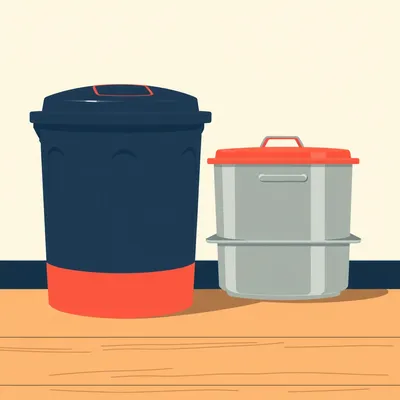
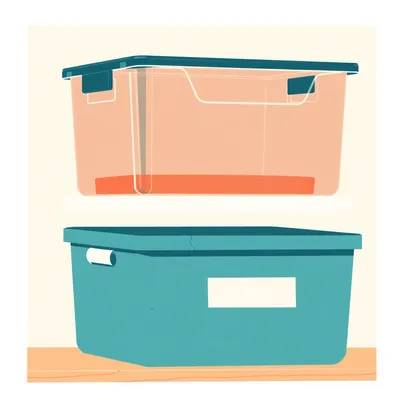
Daniel's been staring at a quietly menacing photo of a home organizer holding a rubbish bin, and it got him thinking. We've spent a lot of time on this show geeking out over Euro containers — the DIN EN 13199 standard, the six hundred by four hundred millimeter footprint, the lid interlocks that actually lock. Industrial storage that's biomechanically researched because someone's going to open that box eight hours a day in a warehouse. And then there's the IKEA Samla, which is... fine. For once a month. For seasonal decorations. The question Daniel's really asking is: who bridges these two worlds? Is there a professional who walks into your home and thinks like a warehouse engineer — workflow analysis, reach depth, pick frequency — instead of just telling you which items spark joy?

And the answer is yes, but they're hiding in plain sight under job titles most people would never think to Google. Before we get there though, let's be precise about what makes these two storage worlds different at a mechanical level, because the gap is bigger than most people realize.
I love that your version of precision involves opening standards documents.
It's where the truth lives. DIN EN 13199 — that's the European standard for transport packaging, specifically small load carrier systems. It specifies the Euro container footprint: six hundred by four hundred millimeters for the full size, three hundred by four hundred for the half size. But here's what matters — it also specifies the material. UV-stabilized polypropylene copolymer. Not recycled content, not whatever plastic was cheapest that quarter. Copolymer specifically because it resists cracking under repeated impact and temperature cycling. These boxes are engineered for a ten to twenty year service life in environments where they're getting slammed onto conveyor belts and stacked eight high.
So when you say "slammed onto conveyor belts," I'm picturing an Amazon fulfillment center where boxes are getting knocked around by automated sorting systems. But those aren't Euro containers, are they? Those are cardboard shipping boxes getting destroyed.
Right — the cardboard is the sacrificial layer. The Euro containers are what the actual inventory lives in before it gets picked and packed. Think about an automotive parts warehouse. A single brake caliper might sit in a Euro container on a shelf for six months, getting pulled out and inspected twice a week by different workers, then put back. Over its lifetime, that container might get handled ten thousand times. Now compare that to your IKEA Samla full of holiday decorations that you open exactly once in November and once in January. The engineering requirements are just fundamentally different.
Whereas the Samla is... polypropylene, sure, but thinner walls, no UV stabilization, and no lid interlock mechanism. The lids just sit there. Stack three of them and the whole thing gets wobbly.
And that's not a design flaw — it's a design choice. IKEA optimizes for shelf appeal and price point. The Samla is meant to look clean and transparent on a store shelf and cost less than ten dollars. Nobody at IKEA is running finite element analysis on the handle geometry for ten thousand insertion cycles. But the engineers at SSI Schaefer or BITO absolutely are, because their customers — automotive plants, pharmaceutical warehouses, hotel linen services — they're tracking failure rates across millions of container movements.
I want to pause on that "millions of container movements" number, because I think it's easy to hear that and not really internalize what it means. If you're running a hotel laundry operation and you've got five hundred rooms, each room generates a load of linens every day. That's five hundred container movements just to collect the dirty linens, another five hundred to return the clean ones. A thousand movements a day, three hundred sixty-five days a year. Over a decade, that's over three and a half million movements. If your container handles fail at even a 0.1% rate, that's thousands of failures. The hotel doesn't care about the cost of the box — they care about the cost of the worker who drops a loaded container on their foot because the handle snapped.
That's the hidden economic logic behind industrial standards. It's never about the unit cost of the container. It's about the system cost of failure. A Samla lid popping off in your closet is annoying. A Euro container lid failing in a pharmaceutical clean room means a batch of product gets contaminated and written off. The stakes are orders of magnitude apart, and the engineering reflects that.
So walk me through the handle thing. You mentioned wrist deviation earlier — what's actually different?
Industrial Euro containers use recessed grips, typically angled at about forty-five degrees, positioned so that when you're carrying a loaded box your wrists stay in neutral alignment. Neutral wrist means the carpal tunnel isn't compressed. Consumer storage boxes almost always use a protruding lip — you hook your fingers under an overhang. That's fine for carrying a box of Christmas ornaments from the closet to the living room once a year. Do it fifty times a day and you'll start feeling it in your forearms within twenty minutes. The industrial handle is tested for over ten thousand insertion cycles in automated picking systems. The consumer handle is tested for... probably someone in the design department picked it up once and said "yeah, feels okay."
There's something almost tragic about that. The warehouse worker gets better ergonomics than the homeowner, because the warehouse worker's employer has a financial incentive to prevent repetitive strain injuries. The homeowner just gets whatever looks nice at the store and deals with the wrist pain in silence.
And that gets to the weight distribution piece, which is where ISO 11228 comes in. That's the international standard for manual handling — it specifies recommended weight limits based on lift height and frequency. For frequent lifting, which they define as more than once every five minutes, the maximum recommended load at waist height is about fifteen to twenty kilograms. At shoulder height it drops to around ten. At floor level, even less because you're lifting with your back in flexion. Industrial shelving systems are designed around these numbers — the heaviest boxes always go at waist height, the light stuff goes up top, and the floor level is for bulk items on pallets, not individual boxes you're reaching for constantly.
And yet every home organization influencer on Instagram has a pantry with heavy canned goods on the top shelf and the floor, because it looks symmetrical in the photo.
That's the quiet menace Daniel was talking about. The photo looks great. The biomechanics are terrible. And here's the thing — the home organizer industry, as it currently exists, is almost entirely behavioral and aesthetic. The primary credential is the Certified Professional Organizer, or CPO, from the Institute for Challenging Disorganization. That certification focuses on the psychology of clutter, decision-making frameworks for discarding items, and strategies for maintaining order. It does not cover anthropometric measurement, reach-depth ratios, or load rating calculations for shelving systems. It's a different discipline entirely.
So if I want someone who can look at my floor plan, measure my reach range, map my pick frequency for every item I own, and specify a modular storage system that's actually optimized for my body and my workflow... the CPO isn't that person.
The CPO is categorically not that person. And I should say — that's not a criticism of CPOs. They're doing important work, especially for people with hoarding disorders or executive function challenges. But it's like comparing a physical therapist to a personal trainer. Related fields, different toolkits, different outcomes.
That's a useful analogy. A personal trainer can help you get stronger and feel better about your body, but if you've got a rotator cuff tear, you need someone who understands the biomechanics of the shoulder joint at a level the personal trainer probably doesn't. The CPO helps you with the emotional relationship to your stuff. The engineer helps you with the physical relationship to your stuff. They're both valuable, but they're not interchangeable.
Right. And the problem is that most people don't know the second option exists. They think storage help begins and ends with decluttering and buying matching bins. The idea that there's a whole discipline of human factors engineering that could be applied to their kitchen cabinets simply never occurs to them.
So who is that person? Daniel's core question — do they exist, and what are they called?
They exist, but they're fragmented across several professional titles and none of them have "home storage" in the name. The closest match is an industrial engineer who specializes in ergonomics and has decided to take residential clients. Industrial engineers are trained in workflow optimization, facility layout, and human factors engineering. They're the people who design warehouse picking routes and factory floor plans. Some of them — usually independents or small consultancies — have realized that the same analytical framework applies to kitchens, garages, and home workshops.
So it's not a regulated profession with a neat title. It's more like a subset of industrial engineers who've gone rogue and started doing houses.
You might also find ergonomists — specifically those certified through the Board of Certification in Professional Ergonomics or the International Ergonomics Association. Ergonomists are trained in anthropometry, biomechanics, and human-system interaction. A certified ergonomist can absolutely do a residential assessment: measure the user's functional reach envelope, analyze task frequency, and recommend storage heights and container types that minimize injury risk. The problem is that most ergonomists work in occupational settings — factories, offices, hospitals — because that's where the paying clients are.
But here's the thing I don't understand. If the skills are transferable, and there's clearly a market of homeowners with money who care about this stuff — I mean, people spend tens of thousands on kitchen renovations — why haven't more ergonomists made the jump to residential?
Part of it is professional culture. Ergonomics as a field grew out of occupational health and safety. The foundational research was done in factories and military settings. The professional networks, the conferences, the certification requirements — they're all built around workplace applications. A certified ergonomist who wants to maintain their credentials needs to log continuing education hours, and those hours are overwhelmingly offered in occupational contexts. There's no "Residential Kitchen Ergonomics" track at the annual Human Factors and Ergonomics Society conference. The field simply hasn't recognized the home as a legitimate domain of practice.
That's fascinating — it's not a skills gap, it's a professional identity gap. The ergonomists could do the work, but their professional community doesn't validate it as "real" ergonomics.
And that's exactly the kind of institutional inertia that creates these weird market gaps. The knowledge exists, the need exists, but the professional infrastructure hasn't caught up.
What would a proper residential ergonomic storage assessment actually look like? Walk me through it.
It would start with a workflow analysis. The consultant maps every item in the space and tags it with a pick frequency — daily, weekly, monthly, seasonal. Then they do an anthropometric assessment of the primary users. That means measuring standing reach height, seated reach height if applicable, grip strength, any physical limitations like back issues or arthritis. Then a space audit — measuring all storage volumes, door swings, clearance zones, lighting conditions. Only after all that data is collected do they start specifying systems.
And the systems they'd specify would be things like Euro containers on adjustable shelving rated for the actual loads, with pull-out mechanisms for deep storage, and everything placed according to the pick frequency map.
Right. Daily-use items at waist-to-shoulder height, within a four hundred to five hundred millimeter reach depth — that's roughly arm's length for most adults. Weekly items can go one shelf higher or lower. Monthly items can go in deeper storage with pull-out trays. Seasonal items go in the attic or the garage loft. And every container is standardized — same footprint, interlocking lids, compatible across rooms. You can take a box from the pantry and put it on the garage shelf and it fits.
I want to make this concrete, because I think a lot of listeners are hearing this and nodding along but not really picturing what it looks like in practice. Let's take a kitchen pantry. Typical American pantry has shelves about sixteen inches deep, floor to ceiling, with stuff shoved in wherever it fits. The engineer's version would be... what?
The engineer's version starts with pull-out drawers or trays on every shelf below shoulder height, because fixed shelving deeper than about twelve inches creates a "dead zone" at the back where items get lost and expire. The drawers are rated for the actual weight of canned goods — not the twenty-pound rating you get on cheap residential hardware, but fifty to seventy-five pounds for heavy items. The drawer slides are full-extension so you can see everything at once. The containers on those drawers are Euro containers in the three hundred by four hundred millimeter half-size, because that fits two across on a standard twenty-four-inch deep pantry shelf. Each container has a label on the front and the lid, and the lids interlock so you can stack them two high without them sliding around when you open the drawer.
And the placement follows the frequency map.
The drawer at waist height has the daily-use containers — cooking oils, salt, frequently used spices, the coffee and tea. The drawer above that, at chest height, has weekly items — pasta, rice, canned tomatoes, the stuff you're reaching for a few times a week but not every meal. The drawer below has monthly items — specialty ingredients, backup supplies, the giant bag of flour. The top shelf, which requires a step stool to reach, has seasonal items — holiday baking supplies, the turkey roasting pan. Nothing heavy goes above shoulder height, ever.
That's such a radical departure from how most people's pantries are arranged, but it's also completely obvious once you hear it described. Of course the heavy stuff shouldn't be above your head. Of course the daily stuff should be right where your hands naturally fall. It's just that nobody ever told us to think about it that way.
And that's the tragedy of the consumer storage industry. The principles are well-established, they're backed by decades of research, and they're completely absent from the retail experience. You walk into The Container Store and nobody asks you about your pick frequencies or your reach envelope. They ask you what color bins you like.
So why isn't this a thing? Why isn't there a "Residential Storage Engineer" certification and a thriving industry of people doing this?
Two reasons. First, cost. Industrial engineers and certified ergonomists bill at a hundred to two hundred dollars an hour. A full residential assessment with measurements, analysis, system specification, and installation oversight could run anywhere from five hundred to two thousand dollars. Most homeowners aren't willing to spend that on storage consulting when they can hire a home organizer for fifty to a hundred dollars an hour to help them declutter and buy matching bins.
And second?
The storage industry itself has no incentive to create this profession. IKEA, The Container Store, Target — they make money selling containers that need to be replaced every few years. A consultant who specifies a Euro container system with a twenty-year lifespan and replaceable components is essentially telling you to buy fewer containers over your lifetime. That's good for the consumer and good for the environment, but it's terrible for the companies that dominate the home storage market.
That's the environmental waste angle Daniel mentioned. The Samla cracks after a few years, or IKEA discontinues that size, and now you've got a mismatched collection of bins that don't stack together and you're back at the store buying a whole new set.
And the old ones go to landfill because polypropylene recycling is spotty at best, especially for consumer goods without clear resin codes. Meanwhile, a Euro container from SSI Schaefer or BITO is designed with replaceable lids, dividers, and label holders. If a lid cracks after ten years, you buy a new lid — not a new box. The standard doesn't change, so a box you bought in twenty twenty-six will still stack perfectly with one manufactured in twenty forty-six. That interoperability is the entire point of the DIN standard.
There's a fun fact buried in here that I stumbled across while researching this. The Euro container standard — DIN EN 13199 — it's actually derived from the Euro pallet standard, which was established in the 1960s as part of the European railway system's effort to standardize freight loading. The Euro pallet is twelve hundred by eight hundred millimeters. The Euro container is exactly half that in one dimension and half that in the other — six hundred by four hundred. So four Euro containers fit perfectly on a Euro pallet with no wasted space. The entire system was designed from the pallet up, which means the geometry has been stable for over sixty years.
That's the kind of long-term thinking that's completely alien to consumer product design. IKEA changes its product dimensions every few years, sometimes just to refresh the catalog. The Euro container standard was designed to outlast the careers of the people who wrote it. And it has.
There's a case study that keeps coming up in these discussions — the small business owner who hired a warehouse consultant for their home workshop. What actually happened there?
This was a woodworker who runs a custom furniture business out of his garage. He was spending about forty percent of his project time just finding tools and materials. He hired an industrial engineer who normally designs warehouse picking systems. The consultant mapped his entire workflow — which tools he used for which project stages, how often he accessed each type of hardware, what his reach patterns looked like at the workbench. The recommendation was a modular French cleat wall system combined with Euro containers on pull-out shelving underneath the bench. Hardware was sorted by project type, not by hardware type — so all the fasteners for cabinet making were in one zone, all the hardware for table builds in another.
Which is the opposite of how most people organize workshops. They sort by category — all the screws together, all the nails together.
And that's the warehouse logic versus the home organizer logic. In a warehouse, you organize by pick frequency and workflow sequence — what gets picked together gets stored together. The woodworker's retrieval time dropped by about forty percent, and he stopped buying duplicate tools because he could actually find what he already owned. That's the kind of outcome an industrial engineer delivers that a decluttering consultant simply isn't trained to produce.
I want to linger on that "stopped buying duplicate tools" point, because that's a hidden cost of disorganization that almost nobody tracks. You can't find your stud finder, so you buy another one. Now you've got two stud finders, neither of which you can find when you need them. Over a decade of DIY projects, that adds up to hundreds or even thousands of dollars in unnecessary purchases. The organized workshop pays for itself in avoided duplicate purchases alone.
There's actually a term for this in lean manufacturing — it's called "overproduction waste," and it's one of the seven wastes identified in the Toyota Production System. In a factory context, it means producing more than is needed because you don't trust your inventory system. In a home context, it means buying a third roll of duct tape because you can't find the two you already own. The same analytical framework that reduces waste in a factory can reduce waste in your garage. It's just that nobody's applying it there.
So for someone listening who can't drop two thousand dollars on a consultant, what can they actually do? How do you apply industrial ergonomics principles to your own home without hiring an engineer?
The first thing is the pick frequency map. Take one storage zone — your kitchen, your closet, your garage — and tag every item with how often you actually use it. Be honest. That pasta maker you used once in twenty nineteen is seasonal, not weekly. Once you've got the frequency data, apply the waist-to-shoulder rule: anything you use daily or weekly goes at that height, within arm's reach. Monthly items can go one shelf lower or higher. Seasonal items go in deep storage — the top shelf, the back of the closet, the garage loft.
And deep storage should be in containers you're not opening constantly, so that's actually where your IKEA Samla boxes are fine.
The Samla is perfectly adequate for seasonal storage. It's the daily-access stuff where the industrial design really matters. Which brings me to the second principle: when you're buying storage for high-frequency items, look for systems that follow a modular standard. Euro containers are the gold standard — six hundred by four hundred millimeter footprint, lid interlock, stackable across sizes. But even within consumer products, some systems are more modular than others. IKEA's IVAR shelving, for example, has a consistent footprint and components that have been available for decades. French cleat wall systems are inherently modular — you can rearrange tool holders without drilling new holes.
The key thing to avoid is proprietary sizes that lock you into one brand. Because that brand will discontinue the product line eventually.
They always do. And then you've got a storage system where half the components are unavailable and you're back to square one. The third principle is about containers specifically: check for lid interlock. A proper interlocking lid has a positive mechanical engagement — tabs, clips, or a tongue-and-groove design that prevents the lid from sliding off when boxes are stacked. If the lid just sits on top by friction or gravity, it's not an interlock. Also check the handle design — recessed grips are better than protruding lips for anything you'll carry frequently.
And if someone does want professional help and has the budget for it, what should they actually search for?
Search for "industrial engineer" or "ergonomics consultant" combined with "home organization" or "residential storage." But when you contact them, ask specific questions: Do you do anthropometric assessment? Do you have experience with workflow analysis? What modular storage systems do you typically specify? If they start talking about decluttering and "sparking joy," you've got a home organizer. If they start talking about reach envelopes and pick frequency and load ratings, you've found the right person. Expect to pay a hundred to two hundred dollars an hour, and expect the assessment to take anywhere from four to ten hours depending on the size of your space.
There's something almost absurd about this — that we've got this incredibly sophisticated industrial storage ecosystem, with ISO standards and biomechanics research and million-cycle testing, and the average person has no access to it. They're stuck buying whatever Target has on the shelf that season.
It's a market failure, but it's also an opportunity. As more people work from home and treat their living spaces as high-performance environments — home offices, home workshops, home gyms — the demand for industrial-grade organization is going to grow. I think we're going to see a new professional category emerge in the next five to ten years. Something like "Residential Storage Engineer" or "Home Ergonomics Consultant." The knowledge exists, the standards exist, the products exist. Someone just needs to package it for the consumer market.
And the environmental argument gets stronger every year. A Euro container system costs maybe three times as much upfront as the equivalent in IKEA boxes, but it lasts five times as long and never needs replacement due to discontinued product lines. Over a twenty-year period, the industrial system is cheaper and generates a fraction of the plastic waste.
Plus the ergonomic benefits. Fewer wrist injuries, less back strain, less time spent searching for things. Those are real quality-of-life improvements that compound over years. The home organization industry has done a brilliant job of making clutter visible as a problem. What it hasn't done is offer a technically rigorous solution. It offers aesthetics and emotional frameworks, which have their place, but they're not the same thing as engineering.
So to answer Daniel's question directly: yes, these people exist. They're industrial engineers and certified ergonomists who take residential clients. They're rare, they're expensive, and they don't have a unified professional title. But they're out there, and the core principles they use — pick frequency mapping, anthropometric assessment, modular system specification — are things you can apply yourself starting this weekend.
And if you do, start with the pick frequency map. That one exercise, done honestly, will tell you more about how to organize your space than any decluttering book ever written.
On the record — here's my prediction. Within three years, we'll see at least one company launch a "residential storage engineering" service that combines a remote video consultation with AI-powered floor plan analysis and a standardized Euro container recommendation. The technology exists now, the demand is growing, and the gap in the market is obvious. Someone's going to fill it.
I'll go further. Within five years, the International Ergonomics Association or a similar body will create a residential ergonomics certification track. The knowledge base is mature, the standards are written, and the consumer demand for evidence-based home design is rising. The pieces are all there — someone just needs to assemble them.
If you've found one of these people — an engineer who organized your pantry, a warehouse consultant who tackled your garage, an ergonomist who measured your reach envelope and specified your shelving — we want to hear about it. Email the show at show at my weird prompts dot com. We'd love to feature them in a future episode.
Thanks to our producer Hilbert Flumingtop for making this show happen. This has been My Weird Prompts. If you enjoyed this episode, leave us a review wherever you get your podcasts — it helps other people find the show.
We'll be back soon with more of Daniel's weird prompts.