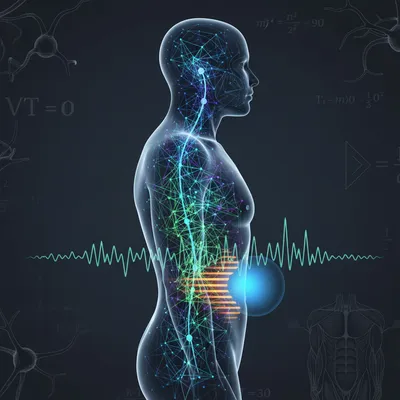
A woman lies on a table in Barcelona. Her diaphragm is twelve millimetres lower than it should be. Her lung volume is up by five hundred millilitres. And her belly is thirty-two millimetres wider than it was an hour ago.

On a normal amount of gas.
They measured it with CT, during an actual distension episode. And then they taught her to fix it with her own ribs and abdominal wall.
Which is the part nobody can ever explain.
Which is the part Daniel has been asking about for, what, three episodes now. He's had APD since his gallbladder came out, and every time it comes up, the Barcelona biofeedback protocol gets mentioned, and every time it's described the same vague way. Sensors on the chest and abdomen, a screen, retrain the muscles. That's it.
That's the whole description, yeah.
He wants the actual papers. What equipment, where the electrodes go, how many sessions, how long, after what meal. What the patient is actually taught to do with their chest and abdomen. Whether it's been validated since, by anyone outside that one group. And then the practical part, which is honestly the harder question. Where can anyone actually get this treated today, is there a way to get a local clinician trained in it, and can you approximate any of it at home without hurting yourself.
And he's explicit about one thing, which I appreciate. If a detail isn't published, say so. Don't guess.
Right. So today we're doing something we don't get to do very often. We're reading the actual papers, and we're telling you exactly what happened in that room in Barcelona.
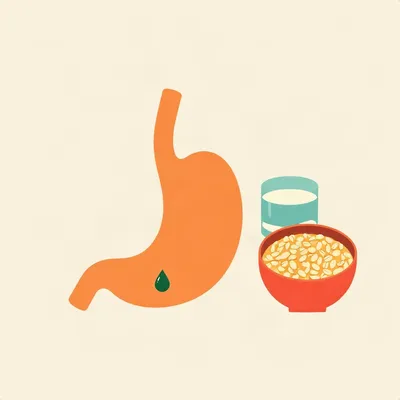
Let's do the refresher fast, because we've covered the mechanism before and I don't want to spend ten minutes on it. The diaphragm is a dome of muscle sitting under the lungs. Normally, when you eat, it stays put and the abdominal wall manages the volume. In abdominophrenic dyssynergia, the diaphragm contracts and drops, and the front abdominal wall goes slack at the same time. You get the whole abdominal contents pushed forward, and you look pregnant. On a normal amount of gas.
The gas isn't the problem.
The gas was never the problem. That's the thing that took the longest to establish, and Villoria and Azpiroz laid it out in the American Journal of Gastroenterology back in 2011. It's a mechanical problem. Two muscles doing the wrong thing at the wrong time. And that's why the probiotic advice misses entirely, because you're not treating too much gas, you're treating a diaphragm that's stuck down.
The hook for me is what happened next. This group in Barcelona published four versions of a treatment over about a decade, and each one is simpler than the last. The first one used electrodes and oesophageal tubes. The most recent one uses no equipment at all.
Just hands.
And almost nobody outside Barcelona offers it. Published, effective, unavailable. That's the actual story here.
So let's start with what actually happened in that room, because the papers are more specific than you'd think. The first treatment study is Barba and colleagues, Gastroenterology, 2015. Open-label, no sham arm. And there's a discrepancy in the paper itself that's worth flagging, because Daniel asked for honesty about what's published. The abstract says fifteen patients were treated. The methods section says twenty-six.
Which is the kind of thing that makes you trust a paper less, not more.
It's a real inconsistency and I'm not going to paper over it. My guess is the abstract was written against an earlier version of the dataset, but nobody's published a correction, so we say it as it is. Somewhere between fifteen and twenty-six patients, open-label.
What did they actually measure?
This is the part I love, because they did the obvious brutal thing. They put these patients in a CT scanner during an actual distension episode. Not a hypothetical, not a symptom diary. They imaged the abdomen while it was happening.
And found what?
Diaphragm twelve millimetres lower than in the non-distended state. Lung volume up by five hundred and one millilitres. Abdominal girth up thirty-two millimetres. That's the signature of the condition, imaged in real time.
So the diaphragm drops, it drags the lungs down with it, and the belly comes out.
That's the whole mechanism in three numbers. Then they did the intervention. EMG-guided biofeedback. And after training, the diaphragm came back up about twelve millimetres on ultrasound, girth fell about twenty-five millimetres, and the sensation score fell forty-three percent.
Which sounds great until you notice there's no control group.
There's a small control-session subgroup that showed no change, which is suggestive, but it's not a sham-controlled trial. The 2015 paper is a proof of concept. The real test is 2017.
Barba, Accarino, Azpiroz, Clinical Gastroenterology and Hepatology.
That one's sham-controlled. Forty-eight patients randomized, and I'll flag the demographics because they matter for how you read it. Roughly ninety-five percent women. Which is consistent with the clinical picture, but it means the evidence base is largely female.
What did the sham look like?
This is the design detail that makes the trial. The placebo group got simethicone capsules. They were told they were getting a treatment. And they sat with the same electrodes on, the same machine running, but the signal was hidden from them. So the only difference between the groups was whether the patient could see her own muscle activity.
And the gap was?
Distension score fell fifty-six percent in the real group versus thirteen percent in the placebo group. Intercostal muscle activity fell forty-five percent. Anterior abdominal wall activity rose one hundred and one percent.
Doubled.
Doubled. And that's the mechanism, right there in the numbers. The intercostals quiet down, which releases the ribcage, and the abdominal wall wakes up and takes over the job of holding things in.
So the training is teaching the abdominal wall to do work it had stopped doing.
And the diaphragm gets to come back up because nothing is pulling it down anymore. The six-month follow-up is the part that surprised me. Pooled across patients, the distension score was 1.7 right after treatment and 0.3 at six months, on a zero-to-six scale.
It kept improving after they stopped.
Continued to improve. The authors say all patients learned the technique, and here's the honest caveat they attach to it. No formal responder threshold was ever defined. So nobody can tell you what percentage of patients responded, because the paper never draws that line.
That's an odd omission.
It's a real one. You can say the average moved a lot. You can't say how many individuals crossed a threshold, because the threshold was never set.
Okay, that's the EMG era. Give me the belt era.
2024, Barba, Livovsky, Accarino, Azpiroz, Gastroenterology. Forty-two randomized. The feedback signal is no longer muscle electrical activity. It's motion.
Meaning?
Two inductive belts, one around the chest, one around the abdomen. The patient watches two traces on a screen. Chest is the top line, abdomen is the bottom line. Her job is to make those two lines behave a certain way.
And the EMG is gone?
The EMG is kept only as an outcome measure. The treatment itself is now just watching yourself breathe.
Results?
Daily distension score fell sixty-six percent versus eight percent in the placebo group. Associated symptoms fell seventy-two percent versus five percent. And the post-meal girth increase was abolished.
Abolished as in gone?
As in the measurement after the meal matched the measurement before it. That's the strongest single result in the whole lineage. Placebo here was a glucose capsule. Patients wore the belts, but the signal was hidden from them. Same design logic as 2017.
And it held?
Held to six months, and the benefit kept accumulating gradually. Now, the authors concede something in the discussion, and I want to give them credit for it because it's the kind of thing researchers usually bury. They say the detailed explanation of the mechanism alone might contribute to the effect.
Meaning telling someone how their body is broken might be part of the cure.
That's a real possibility and they say it out loud.
So we've gone from electrodes on four abdominal sites to two belts. What's the third generation?
Nothing. Barber, Pribic, Serra, Azpiroz, Neurogastroenterology and Motility, 2025. And I have to flag the evidence level here, because Daniel asked us not to pretend. This is a conference abstract only. The full paper has not been seen. Roughly forty patients. The operator uses an audiovisual aid and hands-on guidance, no sensors at all.
And the numbers?
Diaphragm descent reduced by ninety-one percent. Girth increase reduced by fifty-nine percent. Both of those are as good as or better than the instrumented versions.
But?
But the clinical symptom score fell only twenty-four percent versus eight percent in the control arm. Compare that to fifty-six percent in 2017 and sixty-six percent in 2024.
The physiology fixed itself and the patient didn't feel better.
That's the tension at the heart of this whole story. You take away the feedback signal, the muscles still learn something, the mechanics still improve, and the symptom benefit drops by half or more.
Which raises the ugly question of whether the machine is doing the work.
Or whether the display is the teaching. There's a multicentre trial of the equipment-free version running right now, NCT06369753, target around a hundred patients, at Barcelona, Bologna, Bordeaux, Gothenburg, Manchester, McMaster in Canada, and UCLA. One trained operator per site. Estimated completion is right around now, this month.
So we might have an answer soon.
We might have an answer, and the answer is going to be about that gap. Twenty-four versus sixty-six.
Let's do the equipment properly, because this is the thing Daniel could never find. Start with the EMG era.
Italian ASE16 amplifier, PRIMA Biomedical. Disposable surface electrodes, nothing exotic. Abdominal wall gets bipolar electrodes on the right side, over the upper rectus, the lower rectus, the external oblique and the internal oblique. Four sites.
On the right side only?
Right side only. Intercostals get one electrode at the second intercostal space, right midclavicular line. And they didn't just stick them on and hope. They verified placement with a Valsalva manoeuvre for the abdominal sites and a deep inhalation for the intercostal site, then marked the skin so the same spots could be found in later sessions.
That's a level of fussiness that tells you they knew placement was everything.
Placement is everything when your signal is millivolts. And here's the detail that tells you how the field actually works. They originally recorded the diaphragm directly. Nasal tube down into the oesophagus, electrode at the hiatus. Real diaphragm EMG.
And?
They dropped it after the first ten patients. The learning didn't depend on it and it was miserable to tolerate. So the one muscle that's actually causing the problem was the one they stopped measuring.
That's a strange thing to hear.
It's a very practical thing to hear. It tells you the treatment isn't about the diaphragm signal. It's about the patient feeling what her ribcage and belly are doing. The diaphragm position was tracked separately, with ultrasound, following the liver edge. But that was an outcome measure, not a feedback channel.
And the patient is sitting how?
Upright, backrest at the lumbar spine. Display is described in the paper, and I'm quoting the level of detail here, as EMG recordings displayed on a monitor. That's it.
No thresholds, no software, no format.
None published. You cannot reconstruct the display from the literature. That's a genuine gap and it's one of the reasons nobody can just copy it.
Belt era is better documented?
Slightly. Respiratory inductance plethysmography. A plethysmography monitor from Soifer in Barcelona, with SleepSense inductive belts. And the authors explicitly note in the paper that ordinary respiratory-monitoring plethysmography equipment could be adapted for this. They're telling you the hardware isn't special.
Which is a hint, and we'll come back to it.
Big hint. Now the sessions, because the dosing changed a lot and it matters. 2015, one to three sessions of about forty minutes within two weeks, and the patient had to come in while actually distended. You couldn't do it on an empty stomach.
Because you can't train someone to fix a state they're not in.
2017, three sessions of about thirty minutes over roughly ten days, each one after the patient ate their own trigger meal. Home practice, five minutes before and after breakfast, lunch and dinner. Six short sessions a day.
That's a lot of touching base.
It's five minutes. It's less than a coffee. And the point is that you're interrupting the pattern before it sets in. 2024 tightens it further. Three sessions of thirty minutes, roughly one a week, over a four-week programme. Each session starts forty-five minutes after the patient's own most reproducible trigger meal, which is timed to when the distension peaks.
They're catching it at maximum.
They're training at the moment of failure. Same six-times-five-minutes home practice, continued to six months, with reinforcement visits at one and three months.
And the meal is always the patient's own.
Always. Never lactulose. Never a standard test load. Because lactulose and a standard load don't reproduce what the patient actually experiences, and the point is to train against the real thing.
Something's been nagging me. Who's delivering this? What kind of clinician?
The papers say one investigator. The profession is not stated.
Not stated anywhere?
Not in the papers I can see. At Mayo, it's taught by physical therapists. But Barcelona never says. So if you're a patient trying to find the right kind of person, the literature doesn't tell you.
That's a strange omission for something that's supposedly transferable.
It's a strange omission and it's consistent with the bigger problem, which is that the technique lives in the heads of a small number of people and only partly on paper.
Okay. What is the patient actually taught.
This is the most explicit description, and it's in the methods of the 2024 Gastroenterology paper. There's a supplementary video that shows the manoeuvre, and that video is the closest thing to a public instructional resource that exists for this.
Four steps?
Step one, explain the mechanism. The diaphragm is described as blocked. Contracted and low. You tell the patient what's actually wrong, in those terms.
Step two.
Relax the diaphragm so it rises. And you do that by combining two things at once. Chest up, meaning lift the ribcage, lift the costal wall. And abdomen in, meaning contract the front abdominal wall.
Chest up, abdomen in.
That's the core instruction. Then step three is mobilisation. You alternate. Chest down plus abdomen out, which is the diaphragm contracting, with chest up plus abdomen in, which is the diaphragm relaxing. You're taking the diaphragm through its range instead of letting it sit stuck.
And step four?
Two ways to do it. Either breathe normally through the chest the whole time, or close the airway and shift air back and forth between chest and abdomen in what they call a pendular movement. And severe cases may need individual work on posture first, because if you've got pronounced upper-back rounding and shoulders forward, the ribcage can't lift properly to begin with.
So the whole treatment is a posture and a movement pattern.
It's a movement pattern, and here's the thing that Daniel's going to want to sit with. In the EMG era the instruction was phrased differently. Voluntarily reduce intercostal and diaphragm activity while increasing anterior abdominal wall activity, especially on exhalation. Same idea, different vocabulary. And no numeric targets were ever published. Not once.
Now say the thing that's going to get this episode clipped and sent to a lot of people.
The manoeuvre is the opposite of belly breathing. Conventional diaphragmatic breathing, the thing you've been told to do your whole life, is belly out on the in-breath. Chest stays quiet, abdomen expands, diaphragm contracts and drops.
Which is precisely the distension pattern.
Which is precisely the pattern that causes the problem. Livovsky and colleagues, Nutrients, 2021. Sixteen healthy women. They had them deliberately contract the diaphragm, and girth went up about thirty-two millimetres, and bloating sensation went up with it. Compared to relaxing it.
So someone with APD who diligently practices belly breathing is rehearsing the failure.
I want to be careful here, because Daniel asked us not to guess. There is no study showing that belly breathing harms APD patients. What we have is a mechanistic argument. You're practising the exact muscle pattern that produces your symptom. Which is a very good reason to think it doesn't help, and no evidence that it does.
And the rumination protocol?
Teaches the opposite posture. Chest down, abdomen out. That's for a different condition, and it is not to be carried across. If you have rumination syndrome, your instructions are the reverse of this, and mixing them up is a bad idea.
Chest up abdomen in for APD. Chest down abdomen out for rumination. Don't swap them.
This is the single most useful practical thing in the episode and the single easiest thing to get wrong.
There's a review I want on the table before we move to access. Damianos, Tomar, Azpiroz, Barba, American Journal of Gastroenterology, 2022.
Says there are no standardized protocols and access is extremely limited.
That's the inventors' own group writing that.
That's the inventors' own group writing that four years ago, and not much has changed.
Corn, it's Jim. I've been trying to get through for twenty minutes.
Jim, we're in the middle of the protocol.
I don't care about the protocol. I want to talk about the word you used. You said patients had to come in distended. Distended. My neighbour has been using that word about his fence for three years. Three years, Corn. The man has a fence that leans four inches and he calls it distended.
That's a different sense of the word entirely.
Don't tell me about senses. And while I've got you, the parking situation on my street is a joke. Two hours I circled last Thursday. Two hours. For a slot that turned out to be a loading zone.
Jim, if you want to call back after the episode...
I'll call back when I'm ready. And I'm not done about the fence, I'm going to keep calling until somebody at the municipality listens, and if that means you two, then fine.
So the protocol works, and it's published. Why can't anyone get it? That's where this gets frustrating.
Vall d'Hebron is a public hospital. Outside patients need a doctor's referral. And I looked for any kind of international or private patient route into that specific service, and I couldn't find one published anywhere.
Azpiroz is also listed as head of gastroenterology at Quirónsalud Barcelona, which is private.
Listed, yes. Whether he delivers the biofeedback there is unverified. I'm not going to pretend I know, because I don't.
Who's the realistic route then?
Elizabeth Barba. She's the first author on both the 2017 and 2024 trials, and she's described as the inventor of the biofeedback techniques. She's now at Hospital Clínic and she sees private patients through barnaclínic. For a foreign patient paying out of pocket, that's probably the most realistic path that exists.
And the price?
Not published anywhere.
Of course it isn't.
Mayo Clinic Rochester is the other real option. There's a Mayo professional news article from the sixth of June this year, and Dr Xiao Jing Wang, who goes by Iris, describes Mayo teaching the equipment-free Azpiroz technique through physical therapists. She's quoted saying it's a technique you can teach a patient using just hands.
Just hands. Same as Barcelona's latest.
Mayo also runs a separate combined hypnotherapy plus diaphragmatic breathing protocol, uncontrolled, with about sixty-nine percent reporting improved bloating. Different thing, and I'd keep them apart in your head.
What about the trial sites? UCLA, McMaster, Bologna, Bordeaux, Gothenburg, Manchester.
Those sites have trained operators because they're running the trial. That's trialling, not a clinic you can book into. Different thing.
Madrid?
Puerta de Hierro motility unit lists abdominophrenic dyssynergia among the conditions they handle. Whether they deliver this biofeedback is not stated.
Australia?
Dr Douglas Samuel publishes a patient page and a self-guided programme, and to his credit he says explicitly on it that it's unvalidated.
And the US pelvic physios advertising APD treatment?
A number of them do. Breathing and manual retraining. The fidelity to what Barcelona actually teaches is unknown, and I want to be honest that I can't verify any of them against the protocol.
What about the big names? St Mark's, Leuven, Monash, Michigan, Cleveland Clinic.
Nothing published. And I want to be precise about what that means. That is an absence of evidence, not proof that they don't do it. It's possible somebody there offers it and just hasn't written it up.
So worldwide, you can count the confirmed options on one hand.
And two of the fingers are a public hospital that wants a referral and a private clinic that doesn't publish a price.
Let's talk about the course.
This is the concrete lever and I want people to hear this properly. The Barcelona group runs what they call a Hands-On Course on the Management of Abdominal Distension. Azpiroz and Serra teach it. It's endorsed by the European Society of Neurogastroenterology and Motility.
And what does it promise?
It's marketed as teaching clinicians to apply the technique in their own clinic without any special equipment. That's the pitch. You don't need to buy a machine. You need to be taught.
Details?
Fourth edition is this autumn. Fifteen hundred euros. In person only. Organized through the Barcelona conference secretariat, Bocemtium. Earlier editions ran in 2025 and May of this year.
So a patient could, in principle, email their local gastroenterologist a link to that course and say, this is a thing you could learn.
That is exactly the move, and it's the most actionable thing in this entire episode. You bring the 2017 paper, the 2024 paper, the supplementary video, the European consensus statement from 2025, and the course details. And you ask whether they'd be willing to learn it.
Why would a clinician say yes?
Because of what they already own. Most motility labs and pelvic-floor physios already run EMG biofeedback for dyssynergic defecation. That's the standard treatment for a pelvic floor that won't relax. They've got the machine, they've got the software, they've got the staff trained to place electrodes and read a trace.
So they've got two channels sitting idle.
A two-channel surface EMG unit could in principle record an intercostal site and an abdominal site. That's the honest position, because it hasn't been tested in any paper. But the hardware is not the obstacle.
What is?
Training. And I'll give you the strongest argument you can make in that email. Since 2024, the feedback signal doesn't have to be EMG at all. It can be chest and abdominal motion. Which means any sleep lab, any respiratory physiology department, anyone with plethysmography belts already has the equipment. And the inventors themselves are now validating a version with no equipment whatsoever.
So the barrier is a course, not a purchase order.
The barrier is a person willing to spend a day in Barcelona learning it. That's the whole thing.
There's a precedent that makes the home-delivery argument, and I want it on the table.
Rao and colleagues, Lancet Gastroenterology and Hepatology, 2018. Home biofeedback for dyssynergic defecation. Handheld device, four nurse visits, versus office-based biofeedback.
And?
Non-inferior. Sixty-eight percent responders at home versus seventy percent in the clinic. And more cost-effective. Same principle. The treatment can travel.
So the same thing could in principle be done remotely for APD.
In principle. Nobody's done it. But the model exists and it worked for a condition treated with exactly the same modality.
Okay. DIY. What can actually be done at home.
Cheapest version first, and it's free. The instruction itself. Chest up, abdomen in. Five minutes before and after meals. And there's a feedback signal you already own, which is a mirror and a tape measure.
Chest and waist.
There was an earlier trial, NCT04043208, that used chest and abdominal perimeter as the feedback signal, so there's at least a precedent for the idea that watching your own circumference tells you something useful.
What does the mirror add over just doing it?
A mirror tells you in real time whether you actually lifted the ribcage or just thought you did. That's the same role the screen played in Barcelona. It's a truth-teller. And it's the only reason the instrumented versions beat the equipment-free one, in my reading.
And if you want something closer to the 2024 setup?
Two consumer respiration belts. Vernier makes a Go Direct Respiration Belt, about a hundred and forty-nine dollars each, stretch and force sensor, live graph in a free app. You strap one around the chest and one around the abdomen, and you've got the two traces.
Which is close to respiratory inductance plethysmography.
It's the same physical principle. Or a smart shirt with two inductance loops, one at the chest and one at the navel, Hexoskin around a hundred and ninety-nine dollars for the shirt. That's the closest consumer analogue to the 2024 rig.
Whether it shows both channels clearly in real time?
Unverified. I haven't seen anyone test that, and I'm not going to claim it works. What I can say is that the sensing principle is right.
What about EMG? You can buy that too.
You can. MyoWare is about forty-four dollars a channel. OpenBCI, BITalino, all real. But here's why I'd steer people away. Intercostal EMG is low amplitude and it's contaminated by the heart signal. Your heart is sitting right there in the same field, and pulling a clean intercostal trace out of that is a skill. It's not a beginner's project.
And the group itself moved away from EMG.
The group itself moved away from EMG. Take the hint.
Ultrasound?
A handheld ultrasound like a Butterfly is around thirty-nine hundred dollars and up. It can show diaphragm movement, but it's costly and it's operator-dependent. And Barcelona used ultrasound only to measure outcomes, never as a feedback signal. So it's not what they did.
Now the pitfalls, because this is where people get hurt or get discouraged.
First pitfall, and it's the big one. Practising ordinary belly breathing instead. Belly out on the in-breath. That's the opposite manoeuvre and it's the thing most people default to, because it's what they've been told is healthy breathing their entire lives.
You'd be rehearsing the symptom with a clear conscience.
Second pitfall. Copying the rumination posture. Chest down, abdomen out. If you've read about both conditions and you mixed up which is which, you're doing the wrong exercise. Third pitfall, and this is the honest one, the equipment-free trial suggests the symptom benefit is substantially weaker without feedback. Twenty-four percent versus fifty-six to sixty-six. So a DIY version without any real-time signal may be closer to the low end.
Which means the mirror isn't optional.
The mirror is the cheapest fidelity you can buy. Fourth pitfall. Commercial online bloat-fix programmes. They exist, they take money, and none of them are validated against anything. And there's a 2025 paper, Chakraborty and colleagues in Open Medicine, comparing written diaphragmatic breathing instructions to a handheld breathing device. Both improved self-reported bloating, no sham arm, no distension measurement at all.
So the study can't tell you whether either one worked.
It can't tell you whether either one worked. Self-reported bloating with no sham is close to meaningless. Which is exactly why I'd rather people know the Barcelona protocol and its numbers than buy a course from someone who has neither.
Israel, briefly.
Dr Dan Livovsky is the co-author on the 2024 belt trial and the 2021 Nutrients study. He trained as a research fellow at Vall d'Hebron, and he now directs the Neurogastroenterology and Pelvic Floor service at Shaare Zedek Medical Center in Jerusalem.
So the person who helped run the trial is in Jerusalem.
Which is remarkable, and here's the honest caveat. Whether that service formally offers APD biofeedback is not stated on its website. I don't know. It's worth asking. And several Israeli motility units, Rambam, Sheba, Hillel Yaffe, do list pelvic-floor biofeedback, which is the same modality.
So for Daniel specifically, the phone call is to Shaare Zedek.
The phone call is to Shaare Zedek, and the question is whether Dr Livovsky's service would deliver the technique he helped publish. That seems like a reasonable thing to ask a doctor.
Let's do the guidelines, because a listener is going to go to their gastroenterologist and get told something.
The American Gastroenterological Association clinical practice update from 2023, Moshiree, Drossman, Shaukat. It says diaphragmatic breathing and central neuromodulators are used for APD. And then it says the biofeedback benefit has been reported in two studies by one group, and additional studies by other investigators are needed.
Two studies, one group. That's the official American position.
That's the official American position in 2023. It's an honest summary of the evidence and it's also a reason a busy gastroenterologist might not have heard of this.
And Europe?
European consensus 2025, Melchior and colleagues. Biofeedback retraining of the abdomino-thoracic muscles is described as safe and effective for visible distension. Ninety percent agreement.
That sounds strong.
It's graded as very low quality evidence and framed as a good practice statement. And the same document notes the evidence is single-centre, and that a training-the-trainer programme is still ongoing and not fully defined. So the Europeans are endorsing it and flagging exactly the problem we've been describing.
Single-centre evidence, no independent replication, no defined training pipeline.
And no negative trials anywhere, which is worth saying. Nobody has published a study showing this doesn't work. What we have is one group producing four consistent positive results and nobody else producing anything.
What's the cutting-room floor? What did you find that didn't fit?
The thing I couldn't stop thinking about. In the 2017 trial, the intercostal activity fell forty-five percent and the abdominal wall activity rose one hundred and one percent. And the reason that's interesting is that nobody is training the abdominal wall to be stronger. There's no strengthening component. It's not a muscle-building protocol.
So it doubled its activity without being trained to.
It doubled its activity the moment it was given permission to work again. Which suggests the abdominal wall in these patients isn't weak. It's been switched off, and the whole treatment is switching it back on.
And Daniel's going to want to know if that's reversible after years.
That's the open question nobody's answered, and I'd love a trial of that.

Corn, the thing you said about the yoga teacher. No, that was me. Two thousand three, a teacher in a church hall told me chest up, abdomen in. I heard abdomen out, and I've been doing abdomen out four times a week for twenty-three years.
Twenty-three years of the wrong direction.
Twenty-three years. Which I now understand is the exact pattern that makes this condition worse. So I've been running the experiment on myself, unknowingly, since before I'd ever heard of any of this.
Did you ever feel like it was helping?
I felt like my back was straight. That's all I can tell you. I want to ask about the machine, though. The belts. Would those belts let me do the thing where I lie down after lunch and let something else do the monitoring while I have a nap.
You want a belt that watches your breathing while you sleep.
I want a belt that I put on and forget about. There was a device I bought, must have been a couple of thousand on the card, from an infomercial, that was supposed to be a biofeedback unit. Turned out to be a bathroom scale with electrodes taped to the sides. I used it every night for a year and it never once told me anything useful about my gut.
A scale with electrodes.
And I'm going to be honest with you, it worked, but only when I watched that renovation show where they redo the kitchens. Same routine every time. Stand on the scale, watch the show, feel better. I couldn't explain it then and I can't explain it now.
The scale worked but only during a kitchen renovation programme.
Only during that programme. Anyway, it stopped working after a while, and now it only displays the word BLOAT. All caps. Doesn't matter what I do. Stand on it, blink at it, unplug it, the word is BLOAT.
It's currently displaying BLOAT.
Currently. And before that there was the bloating I was trying to cure, which I'm fairly sure came from a specific sparkling water. They discontinued it. I called them twice about it.
You called a water company.
I called a water company. And I tried to return the scale, and the company that made it had been dissolved, and their assets were bought by a firm that now makes industrial pressure sensors for oil pipelines. I've been on their support line three times. Three times. They keep telling me it's a different product line.
So the scale is beyond any support.
The scale is beyond support. So I'd like to know whether these belts would let me do the hands-off version, because I'm not standing on anything again.
So what I'm hearing is that your actual requirement is that the thing works while you're not paying attention to it.
My requirement is that it works while I'm asleep. And the yoga thing, since we're on it. I've been rehearsing the failure pattern since two thousand three, and I want to know whether twenty-three years of it is recoverable.
That's a real question and I don't have a good answer for it. If the abdominal wall is switched off rather than weak, the question is whether the switch still works after two decades.
Then I'll keep the belts in the cupboard. I had a set, sold them two years ago, never got them out of the box.
Okay. So where does that leave us?
It leaves us with an unresolved question and it's the same one Hilbert just described from the other end. Scalability against efficacy. The equipment-free version is what makes the treatment spreadable. It's also the version with the weakest symptom result. Twenty-four percent.
And the multicentre trial with the answer is finishing right about now.
Finishing this month. So we'll know soon whether the trade is worth making, and there's a second question riding on it, which is whether any group outside the Barcelona network ever publishes a replication. That's the one that decides whether this is a real treatment or a very good idea that stayed local.
And a third, which is whether that training-the-trainer programme actually produces clinicians who can do it. The Europeans say it's still not fully defined. If it stays undefined, the course stays a nice idea.
The evidence says it works. The evidence also says one group ran it four times and nobody else has run it once. That's the honest position and it's a strange one to be in for something this effective.
If you want to hear more about the weird corners of medical knowledge, subscribe to My Weird Prompts. We're at my weird prompts dot com. Big thanks to our producer, Hilbert Flumingtop.
And if you've got a local gastroenterologist or a physiotherapist who does biofeedback, the course details are worth sending them. That's the one thing a listener can actually do with today's episode.
Send us your own prompt on Telegram at t dot me slash MWP listener bot. If you want more of this, try episode three ninety-three, The Bloating Glitch; episode five ninety-seven, Retraining the Gut-Brain Circuit After Surgery; and episode fifty-one twenty-one, Measuring Bloating. This has been My Weird Prompts.
We'll be back soon.