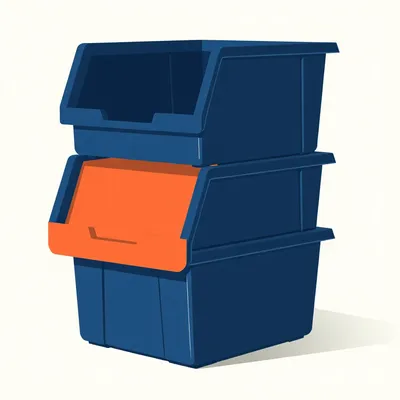
One plastic crate, thirty years of continuous use, still in daily service. That's not a product, that's a pensioner who refuses to retire. And it's what Daniel's been thinking about. Here's what he wrote us.
I've been looking into the Dolav container. It's a large, heavy-duty industrial plastic pallet box. Not glamorous. Nobody's going to admire its aesthetics. But once you start looking into global logistics, agriculture, and manufacturing, you realize it's everywhere. I first came across it while researching industrial storage systems, and I assumed it was just another generic product. Then I noticed Israeli manufacturers prominently market Dolav containers, and the name itself sounded distinctly Israeli. Later, while browsing a British supplier for Euroboxes for my sister, I found Dolav listed there as well. That sent me down a rabbit hole, and sure enough, Dolav is an Israeli company, and the product originated here.
He goes on. We often celebrate Israeli innovations like drip irrigation, cherry tomatoes, and other inventions that have had a global impact. The Dolav doesn't belong in that category from a public relations perspective. It's an industrial crate. It's about as unglamorous as an invention can be. But perhaps that's precisely why it's interesting. One of the assumptions we've challenged before is that plastic equals unsustainable, period. That's certainly true for many disposable products, but it doesn't capture what's happening in industrial plastics. These containers aren't designed to be thrown away. They're designed to survive years, often decades, of continuous use. Engineers have spent enormous time optimizing them for strength, longevity, repairability, stackability, and compatibility with global logistics systems.
He says the Dolav, alongside the German-developed Eurobox system and standardized IBCs, forms part of the infrastructure that quietly keeps modern supply chains moving. Food, pharmaceuticals, automotive parts, agricultural products, all depend on standardized containers that can be stacked, lifted, transported, washed, reused, and shipped efficiently around the world. So his questions are, what was it about the Dolav that made it so successful? Was it solving a problem nobody else had solved as well? Did it introduce a genuinely new design, or was its success driven by manufacturing quality, standardization, and timing? Why did this particular Israeli product become a global industrial standard? And the bigger question, should we think of the Dolav as one of Israel's great industrial success stories, an export with outsized impact despite being invisible to the public? Or are Eurobox enthusiasts like him in danger of exaggerating its importance because they've become fascinated by industrial storage systems? He wants to know where the truth lies. Was the Dolav simply a successful product in a niche market, or is it one of those overlooked innovations that quietly became infrastructure without most people ever realizing it?
So let's open the crate and see what's inside.

First thing to understand is what this thing actually is. A Dolav is an injection-moulded polypropylene pallet box. The standard footprint is eight hundred by twelve hundred millimeters, which is the Euro-pallet footprint, and that's not a coincidence. Capacities range from about four hundred liters up to a thousand liters and beyond. Single-piece construction. No welds, no joints, no seams. The whole thing comes out of the mould as one unit.
Single-piece. So there's nowhere for it to fail at a join, because there are no joins.
Exactly the point. And these are not the storage bins you buy at Target. Those are thin-wall consumer products designed to sit in a closet holding winter clothes. A Dolav is engineered for forklift tines, for being stacked five or six high fully loaded, for sitting in a field in the sun for years, for being pressure-washed with industrial cleaners in a food processing plant. The material is virgin polypropylene with UV stabilizers and impact modifiers baked in. The company has a case study on their site, boxes still in daily use after thirty years in agricultural and industrial settings. Not sitting in a warehouse, not gently used. Daily service. Three decades.
Thirty years is longer than most marriages.
It's longer than a lot of industrial equipment. And that's the thing Daniel's getting at. This isn't disposable plastic. This is engineered infrastructure that happens to be made of polymer. The distinction matters enormously, and it's almost entirely invisible to anyone who doesn't work in supply chains.
So what was the world using before Dolav showed up in nineteen seventy-six?
Wood, mostly. Wooden crates, wooden pallet boxes. Sometimes metal drums for liquids and bulk solids. The problem with wood is it splinters, it absorbs moisture, it harbors bacteria, it's heavy, and it doesn't clean well. In food processing or pharmaceuticals, that's a non-starter. Metal rusts, it's even heavier, and it dents. So there was a genuine gap in the market for something that was durable, lightweight relative to its strength, completely cleanable, and dimensionally stable.
Dimensional stability. That's the part where it doesn't warp in the sun and stop fitting on the pallet it was designed for.
Right. And that's where the material science comes in. Polypropylene with the right additives doesn't warp significantly under normal industrial temperature ranges. It doesn't absorb water. It's resistant to most chemicals. You can steam-clean it. You can leave it outside in the Mediterranean sun for a decade and it still stacks true. Wood can't do any of that.
The name, Dolav. Hebrew?
Yeah, it's a Hebrew name. The company was founded in nineteen seventy-six in Israel. And the timing is one of those things that looks obvious in retrospect but wasn't at the time. Nineteen seventy-six is right when global containerized shipping was taking off. The ISO shipping container had been standardized about a decade earlier. The Euro-pallet standard was becoming dominant across Europe. Global trade was accelerating, and suddenly there was massive demand for standardized, stackable, durable containers that could move seamlessly between trucks, ships, warehouses, and factories.
So they didn't just design a good box. They designed a good box that fit exactly into a system that was exploding.
The eight hundred by twelve hundred millimeter footprint. That slots directly onto a Euro-pallet. A Euro-pallet fits two across in a standard ISO container. The whole system interlocks. If Dolav had picked a proprietary footprint, some weird dimension that only worked with their own pallets, they'd be a footnote. Instead they built to the standard that was becoming the standard, and they rode that wave.
It's the VHS versus Betamax lesson, except applied to crates.
And they won. Or at least, they became one of the standards. The German Eurobox system predates them and is dominant in a lot of European logistics. Dolav carved out a niche by being heavier-duty. Thicker walls, stronger ribs, tougher material formulation. The Eurobox is great for a lot of applications. The Dolav is what you reach for when the application is punishing.
Let's talk about those ribs. Daniel mentioned the design, and I went and looked at some photos. The walls aren't flat. They've got this... pattern.
The Dolav rib. It's a structural reinforcement pattern. If you look at a Dolav box from the side, you see these vertical and diagonal ribs moulded into the walls. They add stiffness without adding a lot of material. It's the same principle as corrugated cardboard or an I-beam. You're putting material where it does structural work and removing it where it doesn't. The result is a box that's strong enough to hold a thousand kilos of potatoes but light enough that a forklift can handle a stack of them.
Potatoes. That's the Cyprus example Daniel mentioned?
Yeah, Dolav has a case study on this. Cyprus potato exporters were using wooden crates. The wood was damaging the potatoes, absorbing moisture, getting gross. They switched to Dolav boxes. Damage rates dropped, hygiene improved, and because the boxes stack securely, they could fit more product in the same shipping space. The case study says they cut shipping costs by thirty percent. And the same boxes are still in use years later.
A thirty percent shipping cost reduction from switching your crate. That's the kind of number that makes logistics managers switch religions.
And it's not just the box itself. It's the lid system. Dolav boxes have integrated lids that lock. When you stack them, the lid of the lower box becomes part of the support for the box above. You can go five or six high in a warehouse or a shipping container. That's vertical space you're not wasting. In logistics, unused vertical space is just money you're leaving on the floor.
So we've got a box that's strong, cleanable, stackable, dimensionally compatible with global shipping infrastructure, and it lasts thirty years. I'm starting to see why Daniel got obsessed.
And there's one more piece that I think is underappreciated. The manufacturing process. Dolav designs and builds its own injection-moulding tools in-house. This is on their innovations page. They don't just make boxes. They design the machines that make the boxes.
Wait. They build their own moulds?
In-house tooling and mould design. That's a core competency they advertise. Injection moulding at that scale, for a single-piece box that big, is not trivial. The mould itself is an enormously complex piece of engineering. You're injecting molten polypropylene into a cavity the size of a large crate, and you need it to fill evenly, cool evenly, and release cleanly, every single cycle, for hundreds of thousands of cycles. If you're buying moulds from a third party, you're limited by what they can do. If you're designing and building them yourself, you can iterate on the design in ways your competitors can't.
So the secret sauce isn't just the box design. It's the ability to keep improving the box design because you control the entire manufacturing stack.
Vertical integration. Design, tooling, moulding, quality control, all under one roof. That's rare in plastics manufacturing. Most companies buy moulds from specialists and run them. Dolav treats the mould-making as part of the product.
That's... actually a much more interesting story than I expected from a plastic crate.
Right? And it connects to something Daniel touched on in his prompt. Israeli innovation. We talk about Waze, Mobileye, Iron Dome, drip irrigation, cherry tomatoes. All consumer-facing or at least publicly visible. But there's this parallel story of industrial manufacturing excellence. Companies like Dolav, Netafim with drip irrigation, Plasson with plastic fittings. These are companies that built global businesses on precision plastic engineering. Not apps, not algorithms, not defense systems. Physical products that have to work in the real world, under real stress, for decades.
Netafim is an interesting comparison. Drip irrigation is celebrated. You see the pipes in fields, you understand the water savings, it's a story that's easy to tell. A Dolav box is just... a box. It does its job so well that you stop seeing it.
That's the invisibility paradox. The more successful infrastructure is, the less visible it becomes. Nobody thinks about the power grid until the lights go out. Nobody thinks about the shipping container until there's a supply chain disruption. And nobody thinks about the crate that the potatoes arrived in, ever. But the global food supply chain depends on these crates. Without standardized, cleanable, stackable containers, fresh produce doesn't move from farm to supermarket efficiently. It spoils, it gets damaged, it costs more.
So the Dolav is infrastructure in the same way that the shipping container is infrastructure. Just at a different scale.
Malcolm McLean's shipping container changed the system. Before containerization, loading a ship took days and required an army of longshoremen. After, it took hours with a handful of crane operators. The container didn't just replace the box. It rewrote the economics of global trade. The Dolav didn't rewrite the economics. It optimized within an existing system. The pallet and the ISO container were already standardized. The Dolav made the box that sits on the pallet that goes in the container better.
So it's not a category-defining innovation. It's a category-optimizing innovation.
And that's not a criticism. Most innovation is optimization. The question Daniel's asking is whether we should put it in the same category as drip irrigation or cherry tomatoes. And I think the answer is... Yes and no. It's not as transformative as drip irrigation. Drip irrigation changed how we grow food in arid regions. That's a civilization-scale impact. The Dolav made bulk logistics slightly more efficient. But that slightly more efficient, multiplied across thousands of shipments, over thirty years, across dozens of industries, adds up to something significant.
It's the difference between a breakthrough and an accumulation. A breakthrough is visible. An accumulation is invisible until you add it all up.
And that's the thing about industrial infrastructure. The gains are distributed. A farmer in Cyprus saves a few cents per kilo on potato shipping. A chemical plant in Germany has fewer spills. A food processor in Brazil has fewer contamination incidents. None of these are headline-grabbing. But they compound.
Let me push back on something, though. Daniel asked if Eurobox enthusiasts like him are in danger of exaggerating the Dolav's importance. I think there's a version of this story where we're just... describing a well-made product in a competitive market. The Dolav is good. But it's not the only heavy-duty pallet box. There are competitors. The German Eurobox system is more widespread in Europe. IBCs, intermediate bulk containers, dominate liquid and bulk chemical transport. The Dolav is a player, not the player.
That's fair. And I think Daniel would acknowledge that. His prompt isn't claiming the Dolav is unique or dominant. It's asking whether it's an overlooked success story that deserves more recognition than it gets. And I think the answer to that is yes, with the caveat that the recognition it deserves isn't public fame. It's the recognition that industrial engineering matters.
The fame it deserves is... being bought by logistics managers who know exactly what they're looking for.
Which is a kind of fame. It's just not the kind that gets you on magazine covers.
The cover of Modern Bulk Logistics Monthly.
I would subscribe to that.
You absolutely would.
There's another angle here that I think is worth pulling on. The sustainability question. Daniel mentioned it in his prompt, and Dolav has a whole sustainability page on their site. The argument is straightforward. A single Dolav box can eliminate thousands of cardboard boxes or wooden crates over its thirty-year life. Cardboard is recyclable, yes, but it still requires energy and water and chemicals to produce and recycle. Wood requires trees. A polypropylene box that lasts three decades and then can itself be recycled, that's a different environmental calculus than a single-use plastic bottle.
The phrase durable plastic sounds like an oxymoron to most people. But in industrial settings, that's exactly what it is.
And the environmental movement has, I think, done a disservice by lumping all plastics together. A polyethylene grocery bag and a UV-stabilized polypropylene pallet box are both technically plastic. But they have almost nothing in common in terms of material science, use case, lifespan, or environmental impact. The grocery bag is used for twenty minutes and persists for centuries. The pallet box is used for thirty years and then gets recycled into another pallet box. They're not the same category.
The problem is the word plastic. It's too broad.
It's like using the word metal to describe both aluminum foil and a bridge girder. Technically true, practically useless.
So where does the Dolav actually sit in the global market? Is it a premium product? A commodity?
Premium. Definitely premium. The injection-moulding process, the virgin material, the in-house tooling, the quality control, all of that costs more than the alternatives. A Dolav box is more expensive upfront than a wooden crate or a cheaper plastic bin. The value proposition is total cost of ownership. You pay more on day one, but you're still using it on day ten thousand. For applications where the box gets beaten up, where hygiene matters, where downtime from a failed container is expensive, the math works.
And for applications where none of that matters, you buy the cheaper option.
Right. The Dolav isn't trying to be the cheapest box on the market. It's trying to be the box you buy when the cheap box fails and costs you more in the long run. That's a classic premium positioning strategy. And it works because the product actually delivers on the promise.
Which brings us back to Daniel's bigger question. Should we think of this as one of Israel's great industrial success stories?
I think it belongs on a list that most people don't know exists. Israel's industrial manufacturing exports are substantial. Plastics, chemicals, machinery, electronics components. The high-tech sector gets all the attention because it's sexy and it produces billion-dollar exits. But the industrial sector has been quietly building global businesses for decades. Dolav is a perfect example. It's not a unicorn. It probably never will be. But it's a company that identified a global need, engineered a superior solution, and has been selling it successfully for nearly fifty years.
Fifty years. Nineteen seventy-six to twenty twenty-six.
Half a century of making plastic boxes. That's not a flash in the pan. That's a institution.
And it's still privately held, I assume?
As far as I can tell, yeah. It's not a public company. It's not making headlines. It's just... doing the work.
There's something almost refreshing about that. In a world where every startup is trying to disrupt something and get acquired, here's a company that just makes really good crates and has been doing it for fifty years.
The anti-disruption. Disruption through sheer durability.
I want to go back to something you said earlier about invisibility. The more successful infrastructure is, the less visible it becomes. I think that's the real insight here, and it's bigger than the Dolav.
Say more.
We have this cultural obsession with visible innovation. The new phone, the new app, the new car. Things we can see and touch and show off. But the things that actually make modern life possible, the power grid, the water system, the shipping containers, the pallet boxes, the logistics software, the cold chain, all of that is invisible to most people. And because it's invisible, we undervalue it. We don't celebrate the engineers who design pallet boxes. We celebrate the entrepreneurs who design apps.
The phone you're using to order groceries was shipped in a container that was loaded by a forklift that was moving pallets that were stacked with boxes that were probably, somewhere in the chain, a Dolav or something like it. The digital economy runs on physical infrastructure. And the physical infrastructure runs on... crates.
The cloud is just someone else's server. And that server arrived on a pallet.
In a box. Probably a really well-engineered box.
What's the takeaway for someone listening who doesn't work in logistics and isn't about to buy industrial pallet boxes?
I think there are two. The first is specific to the Dolav. It's a genuine success story. Not because it changed the world, but because it solved a specific problem with exceptional engineering and manufacturing quality, and it rode the wave of global containerization at exactly the right moment. That's worth recognizing, even if it's not glamorous.
And the second?
The second is about how we see the world. The most impactful technologies are often the ones you never notice. Infrastructure shapes our lives more than any consumer gadget, but it gets almost no attention. The Dolav is a reminder to look at the pipes, not just the faucets. Next time you see a stack of industrial crates, ask what they're made of, how long they've been in service, what they replaced. The invisible infrastructure of the global economy is full of fascinating engineering stories.
It's a mindset shift. From noticing the shiny to noticing the sturdy.
The sturdy is often more interesting. The shiny is designed to be noticed. The sturdy is designed to work. Those are different design philosophies, and they produce different kinds of objects.
I'm now going to be insufferable at parties. Did you know that the potato you're eating probably traveled in an Israeli-designed polypropylene pallet box that's been in service since the nineties?
You don't go to parties.
I go to... logistics conferences.
You've never been to a logistics conference.
I'd be very popular at one.
Hilbert: If the Dolav is so well-engineered and lasts thirty years, doesn't that mean they eventually saturate their own market? How do you keep growing when your product refuses to die?
That's a sharp question, Hilbert. It's the classic durable goods problem. And I think the answer is probably a combination of things. Market expansion into new regions and industries, new product lines for different applications, and honestly, the sheer growth of global trade means more boxes are needed every year. Plus, boxes do eventually get lost, damaged beyond repair, or retired. Thirty years is the upper end, not the average.
Also, a company that's been doing this for fifty years has probably figured out the math. If your product lasts forever, you charge accordingly upfront, and you keep finding new customers. The world's a big place. There are always more potatoes.
Thanks, Hilbert. Good question.
Here's what I'm left wondering. Daniel asked about the Dolav specifically, but the question applies more broadly. What other invisible Israeli innovations are quietly running the world? And beyond Israel, what about innovations from other countries that we've never heard of? The products and technologies that are everywhere but never celebrated.
That's the invitation, really. If you're listening and you work in an industry with its own version of the Dolav, some piece of equipment or infrastructure that's brilliant and durable and completely overlooked, we want to hear about it. Send it to us.
The show's at my weird prompts dot com. Tell us about the crate that changed your industry. Or the fitting, or the valve, or the sensor. The things that work so well they've become invisible.
This has been My Weird Prompts. Keep looking where nobody else is looking.