Daniel's been deep in the unboxing trenches, and he's had a revelation. Here's what he wrote to us — and I'm going to read this nearly in full because the texture matters. "I've recently become a huge proponent of tactical belts and modular carry systems. I began seeing these on AliExpress when I was searching for flashlights, and I came across the term EDC for the first time — everyday carry. I was kind of put off by the military and prepper vibes, but I really liked the stuff from Nitecore. We recently moved apartment, and I have ADHD. For my whole life I've had trouble with losing things and misplacing things. Over the years I've gotten better at not actually losing things like my wallet permanently, but I seem to have actually gotten worse at misplacing things around the house. So when we were unboxing and trying to parent, drill, do all the rest of it simultaneously, I realized I needed any system that would help urgently, and picked up one of these. It was love at first ratchet, but you also need to know how a ratchet works, or you will find yourself on the toilet desperately trying to search the spec sheet to see how the ratchet actually un-ratchets." He goes on — "hopefully at some point in the not-too-distant future, our crazy current phase of parenting and unboxing will be over, and at that point I want to bifurcate into two belt systems. System one for when I'm actively doing hardware stuff, keeping the drill holster, the rest of it. But I see long-term value in this, and my thinking right now is that this is my system for life. So my task for you, Herman and Corn, is to build out my second belt, which is going to be the non-DIY everyday belt. I want you to think about how to configure a belt system for something that will be as unobtrusive as possible while providing just the right amount and type of accessories needed for things that one might carry every day." Then he lists the items: power bank, USB cable, phone, wallet, headlamp. He adds daily medications and a supplement — specifically omeprazole, which if he leaves the house without it, causes what he calls "unexpected problems." And he wants us to build this out in detail, starting with the belt and then the exact pouch layout.

The toilet spec-sheet moment is what sells this. You're sitting there, belt locked around you, and you realize you have no idea how to get it off. That's not a failure of the user — that's a rite of passage with ratchet belts.
It's the moment the thing you bought to solve problems becomes the problem.
And for someone with ADHD, that moment is especially sharp because the impulse is to buy the thing, unbox the thing, strap it on immediately — and only then realize there's a mechanism you haven't learned. So let's start with that mechanism. A ratchet belt uses a toothed track — think of a zip tie but made of nylon — and a spring-loaded pawl inside the buckle. You pull the tail through to tighten, and the pawl clicks into each tooth as you go. To release, you squeeze both side levers on the buckle simultaneously and pull the buckle away from your body. That's the specific move Daniel was searching for on the toilet.
Squeeze both levers at once. Not one, not alternating. Both.
That dual-lever design is a safety feature — it prevents accidental release if you lean against something. The Nitecore NBP31 uses exactly this mechanism. The 5.11 Operator Belt, by contrast, uses a Velcro-lined nylon closure with a cobra-style buckle. Quieter, but less precise — you're limited to where the Velcro lands, whereas the ratchet gives you millimeter-level adjustment.
Which matters when you're adding pouches. A belt that's slightly too loose will sag under the weight of a power bank, and a belt that's slightly too tight becomes something you're constantly aware of — which for an ADHD brain is a distraction that never stops.
I spent years in pediatrics watching parents manage their own attention while managing kids, and the constant low-grade distraction of uncomfortable clothing is a real cognitive tax. The ratchet solves that — you adjust it once in the morning, it stays exactly where you set it, and you forget it exists.
So the belt is the Nitecore NBP31. Daniel already likes Nitecore's design language, and the buckle sits flat — no giant cobra buckle bulge pushing against your shirt. It's one point five inches wide, which is the sweet spot for pouch compatibility without looking like you're about to direct traffic on a runway.
Thirty-nine ninety-nine on the Nitecore store. Compare that to the 5.11 Operator at fifty-four ninety-nine, and you're getting a more precise mechanism for less money. But the belt is just the rail — the pouches are where the system actually does its work.
And this is where we need to talk about attachment mechanisms, because Daniel specifically asked about MOLLE versus other options. Most people hear "tactical belt" and think MOLLE webbing — those rows of nylon loops you weave pouches through. It's secure, it's standardized, it's also bulky and tedious to reconfigure.
For a duty belt where you're carrying a radio, handcuffs, a baton — MOLLE makes sense. For an everyday belt carrying a phone and some omeprazole, it's overkill. You're adding bulk for security you don't need, and you're committing to a twenty-minute re-weave every time you want to move a pouch.
Nitecore has a slide-on clip system that's much better for this use case. The pouch has a clip on the back that slides over the belt and locks in place — no weaving, no excess nylon. You can move a pouch from one position to another in about three seconds.
Which matters for adoption. Daniel has ADHD. If reconfiguring the belt is friction, he won't do it — and then the system sits in a drawer. The slide-on clip removes that barrier. I'd recommend a hybrid approach: slide-on clips for the primary pouches, and one small MOLLE panel for the headlamp, which we'll get to.
Let's lay out the exact configuration. I'm going to use clock-face coordinates — twelve o'clock is your belt buckle, six is the small of your back. Daniel's right-handed, so we're optimizing for right-hand access.
Start with the phone. That's the item he reaches for most often, and it's the bulkiest thing in a pocket. I'd put it at ten o'clock — left hip. The Nitecore NPA10 magnetic pouch. Holds phones up to six point seven inches, magnetic flap closure, sits flat against the body. Left hip because most people pull their phone with their left hand and operate with their right.
The magnetic closure is important here. Zippers are slow, Velcro is loud — and Daniel's a parent. A magnetic flap opens silently and closes itself when you drop the phone back in. You're not waking a sleeping kid with the rip of Velcro.
Next, wallet at eleven o'clock — just forward of the phone on the left side. Nitecore NPA20 slim pouch. Holds a bifold vertically, zero bulk. This is the item Daniel's been losing his whole life, and the solution isn't a better wallet — it's giving the wallet a permanent physical home on his body.
The home is the thing. You don't lose your phone because your phone lives in a specific place. The wallet has never had that — it floats between jackets and pants and desks and countertops. The pouch is the home.
Meds at one o'clock — right front. NPA30 utility pouch. Two compartments, weather-resistant zipper. Omeprazole in one compartment, supplement packets in the other. This is the item that has real consequences if forgotten — Daniel said it himself, leaving the house without omeprazole causes unexpected problems. So it goes at one o'clock where he'll see it every time he looks down.
The NPA30 is padded, which matters for medication. Omeprazole needs to stay dry and at room temperature — a padded pouch against your body isn't going to cook the pills the way a car glovebox would, but it's also not going to get crushed when you lean against something.
For the supplement — and Daniel didn't specify whether it's powder or tablets — I'd add a small waterproof pill fob on a mini-carabiner clipped to the belt loop near the NPA30. That keeps it separate from the omeprazole, no cross-contamination, and the carabiner means you can detach it without opening the pouch.
Headlamp at two o'clock — right hip, just behind the meds pouch. This is the one item where I'd use a small MOLLE panel rather than a slide-on clip, because the headlamp needs to be accessible but also needs to sit at a specific angle. The Nitecore NU25 — fifty-two grams, USB-C rechargeable, has a red light mode which is perfect for parenting. You're checking on a kid at night, you don't want to blast white light into their face.
The NU25 is genuinely ultralight. Most headlamps are bulky enough that you'd never consider belt-carrying them, but at fifty-two grams the pouch adds almost nothing. And the red light mode is a feature I used constantly as a pediatrician — preserves night vision, doesn't startle.
Now the hard one. Power bank and USB cable. This is where most belt systems fail, because a power bank is a brick, and a cable is a tangle, and you're trying to make both disappear.
The Nitecore NB10000 is the answer for the power bank itself. Ten thousand milliamp-hours in a carbon fiber shell, weighs a hundred and fifty grams — about the weight of a smartphone. The question is how to mount it.
I'd put it at eight o'clock — small of the back, offset to the left. Horizontal orientation. You can use another NPA10 pouch stretched horizontally, but honestly that might be too bulky. The alternative is a belt-clip power bank that attaches directly to the belt without a pouch — something like the Anker PowerCore 5000, which is smaller capacity but clips on and off in one motion.
The trade-off is capacity versus bulk. The NB10000 in a pouch gives you two full phone charges and will last all day. The clip-on 5000 gives you one charge and is invisible. For Daniel's everyday use — he's a parent, he's not hiking the Appalachian Trail — the clip-on 5000 is probably sufficient, and the lower profile means he'll actually wear it.
And if he needs more capacity on a specific day, he can swap in the NB10000 in its pouch. The modular system means you're not locked into one configuration.
The cable is the sneaky problem. A loose USB cable in a pouch becomes a rat's nest in about four hours. Solution: a retractable USB-C cable. Nomad Goods makes one for twenty-nine ninety-five — thirty centimeters of cable on a spring-loaded spool. Generic versions are about eight dollars on Amazon and work fine.
Thirty centimeters is enough to charge while walking — phone in hand, power bank on belt, cable running between them. It's not enough to get tangled in a door handle, which is the actual design constraint here.
Store the retractable cable in the same pouch as the power bank. They're a paired system — you never need one without the other.
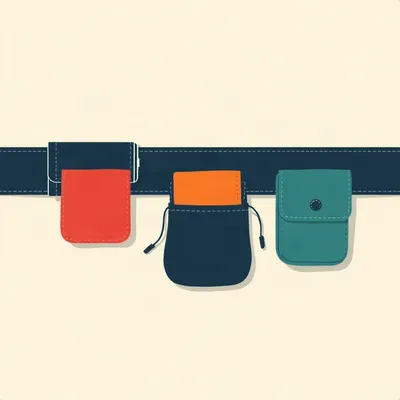
So the full layout: ten o'clock, phone in NPA10 magnetic. Eleven o'clock, wallet in NPA20 slim. One o'clock, meds in NPA30 utility with a pill fob on a carabiner nearby. Two o'clock, NU25 headlamp on a small MOLLE panel. Eight o'clock, power bank and retractable cable in a clip-on or low-profile pouch.
Six items, five positions, all accessible with one hand, nothing dangling, nothing visible under an untucked shirt.
And that last point is the one Daniel's really asking about when he says "unobtrusive." He doesn't want to look like he's about to breach a door. The whole system needs to disappear.
The key choices: everything in black or dark gray — no multicam, no coyote brown, no olive drab. Pouches sit flush against the body — no drop-leg platforms, no dangle pouches on straps. The belt is worn under an untucked shirt or sweater. The only item that protrudes at all is the headlamp at two o'clock, and that's hidden by your arm when you're standing normally.
The headlamp is the one item where you accept a little bulk because the utility is so high. A parent needs hands-free light constantly — changing diapers in dim rooms, finding dropped pacifiers under furniture, navigating a dark hallway with a kid in one arm. The NU25 earns its spot.
And it's removable. The MOLLE panel stays on the belt, but the headlamp itself comes out of its pouch when you need it and goes back when you're done. You're not walking around with a headlamp strapped to your belt looking like a cave explorer.
Let's talk about the bifurcation plan, because this is where Daniel's thinking is sharp. He wants two belts — one for DIY with the drill holster and tape measure, one for everyday with this configuration we just laid out. The question is whether those should be two separate belts or one belt that gets reconfigured.
Two separate belts. Absolutely. Swapping pouches daily is friction, and friction kills adoption for ADHD brains. The mental overhead of "which pouches do I need today, let me move the drill holster off and the med pouch on" — that's a task that gets postponed, then skipped, then the whole system collapses. Buy a second NBP31 for forty dollars. Leave the everyday pouches permanently mounted. The DIY belt lives in the workshop; the everyday belt lives on your pants.
The total cost for the minimum viable system — one NBP31 belt plus three NPA pouches — is about a hundred dollars. That's belt, phone pouch, wallet pouch, med pouch. The headlamp and power bank can come later.
And I'd argue they should come later. This is the ADHD-specific advice: do not buy everything at once. The impulse with a new system is to acquire the complete set immediately — all six pouches, the headlamp, the power bank, the retractable cable, the carabiner, the pill fob. Then you spend an evening configuring everything perfectly, wear it once, feel self-conscious, and abandon it.
The thing about ADHD is that novelty is a drug, and when the novelty wears off the system has to be simple enough to survive on habit alone. Three pouches is simple. Six is a project.
Start with the core three — phone, wallet, meds. Wear them for two weeks. Let the muscle memory develop. Your left hand learns where the phone lives. Your right hand learns where the omeprazole is. After two weeks, add the headlamp. Two weeks after that, add the power bank. You're building a habit stack, not buying a costume.
And during those two weeks, implement what I'd call a belt check ritual. Every time you leave a room, pat each pouch in order — phone, wallet, meds. That's three seconds. It replaces the frantic pocket-patting that Daniel's probably doing right now, where he slaps six different pockets trying to remember what's where.
The pat-down is a form of environmental scaffolding — you offload working memory onto the physical world. Instead of holding "where is my wallet" in your head, your hand confirms it's at eleven o'clock. Studies on this are striking — externalizing memory reduces task-switching costs by about forty percent. For someone with ADHD, that's the difference between walking out the door confident and walking out the door anxious.
Forty percent is enormous. That's not a marginal improvement — that's a different category of functioning.
And it's why I keep saying this isn't a fashion choice. The belt system is a cognitive prosthetic. It routes around the working memory deficit that makes Daniel misplace things. Every item has a physical location that you can see and feel. The question isn't "where did I put my omeprazole" — the answer is always "one o'clock."
The belt answers questions. It doesn't ask them.
That's the design brief, exactly. And it's why the pouch layout matters so much — the positions aren't arbitrary. Phone at ten o'clock because that's where your left hand naturally falls. Wallet at eleven because it's adjacent but distinct — you can feel the difference between the magnetic closure of the phone pouch and the slim profile of the wallet pouch without looking. Meds at one o'clock because it's the most visible position when you glance down. The layout encodes information.
The omeprazole specifically — Daniel mentioned it by name, and that tells me this isn't a hypothetical. He's had the experience of being out somewhere and realizing he doesn't have it, and the next few hours are uncomfortable at best. That's the kind of consequence that makes a system stick.
Omeprazole is a proton pump inhibitor — it reduces stomach acid. If you're on it daily and you miss a dose, the rebound acid secretion can be worse than the original symptoms. So "unexpected problems" is Daniel being diplomatic. It's unpleasant, and it's avoidable with a system that makes the medication impossible to forget.
Because it lives on your body. Not in a bag you might leave behind, not in a jacket you might switch out, not in a drawer you might forget to open. On your belt, at one o'clock, every single day.
The supplement is trickier because we don't know the form factor. If it's a powder packet, the NPA30's second compartment handles it. If it's a tablet, the pill fob on the carabiner is cleaner — you can pop it off, take the supplement, clip it back, no cross-contamination with the omeprazole bottle.
The carabiner is doing double duty. It's not just keeping the supplement separate — it's a visual indicator. If the carabiner is empty, you forgot to refill the fob. If it's there, you're good. Another piece of information encoded in the physical world.
Let's talk about what happens long-term, because Daniel said he sees this as his system for life. The parenting phase he's in right now — unboxing, drilling, constant chaos — that's going to shift. Eventually it becomes school runs and soccer practice and parent-teacher conferences. The system needs to adapt.
The beauty of the modular approach is that the belt is the constant. The pouches can change. When the headlamp is no longer a daily need, the MOLLE panel comes off and the NU25 goes in a drawer. When the kid is old enough that you're not carrying a power bank everywhere, that pouch comes off too. You're left with phone, wallet, meds — the core three that will probably never change.
And if Daniel's needs evolve in the other direction — say he starts carrying a small first-aid kit because he's got a toddler who scrapes knees — he can add an NPA pouch in about ten seconds. The slide-on clip system means reconfiguration is trivial. Compare that to a traditional MOLLE belt where adding a pouch means unthreading and rethreading webbing for fifteen minutes. That's the difference between a system that evolves with you and a system that sits in the closet.
I want to address a misconception that might be in Daniel's head, because he mentioned being put off by the military and prepper vibes. The assumption is that anything with MOLLE webbing or tactical styling is going to look ridiculous in civilian life. And that's true if you're wearing a full duty belt with a drop-leg holster and six magazine pouches. But a black Nitecore belt with three slim black pouches under an untucked shirt — that's invisible. The only person who knows it's there is you.
The Nitecore design language helps here. Their stuff doesn't look military — it looks like consumer electronics accessories. The NPA pouches have clean lines, no webbing on the outside, no D-rings clanking around. They could pass for a phone case or a minimalist wallet if anyone noticed them at all.
Which they won't. People don't look at belts. They look at faces, they look at phones, they look at kids. The belt is in the peripheral zone that nobody's attention ever lands on — unless you're wearing a giant cobra buckle that catches the light. Which is another reason the NBP31's low-profile ratchet buckle is the right choice.
The ratchet mechanism itself is worth defending. It's actually simpler than a traditional buckle — a pawl and a toothed track, same mechanism that's been used in industrial cargo straps for decades. No springs to wear out, no pins to break. The dual-lever release means it won't accidentally loosen if you lean against a counter. It's more reliable than Velcro, which loses grip over time as the hooks get clogged with lint.
The toilet moment Daniel described — that's not the mechanism failing. That's the user encountering a new interface without instructions. Once you know the move — squeeze both levers, pull away — you never forget it. It's like learning to open a childproof cap. Frustrating for thirty seconds, then automatic for life.
And that's the arc of the whole system. The first week is learning where everything lives and how the closures work. The second week is building the pat-down ritual. By week three, you're not thinking about it at all — you just have your stuff, always, in the same places, and your pockets are empty.
Empty pockets. That's the dream Daniel's chasing. No phone bulge on the thigh, no wallet creating a permanent dent in the back pocket, no tangled cable emerging from a jacket like a distressed snake. Everything on the belt, distributed around the waist, invisible under a shirt.
The power bank is the one item where I'll admit the solution isn't perfect. A hundred and fifty grams on the belt is noticeable. The clip-on 5000 is better for everyday, but it's still a lump at eight o'clock. If Daniel finds it annoying, there's a fallback: keep the power bank in a bag and just carry the retractable cable on the belt. The cable is the part that tangles and gets lost — the power bank is easy to remember because it's heavy enough to notice when it's missing.
That's a reasonable compromise. The cable lives at eight o'clock in a tiny retractable spool pouch. The power bank goes in the diaper bag or the daypack. You still get the benefit of never hunting for a cable, and you lose the bulk of the battery. And honestly, for most everyday parenting scenarios, you're near a bag anyway. The power bank on the belt makes more sense for the DIY configuration, where you might be up a ladder or under a sink and can't easily get to a bag.
Which circles back to the bifurcation plan. The DIY belt gets the heavy-duty items — drill holster, tape measure, larger power bank. The everyday belt stays lean. Daniel's instinct to split them is correct. Let's distill this into concrete actions. Action one: buy the Nitecore NBP31 belt and three NPA pouches — NPA10 for phone, NPA20 for wallet, NPA30 for meds. Total cost about a hundred dollars. That's the minimum viable system. Wear it for two weeks.
Action two: after two weeks, add the NU25 headlamp on a small MOLLE panel at two o'clock, and add the retractable USB-C cable at eight o'clock. The power bank can stay in a bag for now. If the cable-on-belt approach works, add the clip-on power bank later.
Action three: implement the belt check. Every time you leave a room, pat phone, wallet, meds — three seconds. Do it even when you know everything is there. The point is to build the habit so it fires automatically when you actually are missing something.
The goal isn't to look tactical. The goal is to never ask "where is my omeprazole" again. If the system achieves that, it's a success. Everything else — the headlamp, the power bank, the retractable cable — is optimization on top of a solved problem.
The solved problem is the core three. Phone, wallet, meds. Those are the items Daniel has been misplacing his whole life, and they're the items that cause real friction when they're missing. Everything else is nice to have.
I'm curious whether Daniel will actually bifurcate into two belts, or whether the everyday belt ends up absorbing the DIY role. The tension between specialization and simplicity is real — two belts means two things to remember, two things to switch between.
My bet is he starts with two and converges to one point five — the everyday belt stays as configured, and the DIY belt gets pulled out only when there's actual hardware work happening. Most days, the DIY belt sits on a hook. That's fine. The point of having two is that the everyday belt is always ready — no reconfiguration, no decision fatigue, just put it on and go.
The broader thing here is that modular carry systems are going mainstream in a way they weren't five years ago. Nitecore is leading this with the NPA line — designs that don't look like military gear, that are aimed at people who just want their pockets empty and their stuff organized. We're going to see more of this.
The civilian EDC market is growing fast, and it's not about prepping or tactical cosplay. It's about exactly what Daniel described — being a parent with ADHD who's tired of patting six pockets and still not finding the omeprazole. That's a real human need, and the hardware is finally catching up.
Hilbert: If Daniel puts all this stuff on a belt, doesn't he just look like a dad who's given up on pockets entirely? Like, is there a point where the belt system itself becomes conspicuous?
Fair question. The answer is the untucked shirt. A single layer of fabric — t-shirt, polo, casual button-down — hides the entire system. The only giveaway is if you bend over and the shirt rides up, which is when someone might glimpse a black pouch at your hip. But even then, it reads as a phone holster, which is already socially invisible.
The headlamp at two o'clock is the one item that could print through a thin shirt. If that's a concern, move it to five o'clock — back right, behind the hip — where it's hidden by the curve of your body. You lose some accessibility, but for an item you use a few times a day, that's a reasonable trade.
Hilbert's question gets at the real design tension: the more capable the system, the more visible it becomes. Daniel's brief is to maximize capability while staying invisible. I think the configuration we laid out threads that needle — but he'll know within a week of wearing it whether it feels right.
And if it doesn't, he can adjust. That's the whole point of modular. Move the pouch, swap the pouch, drop the pouch. The system serves you, not the other way around.
One open question I'm left with: will the everyday belt actually stay everyday, or will it gradually accumulate DIY items until it's just the old belt again? The gravitational pull of "I'll just clip the tape measure on for this one task" is strong.
That's the discipline question, and it's the same one that applies to any organizational system. The belt doesn't enforce its own boundaries — Daniel does. But the fact that he's thinking about bifurcation upfront, before the DIY belt even exists, suggests he's serious about keeping them separate.
If you've got a weird prompt for us — something about belts, or ADHD, or parenting, or all three — send it in. We'll build you a system. Email the show at show at my weird prompts dot com.
Thanks to Hilbert Flumingtop for the question. This has been My Weird Prompts. We'll be back soon.