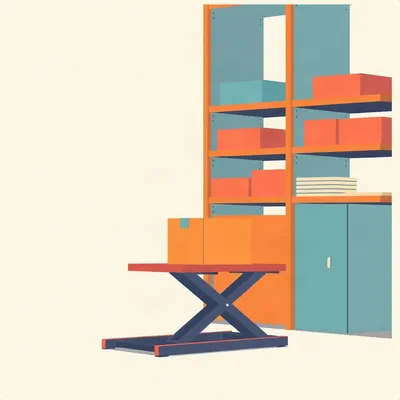
Daniel's been reorganizing the apartment again, and he's hit a storage category that doesn't exist. He's got the Eurobox system handling everything up to about forty-five centimeters tall. He's looked at Dolav boxes as the next step up in durability. But between those two, there's a gap for things that are narrow and tall. A light stand that's a meter and a half collapsed. Tripods. A shovel. Brooms. His point is that modular storage works because everything has a designated container, which makes it trackable and movable. But this class of object doesn't fit any container he's found, and leaving them freestanding isn't an option because they're fall hazards with a small child around.

And he's right that the gap is real. The Eurobox ecosystem is built around the sixty by forty footprint, and the tallest attached-lid boxes in that format top out right around forty-five centimeters. The Dolav family is even more extreme in the other direction. The standard Dolav pallet box is twelve hundred by eight hundred millimeters and seven hundred forty millimeters tall. That's a pallet-sized box. It's not going in an apartment closet. There is no tall-narrow sibling in either family. Nobody makes a sixty-by-forty box that's a meter and a half tall. It would be unstable, it would be impossible to reach into, and the injection-molding cost would be absurd.
So the market has decided that tall narrow objects don't get boxes. They get racks, tubes, or cabinets. Which is fine, except Daniel's whole system is built on the idea that everything lives in a designated container.
And here's the tension. The products that actually solve this problem split into three families, and each one sacrifices something Daniel's modular philosophy depends on. Wall-mounted grip racks give every object a fixed position and get them off the floor entirely, which solves the child-safety problem completely. But they're fixed to a wall. They don't move when your storage footprint changes. Free-standing tube organizers are movable, but they're exactly the kind of tall thing a toddler can pull over. And tall narrow cabinets enclose everything, which is the safest option, but they're the least modular and the most expensive.
So the modularity promise and the child-safety requirement are in direct conflict. That's the actual problem he's asking about, whether he framed it that way or not.
Let's start with the wall-mounted option, because I think it's the closest thing to what he actually wants. The grip rack category has been around for decades, but the current generation is surprisingly good. The Sorbus wall-mounted organizer is five gravity-controlled rolling-ball slots plus six hooks. The balls grip whatever you push in, so it auto-adjusts to handle thickness. That matters for Daniel's use case because a light stand column, a tripod leg, and a broom handle are all different diameters. It holds up to eleven items, it's sixteen inches wide, and it's thirty-two dollars at Target right now.
Thirty-two dollars. So the entire tall-object problem for eleven items costs less than one Eurobox with a lid.
That's the thing about this category. It's shockingly cheap. And there's a stainless steel tier if you want more durability. POPRUN makes a three-slot, eight-hook rack in SUS304 stainless rated for about thirty pounds. Poboola claims fifteen pounds per hook and ten pounds per slot, up to a hundred fifty pounds total. Those are real numbers for a rack that's holding a shovel and a couple of tripods.
But a rack isn't a container. Daniel's point about tracking belongings is that if everything is in a box, you can look at the box and know the thing is there. A rack gives you designated positions, but the objects are exposed, and they're still individual objects. You haven't created a unit you can move.
Right. And that's the second family. The free-standing tube organizer. The clearest example is the Stickstow Multi. It's a twenty-inch tall ABS unit with four-inch diameter tubes, and it holds thirty-five plus long-handled items. It's essentially a Dolav for sticks. One durable plastic body that corrals an entire class of tall objects. It's a hundred ninety dollars, weighs twelve pounds, and it's got drainage holes in the tube bottoms so you can store wet brooms and mops without them sitting in water.
Wait. Twenty inches tall but it holds thirty-five long-handled items. So the items stick out the top by a meter or more.
Yes. The tubes are only tall enough to keep the handles upright. The items themselves extend well above the unit. It's not enclosing anything. It's organizing the bottom ends so the tops don't fall over.
So it's a rack with extra steps and a plastic body.
It's a rack you can pick up and move. That's the difference. If Daniel's storage footprint changes, he can lift the whole Stickstow Multi with everything still in it and carry it to a new spot. You can't do that with a wall-mounted grip rack without unscrewing it from the wall. The Stickstow is free-standing by design, which means it's also a tip-over risk by design.
And that's the problem. He said the objects can't be freestanding because they're fall hazards for Ezra. A twenty-inch base holding a meter-and-a-half light stand is a lever. A toddler grabs the light stand, and the whole thing pivots.
Unless you anchor it. And here's where the third family comes in, because the modular tower category has already solved this problem. The UbeCube CrateCloset Tower is a stackable crate system, five collapsible crates plus shelves and hooks, a hundred fifty dollars. It ships with ScrewClips specifically for wall anchoring, and the instructions say to anchor it especially when stacking more than three crates high. So the modular tower people have accepted that once you go vertical, you're no longer free-standing. You're wall-anchored.
Which means the modular, movable promise is partly an illusion once child safety enters. You can have movable, or you can have safe, but you can't have both unless you're willing to unanchor and re-anchor every time you move.
That's the trade. And I think Daniel's instinct that there's an intermediate gap is well-founded, but the market hasn't filled it with a purpose-built modular box. It's filled it with adjacent categories that each solve part of the problem. The grip rack solves designated position and child safety but not movability. The tube organizer solves movability but reintroduces the fall hazard. The tall narrow cabinet solves enclosure and safety but costs a thousand dollars and isn't modular at all.
Let's talk about that cabinet, because the numbers are interesting. Sixty-two inches tall, thirteen by thirteen footprint. That's thirty-two centimeters by thirty-two centimeters by a hundred fifty-seven centimeters. A narrow vertical column. It's got metal tripod legs and three exterior shelves. Nine hundred ninety-four dollars.
And that's the thing. For a thousand dollars, Daniel could buy thirty Sorbus racks and mount them on every wall in the apartment. The cost spread across these three families is enormous. Thirty-two dollars for a grip rack, a hundred ninety for a tube organizer, a thousand for a cabinet. And the cabinet is the only one that actually encloses the objects so a child can't reach them at all.
But does Daniel need full enclosure? His stated problem is fall hazards, not access. A light stand is not a poison. It's not a knife. The danger is that it tips over and hits someone. A wall-mounted rack at adult height solves that completely, because the object is no longer standing on the floor where it can pivot.
That's the key insight. The fall hazard isn't the object itself. It's the object standing vertically on the floor. Any solution that gets the object off the floor and fixed to something stable eliminates the hazard. The rack does that. The cabinet does that. The tube organizer does not, unless it's anchored.
So the real question is whether Daniel wants to drill into his walls. Because the cheap, effective solution is wall-mounted, and the movable solution is either unsafe or requires anchoring anyway.
And he's renting. That's worth remembering. He just moved into a new apartment. Wall-mounted racks mean holes in the wall, which means patching and repainting when he moves out. That's a real cost in time and effort, and it might be why he's asking about containers instead of racks.
But he's also the guy who mounted a SKÅDIS pegboard on industrial shelving to keep it away from Ezra. He's not afraid of mounting things. He's already made the calculation that some things need to be up high.
Right, and that was an ergonomic compromise he's still living with. The pegboard is too high to use comfortably, but it keeps things out of reach. This is the same trade-off. A wall-mounted grip rack at adult height means the broom handles and light stands are reachable for him, but the rack itself is fixed to the wall.
Let's think about what actually makes sense for his specific objects. He's got a light stand that's a meter and a half collapsed. A couple of tripods. A shovel. Some brooms. These are not all the same diameter, and they're not all the same weight. The light stand is probably the heaviest and the most dangerous if it falls. The brooms are light and harmless. The shovel is in between.
The light stand is the one I'd put in a cabinet or a hard case. A collapsed light stand is still a metal tube with a weighted base. If it tips, it's a lever with mass at the top. That's the one object where the fall hazard is serious. A broom falling over is annoying. A light stand falling over can crack a skull.
So maybe the answer isn't one solution. Maybe the light stand gets its own dedicated case, and the brooms and shovel go on a rack.
And here's where I'd point to the photography gear industry, because they've already solved the light stand storage problem. Selens makes light stand bags and rolling gear carts. A light stand bag is a padded nylon case with a zipper, designed to hold a collapsed stand. It's not modular in the Eurobox sense, but it's a designated container for exactly the object Daniel is worried about. It encloses it, it's movable, and it can be laid flat on a high shelf or stood in a corner where it's too short to tip dangerously.
A padded bag. So the answer to the tall narrow object problem is that some objects get bags, some get racks, and some get cabinets. There's no unified system.
And that's the honest answer. The modular storage dream breaks down at the tall narrow category because the physics don't cooperate. A box that's a meter and a half tall and narrow enough to fit a light stand would be unstable, hard to reach into, and expensive to mold. The market has responded by creating specialized solutions for each sub-category, and the consumer has to accept that the unified system has limits.
Daniel's not going to love that. He's the guy who built a calculator comparing Eurobox and ALC price per usable liter. He wants the system to be total.
But here's the thing. The system can still be total if he defines the system differently. The designated container for a light stand is a light stand bag. The designated container for brooms is a wall-mounted grip rack. The designated container for a shovel is a tube organizer or a rack hook. Each object still has a designated place. It's just that the places are different types of products.
So the modularity principle survives, but the container uniformity doesn't. Which is probably the right answer for a home anyway. An industrial warehouse needs uniform containers because forklifts and pallet racks demand standardization. A home doesn't have forklifts. It has a toddler and a closet.
And the toddler changes everything. Daniel's original argument for modular storage was trackability and movability. But the toddler adds a third requirement that overrides the other two in some cases. Safety. And safety is not modular. Safety is specific. It's anchoring this cabinet, mounting that rack high, putting this heavy thing in a padded bag on a high shelf.
Let's get concrete about what I'd actually recommend for his apartment. The light stand goes in a padded light stand bag, laid flat on the top shelf of his industrial shelving. It's enclosed, it's trackable, it's out of reach, and it's not a fall hazard because it's not standing up.
The tripods are the same. Collapsed tripods are short enough to fit in a standard Eurobox, actually. A folded tripod is typically around sixty to seventy centimeters. That's within the height of a tall Eurobox with a lid. So the tripods might not even be in the tall narrow category. They might just go in a box.
That's a good catch. A collapsed tripod is not a meter and a half. It's a folded bundle. The light stand is the outlier because it doesn't fold, it telescopes, and even collapsed it's long.
Right. So the tripods go in a Eurobox. The light stand gets a bag. The brooms and shovel go on a wall-mounted grip rack at adult height. That's three different solutions, but each object has a designated container or position, and nothing is freestanding where a toddler can pull it over.
And if he doesn't want to drill walls, the Stickstow Multi is the fallback, but he has to anchor it. The product doesn't ship with anchoring hardware, but any anti-tip strap kit from a hardware store will do. Screw one end into the wall, the other into the unit, and it's not going anywhere.
The UbeCube approach. They ship ScrewClips with their tower specifically because they know that once you stack crates, you've created a tipping hazard. The same logic applies to the Stickstow. It's a twenty-inch base with a meter of broom handles sticking up. Anchor it or don't buy it.
And honestly, for thirty-two dollars, the Sorbus rack is the better deal if he's willing to mount it. Five rolling-ball slots plus six hooks, eleven items, and it auto-adjusts to handle diameter. That handles brooms, a shovel, and probably a light stand too if the stand has a hook point or a column that fits in the grip.
The grip slots are designed for handles up to about an inch and a quarter in diameter. A light stand column might be too thick. That's worth checking before he buys. The hooks are more forgiving. He could hang the light stand by its top bracket or its base.
So the recommendation is a layered approach. Wall-mounted grip rack for the long-handled household items. Padded bags for the light stand. Eurobox for the tripods. And if he wants a movable unit for the brooms, the Stickstow Multi with an anti-tip anchor.
And the cabinet is the overkill option. A thousand dollars for a thirteen-by-thirteen cabinet with tripod legs is a lot of money for what amounts to a lockable broom closet. Unless he's storing something dangerous, like a firearm or chemicals, the cabinet doesn't earn its price.
The cabinet also has tripod legs. Which is funny, because the whole problem is tripods and tall things falling over, and the thousand-dollar solution is a cabinet standing on three metal legs.
That cabinet is a fall hazard in its own right. Thirteen by thirteen footprint, sixty-two inches tall, on tripod legs. That's the least stable configuration possible for a tall object. You'd have to anchor it immediately.
So the most expensive solution is also the one that most needs the anchoring hardware that the cheaper solutions already include or don't need. The market is not rational here.
The market is responding to aesthetics, not safety. The cabinet is a display piece. It's meant to look good in a living room. The Sorbus rack is meant for a garage or a utility closet. Daniel's apartment is a home, and he's trying to integrate industrial storage into a domestic space. The tension is real.
Let's talk about the Dolav connection, because Daniel mentioned it and it's worth addressing. He said the Dolav is one step up from the Eurobox in durability. And he's right. The Dolav is a one-piece injection-molded HDPE pallet box. No seams, no runners to tear out, no water ingress. Dolav commissioned TÜV SÜD to abuse-test the Ace against three competitors, drop tests, crush tests, spike tests. The one-piece design is the differentiator.
And the domestic equivalents are a clear step down. The Stickstow is ABS, not HDPE. The Sorbus is plastic. The stainless racks are the only thing in this category that approaches industrial durability, and they're still just bent wire and sheet metal. There's no domestic product that matches Dolav's one-piece molded construction for tall narrow objects.
Daniel's instinct that there's an intermediate gap is correct, but the gap isn't between Eurobox and Dolav. It's between the industrial standard and the domestic afterthought. The industrial world doesn't need tall narrow boxes because warehouses store long objects on cantilever racks or in vertical tubes. The domestic world gets the leftover products.
That's why the answer is a patchwork. The industrial solution for long objects is a cantilever rack, which is a wall-mounted system. The domestic version is the grip rack. The industrial solution for movable long-object storage is a tube cart, which is the Stickstow Multi. The industrial solution for enclosed long-object storage is a vertical cabinet, which is the thousand-dollar display cabinet. All three families exist in both worlds, but the domestic versions are smaller, cheaper, and less durable.
The recommendation is clear, but it's not the unified system Daniel was hoping for. The tall narrow category resists modularity because the objects are physically different from boxes. A box is a container you put things in. A light stand is a thing that stands up. You can't put a standing thing in a box without either a very tall box or a bag that lets it lie down.
The bag is the overlooked solution here. Daniel's whole framing assumes the object stays vertical. But a light stand in a padded bag can lie flat on a shelf. It's no longer tall. It's no longer a fall hazard. It's just a long flat object in a designated container.
That's the reframe. The tall narrow object problem is only a problem if you insist on storing the objects vertically. Lay them down, and they fit in existing systems. The light stand bag is the key. The tripods fold. The shovel and brooms are the only things that need to stay vertical, and they're light enough that a wall rack solves it completely.
The shovel and brooms are exactly what grip racks were designed for. The rolling-ball grip handles the tapered handles. The hooks handle the hanging loops. Five slots and six hooks covers a household's worth of long-handled cleaning tools.
The final answer is: wall-mounted grip rack for the vertical items, padded bags for the collapsible-but-long items, Eurobox for the foldable items, and an anti-tip anchor for anything free-standing. The unified system survives as a principle, not as a product.
If he wants to spend money on the premium solution, the Stickstow Multi with an anchor kit is the closest thing to a Dolav for sticks. It's a hundred ninety dollars, it's ABS, it holds thirty-five items, and it's movable. But it's not a Dolav. It's not one-piece molded HDPE. It's a domestic product with domestic compromises.
The Dolav comparison is actually useful here, because it clarifies what Daniel's actually asking for. He wants Dolav-level durability and modularity in a tall narrow format. And the answer is that it doesn't exist. The market has decided that tall narrow objects get racks and bags, not boxes. The gap is real, and it's filled by adjacent categories, not by a purpose-built product.
Maybe that's the honest takeaway. The modular storage dream has limits. It works brilliantly for objects that fit in standardized footprints. It breaks down for objects that are physically long. And the solution is to accept the patchwork and apply the principle where it works.
Which is a very Daniel conclusion. The system is total, but the containers are varied. Each object has a designated place. The places are different kinds of places.
The toddler is safe, which is the actual priority. Everything off the floor, everything anchored, everything enclosed or out of reach.
Let's talk about the anchoring hardware, because it's the hidden requirement in all of this. The UbeCube ships with ScrewClips. The Stickstow doesn't. But any anti-tip kit works. The standard kit is two brackets, two screws into the wall, two into the furniture, and a strap or cable connecting them. Ten dollars at any hardware store.
The installation is trivial. Find a stud or use drywall anchors. The force involved is a toddler pulling on a broom handle, not a earthquake. A single anchor point at the top of the unit is enough.
The light stand is the one I'd be most careful about. If it's in a bag on a high shelf, make sure the shelf is anchored too. Industrial shelving is usually stable because it's heavy and wide, but a top-heavy shelf with a toddler climbing on the lower shelves is a different calculation.
That's the thing about childproofing. It's never one object. It's the system. The shelf holds the bag holds the light stand. The toddler climbs the shelf, the shelf tips, the light stand falls. The whole chain has to be secure.
The recommendation includes anchoring the shelving too, if it's not already. Daniel's industrial shelving is probably stable, but it's worth checking.
The grip rack should be mounted high enough that Ezra can't reach the items even if he stands on something. Adult shoulder height is the minimum. Higher if possible.
Which is the SKÅDIS compromise again. Reachable for Daniel, unreachable for Ezra. The ergonomic tension is real.
But it's the correct trade. An awkward reach is better than a cracked skull.
Here's the concrete deliverable. For a light stand, buy a padded light stand bag, lay it flat on the top shelf, done. For tripods, fold them and put them in a Eurobox. For brooms and shovel, mount a Sorbus or stainless grip rack at adult height. If you want a movable unit, buy a Stickstow Multi and anchor it with an anti-tip kit. If you want full enclosure and have a thousand dollars, buy the narrow cabinet and anchor it immediately.
The total cost for the sensible version is about a hundred fifty dollars. Thirty-two for the Sorbus, forty for a light stand bag, and the Eurobox he already has.
Versus a thousand for the cabinet. The sensible version wins.
Every time.
Daniel's going to push back on the bag, I think. It's not modular. It's not a standardized footprint. It's a soft case.
But it's the right tool. A light stand is a precision instrument with locking collars and a weighted base. It deserves a padded case. The bag is the designated container. It just happens to be soft.
It's trackable. One bag, one light stand. If the bag is on the shelf, the light stand is in the bag. Same principle as the Eurobox.
The principle survives. The container changes.
That's the line. The principle survives, the container changes. That's the whole answer to Daniel's prompt.
Hilbert: The Sorbus rack is thirty-two dollars at Target, but it was sixty-four. The sale price has been running since June. I bought two of them for the garage in one of my rental units. The rolling balls jam if you put anything with a textured grip in them. Foam handles, rubberized grips, they stick. Smooth wood and metal are fine.
That's a real limitation. Daniel's broom handles are probably smooth, but if he has anything with a rubber grip, it's going to fight the balls.
Hilbert: The hooks are fine. The slots are the problem. I ended up putting the textured handles on the hooks and the smooth ones in the slots. Works, but it's not what the marketing shows.
The rolling-ball mechanism is gravity-dependent. The balls roll down and wedge the handle against the back of the slot. If the handle has friction, the balls can't roll, and the grip doesn't engage. It's a known issue with that design.
Hilbert: The stainless ones don't have that problem. They use spring-loaded cams instead of balls. Costs more, but it actually grips. I put a POPRUN in the other unit. No jams.
The thirty-two dollar solution has a failure mode, and the fix is the sixty-dollar stainless version. Still cheaper than the cabinet.
Hilbert: The Stickstow is overpriced for what it is. A hundred ninety dollars for an ABS tube with drainage holes. You can get a commercial mop bucket with a wringer for less, and it holds more.
But the mop bucket doesn't have the tube dividers. The Stickstow's whole point is that each item gets its own tube, so they don't tangle.
Hilbert: They tangle anyway. The tubes are four inches wide. A broom head is wider than that. The heads sit on top of the tubes and lean into each other. It's a corner pile with extra steps.
That's a fair criticism. The tube organizer keeps the handles separated but not the heads. For brooms with wide heads, it's still a pile.
Hilbert: I use a wall rack for the brooms and a canvas bag for the long stuff. Same as you said. The bag is the answer. I've got a tripod in a duffel bag on a shelf. Been there for fifteen years. Never tipped over.
The bag is the answer. We keep coming back to it.
Hilbert: Because it works. The bag doesn't care how long the thing is. It just holds it.
The bag is cheap. A padded light stand bag is forty dollars. A duffel bag is twenty. The designated container doesn't have to be rigid.
Hilbert: The Dolav is rigid because it has to survive forklifts. Your apartment doesn't have forklifts. You don't need Dolav durability for a light stand in a closet.
That's the industrial versus domestic gap in one sentence. The durability requirement is different because the environment is different.
Hilbert: I moved a Dolav once. Full of engine parts. Took two men and a pallet jack. You don't want that in your apartment.
No, you don't.
Hilbert: The light stand bag is the right call. Lay it flat. Done.
I think we've landed it. The tall narrow object problem has no unified container solution because the physics don't cooperate. The answer is a patchwork of wall racks, padded bags, and existing boxes, with anchoring as the hidden requirement for anything free-standing. The modular principle survives as a tracking system, but the containers vary by object type.
The child-safety requirement overrides movability. Anything that can tip gets anchored or mounted. Anything heavy gets laid flat. Anything light gets hung high.
The one open question I have is whether Daniel will accept the bag as a container. His system is built on rigid boxes with standardized footprints. A soft bag is a philosophical concession.
But it's the right concession. The bag is the designated container for the light stand. It tracks it, it protects it, it moves it. The fact that it's soft doesn't make it less of a container.
Fair. And the alternative is a thousand-dollar cabinet that needs anchoring anyway. The bag wins on every axis except rigidity.
Rigidity was never the actual requirement. The requirement was trackability and movability. The bag does both.
The final answer is a layered system. Wall rack for the vertical household items. Padded bags for the long collapsible items. Eurobox for the foldable items. Anti-tip anchors for anything free-standing. Total cost around a hundred fifty dollars. Nothing freestanding where a toddler can reach it.
The Dolav stays in the warehouse where it belongs.
Thanks to Hilbert Flumingtop for producing, and for the rolling-ball warning.
This has been My Weird Prompts. If you've got a storage gap we haven't covered, email us at show at my weird prompts dot com.
We'll be back soon.