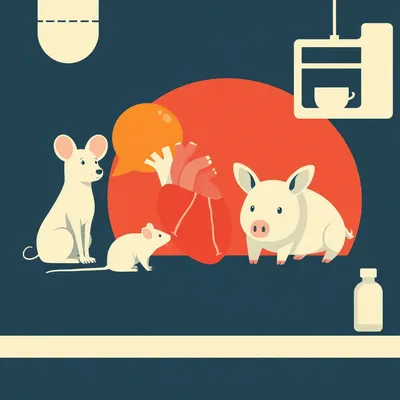
Daniel sent us this one. Last episode we talked about modafinil, and we mentioned those rodent studies — rats pressing levers, the vigor of their lever-pressing used as a proxy for how habit-forming a drug might be. And the prompt basically asks: that data is genuinely useful, but when you picture those animals in those cages, it's hard not to feel something. How does medical science actually grapple with treating lab animals ethically? Is there a real movement to move away from animal testing, or is that still far off? And what animals are we even talking about?

That rat pressing a lever for a sugar pellet — it's a small moment in a huge system. So let's zoom out and look at the scale of animal testing in medical research. Globally, we're talking about an estimated hundred to two hundred million vertebrate animals used in research every year. And that range is wide because reporting is inconsistent — some countries don't publish detailed numbers, and in the United States, the animals used most often aren't even counted under federal law.
Mice and rats. They're explicitly excluded from the Animal Welfare Act. And they make up about ninety-five percent of all lab animals. So the federal law that's supposed to protect research animals simply doesn't apply to the vast majority of them.
The regulatory system has a hole the size of a rodent-shaped door.
And that's not an oversight — it was a deliberate exclusion when the act was written. The logic was that mice and rats are so essential to biomedical research that regulating them would be too burdensome. Which is, you know, a position you can hold, but it means the primary federal protection for lab animals is largely symbolic for the species that bear the brunt of the work.
Of course it was deliberate. So before we get into the ethics and the alternatives, let's lay out the actual framework that does exist — because there is one, even if it's patchy.
To understand how science grapples with this, we need to start with a framework that's been around since nineteen fifty-nine but is more relevant than ever: the three Rs. Replacement, Reduction, and Refinement. They were introduced by William Russell and Rex Burch in their book "The Principles of Humane Experimental Technique." And they've since been codified into law in the European Union under Directive twenty-ten slash sixty-three EU, and into NIH policy through the Guide for the Care and Use of Laboratory Animals. If you're a researcher in most of the developed world, you cannot get funding or publish in a reputable journal without demonstrating you've applied the three Rs.
Walk me through them.
Replacement is the most straightforward — use non-animal methods wherever possible. That means in vitro cell cultures, computer simulations, human volunteer studies. If you can get the data without an animal, you must.
Use the minimum number of animals needed to achieve statistical significance. This is where experimental design matters enormously. You don't use twenty animals if a properly powered study says you only need twelve. You share control groups across experiments. You use the same animals for multiple compatible tests when possible. And you use advanced statistical methods that extract more information from fewer subjects.
Refinement is the one that's most relevant to the modafinil study.
Refinement means minimizing pain, distress, and suffering. That includes anesthesia for surgical procedures, pain management, enriched housing so animals aren't in barren cages, and humane endpoints — meaning you end the experiment before an animal reaches a state of severe suffering. And this is where the modafinil study's methodology becomes relevant. They used operant conditioning chambers — Skinner boxes — with a progressive ratio schedule.
Explain what that actually is, because it sounds more clinical than it feels.
A progressive ratio schedule is a task where the animal — in this case a rat — presses a lever to get a reward, usually a sugar pellet or a small food pellet. But here's the thing: each successive reward requires more presses. So the first pellet might take one press. The second takes two. It escalates until the animal decides it's no longer worth the effort. The point where they give up is called the breakpoint. And the idea is that a drug with higher addictive potential will make the animal work harder — they'll persist through a higher ratio before giving up.
You're measuring how motivated the animal is, and you're using that as a stand-in for how addictive the drug might be in humans.
And from a Refinement perspective, this is considered a relatively humane protocol. It's voluntary — the animal chooses when to press the lever and when to stop. There's no physical harm, no electric shock, no forced ingestion. The animals are trained, they perform the task, and they go back to their home cages.
They're still in cages. They still experience frustration. They still live in a laboratory.
That's the ethical tradeoff that Refinement can't fully resolve. You can give them enriched housing — nesting material, tunnels, social housing for social species — but they're still confined, their lives are still controlled, and they're still ultimately euthanized at the end of the study. The three Rs are about minimizing harm, not eliminating it.
How does that enrichment actually work in practice? Like, what does an enriched rat cage look like versus a standard one?
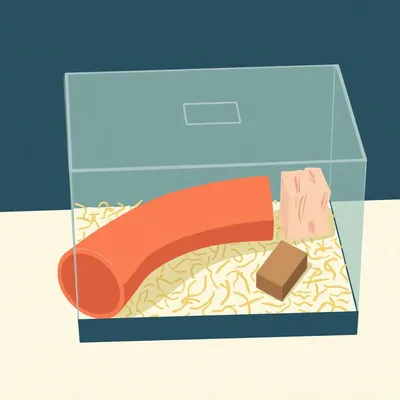
A standard cage is basically a plastic shoebox with bedding and food and water. That's it. An enriched cage might include PVC tunnels the rats can run through, wooden blocks they can gnaw on — because rodents' teeth grow continuously and they have a biological need to chew — shredded paper for nest building, and if they're socially housed, which rats should be because they're highly social, you've got multiple animals together so they can groom each other and sleep in piles, which they naturally do. Some facilities even provide running wheels, though those are more common for mice. The science on enrichment is actually really compelling — enriched animals show less stereotypical behavior, which is repetitive, functionless activity like bar-mouthing or circling that you see in barren environments. They have lower stress hormone levels. And here's the thing that researchers care about: they actually produce better data, because a chronically stressed animal is a confounded experimental subject.
Enrichment isn't just ethical — it's scientifically better.
That's the argument that's won over a lot of researchers who might not be moved by the ethics alone. If your data is noisier because your animals are stressed and depressed, you're wasting your own time and grant money. Good welfare is good science.
What does the oversight actually look like? Who's checking that researchers are doing this?
In the United States, every institution that receives federal funding and uses vertebrate animals must have an Institutional Animal Care and Use Committee — an IACUC. Every single research protocol involving animals has to be reviewed and approved by this committee before it can begin. The IACUC includes at least one veterinarian, one scientist with animal research experience, and one person who's not affiliated with the institution — a community member whose job is to represent the public interest.
They can reject a protocol?
They can reject it, require modifications, or approve it with conditions. They also inspect facilities every six months. If they find violations, they can suspend research. It's a real enforcement mechanism, not just a rubber stamp. I've spoken to researchers who've had protocols sent back three or four times with increasingly detailed questions about their justification for animal numbers or their pain management plans. It can be rigorous.
The rat and mouse loophole you mentioned — does the IACUC still cover them?
Yes, because the IACUC requirement comes from the Public Health Service Policy, not the Animal Welfare Act. So even though mice and rats aren't covered by the AWA, they are covered by IACUC oversight if the institution receives NIH funding — which virtually all major research institutions do. So there is a patchwork of protections. The AWA exclusion means the USDA doesn't inspect mouse and rat facilities, but the IACUC does. It's inconsistent, and critics argue it creates accountability gaps.
It's not the regulatory wasteland people sometimes imagine, but it's also not comprehensive.
And this is where the public perception often diverges from reality. There's a misconception that animal testing is completely unregulated and animals suffer horribly with no oversight. The reality is that there are strict regulations — IACUCs, the three Rs, institutional policies — but enforcement is uneven, and the exclusion of mice and rats from the Animal Welfare Act remains a major point of contention among ethicists and advocacy groups.
Let's talk about who these animals actually are. You said mice and rats are ninety-five percent. What's the breakdown?
Mice account for roughly sixty percent of all vertebrate animals used in research globally. Rats are about twenty percent. Zebrafish have exploded in the last two decades — they're now about ten percent. And then you've got rabbits, guinea pigs, hamsters, dogs, cats, and non-human primates, each less than half a percent individually, but they're the most controversial.
They're transparent as embryos, so you can literally watch development happen in real time under a microscope. You can see the heart forming, the blood vessels branching out, the nervous system wiring itself up. It's like a living biology textbook. They breed in huge numbers — a single pair can produce hundreds of embryos in a week — they're cheap to maintain, and their genome is surprisingly relevant to humans. We share about seventy percent of our genes with zebrafish. They're used heavily in developmental biology, toxicology, and genetic research. And they occupy an interesting ethical space — people tend to feel less moral concern about fish than about mammals, though that's a position that's increasingly being challenged.
The non-human primates are the flashpoint, though.
They make up less than half a percent of research animals, but they're the most cognitively complex, the most expensive, and the most ethically charged. They're used primarily in neuroscience, infectious disease research, and safety testing for drugs that can't be adequately tested in other species. In the United States, most research primates are purpose-bred — they're born in captivity for research — but some are still imported. And the ethical debate around primate research is the most intense, because their capacity for suffering is so clearly evident.
I remember that case from a few years ago — the monkey selfie copyright dispute. That wasn't research, but it brought this question of primate consciousness into the public conversation in a weird way.
Right, the narwhal tusk, or wait — no, the crested macaque that picked up the photographer's camera and took a series of selfies. PETA actually filed a lawsuit arguing the monkey should own the copyright, which the courts ultimately rejected. But what was interesting about that case was the amicus briefs from primatologists arguing that the macaque's behavior demonstrated intentional, goal-directed action — the monkey understood that pressing the shutter button produced a result it found interesting. That's not human-level cognition, but it's not nothing either. And that's the tension with primate research — you're working with animals that have clear intentionality, clear social relationships, clear emotional lives.
The modafinil study used rats — voluntary task, no physical harm, relatively refined. But let's push on something. The data from that study showed modafinil had mildly habit-forming properties compared to amphetamine. That's useful information for human medicine. But the animals still lived in a lab, were trained to perform a task they didn't choose, and were eventually euthanized. How does a researcher justify that?
The standard justification is utilitarian — the suffering of a small number of animals is weighed against the potential benefit to a large number of humans. In the case of modafinil, that's a drug prescribed for narcolepsy, shift work sleep disorder, and off-label for ADHD. Millions of people take it. Understanding its addictive potential matters enormously for patient safety. A rat study might involve forty or fifty animals. If it prevents one case of severe addiction in a human patient, the utilitarian calculus says that's a net good.
If you reject that calculus entirely?
Then you're in the camp of someone like Peter Singer, the philosopher who argues that suffering is suffering regardless of species — that the capacity to suffer, not membership in the species Homo sapiens, is what matters morally. From that perspective, a rat's suffering counts in a way that can't simply be outweighed by human benefit. It's not that the benefit is irrelevant, but that you can't just do a simple arithmetic of forty rats versus millions of humans.
Because if you do that arithmetic, you end up in some pretty uncomfortable places. You could justify almost anything if the human benefit is large enough.
And Singer's whole project is to point out that we don't accept that logic when it comes to humans. We don't say, well, experimenting on this one human without consent will benefit millions, so it's fine. We recognize that the individual's interests can't just be steamrolled by the aggregate benefit. Singer's argument is that there's no morally relevant difference between a human and a rat that justifies drawing that line at the species boundary. The relevant feature is the capacity to suffer, and rats clearly have that.
Which is why this doesn't have a clean answer.
It really doesn't. And I think that's the thing most people don't appreciate about this debate — the people inside it, the researchers and the ethicists, they're not oblivious to the moral tension. They're living in it every day. The three Rs exist precisely because the scientific community recognized, back in nineteen fifty-nine, that this tension needed a framework. Russell and Burch weren't animal rights activists — they were scientists who saw that better treatment of animals produced better science, and that the moral question couldn't be ignored.
The three Rs give us a structure, but they don't answer the bigger question: can we actually move away from animal testing entirely? That's where the FDA Modernization Act comes in.
So in December of twenty twenty-two, Congress passed the FDA Modernization Act two point zero. And this is a landmark piece of legislation. It removed a mandate that had been in place since nineteen thirty-eight — the Federal Food, Drug, and Cosmetic Act required animal testing before any drug could proceed to human clinical trials. The Modernization Act says drug developers can now use alternative methods — what they call "new approach methodologies" or NAMs — instead of animal testing for investigational new drug applications.
The law changed. What does that actually mean in practice?
It means the FDA is now actively evaluating data from things like organ-on-a-chip systems, computer models, and microphysiological systems as part of drug approval applications. This isn't theoretical — there are companies like Emulate Incorporated that have developed a lung-on-a-chip, a microfluidic device lined with human lung cells that can model drug absorption and inflammation. In twenty twenty-three, the FDA began accepting data from these chips for IND applications. That's real, and it's happening now.
It doesn't mean animal testing is going away overnight.
Not even close. And this is the second big misconception I want to address — the idea that we could just replace all animal testing with computers and cell cultures tomorrow. We can't. Complex behaviors like addiction, depression, pain — these require an intact nervous system, a whole organism, and often a social environment. The modafinil study's progressive ratio task cannot be replicated in a dish. You can't model the motivational dynamics of drug-seeking behavior in a cell culture. You need a living animal that wants things, that experiences frustration, that makes choices.
Because addiction isn't a cellular phenomenon — it's a behavioral one.
A liver cell in a dish can tell you if a compound is toxic to liver cells. An organ-on-a-chip can tell you how a drug moves through a simulated circulatory system. But neither of them can tell you whether a drug makes a sentient being work harder for a reward. That requires a brain, a motivational system, and a history of learning. Those are whole-organism properties.
What about computer models? AI is getting better at predicting molecular interactions.
Computer models are excellent for certain things. QSAR models — quantitative structure-activity relationship models — can predict how a molecule's chemical structure relates to its biological activity. Physiologically based pharmacokinetic models can simulate how a drug is absorbed, distributed, metabolized, and excreted. These are widely used and getting better. But they're trained on existing data, and existing data comes from — you guessed it — animal studies. And for novel compounds or complex behavioral endpoints, the models break down. They can't predict what they haven't seen.
The alternatives are real but narrow. What about organoids?
Organoids are fascinating. These are miniature organs grown from stem cells — you can grow a tiny brain, a tiny liver, a tiny kidney in a dish. They're three-dimensional, they have multiple cell types, and they self-organize in ways that mimic real tissue. For toxicity testing, they're incredibly promising. You can screen hundreds of compounds against a liver organoid and identify which ones cause damage, without using a single animal.
Again — no behavior.
An organoid doesn't want anything. It doesn't learn. It doesn't have a history. It's a beautiful model of tissue-level biology, but it's not a model of psychology.
Where does the movement to phase out animal testing actually stand? Is there a real push within medicine, or is this mainly an external advocacy thing?
It's both, and they're increasingly aligned. Within the scientific community, there's genuine momentum. The NIH now requires all grant applications to justify animal use and explicitly consider alternatives — that policy went into effect in twenty twenty-one, driven in part by advocacy from groups like the Physicians Committee for Responsible Medicine. The National Centre for the Replacement, Refinement and Reduction of Animals in Research — the NC3Rs in the UK — funds validation studies for alternative methods. There's even a movement to add a fourth R — Responsibility — to the three Rs framework, emphasizing the researcher's moral obligation to continuously push for alternatives.
On the external side?
You've got organizations like the Humane Society, which maintains the AltWeb database — over fifty validated non-animal methods for toxicity testing alone. PETA and Cruelty Free International run certification programs. And the EU's ban on animal testing for cosmetics, which went into full effect in twenty thirteen, is probably the most successful case study of replacement working at scale.
Explain that one — the cosmetics ban.
In twenty thirteen, the European Union banned animal testing for cosmetic products and ingredients, and also banned the sale of cosmetics that had been tested on animals anywhere in the world. This created an enormous market incentive to develop alternatives. And it worked. Companies developed validated non-animal methods like reconstructed human epidermis models — EpiSkin and EpiDerm are the commercial names — which are basically lab-grown human skin that can be used for irritation and corrosion testing. These methods are now used globally, not just in Europe, because they're often cheaper and more reliable than animal tests.
Cheaper and more reliable is the winning combination.
That's what drives adoption. And that's the thing about the FDA Modernization Act — it doesn't ban animal testing, it just removes the mandate. But if alternatives become cheaper, faster, and more predictive than animal models, the market will shift. The challenge is that for complex endpoints — behavioral pharmacology, systemic toxicity, chronic disease modeling — the alternatives aren't there yet.
The rat in the Skinner box isn't going anywhere soon.
Not for studies like the modafinil one, no. And that's the uncomfortable reality. We can reduce the number of animals, we can refine the protocols to minimize distress, and we can replace animal tests wherever alternatives exist. But for the foreseeable future, if you want to know whether a drug is addictive, you're going to need an animal that can become addicted.
Let me push back on that, though. Isn't there an argument that animal models of addiction are actually not that predictive of human addiction? That we've had drugs that looked great in animal models and turned out to be disastrous in humans, and vice versa?
That's absolutely true, and it's a point the alternatives advocates make forcefully. Animal models have significant failure rates. A compound that reduces cocaine self-administration in rats might not work in humans. A drug that shows no addictive potential in a progressive ratio task might still be abused by humans in real-world conditions. The predictive validity of animal models is imperfect.
You're harming animals for data that might not even translate.
That's the strongest argument for alternatives — not just the ethical argument, but the scientific one. If we could develop human-relevant models that predict addiction better than rats do, we'd have both better ethics and better science. Organ-on-a-chip systems with human neurons, AI models trained on human clinical data, human volunteer studies with neuroimaging — these aren't just more ethical, they're potentially more predictive.
We're not there yet.
We're not there yet. And the people working on this are very honest about that. I've read interviews with researchers at the NC3Rs who say flatly that full replacement of animals in biomedical research is decades away at minimum, and may never be complete for certain types of studies. The goal right now is to replace where we can, reduce where we can't replace, and refine everything else.
What does this mean for someone listening who's not a researcher? What can they actually do?
A few concrete things. If you're buying cosmetics or household products, look for cruelty-free certifications — Leaping Bunny is the gold standard, PETA's Beauty Without Bunnies is also widely recognized. These certifications mean no animal testing was used at any stage of production, including ingredients sourced from third parties.
For medical products?
That's harder. Every prescription drug on the market today has an animal testing history — it's required by law in most countries, and even the FDA Modernization Act doesn't erase the past. But you can ask your doctor about the animal testing history of specific drugs, and you can support organizations that fund alternatives research. The NC3Rs, the Johns Hopkins Center for Alternatives to Animal Testing, the Physicians Committee for Responsible Medicine — these groups are doing the work of validating alternatives and pushing for policy change.
If you're a scientist or in a policy role?
Advocate for closing the rat and mouse loophole in the Animal Welfare Act. Push for stronger IACUC enforcement. Support funding for alternatives validation — right now, one of the biggest bottlenecks is that it's expensive to validate a new method to the FDA's satisfaction, and there's limited funding for those studies. The FDA Modernization Act created the pathway, but the pipeline needs to be filled.
Where does this leave us? Back in that lab, with a rat and a lever, and a question that doesn't have a clean answer.
I think that's the honest place to land. The modafinil study produced useful data — we know more about the drug's habit-forming potential because of those rats. That data protects human patients. And those rats lived in cages, performed tasks they didn't choose, and were euthanized when the study ended. Both things are true. The three Rs framework gives us a way to minimize the harm, and the FDA Modernization Act gives us a path toward reducing our reliance on animals over time. But the tension doesn't resolve.
What's your sense of the next ten years?
More alternatives validated, fewer animals used per study, better refinement of protocols. Organ-on-a-chip systems will become standard for certain types of toxicity testing. AI models will get better at predicting pharmacokinetics. But for behavioral pharmacology — addiction, depression, anxiety — I think we'll still be using animals in twenty thirty-six. The question is how many, and how well we treat them.
The image that sticks with me is the breakpoint. The moment the rat stops pressing the lever. You're measuring motivation, but you're also measuring something else — the point at which the effort isn't worth the reward anymore. There's something almost philosophical about using that as your endpoint.
It's a deeply human question, measured in a rat. When do you give up? What makes you keep going? And does this drug change that calculus? That's what the progressive ratio schedule is actually measuring. And you're right — there's something existential about it.
The rat doesn't know it's contributing to human knowledge. It just knows the pellet stopped being worth the work.
Which is, in a way, the entire ethical problem in one image. The rat can't consent. It can't understand the purpose. It just experiences the cage, the task, the frustration, and eventually the end. And we, the humans, have to decide whether what we learn justifies what we took.
That's heavy. Not where I expected the modafinil episode to lead us.
The best prompts do that. They start with a drug and end with a question about suffering.
Now: Hilbert's daily fun fact.
In the late Victorian period, the Irish sport of hurling was widely misattributed to ancient Celtic warriors who supposedly played it with the severed heads of their enemies. This was later corrected by historians who traced the myth to a single sensationalized travelogue written by a British officer who had never actually visited Ireland, but had spent considerable time in the Atacama Desert, where he heard a vaguely similar legend about a local ball game and decided to embellish.
That took a journey.
The Atacama to Ireland pipeline.
So to wrap this up — the next time you hear about a drug study, whether it's modafinil or something new, the animals are there in the background. They're not an afterthought, and they're not a footnote. They're a real ethical cost that science is grappling with, imperfectly but not indifferently.
If this episode made you think, share it with someone who cares about science ethics. These conversations matter precisely because they don't have easy answers.
This has been My Weird Prompts. I'm Corn.
I'm Herman Poppleberry. Thanks to our producer, Hilbert Flumingtop. You can find us at myweirdprompts.
Or wherever you get your podcasts. We'll be back.