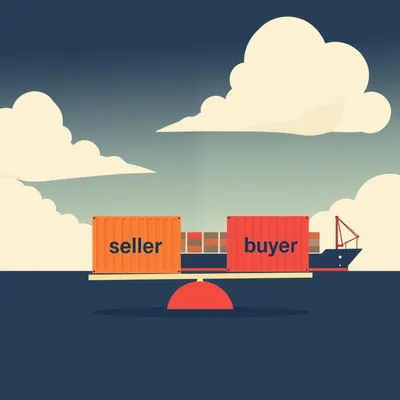
Daniel sent us this one — he wants to do the middle ground of Incoterms. We've already done EXW, DAP, DDP in separate episodes. This time it's the eight terms where responsibility is genuinely shared between buyer and seller — FCA, FOB, CIF, CPT, CIP, CFR, FAS, DPU. And he wants the commercial strategy angle, not a glossary. Which terms are thriving, which are fading, and which ones are quietly costing importers thousands because nobody questions the supplier's default.

This is exactly the conversation most importers never have until something goes wrong. And the timing is interesting — we're nearly a century past the original Incoterms design, which was built for break-bulk shipping, port-to-port contracts, paper bills of lading. Containerization changed the physical geography of risk, but the rules haven't fully caught up with what that means in practice.
The framing here is: these eight terms represent a spectrum of shared responsibility. Risk transfers at a specific point, costs get allocated, and the negotiation is about where that point sits. The problem is that many of the most popular terms were designed for a shipping world that no longer exists.
And I want to be upfront — I've said before that for most small importers sourcing from China, FOB is the default correct choice. I need to walk that back, at least partially. The more I've dug into this, the clearer it is that FOB persists because of habit and institutional inertia, not because it's optimal for containerized cargo.
That's a big admission from you. What changed your mind?
The ship's rail. Or rather, the fact that the ship's rail hasn't been a meaningful risk transfer point for about fifty years. FOB was designed for loose cargo — crates, barrels, pallets — being hoisted over the side of a vessel. That physical moment of crossing the rail was where risk shifted from seller to buyer. It was visible, measurable, and made sense in 1936. But containers aren't loaded at the ship's rail. They're stuffed at inland depots, sometimes hundreds of kilometers from the port, then trucked to the terminal and stacked. The container might sit at the port for three days before being loaded. The ship's rail is a fiction.
The International Chamber of Commerce itself has been saying this since when?
Since the 2010 revision. The ICC explicitly recommends FCA for containerized cargo. They reiterated it in 2020. And yet a 2023 ICC survey found that roughly sixty percent of international trade transactions still use FOB or CIF. That's not because sixty percent of cargo is break-bulk. It's because habits in global trade are sticky and suppliers in China have built their entire logistics operations around FOB.
Let's unpack that. Walk me through FCA versus FOB — what's the actual difference in how risk transfers?
Under FCA, Free Carrier, the seller delivers the goods to a carrier nominated by the buyer at a named place — and that place can be the seller's premises, a freight forwarder's warehouse, a container yard, anywhere. Risk transfers at that handover point. If the container gets damaged on the truck to the port, it's the buyer's problem, but the buyer chose the trucking company. Under FOB, the seller is responsible for getting the goods to the port and loaded onto the vessel. Risk transfers when the goods are on board. The problem is that for containerized cargo, the seller controls the inland move — trucking from factory to port, terminal handling, all of it — but the risk during that inland leg is technically the seller's. Except in practice, it's murky.
Give me a concrete scenario.
An importer in Tel Aviv buys FOB Shenzhen for a forty-foot container of electronics. The supplier arranges trucking from their factory in Dongguan to Yantian port. That's a three-hour drive. The container is loaded at the factory on a Tuesday, arrives at the port Wednesday, sits in the terminal until Friday, gets loaded Friday evening. Under the strict legal interpretation of FOB, risk transfers when the container is on board the vessel on Friday. But if the truck overturns on the highway on Tuesday, who bears the loss? The seller arranged the trucking, but the buyer owns the goods under the sale contract. This gets litigated constantly.
The buyer had zero control over which trucking company was used, what route they took, whether the container was properly secured.
The buyer is bearing risk during a leg of the journey they had no hand in arranging. That's the fundamental misalignment FOB creates for containers. FCA fixes this by making the risk transfer point the handover to the carrier the buyer selected. If the buyer's forwarder picks up the container at the factory gate, risk transfers at the gate. Clean, simple, aligned.
Why do Chinese suppliers love FOB?
They want to manage the inland trucking because they have established relationships with local trucking companies and freight forwarders — and those relationships often include margin. The supplier isn't just arranging transport, they're marking it up. Second, it keeps the ocean freight negotiation with the buyer. The buyer books the vessel and pays the ocean freight under FOB. The supplier doesn't want that headache. So FOB gives them inland control without ocean responsibility. It's the sweet spot for them.
For the buyer it's... not the sweet spot.
It's the path of least resistance. The supplier says "we'll do FOB, it's standard," and the buyer says okay because they've always done FOB and changing feels like work. But there's a documentary problem with FCA that keeps FOB alive, and it's worth naming directly.
The bill of lading issue.
Under FCA, the seller delivers the goods to the carrier at an inland point — say, a container freight station in Shenzhen. The carrier issues a receipt, but it's not an onboard bill of lading. The onboard bill of lading only gets issued once the container is actually on the vessel. But many buyers need an onboard bill of lading for letter of credit compliance. Their bank won't release payment without it. So if the seller delivers under FCA to an inland depot, they can't provide the onboard bill of lading the buyer's bank demands. This creates a documentary gap.
The workaround costs money.
The workaround is either the buyer accepts a received-for-shipment bill of lading and negotiates with their bank — which many banks won't accept — or they pay for a switch bill of lading, which is essentially a second set of documents issued after loading that backdates or substitutes the original. That can run two hundred to five hundred dollars per container. Or the buyer and seller agree that the seller will assist in obtaining the onboard bill of lading under FCA, which the 2020 rules now explicitly allow, but it's an extra step that requires trust and coordination.
FCA is technically superior but creates a paperwork headache that FOB avoids. That's a very trade-finance reason for a logistics rule to persist.
It's exactly why FOB survives. Not because it's better, but because the documentary infrastructure of international trade — letters of credit, bank requirements, customs procedures — was built around the ship's rail concept. Changing the Incoterm without changing the banking practices creates friction. And friction costs money.
Let's move to the terms that add insurance and freight into the mix. CIF and CFR — these are the ones where the seller arranges and pays for carriage to the destination port. What's the core distinction?
CIF is Cost, Insurance, and Freight. The seller pays for transport to the named destination port and provides insurance. CFR is Cost and Freight — same transport obligation, but no insurance requirement. The seller pays the freight, the buyer arranges their own insurance. Under both, risk transfers when the goods are on board the vessel at the port of shipment. This is the crucial thing most importers miss: the seller pays for the freight, but the buyer bears the risk during the voyage.
If the ship sinks halfway to Ashdod, the buyer has a problem.
A very large problem. The seller has fulfilled their obligation — they paid the freight, the goods were loaded, risk transferred. The buyer now has to claim on their insurance. And if they assumed CIF meant the seller was responsible until arrival, they may not even have insurance. Under CFR, they definitely need their own policy. Under CIF, the seller provides insurance, but here's the trap: CIF only requires minimum coverage.
ICC-C, which is the Institute Cargo Clauses C level. Fire, explosion, vessel stranding, sinking, collision, discharge at a port of distress. It explicitly excludes a long list of common container losses: washing overboard, water ingress, theft, pilferage, rough handling, crushing. For a container of electronics from Shenzhen to Israel, ICC-C covers roughly sixty to seventy percent of typical claims. The other thirty to forty percent — the container gets dropped during unloading, the seal is broken and items are stolen, water gets in through a damaged door gasket — those aren't covered.
The importer thinks they're insured because the seller provided a certificate, but the coverage is Swiss cheese.
Worse than Swiss cheese. Swiss cheese has more substance than ICC-C. I saw an analysis that estimated for a typical mixed container shipment on the China-Israel route, ICC-C leaves about thirty-five percent of loss scenarios uncovered. And the buyer often doesn't discover this until they file a claim.
Give me the nightmare scenario.
Israeli importer buys CIF from a supplier in Ningbo for a container of machinery parts. The container is loaded, the vessel hits heavy weather in the South China Sea, several containers are swept overboard — including theirs. They file a claim on the CIF insurance certificate. Washing overboard is excluded under ICC-C unless it's specifically added as an extension. The buyer assumed "CIF means insured" and didn't read the policy wording. They're out the full value of the shipment, which might be eighty thousand dollars.
This isn't a rare edge case.
It's common enough that marine insurance brokers have a whole practice area around fixing CIF coverage gaps. The fix is simple: if you're buying CIF, demand the seller provide ICC-A coverage, which is all-risk. Or switch to CIP, which since the 2020 revision requires ICC-A by default. Or buy your own cargo insurance separately and use CFR instead.
Let's talk about CIP and CPT then — these are the multimodal successors.
CPT, Carriage Paid To, and CIP, Carriage and Insurance Paid To, were designed for containerized and multimodal transport. Under both, the seller delivers the goods to the first carrier — not the ship's rail — and risk transfers at that point. The seller then arranges and pays for carriage to the named destination, which can be an inland point, not just a port. CPT has no insurance requirement. CIP requires insurance, and since 2020, it requires ICC-A all-risk coverage. That's a major improvement.
CIP is essentially CIF done right for containers.
Risk transfers at the first carrier, which aligns with physical reality. Insurance is all-risk, which aligns with what buyers actually need. And the destination can be inland — the buyer's warehouse in Petah Tikva, not just the port of Ashdod. For a full container load from China to Israel, CIP is often the optimal term for a buyer who wants the seller to handle logistics but doesn't want to be underinsured.
What's the catch?
The catch is that CPT and CIP give the seller control over carrier selection. The seller arranges and pays for the entire carriage to the destination. If the seller chooses a slow carrier to save two hundred dollars on freight, the buyer's shipment arrives ten days late, and the buyer has no recourse — the seller fulfilled their obligation by arranging carriage, not by guaranteeing a transit time.
The buyer is betting on the seller's logistics competence and willingness to prioritize speed over cost.
That's a bet that doesn't always pay off. Scenario: Israeli importer buys CPT from a supplier in Shanghai for a time-sensitive shipment of retail goods. The supplier books with a carrier that transships through Port Said, adding eight days to the transit. The shipment arrives after the buyer's customer's deadline. The buyer loses a fifteen-thousand-dollar order. The seller says "we arranged carriage as required under CPT." The buyer eats the loss.
The sophistication requirement here is: if you're using CPT or CIP, you need to specify the carrier or at least the service level in the sales contract. Don't just accept "carriage arranged.
The Incoterm defines the default obligations. The sales contract can add specificity. "CPT Ashdod, carrier must be ZIM, transit time not to exceed twenty-five days." That's a perfectly valid contractual addition, and it protects the buyer from the slow-carrier problem.
Let's talk about DPU. This is the newest term — replaced DAT in 2020. What's its deal?
DPU, Delivered at Place Unloaded, is the only Incoterm that explicitly requires the seller to handle unloading at the destination. Under DAP, the seller delivers to the named place, but the buyer handles unloading. Under DPU, the seller's responsibility extends all the way through unloading. The seller bears all risk and cost until the goods are off the truck or off the container at the named place.
When would you actually use this?
Project cargo, heavy machinery, anything where unloading is complex and risky. If you're importing a fifty-ton industrial press from Germany to Israel, you don't want your local forklift operator figuring out how to get it off the truck. You want the seller's rigging crew doing it, because if they drop it, it's their problem. DPU is also gaining traction for full-container-load deliveries where the buyer wants a true door-to-door service without any logistics involvement — the seller handles everything up to and including placing the goods in the buyer's warehouse.
The seller is pricing in a significant risk premium for that.
DPU is expensive. The seller is bearing risk through the entire journey plus unloading, and they're going to charge for that. For standard containerized consumer goods, it's probably overkill. For a specialized machine tool where the unloading is dangerous, it's worth every shekel.
What about FAS? You mentioned it's the niche survivor.
FAS, Free Alongside Ship, is used almost exclusively for bulk commodities — oil, grain, scrap metal, bulk chemicals. The seller delivers the goods alongside the vessel at the named port, and the buyer arranges loading. It's designed for cargo that's lifted aboard by the ship's own gear — cranes, grabs, pumps. Containerization made FAS nearly irrelevant for manufactured goods because containers aren't delivered "alongside" the ship in the traditional sense. But bulk shipping hasn't changed its fundamental loading methods in a century, so FAS survives there.
If you're importing containerized goods, you can basically forget FAS exists.
You'll probably never encounter it unless you're in the commodities business. It's the most specialized of the middle-ground terms.
Let's step back and do the ranking Daniel asked for. If you're looking at these eight terms through the lens of modern containerized trade, which ones are winning and which are legacy?
Tier one — essential for modern trade: FCA, CIP, and DPU. FCA because it aligns risk transfer with physical reality for containers. CIP because it provides meaningful all-risk insurance coverage and works for multimodal transport. DPU because it solves a specific problem for project cargo and high-value unloading scenarios.
Useful in specific contexts: CPT and FAS. CPT is fine if you trust your supplier's carrier selection and you're buying your own insurance separately. FAS is essential for bulk commodities and irrelevant for everything else.
Tier three — the legacy terms you should avoid for containers?
FOB, CIF, and CFR. FOB because the ship's rail is a fiction for containers and it creates an inland risk mismatch. CIF because the minimum insurance coverage is inadequate and creates a false sense of security. CFR because it combines the risk mismatch of CIF with no insurance requirement at all — the buyer bears all voyage risk and may not even realize they need their own policy.
That's a strong take. You're essentially saying three of the most commonly used terms in global trade should be retired for containerized cargo.
The ICC has been saying it about FOB since 2010. The insurance industry has been saying it about CIF for decades. The persistence of these terms isn't about merit — it's about institutional inertia. Banks are comfortable with FOB bills of lading. Suppliers are comfortable with FOB logistics chains. Buyers don't question what they've always done. And nobody wants to be the one who changes the term and then has a shipment go wrong, because then they get blamed for the change, not for the underlying risk that was always there.
That last point is underrated. There's a career-risk dimension to Incoterm selection. If you've done FOB for ten years and a container gets damaged, it's just bad luck. If you switch to FCA and the same thing happens, someone's going to ask why you changed the terms.
The organizational psychology of trade compliance is a whole separate episode. But it explains a lot about why suboptimal terms persist. The person making the Incoterm decision at the importing company is often not the person who bears the financial consequences of a loss. The procurement manager who agrees to FOB doesn't see the insurance claim that gets denied three months later.
What's the single most impactful change an importer can make?
Switch from FOB to FCA for all containerized shipments from China. This one change aligns risk transfer with the physical handover of the container to the carrier the buyer selected. It gives the buyer control over inland logistics, which often saves money — consolidating multiple suppliers' shipments through a single forwarder can cut inland trucking costs by two to three hundred dollars per container. And it eliminates the documentary fiction of the ship's rail.
If the supplier resists?
Chinese suppliers resist FCA because it strips away their inland logistics margin and their relationship with the trucking company. The negotiation tactic is to offer to split the savings. Say "I can get inland trucking from your factory to the port for two hundred dollars less than you're charging me under FOB. Switch to FCA, I'll give you half that savings as a price increase on the goods, and we both come out ahead." That reframes it from "I'm taking something away from you" to "we're both making more money.
For insurance, the equivalent move is CIF to CIP.
If your supplier offers CIF, counter with CIP. The insurance coverage jumps from ICC-C to ICC-A. The cost difference is usually marginal — maybe fifty to a hundred dollars per container. If the supplier won't do CIP, at minimum demand to see the CIF insurance certificate and check the coverage. If it's ICC-C, buy your own supplemental policy to cover the gaps. The premium for a standalone ICC-A cargo policy on a single container from China to Israel is typically between one hundred fifty and three hundred dollars. That's cheap compared to an uncovered eighty-thousand-dollar loss.
Let's talk about the broader trend. Daniel asked whether e-commerce platforms are going to make these middle-ground terms less relevant. Alibaba Logistics, Amazon Global Logistics — they're pushing standardized shipping terms where the platform handles everything.
For small parcel and less-than-container-load shipments, absolutely. The platform model absorbs the Incoterm complexity and presents the buyer with a simple choice: "pay this price, get it delivered to your door." The Incoterm underneath might be DAP or DDP, but the buyer never sees it. For full container loads and business-to-business trade, though, the middle-ground terms remain essential because the stakes are higher and the negotiation is direct. A platform isn't going to absorb the risk on a two-hundred-thousand-dollar machinery shipment.
The sophistication gradient is: if you're buying small volumes, let the platform handle it. If you're buying containers, learn the Incoterms or pay someone who does.
The cost of not learning them is real. I've seen estimates that a single poorly chosen Incoterm on a container shipment can cost between five hundred and five thousand dollars in unnecessary costs — either through inland logistics markups, inadequate insurance, or delays caused by documentary problems. Multiply that across a company that imports fifty containers a year, and you're looking at twenty-five thousand to a quarter-million dollars in avoidable losses.
That's the quiet cost of habit. Nobody notices because it's baked into the per-shipment economics and nobody audits it.
A simple audit of Incoterm usage across a year of shipments is probably the highest-return hour of work most importers could do. Look at every shipment. Ask: what term did we use? Who chose it? What risk did we actually bear? Were there any claims, delays, or unexpected costs? I'd bet that most companies find at least one shipment where the answer is "we used CIF, the container was damaged by water ingress, and our claim was denied because the coverage was ICC-C.
The fix costs fifty dollars in additional insurance premium.
On the next shipment, yes. The expensive lesson already happened.
To synthesize: the best Incoterm isn't the one that's easiest to agree on. It's the one that aligns risk transfer with whoever can best control and insure against that risk. And for containerized cargo, that's almost never the ship's rail.
That's the thesis. And it's worth saying explicitly: if you're an importer and your supplier proposes FOB or CIF, your default response should not be "okay." It should be "why not FCA or CIP?" Make them justify the legacy term. If they can't — and they usually can't, beyond "this is what we always do" — you've just identified an opportunity to reduce your risk and probably save money.
Before we wrap, I want to flag one misconception that even experienced importers make. The Incoterm doesn't determine who bears risk during the entire journey. Risk transfers at a specific point. After that point, the other party bears all risk even if the first party is still arranging and paying for transport. CIF is the classic trap here — the seller pays for freight to the destination port, so the buyer assumes the seller is responsible until arrival. They're not. Risk transferred at the port of loading. The seller's obligation is to arrange and pay for carriage, not to guarantee safe arrival.
That distinction between "arranging transport" and "bearing transport risk" is the single most important thing to understand about the middle-ground terms. The seller can be responsible for logistics without being responsible for loss. The two are separate, and the Incoterm defines exactly where they diverge.
Alright, let's land this. If you could retire one Incoterm tomorrow, which one?
FOB for containerized cargo. It's the most persistent anachronism in international trade. The ship's rail hasn't been a meaningful risk transfer point since containerization became universal in the 1970s. Retiring it would force the industry to confront the real geography of risk and adopt FCA, which actually reflects how containers move through the world.
If you could persuade more businesses to adopt one?
It combines multimodal risk transfer with meaningful all-risk insurance. It's the term that best protects buyers who want the seller to handle logistics without leaving them exposed to the coverage gaps that CIF creates. The 2020 revision upgrading CIP to ICC-A was one of the most impactful changes the ICC has made, and most importers still don't know about it.
Now: Hilbert's daily fun fact.

In the early 1500s, a Turkmen silversmith in Merv developed a method of preserving fresh grapes by sealing them in clay jars filled with a mixture of dried mint and powdered salt, then burying the jars in the cool sand of the Karakum Desert. The technique kept grapes edible for over a year and was nearly lost when the city was destroyed by the Safavids in 1510. A single jar was recovered intact during a Soviet archaeological dig in 1947, and the grapes inside were described as "leathery but identifiable.
Leathery but identifiable. That's going to stay with me.
I have so many questions about the 1947 archaeologist who decided to eat them.
This has been My Weird Prompts. Thanks to our producer Hilbert Flumingtop. If this episode made you look at your last purchase order differently, leave us a review and tell us which Incoterm you're switching to. Find every episode at my weird prompts dot com.
Or email the show at show at my weird prompts dot com. We'll be back next week.