Daniel's been on an EDC belt journey for a while now, and today he wants to zoom in on the thing that actually clips onto the belt — the admin pouch. His argument is that these are the natural entry point for the whole accessory ecosystem, especially if you're not in law enforcement or the trades. He's got ADHD, he loses things from pockets, and he thinks a zippered external pouch solves that. He also admits they can look goofy, and he wants to know what that tradeoff actually costs.
The questions he's asking: what sizes are out there, from the tiny Maxpedition Barnacle up to something that holds a passport and a charger — how do you attach these things to a belt versus MOLLE webbing on a bag — which manufacturers matter — and what do you actually put in one of these once you own it. So let's start with the obvious question. What even counts as an admin pouch, and why is this the thing you buy first?

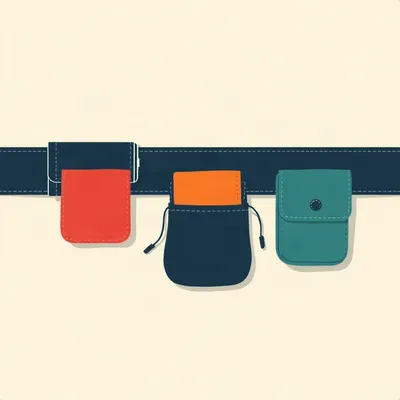
An admin pouch is a zippered fabric container, usually rectangular, designed to attach to a belt or MOLLE webbing. The defining feature is internal organization — slots, elastic loops, mesh pockets, dividers. That's what separates it from a dump pouch, which is just an open-top sack with zero structure, or a phone pouch, which is a single-device sleeve. An admin pouch is a tiny filing cabinet you wear on your hip.
And it's the natural starting point because it's a generalist. A dedicated multi-tool sheath holds one tool. A magazine pouch holds one magazine. An admin pouch replaces the contents of your pockets — wallet, keys, phone, pen, small notebook, charger — and consolidates them into one external unit. You don't have to change what you carry. You just change where you carry it. That's the lowest-commitment entry point into the whole belt accessory system.
So it's a pocket transplant. You're not adding new capabilities, you're relocating the ones you already use. Which means the barrier to trying it is basically the cost of the pouch and the willingness to look like you're about to radio for backup.
That's... yeah, that's the tradeoff. But let's sit with the ADHD angle Daniel raised, because it's not just a convenience thing. There's a real mechanism here.
Walk me through it. I lose things constantly and I've accepted it as a personality trait. You're saying a zippered pouch fixes that?
Not fixes — compensates. The core problem Daniel's describing is object permanence failure combined with location migration. You put your keys down on a surface, the surface leaves your field of view, the keys cease to exist in your working memory. That's the ADHD tax. But it's compounded by the fact that your pockets change — jacket pocket one day, pants pocket the next, bag pocket when you're traveling. The item's home is always shifting.
An admin pouch externalizes your carry to a single, fixed location relative to your body. It's always at your four o'clock or your three o'clock, depending where you mount it. Your hand learns that location. Muscle memory kicks in. The zipper is the physical close-loop — it prevents items from falling out when you sit, when you bend over, when you get out of a car. Pockets fail at all three of those.
Hm. So it's the "don't put it down, put it away" principle, but the pouch is the "away" that's always on you.
And for someone with ADHD, "away" is usually a death sentence for the object. A drawer, a bag compartment, a shelf — those are black holes. But a pouch on your belt is "away" that you can touch without looking. That's the difference.
I've lost three phones to the gap between a car seat and the center console. A zipper would have stopped all three. I'm starting to resent my pockets.
You should. Pockets are terrible at retention during sitting. The angle changes, the opening deforms, and gravity does the rest. A zippered pouch solves that completely.
Alright, so the mechanism makes sense. Now let's talk about the actual products. Daniel mentioned the Maxpedition Barnacle as the tiny end of the spectrum. What's the size range we're actually dealing with?
Maxpedition gives us a clean three-tier spectrum. At the small end, the Barnacle — it's roughly three by five inches. Holds a phone, a few cards, maybe a small pen. Minimal internal organization — a couple of slots, not much else. This is a phone-and-wallet replacement, nothing more. If you try to stuff a power bank in there, you'll hate it.
The mid-tier is the E.D.C. Pocket Organizer — about five by seven inches. Multiple internal slots, elastic loops, a mesh pocket. This is where the category starts to earn the name "admin pouch." You can fit a small power bank, a notebook, a pen, your wallet, your keys. It's the Goldilocks size for most people.
Then the top end is the Compact Admin Pouch, the CAP — about six by eight inches, padded interior. This thing fits a passport, a ten-thousand-milliamp power bank, a charging cable, a small multi-tool, sunglasses in a soft case. At this size you're not replacing your pockets anymore — you're replacing a small daypack.
So the Barnacle is "I don't trust my pants," the E.D.C. is "I carry things and I want them organized," and the CAP is "I'm leaving the house with a mission."
That's... a surprisingly accurate summary. The CAP is basically a mini go-bag. Some people use it as a camera pouch for a compact mirrorless body with a pancake lens.
And at what point does it stop being an admin pouch and start being... a purse?
I think the line is whether it stays on your belt or needs a shoulder strap. The CAP is still belt-mountable on a rigid one-point-seven-five-inch belt. Beyond that size, you're into cross-body territory.
Let's talk about the attachment question, because Daniel specifically asked about belt versus MOLLE. What's the actual difference in how these things feel when you're wearing them?
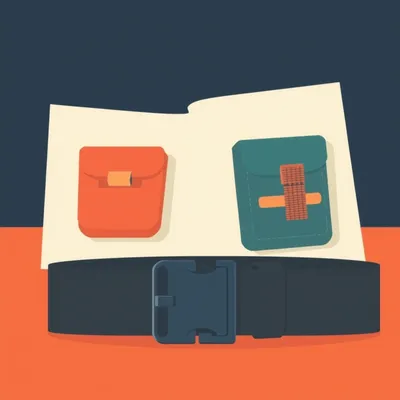
Belt carry means you thread the pouch onto a one-and-a-half or one-point-seven-five-inch belt — the pouch has a loop or a tunnel on the back. This is the most secure method. The pouch sits flat against your hip, it doesn't flop when you walk, and you can access it without removing anything. Your hand goes to your hip, unzips, retrieves. Done.
MOLLE attachment uses straps or clips — typically Malice clips or similar — to weave the pouch onto a MOLLE grid on a backpack, a chest rig, or a cross-body bag. This gives you positional flexibility — you can move the pouch around on the host platform — but it introduces wobble. The pouch isn't fixed rigidly; it has play. And the bigger usability issue is that the pouch goes where the bag goes. If the bag is on your back, you have to take it off to access the pouch. If the bag is on the floor, so is your admin pouch.
So MOLLE is great if you're building a loadout on a plate carrier and you need to reposition pouches for different missions. For everyday carry, it's solving a problem you don't have.
Mostly, yes. The one exception is if you already carry a cross-body bag or a sling pack daily. In that case, attaching a small admin pouch to the bag's MOLLE webbing gives you quick-access storage on the outside of the bag. But at that point you're accessorizing a bag, not building a belt system.
And belt carry — is there a minimum belt rigidity you need for these to work?
For the Barnacle, almost any belt works. It weighs nothing. For the E.D.C. Pocket Organizer, you want at least a one-and-a-half-inch nylon belt with some structure — a floppy dress belt will sag. For the CAP fully loaded, you need a proper one-point-seven-five-inch tactical or rigger's belt. The kind Daniel was researching in the belt episodes. Without that rigidity, the pouch pulls the belt outward and you get a hip bulge that's both uncomfortable and visible.
So the belt is the platform, the pouch is the payload. Skip the platform and the payload becomes a problem.
That's the exact lesson from the earlier episodes. The belt does the work.
Alright. That covers the mechanics. But there's a whole other dimension to this: the look. And Daniel was honest about it — admin pouches can look goofy. I want to sit with that for a minute, because I think it's the real reason more people don't use these.
It's the number one objection, and it's not trivial. Admin pouches were designed for tactical contexts. Black Cordura nylon, PALS webbing on the front, Velcro patch panels, subdued colors. When you wear that in a civilian setting — at a coffee shop, at an office, at a kid's birthday party — it signals something you probably aren't. You look like you're about to go on patrol, or like you're cosplaying a SWAT team member.
And the Velcro patch panel is the cherry on top. It's an empty canvas screaming for a morale patch, and now you're the guy with a pun embroidered on his hip.
The goofiness has layers. There's the tactical signaling, there's the boxy silhouette, and then there's the fanny pack association — even though it's on your hip, not your front, the visual language is similar. A rectangular fabric container on a belt reads as "fanny pack" to most people, and fanny packs have a cultural baggage that's hard to shake.
So what do you do about it? Daniel's not asking us to pretend it's not goofy — he's asking how to manage the tradeoff.
Four things. First, color. Black Cordura screams tactical. Gray, navy, coyote brown, or earth tones read as more civilian. Maxpedition offers most of their pouches in multiple colors, and the non-black options reduce the visual footprint significantly.
Second, avoid MOLLE webbing on the front panel. Some pouches have it, some don't. The Barnacle, for example, has a relatively clean front face. The E.D.C. Pocket Organizer has three rows of PALS webbing. If you're not attaching anything to it, that webbing is just visual noise that says "tactical." Choose a pouch with a cleaner profile.
Third, slimness. A pouch that's one inch thick when loaded is barely noticeable under a shirt. A pouch that's three inches thick because you stuffed it full creates a visible bulge that draws the eye. The silhouette matters more than the fabric.
And fourth — and this is where I think Corn's going to land — you just accept it.
I do land there. The function is so much better than pockets that the aesthetic tradeoff is worth it. I've lost things from pockets. I've had things fall out in cars, in theaters, on planes. A zippered pouch would have prevented every single one of those losses. If the cost of never losing my keys again is that someone at the grocery store thinks I look a little tactical, I'll pay that.
There's also a normalization effect happening. Ten years ago, wearing a phone on your belt in a holster was a dad move that got you mocked. Now everyone carries a phone, and belt holsters are unremarkable. Admin pouches may follow the same trajectory as more people adopt EDC systems.
The first person in an office to wear a bluetooth headset looked like a cyborg. Now nobody notices. The goofiness is a function of adoption rate, not the object itself.
There are companies already pushing in that direction. Let's talk about the manufacturer landscape beyond Maxpedition.
Go. Who else is making these, and what differentiates them?
5.11 Tactical has a whole "Pouches and Attachments" category on their website — admin pouches, utility pouches, dump pouches, in multiple sizes and colors. Their stuff is solid, mid-range pricing, and widely available. They tend to be a bit more overtly tactical in design language than Maxpedition, but the build quality is good.
Vanquest is the premium player. Their pouches have highly structured internal organization — lots of elastic loops, dedicated slots, sometimes removable dividers. The materials are top-tier. If Maxpedition is a filing cabinet, Vanquest is a custom drawer system. You pay for it, but the organization is obsessive.
Condor Outdoor is the budget option. Wide MOLLE compatibility, decent construction, much lower prices. The tradeoff is materials — the nylon is thinner, the zippers are less robust. For light everyday use, they're fine. If you're loading a pouch heavy and using it daily, the wear shows faster.
And then there's Tom Bihn — completely different aesthetic. Non-tactical, clean lines, excellent materials and organization. Their pouches are designed for bags more than belts, but some of their smaller organizers work on a belt loop. The downside is limited belt-carry options and a price point that makes Vanquest look reasonable.
So the market splits into tactical — Cordura, subdued colors, MOLLE-focused — and everyday — cleaner lines, more colors, belt-loop or clip attachment. And the everyday side is growing.
It is. The "tech carry" brands — Alpaka, Aer, Bellroy — are making slim, well-organized pouches that happen to work on belts, even if they don't call them admin pouches. Alpaka's hub pouch, for example, is essentially an admin pouch in X-Pac fabric with a magnetic closure instead of a zipper. It looks like a tech accessory, not a piece of kit.
That convergence is interesting. The line between "admin pouch" and "tech organizer" is blurring. In five years, we might not call them admin pouches at all.
The function stays the same, the aesthetic evolves. That's the pattern with most gear categories.
So let's get practical. Daniel asked what you actually carry in one of these. You've used these — walk me through a sample loadout for the Barnacle and the CAP.
Barnacle loadout: phone, two cards — ID and credit card — a small pen like a Fisher Space Pen, and maybe a folded index card for notes. That's it. The Barnacle is not a general-purpose pouch. It's a phone-and-wallet replacement with a pen slot. If you try to add keys, they'll scratch your phone. If you add a power bank, it won't zip closed. Respect the size.
CAP loadout: passport, a ten-thousand-milliamp power bank, a six-inch USB-C cable, a small multi-tool like a Leatherman Squirt, sunglasses in a soft case, and a Field Notes notebook with a pen. That's a full day-out loadout. You could fly with that as your personal item supplement — everything you need in the seat back pocket, on your hip, not in the overhead bin.
The principle is don't overstuff. A bulging pouch defeats the purpose — it's uncomfortable, it looks worse, and it strains the zipper.
That's the single biggest mistake people make. They buy a pouch, they fill every slot and loop, and then they add one more thing because there's technically space. Now the pouch is three inches thick, it pulls the belt outward, and it prints through your shirt like a tumor. The pouch should replace your pocket contents, not supplement them. If you're carrying more than you used to carry in your pockets, you're doing it wrong.
A pouch that bulges is a pocket with extra steps. You've just moved the problem to a more visible location.
And paid money for the privilege.
Alright. I want to step back and talk about what this category is actually doing. We've covered the mechanics, the sizes, the manufacturers, the look. But the thing that strikes me is that admin pouches solve a problem most people don't realize they have until they try the solution.
Say more.
Most people lose things from pockets occasionally. They accept it as normal. They pat their pockets before leaving a room, they check the car seat, they have a moment of panic when they don't feel their phone. That's background stress that they've normalized. An admin pouch eliminates that entire category of anxiety. You don't pat your hip because you know the zipper is closed. The items are either in the pouch or they're not — there's no ambiguity.
It's a binary state. Zipped equals secure. Unzipped equals access. Pockets are analog — they're secure-ish, accessible-ish, depending on angle, fabric, activity. A zippered pouch is digital in that sense. It's either closed or it's not.
And for someone with ADHD, that binary state is huge. Ambiguity is the enemy. "Where are my keys?" is a question that can derail ten minutes of your morning. "My keys are in the pouch, the pouch is on my belt" is a statement that takes half a second to verify by touch.
The touch verification is underrated. You can check that the pouch is there without looking, without breaking conversation, without stopping what you're doing. Your hand just drops to your hip, feels the Cordura, and your brain gets the "all clear" signal.
I've been skeptical of EDC culture for a long time because a lot of it looks like consumerism dressed up as preparedness. But this specific item — the admin pouch — feels different. It's functional in a way that a titanium keychain bottle opener is not.
The bottle opener that weighs four ounces and costs eighty dollars. Yes, that's a different category entirely.
The admin pouch is a prosthetic for a cognitive limitation that a lot of people have and don't want to admit to. Losing things isn't a character flaw, but it feels like one. And here's a thirty-dollar piece of nylon that fixes it.
The price point is part of what makes it the gateway. A Barnacle is what, twenty-five, thirty dollars? A CAP is maybe forty-five. That's impulse-buy territory. You can try the concept without committing to a two-hundred-dollar belt system.
And if it doesn't work for you, you're out the cost of a dinner. If it does work, you've just eliminated a daily source of friction for less than the price of a video game.
I want to circle back to something you said earlier about the goofiness being a function of adoption rate. I think there's a parallel here with backpacks in professional settings. Thirty years ago, wearing a backpack with a suit was a fashion crime. Now it's completely unremarkable. The object didn't change — the context did.
The backpack went from "schoolchild" to "professional." The admin pouch might go from "tactical" to "organized." Same trajectory, different decade.
And the companies that figure out how to make an admin pouch that doesn't look like an admin pouch — that looks like a sleek tech accessory — are going to capture the market that Maxpedition can't reach.
The Alpaka play. X-Pac fabric, magnetic closures, clean lines, no webbing. It's an admin pouch for people who would never Google "admin pouch."
And that's where I think the category is heading. The function is too good to stay in the tactical niche forever.
Before we wrap, I want to hear from Hilbert. He's been quiet, which usually means he's got something.
Hilbert?

The ferret was fine.
...I'm going to need more than that.
Worked a summer at an army surplus store in central Pennsylvania. Nineteen ninety-three. Sold Maxpedition pouches to people who'd never been near a military base. Preppers, hikers, one guy who wanted to carry his ferret in a MOLLE pouch.
A live ferret.
Live ferret. He cut air holes in the mesh pocket. Ferret seemed comfortable. Store manager made him buy the pouch first.
Did the ferret... stay in the pouch?
Mostly. It'd poke its head out when someone walked by. Best sales tool we had that summer.
I have so many questions and I'm going to ask none of them.
The point I wanted to make — you're both right about the ADHD angle. But the thing that makes these pouches look goofy isn't the Cordura. It's the bulge. Ninety percent of people overstuff them. They buy a Barnacle and try to fit a whole day's carry in it. Creates this lump on the hip that looks like a medical device.
Had a customer come back demanding a refund. Said his pouch looked like a tumor. I opened it up. He'd crammed a full-size DSLR camera into a Barnacle. The zipper was screaming. The fabric was stretched. Looked like a snake that ate a brick.
A DSLR in a Barnacle. That's... ambitious.
He was angry at the pouch. Not at himself for putting a camera the size of a toaster into a three-by-five-inch pocket. The pouch didn't fail. His expectations did.
That's the overstuffing problem you were describing. People treat the pouch capacity as a target instead of a limit.
Fill it to eighty percent. Leave room for the zipper to move. If it bulges, take something out. The pouch should disappear under a shirt. If it doesn't, you're carrying too much or you bought the wrong size.
The ferret guy — did he keep the pouch?
Bought three more. Different sizes. Said the ferret liked having options.
Of course he did.
Still have one of those pouches. The Barnacle, not the ferret one. Kept it in a drawer for twenty years. Zipper still works.
Maxpedition zippers are YKK, right?
YKK zippers across the whole product line. They don't fail. The fabric will wear out before the zipper does.
That's what I was going to say. The pouch outlasts the person's interest in carrying it. That's the real test.
The question that leaves me with is this: as these pouches get more popular outside tactical circles, are manufacturers going to design specifically for the civilian aesthetic — cleaner lines, non-tactical materials, hidden attachment systems? Or does the category stay a niche within a niche?
I think the Alpaka and Bellroy approach answers that. They're already making slim, well-organized pouches that work on belts. They just don't call them admin pouches. The function is converging with the tech-organizer category. Give it a few years and the distinction might disappear entirely.
The name "admin pouch" might be the last tactical thing about it. Everything else evolves toward the mainstream.
The mainstream needs this product more than it knows. Most people lose things from pockets. Most people have that moment of panic. The solution exists and it costs thirty dollars.
If you've ever lost your keys, your wallet, or your mind trying to find a pen in your bag, an admin pouch might be the cheapest, simplest fix you haven't tried.
This has been My Weird Prompts. Thanks to our producer Hilbert Flumingtop.
Find us at my weird prompts dot com, or email the show at show at my weird prompts dot com. We'll be back soon.