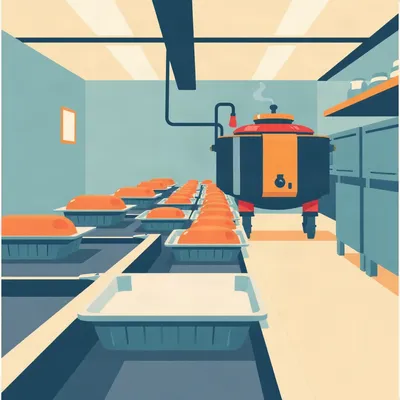
So I've been deep in B2B purchasing lately, buying industrial storage for the apartment. Euroboxes, specifically. And it got me thinking about a whole other layer of the supply chain that Daniel's been puzzling over. Here's what he wrote.
He says he's been exploring B2B purchasing for personal needs. Picked up a set of Euroboxes for industrial storage. Generally the only way to access these is through B2B channels, regardless of whether you're actually a business or just yourself. He's become very familiar with the ecosystem of building and industrial suppliers here in Israel, and he's a long-term advocate of leveraging B2B channels, which people often think are closed off but are more open than they appear. He's used them to buy things like gastronorm pans for the kitchen, which have really stood the test of time. He thinks you can often get vastly superior and more durable products compared to what's in big-box stores, at least if you're comfortable with the industrial aesthetic.
Then he gets to the part that confuses him. One subset of the landscape is what he calls industrial suppliers, stores like Talmir in Israel, but internationally names like Digikey, Mouser, and Farnell. He was always curious what exactly these are, because their websites look very different from even a big B2B supply operation. The websites tend to look very Windows ninety-eight and consist of a vast catalogue of parts, an almost impossibly large catalogue that wouldn't fit in even a huge warehouse.
He mentions that one of his previous jobs was as a communications manager for an IoT startup. They had a lab on site, the hardware and IoT gateway was made at a small scale on premises. He'd lost contact with most former colleagues and never knew the hardware team that well, but years later he's wondering if these are the type of distributors that are actually tapped into by even small hardware operations. Countless times he's working on tech projects and runs into a road bump because he doesn't have a specific part. He uses AliExpress and builds up an inventory system to try to proactively avoid not having components. But if you're trying to meet consumer demand, this becomes a blocker.
He's seen a couple of sites that offer delivery SLAs along the lines of they'll get you any part you need from their impossibly large catalogue within a number of hours. And he asks, are these distributors the quiet saviors that prevent critical parts from blocking whatever kind of project they're needed for? He's envisioning government customers where missing a specific type of bolt or transistor has much bigger implications than some ESP32 project getting delayed. He wants to understand what role these distributors play in the ecosystem. Are they one step above the B2B suppliers in the food chain, specialized on the basis of large inventory and SLAs, or are both of these equally important functions?

Okay, there's a lot here, and the first thing we need to do is get the taxonomy straight, because Daniel's question about whether these are one step above B2B suppliers reveals a really common confusion. They're not above. They're beside.
Parallel tracks.
Exactly two different supply chains that happen to both be business-to-business. On one side you've got what Daniel's been buying from, Talmir, Grainger, McMaster-Carr. These are MRO suppliers. Maintenance, repair, and operations. They sell finished goods. Shelving, gastronorm pans, fasteners, safety equipment, motors. A factory needs a replacement conveyor belt, they call Grainger. On the other side, you've got Digikey, Mouser, Farnell. These are electronic component distributors. They don't sell finished goods. They sell raw components. Semiconductors, capacitors, resistors, connectors, sensors. The building blocks that get assembled into something else.
So the Euroboxes and the ESP32 microcontroller are fundamentally different categories of thing moving through different channels.
Right. And the confusion happens because both channels look similar from the outside. Huge catalogs, B2B, websites that seem designed by someone who's never seen a consumer app. But the underlying function is completely different. MRO is about keeping operations running. Component distribution is about enabling design and production.
Daniel's gastronorm pan will never be soldered onto a circuit board.
I mean, I'd love to see someone try, but no. So let's start with what Digikey, Mouser, and Farnell actually are. They're authorized distributors. This is a specific legal and commercial designation. They buy components directly from manufacturers, Texas Instruments, Analog Devices, Murata, Molex, and they resell them. They are not brokers. They are not gray market. Every part they sell has full traceability back to the factory that made it.
And the scale of this is genuinely hard to wrap your head around. Digikey lists over fifteen million parts from more than three thousand suppliers. Of those, about two point seven million are in stock and ready to ship at any given moment. Mouser claims over six million SKUs. Farnell, which is part of the Avnet group and operates under the Element fourteen brand in a lot of regions, has over one point five million.
The number that always gets me is the two point seven million in stock. That's not a catalog of things they can order. That's sitting on shelves.
In Thief River Falls, Minnesota. Population about eight thousand five hundred. Digikey's main facility there is two point three million square feet. That is one of the largest distribution centers in the world, and it's in a town most people have never heard of.
And this is where the impossibly large catalogue thing Daniel mentioned starts to make sense. It's not one warehouse in the traditional sense. Digikey's Thief River Falls facility uses automated storage and retrieval systems, basically giant robotic systems that fetch parts from dense shelving. They employ over twelve hundred people in that town. It is the economic engine of the entire region.
An NPR piece from April last year covered the tariff exposure for Digikey specifically because of how much of that town's economy depends on this one company. Tariffs on Chinese components, which are a huge portion of the electronics supply chain, hit Thief River Falls directly.
And that's the other thing about the impossibly large catalogue. Not everything is in Minnesota. Some parts are drop-shipped directly from manufacturers. Others sit in regional hubs around the world. Digikey has distribution centers in Europe and Asia. So when you order a part, the system figures out the fastest source and routes it. The catalogue feels infinite because it's distributed across a global network, but the core stock, the stuff they guarantee same-day shipping on, is physically in that Minnesota facility.
Let's talk about the websites, because this is where Daniel's observation about Windows ninety-eight is both accurate and missing the point.
It's the thing everyone notices first. You go to Digikey dot com and it looks like it was built in nineteen ninety-eight and has been gently updated ever since. That's because it was, and it has been. These sites were built in the late nineties and early two thousands, and they have never been redesigned in the way a consumer site would be. No full rebrand, no slick redesign every two years.
And the reason is not that they're lazy or behind the times. It's that their core users would revolt.
The primary user of Digikey or Mouser is an electrical engineer or a procurement professional. They are not browsing. They are not discovering products. They are executing a parametric search. They know they need a capacitor with a specific capacitance, voltage rating, tolerance, temperature coefficient, package size, and dielectric type. They need to filter fifty thousand capacitors down to the twelve that match their exact specifications, then compare those twelve on price, availability, and datasheet.
Parametric search is the thing Amazon cannot do.
Amazon cannot do it at all. If you search for a ten microfarad capacitor on Amazon, you get a jumble of results with inconsistent specs, no way to filter by tolerance, and a real risk of counterfeits. On Digikey, you get a table where every column is a parameter, and you can narrow down with surgical precision. The interface is essentially a database front-end. And that's the point. It's not supposed to be pretty. It's supposed to be fast and precise for someone who knows exactly what they need.
If you redesign that interface, you risk breaking the search engine that millions of bills of materials depend on. These companies have customers whose entire production workflow is built around Digikey's part numbers and parametric tables. Change the UI, and you've broken their internal tooling.
There's a real case of if it ain't broke. And for the engineers using it, it's not broke. It's fast. It loads quickly. The information density is extremely high. Every pixel is doing work. Consumer websites spread information out with whitespace and lifestyle photography because they're trying to create an experience. Digikey is trying to get an engineer from search to checkout in under two minutes so they can get back to designing a circuit board.
The lifestyle photography of a capacitor.
I mean, some of the product photos are beautiful in their own way, but no one's putting a surface-mount resistor in a tastefully lit kitchen scene.
So the Windows ninety-eight look is not a bug. It's a feature that has been carefully preserved because the cost of changing it, in terms of user productivity, is enormous.
And these companies do update their sites. Mouser has done some modernization. Digikey has improved search and added features. But it's incremental. Layer upon layer. You can see the archaeology of web development if you look closely. The core architecture is still that late-nineties database-driven catalog, and that's exactly what the users want.
Now let's get to the SLA promise, because this is the part that connects to Daniel's quiet savior thesis. Digikey offers same-day shipping for orders placed before eight PM Eastern time, with delivery in one to three days via FedEx. Farnell has similar guarantees. This is not marketing fluff.
It's the core value proposition. If you're running a production line and a component runs out, that line stops. A stopped automotive production line can cost a hundred thousand dollars an hour or more. A medical device manufacturer missing a single specialized IC might have an entire batch sitting incomplete. The SLA is not a nice-to-have. It is an insurance policy against catastrophic downtime.
And this is where the quiet savior idea gets interesting. During the chip shortage of twenty twenty-one through twenty twenty-three, lead times for many components stretched to fifty-two weeks or more. If you ordered directly from a manufacturer, you were waiting a year. Distributors like Digikey and Mouser became the only source for allocation.
They had stock when no one else did, because they'd built up inventory as part of their business model. And they implemented allocation systems that prioritized medical and defense customers. If you were building ventilators during a pandemic, Digikey made sure you got your parts. If you were building consumer gadgets, you might have to wait. That prioritization is a deliberate part of their role in the supply chain.
So the quiet savior framing is not an exaggeration. In a crisis, these distributors are the buffer between a fragile global supply chain and the critical infrastructure that depends on it.
And it's not just crises. Day to day, they serve the same function. A small hardware startup, like the IoT company Daniel worked at, doesn't have the volume to buy directly from Texas Instruments. TI's minimum order might be ten thousand units. The startup needs fifty. Digikey breaks that bulk. They buy the ten thousand from TI, stock them, and sell fifty to the startup at a markup. The markup is the price of access.
Which brings us to the hobbyist angle. Daniel mentioned his ESP32 projects and using AliExpress. Can an individual use Digikey?
No minimum order on most parts. You can buy a single resistor for three cents and they'll ship it to you. The barrier is not access. It's the user experience. If you don't know what a zero eight zero five package size is, or what tolerance you need, the parametric search is overwhelming. It's hostile to the non-engineer by design, because the non-engineer is not the target customer.
But if you can get past that, you get something AliExpress cannot offer. Authenticity and traceability.
This is the critical distinction. AliExpress is fantastic for price and variety. You can get an ESP32 board for three dollars. But counterfeit components are a real problem. A counterfeit capacitor might look identical but have a fraction of the rated capacitance or fail after a hundred hours. For a hobbyist project, that might mean a flaky sensor that you debug for a weekend and then replace. Annoying but not catastrophic.
For a satellite, it means a hundred million dollar failure.
Or a pacemaker, or a flight control system, or a nuclear power plant sensor. The cost of a counterfeit part scales with the stakes of the application. Digikey and Mouser guarantee original parts with full manufacturer traceability. If a part fails, you can trace it back through the supply chain to the exact factory batch. That traceability is not just a quality assurance thing. It's a regulatory requirement for aerospace, defense, and medical devices.
So Daniel's government customer thought experiment is exactly right. These distributors are precisely who government contractors call when a critical part is missing. Many of them have dedicated government sales teams and comply with ITAR, DFARS, and other defense procurement regulations. They offer military-spec handling and guaranteed delivery windows for defense contracts.
The government SLA isn't just we'll try to get it to you fast. It's a contractual obligation with penalties. If a defense contractor needs a specific connector for a radar system and the line is down, Digikey doesn't just ship it. They document the chain of custody, they certify the part's authenticity, and they meet a delivery window that's written into a contract. That's a completely different level of service than what Grainger does, even though Grainger also serves government customers.
And this is where Daniel's question about whether these are one step above B2B suppliers gets its clearest answer. Grainger might sell you the bolt that holds the radar system to the wall. Digikey sells you the transistor inside the radar system. Both are important. Neither is above the other. They're just different layers of the stack.
The bolt and the transistor analogy is exactly right. MRO suppliers serve the physical infrastructure. Component distributors serve the electronic infrastructure. A factory needs both. The conveyor belt motor comes from Grainger. The sensor that monitors the motor's temperature comes from Digikey. They intersect at the edges but they're fundamentally different supply chains with different logistics, different quality requirements, and different customer expectations.
Let's talk about the AliExpress comparison more directly, because I think this is the practical question a lot of listeners will have. When do you use which?
The framework I'd suggest is risk-based. For hobbyist projects, use AliExpress for cheap, non-critical parts. Resistors, LEDs, basic connectors, prototyping boards. If a part fails, you swap it out and move on. The cost savings are enormous, and the risk is low. But for anything where failure would be a real headache, use Digikey or Mouser. Microcontrollers, sensors, power management ICs, anything that's hard to debug or replace.
The debugging cost is the hidden one. A counterfeit capacitor that causes intermittent noise in your sensor readings might waste days of troubleshooting. Your time is worth more than the three dollars you saved.
And for anything that's going into a product you're selling, or a prototype you're showing to investors, or something safety-critical, the authorized distributor is not optional. The liability of a counterfeit part causing a failure in a shipped product is not something you want to carry.
There's also a middle ground that's worth mentioning. For mechanical parts, fasteners, enclosures, the MRO suppliers like McMaster-Carr are often the best option. Their website is actually a masterclass in industrial UX. Better than Digikey's in some ways. You can download CAD models for almost every part. You can filter by every dimension. And their shipping is absurdly fast.
McMaster-Carr's website is its own fascinating case study. It looks old but the search is incredibly powerful, and they've had three-D CAD models for almost everything since the early two thousands. But they're firmly in the MRO camp. They sell finished parts, not electronic components. The distinction holds.
So the decision framework is, what are you buying, and what happens if it fails. If it's a finished good for physical infrastructure, MRO supplier. If it's an electronic component and failure is expensive, authorized distributor. If it's an electronic component and failure is merely annoying, AliExpress.
If you're in a B2B purchasing role, the most important thing is to understand that MRO suppliers and component distributors are not interchangeable. Treating them as such leads to delays and wrong parts. A procurement person who calls Grainger looking for a specific Texas Instruments voltage regulator is going to have a very confusing conversation.
I want to circle back to something Daniel mentioned about building up an inventory system and using AliExpress proactively. That's actually a really smart approach for a hobbyist or small-scale operation, but it reveals the fundamental tension. He's trying to solve the availability problem himself, by stocking parts in advance, because he doesn't have the SLA that a production operation would have.
That self-stocking approach has its own costs. The cost of a touch, as we've discussed before. Every part you stock is capital tied up, space occupied, and a thing you have to manage and find later. The distributors solve this by being your inventory. You pay a markup per part, but you don't carry the inventory cost. For a business, that trade-off is almost always worth it. For a hobbyist, it depends on how much you value your space and sanity.
Daniel's Euroboxes are literally a solution to this problem. He's built an industrial storage system to manage his own component inventory. He's essentially running a miniature warehouse.
Which is great, and I respect the dedication, but it's also kind of proving the point. The distributors exist so that most people don't have to do that. The IoT startup Daniel worked at, the one with the on-premises lab, they were probably ordering from Digikey or Farnell regularly. The hardware team would have had accounts. They'd order what they needed for each build, and it would arrive in two days. No need to stockpile.
The small-scale manufacturing Daniel described, making IoT gateways on premises, that's exactly the kind of customer these distributors serve. Too small to buy direct from manufacturers, too dependent on reliability to use AliExpress for everything.
That tier of customer is huge. There are thousands of small hardware companies, research labs, university engineering departments, and niche manufacturers that depend on these distributors. They're not flashy. They don't make headlines. But they're the ones building the sensors, controllers, and devices that run a lot of modern infrastructure.
The quiet part of quiet saviors is literal. Most people have never heard of Digikey. The company does about five billion dollars in annual revenue and is privately held. It's one of the largest companies you've never encountered unless you're in the industry.
Mouser is owned by Berkshire Hathaway. Warren Buffett's company. That tells you something about the economics of this business. It's not glamorous, but it's essential, and it has wide moats. The inventory investment alone is a massive barrier to entry. You can't just start a competitor to Digikey. You'd need billions in working capital just to stock the parts.
The relationships with manufacturers. Becoming an authorized distributor requires agreements with thousands of suppliers, each with their own terms, quality requirements, and supply commitments. It's not a business you can disrupt with a better website.
The website is not the product. The inventory and the supply chain are the product. The website is just the interface to it. That's the thing people miss when they mock the Windows ninety-eight look. They're judging the interface without understanding what it's an interface to.
Alright, let's get practical. Given everything we've covered, what should someone actually do with this information?
First, if you're building anything that matters, a product, a prototype for something you might manufacture, a critical system, use authorized distributors for critical components. The cost premium is real, but it's insurance against counterfeit and supply chain disruption. Think of it as paying for traceability.
Second, learn to use parametric search. It's the superpower that makes these supposedly outdated sites faster and more precise than any modern e-commerce platform. Once you understand how to filter by the parameters that matter for your application, you can find exactly the right part in seconds. It's a skill that pays back enormously.
Third, for hobbyist projects, use a hybrid approach. AliExpress for passives and connectors where the risk is low. Digikey or Mouser for the microcontroller, the sensor, the power IC, anything where a failure means hours of debugging. The few extra dollars per part is cheaper than your time.
Fourth, if you're in a purchasing role, or even just doing procurement for a small company, understand the distinction between MRO and component distribution. Know which suppliers serve which need. Calling the wrong one costs time and money, and it makes you look like you don't know your own supply chain.
A bonus fifth. If you're a hobbyist who's been intimidated by these sites, just try ordering something simple. A pack of resistors or an LED. The checkout process is straightforward, shipping is fast, and you'll get a feel for how the catalog works. The first order is the hardest. After that, it clicks.
To wrap up, let's step back and think about where this is heading. The open question I keep coming back to is, as supply chains become more volatile, will these distributors become more consumer-facing, or will they remain the hidden backbone they've always been?
I think they'll stay hidden, but their role will become more critical. The trend toward reshoring and supply chain resilience actually increases the value of domestic distributors with deep inventory. If you can't rely on just-in-time shipments from Asia, you need a buffer. Digikey's warehouse in Minnesota is exactly that buffer.
The other angle is AI. Imagine AI-driven design tools that can spec an entire bill of materials and place the order with Digikey automatically. The parametric search interface, which is already powerful for humans, becomes even more powerful when an AI can optimize across thousands of parameters simultaneously. The Windows ninety-eight front-end might become irrelevant, not because it gets redesigned, but because no human looks at it anymore.
That's a fascinating thought. The website stays exactly as it is, but the primary user becomes an API. The engineer describes what the circuit needs to do, the AI translates that into a BOM, and the order goes out without anyone clicking through a parametric table.
The hidden backbone gets even more hidden.
I think that's probably the right future for them. They're not going to become a consumer brand. They don't need to. Their value is in being the reliable, invisible infrastructure that everything else runs on.
If you enjoyed this episode, please leave a review. It helps other weird prompters find the show.
Thanks to our producer Hilbert Flumingtop.
This has been My Weird Prompts.
We'll be back soon.
I'm going to go organize some Euroboxes.