Daniel sent us this one — and it's got real emotional weight behind it. He describes suburbs as a monotonous sea of cookie-cutter places where people commute by car to jobs, return exhausted to homes that exist only to serve housing, and then rinse and repeat. He calls it bleak. And he's asking whether there's a better model — one where employment, recreation, and housing all coexist without car dependency. He brings up growing up in Ireland with the language of inner and outer suburbs, wonders if that vocabulary still holds up, and asks what cities and planning schools have actually built the alternative. There's a lot to unpack here.

There really is. And what I appreciate about the way this is framed is that it's not abstract. It's rooted in lived experience — watching Jerusalem choke on traffic, seeing air quality degrade, feeling that something about the suburban bargain doesn't add up. That's not just an aesthetic preference. That's someone noticing that the math of how we build cities doesn't close.
The math of how we build cities. That's the episode right there. So let's start with the vocabulary question, because it's a good diagnostic. Inner suburb versus outer suburb — is anyone still using those terms?
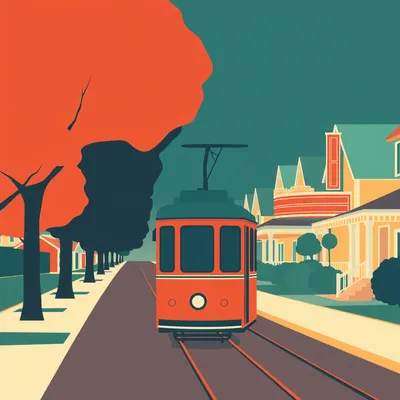
They are, but they mean something quite specific historically, and the meaning has shifted. The term inner suburb originally described those nineteenth-century districts that grew up around streetcar lines — places like Brookline outside Boston, or Camden Town in London. They were built before mass car ownership, so they had to be walkable and transit-connected by definition. You'd get a mix of housing types, some corner shops, a pub or a café, and a tram stop that got you downtown in twenty minutes.
The streetcar suburb is almost the opposite of what we mean by suburb today.
The outer suburb is the post-war invention — Levittown, the automobile suburb, the place where you cannot function without a car because the planning separated every use from every other use. And that's the key distinction. It's not distance from the center that defines the difference. It's the transportation technology that shaped the development.
Which means when the prompt talks about growing up in Ireland and hearing inner versus outer suburb, the Irish context probably mapped pretty well to that historical distinction. Dublin's inner suburbs like Rathmines or Clontarf grew up around trams in the late eighteen hundreds. The outer suburbs came later with the car.
And here's the thing — in twenty twenty-six, the term inner suburb is still used in planning literature, but it's become blurry. A lot of what we call inner suburbs today are actually the streetcar suburbs of a century ago that got absorbed into the city. They're now just neighborhoods. The real planning question isn't about the label. It's about the form. What does the place actually let you do without getting in a car?
Which brings us to the model the prompt is actually describing. A city center surrounded by neighborhoods that function as connected villages — mixed-use, slightly less dense than the core, but not dormitory suburbs. Does that have a name in planning?
It has several. The most precise match is probably the urban transect, which comes out of the New Urbanism movement — Andrés Duany and Elizabeth Plater-Zyberk developed it in the nineteen nineties. The transect classifies zones from T-one, which is natural wilderness, all the way up to T-six, which is the dense urban core. The sweet spot the prompt is describing — neighborhoods that feel like connected villages with a mix of housing, shops, and workplaces — that's T-three and T-four. The sub-urban zone and the general urban zone.
Sub-urban meaning not suburb in the Levittown sense, but the zone just below full urban intensity.
T-three is what they call the sub-urban zone — think tree-lined streets, houses with porches, but still within walking distance of a corner store or a small office. T-four is the general urban zone — row houses, apartment buildings, mixed-use main streets. Both of them are fundamentally different from the T-three that actually got built in most of America, which is the sprawl version — same density on paper, but no connectivity, no mix of uses, no transit.
The vocabulary the prompt is groping toward isn't inner suburb. It's something more like the urban transect's middle zones. Connected villages within the city fabric.
And this connects to a much older tradition too. The prompt is essentially describing Ebenezer Howard's garden city model from eighteen ninety-eight. Howard envisioned self-contained communities of about thirty-two thousand people, surrounded by greenbelts, with their own employment, their own amenities, connected to a central city by rail. Not dormitory suburbs, but genuine satellite towns.
The garden city gets invoked a lot, but most people don't realize how specific Howard's vision was. He wasn't describing quaint villages with roses round the door. He was describing economically self-sufficient new towns with their own industry.
The first two garden cities actually got built — Letchworth in nineteen oh three and Welwyn in nineteen twenty. They're still there. They're still functioning. People commute within them, not just out of them. The model worked, it just didn't get replicated at scale because the car made it cheaper to build sprawl.
Cheaper in the narrow sense. Cheaper for the developer who doesn't have to pay for the connecting infrastructure. Not cheaper for the resident who now needs two cars.
We'll get to the affordability paradox. But let me stay on the planning history for a moment, because there's another concept that maps directly onto what the prompt is describing, and it's the one that actually got traction in continental Europe. The polycentric city.
Polycentric meaning multiple centers, not one downtown core.
The traditional North American model is monocentric — one central business district surrounded by rings of decreasing density, all the jobs downtown, all the housing in the rings. The polycentric model says no, you want multiple nodes of mixed-use density, each one functioning as a kind of village center, connected by high-quality transit. Employment is distributed across the nodes, not concentrated in one place.
This isn't just theory. Copenhagen's been doing it since nineteen forty-seven.
The Finger Plan. This is one of the most influential planning documents of the twentieth century, and it's exactly what the prompt is asking about. Copenhagen drew five transit corridors radiating from the city center, like the fingers of a hand, with green wedges preserved between them. Each finger has a commuter rail line, and around each station, you get mixed-use development — housing, offices, shops, schools. You can live in one of these nodes and access most of what you need without going into the center.
The green wedges aren't just parks. They're working farmland, forests, recreational areas. They're productive landscape that also prevents the fingers from merging into a blob of sprawl.
The Finger Plan was adopted in nineteen forty-seven and it's still the guiding framework for regional development today. Almost eighty years. That's the kind of staying power you get when a plan actually serves human needs rather than developer convenience. And here's the number that matters — Copenhagen's modal split for commuting is about forty-one percent by bike, twenty-eight percent by public transit, and only about twenty-nine percent by car. That's in a city with real winters.
The Danes bike in February. It's humbling.
It's infrastructure. When you build protected bike lanes that are actually separated from car traffic, and when you locate housing and jobs near stations, people use the system. It's not about national character. It's about design.
Copenhagen gives us the regional structure. But the prompt also asks about schools of planning that endorse this model. New Urbanism we've touched on.
Transit-oriented development, or TOD, is probably the most influential framework right now. Peter Calthorpe formalized it in the early nineteen nineties. The core principle is deceptively simple — you zone for high-density mixed use within a half-mile radius of every transit station. That's about an eight-hundred-meter walk. Within that radius, you allow apartments, offices, retail, and you reduce parking requirements because people don't need to drive to the station.
The half-mile isn't arbitrary. That's about a ten-minute walk for most people. It's the distance people will actually walk rather than get in a car.
Studies consistently show that people will walk about five to ten minutes to transit. Beyond that, ridership drops off a cliff. So TOD draws a hard circle around every station and says, within this circle, we're going to build a real place. Outside it, lower density is fine. But the node itself has to be genuine.
Has it worked anywhere at scale?
Curitiba in Brazil is the canonical example. Starting in the nineteen seventies under mayor Jaime Lerner, Curitiba developed a bus rapid transit system along five arterial corridors, and they concentrated all the high-density zoning along those corridors. So instead of one downtown with sprawl around it, you get five linear spines of density, each with dedicated bus lanes, each with mixed-use development. Today, Curitiba's BRT system carries over two million passengers a day, and about seventy percent of commuters use public transit.
Two million passengers a day on buses. That's more than a lot of metro systems.
The key detail is that the zoning and the transit were designed together. You can't retrofit one without the other. If you put a great bus line through single-family zoning, nobody rides it. If you up-zone without transit, you just get traffic. The magic is in the simultaneous deployment.
Which is also the story of Tokyo, but through a completely different mechanism.
Tokyo is fascinating because it wasn't centrally planned the way Curitiba was. It emerged from the private railway model. In the early twentieth century, Japanese rail companies realized they could make more money by developing real estate around their stations than by just selling tickets. So they built department stores, housing, offices, entertainment complexes — all clustered around their station hubs. Each station became a self-contained node.
The rail company becomes the developer, and the incentive is to make the station a place people want to be, not just pass through.
And because multiple private railways compete, you get multiple nodes, each with its own character. Shinjuku, Shibuya, Ikebukuro — these aren't just stations. They're full urban centers with hundreds of thousands of jobs each. Tokyo's metropolitan area has thirty-eight million people, and it functions on a transit mode share of about fifty-seven percent. That's not despite the density. It's because the density is organized around transit.
We've got Copenhagen as the top-down planned version, Curitiba as the bus-based developing-world version, and Tokyo as the market-driven private-rail version. All transit-first.
We should mention Vienna, because it's doing something that maps specifically onto the prompt's idea of connected villages within the city. Vienna has a program called Stadt ohne Rand — City Without Edge. The idea is that the outer districts shouldn't feel like a hard boundary between urban and suburban. They should integrate mixed-use zoning, social housing, cultural venues, and tram connections so that living in the twenty-second district doesn't feel like you've been exiled from city life.
City Without Edge. That's a beautiful phrase. It captures exactly what the prompt is after — not a sharp cutoff where the city ends and the dormitory begins, but a gradual transition through neighborhoods that all feel like part of the urban fabric.
Since twenty fifteen, Vienna has increased mixed-use zoning in its outer districts by about forty percent. They've been adding tram lines, building affordable housing, putting schools and clinics and shops into the same developments. It's not a theoretical model. It's an active program with measurable results.
The model exists. It has names — polycentric city, transit-oriented development, the urban transect, the Finger Plan. It has working examples. The question then becomes, why isn't it the default?
Because the car made a different model cheaper in the short term. And I want to be precise about what cheap means here. Suburban land is cheaper per square foot because it's farther from jobs and amenities. But the total cost of living in a car-dependent suburb includes things that don't show up in the rent or mortgage. The average American spends fifty-four minutes per day commuting, according to the twenty twenty-four Census Bureau data. That's about two hundred and thirty hours a year. If you value that time at anything above zero, the cheap house starts to look expensive.
That's before you factor in car ownership. Two cars per household, insurance, maintenance, fuel.
AAA puts the average annual cost of owning a new car in the US at over twelve thousand dollars. For a two-car household, that's twenty-four thousand a year, after tax. If you could drop one car because you had decent transit, that's effectively a twelve-thousand-dollar raise. The suburban house isn't cheaper. The costs are just hidden in different line items.
The affordability paradox. The prompt acknowledges this explicitly — if the only way to get to jobs is by car and this is where it's affordable, people will follow suit. But that doesn't mean it's what they want.
This is where the policy levers are. If we want the polycentric model to be the affordable option — not just the desirable one — we have to stop subsidizing sprawl. Right now, in most North American cities, the infrastructure for suburban development is paid for by general tax revenue. The water lines, the roads, the sewer extensions — the developer doesn't bear the full cost. The municipality does. And then the municipality discovers, twenty years later, that the tax base from low-density housing can't cover the maintenance costs.
Strong Towns has been making this argument for years. The suburban development pattern is a Ponzi scheme. The initial infrastructure is built with state and federal grants, and the replacement costs are never accounted for.
There's a specific mechanism that locks this in — zoning codes that prohibit mixed use. In most American cities, it's still literally illegal to build an apartment above a shop. The zoning code was written in the nineteen fifties to separate uses, and it's never been updated. If you want to build the kind of connected village the prompt describes, in most places you'd need a variance. You'd need to ask permission to build the thing that was normal for thousands of years of human settlement.
The apartment above the shop. The most traditional urban form in history.
Parking minimums are the other half of the trap. Most cities require a minimum number of parking spaces for any new development — two spaces per apartment, one per three hundred square feet of retail, and so on. These requirements make mixed-use development financially impossible in many cases, because the parking takes up more land than the building. You're effectively mandating car dependency through the zoning code.
Let's talk about the car question directly, because the prompt takes a strong position — cars do not have places in cities. But then immediately adds the nuance. It's not an absolutist position. It's a question about the default mode.
That's the right way to frame it. A car-free city doesn't mean a city where no vehicle ever enters. It means a city where the car is not the default assumption for every trip. Emergency vehicles, delivery trucks, construction equipment, accessible transport for people with disabilities — all of that still exists. What changes is that the private car stops being the thing that dictates every dimension of the street.
The street goes from being a car corridor that pedestrians are allowed to cross, to being a public space that cars are allowed to use under certain conditions.
That's the conceptual flip. And it's already happening in cities that are implementing congestion pricing, low-emission zones, superblocks. Barcelona's superblock model takes nine square blocks and restricts through-traffic to the perimeter. Inside the superblock, streets become shared spaces — playgrounds, seating, trees. Cars can still access them, but at walking speed, and they don't cut through. The result is a sixty percent reduction in car traffic within the superblock and a significant drop in air pollution.
The prompt mentions Jerusalem's descent into traffic congestion. That's a city that was not designed for the car volume it now has, and it shows. Narrow streets, limited parking, constant construction. The geography itself resists the car, but the planning keeps accommodating it.
Jerusalem is a case study in what happens when you try to retrofit car infrastructure onto a pre-car city. It doesn't fit. You end up destroying the very qualities that made the city valuable in the first place — the walkability, the density of human interaction, the sense of place. And you still end up with congestion, because induced demand means more roads just fill up with more cars.
The thing traffic engineers discovered in the nineteen sixties and then collectively forgot for forty years.
The fundamental law of road congestion, as it's sometimes called. When you expand road capacity, travel time initially drops, which makes driving more attractive, which attracts more drivers, until travel time returns to exactly where it was before. The only way to reduce congestion is to provide alternatives that are genuinely competitive with driving. Not slower alternatives. Not alternatives that feel like a compromise. Alternatives that are faster, cheaper, or more pleasant.
Which brings us to the hub-and-spoke model the prompt describes. Regional rail spokes connecting cities, with internal transit within each node. Does that map onto any real system?
It maps almost perfectly onto the Swiss model. Switzerland runs what's called an integrated clock-face timetable. Every train station has departures at the same minutes past every hour, in both directions, and connections are timed so you never wait more than a few minutes for a transfer. The entire country functions as a single coordinated network. You can live in a small town, take a regional train to a larger node, transfer to an intercity train, and be in Zurich or Geneva in under an hour.
The Swiss are not exactly known for tolerating inefficiency. If the system didn't work, they'd have scrapped it.
The mode share for public transit in Switzerland is among the highest in Europe. And the key design principle is that the timetable drives everything. In most countries, the infrastructure is built first and the schedule is whatever fits. In Switzerland, the schedule is designed first and the infrastructure is built to make it possible. It's a completely different mental model.
The prompt's instinct about hub-and-spoke is basically correct. You want regional rail for intercity connections, and then within each city or node, you want trams, buses, bike lanes, and walkable streets. The spoke gets you between nodes. The hub is where you switch to the local network.
The local network doesn't have to be rail. Curitiba proved that buses can do the job if they have dedicated lanes and signal priority. The vehicle type matters less than the right-of-way. A bus stuck in traffic is useless. A bus with its own lane is functionally equivalent to light rail at a fraction of the cost.
Let's address the misconception that the prompt might be dancing around. Is this model anti-suburb?
It's anti-car-dependency, not anti-suburb. There's a distinction that gets lost in a lot of urbanist discourse. Low-density living isn't the problem. The problem is low-density living that's isolated from everything else, where you can't walk to a corner store, where your kids can't get to school without being driven. The streetcar suburbs of the eighteen nineties were low-density by modern standards, but they were connected. They had a main street. They had transit.
The suburb as a form isn't inherently bad. It's the post-war automobile suburb that's the problem child.
And we should be honest that a lot of people prefer a detached house with a garden. That preference isn't illegitimate. The question is whether we can deliver that preference without mandating car dependency for every trip. The streetcar suburb suggests we can. The garden city suggests we can. The question is political will, not technical feasibility.
The political will is shifting. The fifteen-minute city concept — which is essentially what the prompt is describing, though it doesn't use that term — has gone from a niche planning idea to a mainstream policy framework in under a decade.
Paris is the highest-profile example. Mayor Anne Hidalgo campaigned on the Ville du Quart d'Heure — the fifteen-minute city — and has been implementing it aggressively. The idea is that every Parisian should be able to reach work, shopping, healthcare, education, and recreation within a fifteen-minute walk or bike ride. That means decentralizing services, converting roads to pedestrian and bike infrastructure, and creating neighborhood hubs.
Paris has the density to make it work. But can the fifteen-minute city model translate to lower-density contexts?
It can, but it requires a different approach. In a lower-density area, the fifteen-minute radius covers fewer people, so the mix of services has to be curated differently. You might not get a hospital, but you can get a clinic. You might not get a department store, but you can get a grocery and a pharmacy and a café. The principle scales. The specific mix varies.
Let me try to synthesize what we've covered. The prompt is describing a polycentric city with transit-oriented development, organized around mixed-use nodes connected by regional rail, where the car is an option but not a requirement. This model has a century of planning theory behind it — from Ebenezer Howard's garden cities through the Finger Plan through New Urbanism through the fifteen-minute city. It has working examples at scale in Copenhagen, Tokyo, Curitiba, Vienna, and increasingly Paris. The barriers are not technical. They're regulatory — zoning codes that prohibit mixed use, parking minimums that mandate car dependency, and infrastructure financing that subsidizes sprawl.
That's a solid synthesis. And I want to add one more dimension that the prompt touches on but doesn't fully articulate. The remote work revolution. Since twenty twenty, the share of people working from home at least part-time has transformed. If you don't need to commute to a central business district five days a week, the monocentric model loses its rationale. The jobs can be distributed. The nodes can be genuine live-work places, not just bedroom communities with a coffee shop.
The pandemic accelerated something that urbanists had been arguing for decades. The central business district was always a nineteenth-century invention, a product of the need for face-to-face coordination in an era before telecommunications. We don't need it anymore, or at least we don't need it to the same degree.
That means the polycentric model becomes more viable, not less. If employment is distributed, transit demand becomes more distributed too. You don't get the crush-load peak into downtown at eight thirty a.and the empty trains at midday. You get steadier, more manageable demand throughout the day. The economics of transit improve.
Remote work doesn't kill cities. It just changes their shape.
It kills the monocentric city. It's great for the polycentric city.
We've laid out the theory, the history, the examples. But the prompt is ultimately asking for something practical. What can someone who reads this actually do? How do you push your city in this direction?
First, mixed-use zoning reform. Most cities have a zoning code that's publicly available, and most of them still prohibit the kind of development the prompt describes. Showing up to a planning board meeting and saying, I want to be able to open a corner shop in my neighborhood, or I want my landlord to be able to convert the ground floor to a café — that's a concrete, winnable ask. It's not abstract. It's a line in the zoning code.
The planning board meeting is where decisions actually get made. Three people showing up can shift a vote.
Second, transit-oriented development with affordable housing. When your city proposes a new transit line or a new station, the default developer response is to build luxury condos around it. That's not what makes a polycentric city work. You need mixed-income housing. You need units that the people who work in the node can actually afford. Advocacy groups like Strong Towns and local YIMBY chapters push for exactly this — more housing, more types of housing, near transit.
YIMBY meaning Yes In My Backyard. The counter to the NIMBY reflex that blocks everything.
Third, use the fifteen-minute city as an evaluation lens. When your city proposes a new development, ask: does this make it possible to meet more of my daily needs within a fifteen-minute walk or bike ride? If the answer is no, ask why not. That single question — what can I reach from here without a car? — is a diagnostic tool that cuts through a lot of planning jargon.
It's a surprisingly powerful heuristic. You don't need to be an urban planner to ask it.
The prompt's author doesn't need to be an urban planner to have good instincts. The model he's describing isn't a fringe idea. It's the mainstream of European planning for the past seventy years. It's just not the model that North America adopted after World War Two. And the reason it's not is not that Americans prefer sprawl. It's that sprawl was the only thing that was legal to build.
Legal to build, and heavily subsidized. The federal highway program, the mortgage interest deduction, the FHA redlining maps. A whole stack of policies tilted the playing field toward the automobile suburb. It wasn't a free market outcome. It was engineered.
The prompt's final question is the right one. What cities and schools of planning have endorsed this model? The answer is: most of the ones that have thought seriously about how cities work. Jane Jacobs wasn't an academic planner, but her critique of the monocentric, car-dependent city in The Death and Life of Great American Cities is essentially the same critique the prompt is making from personal experience. The garden city movement, the Regional Planning Association of America, the Congress for the New Urbanism, the European Union's Urban Agenda with its compact city framework — they all converge on the same set of principles. Connect with transit. Make walking pleasant. Don't let the car dominate.
The prompt isn't asking for something radical. It's asking for something that was normal for most of human history and remains normal in much of the world.
The suburb as a dormitory with no services, no jobs, and no transit is the historical anomaly. It's a seventy-year experiment, and the results are in. It produces congestion, isolation, fiscal insolvency, and emissions that we can no longer afford. The January twenty twenty-six IPCC report on transport emissions made this explicit — the sector is not on track to meet Paris Agreement targets, and the single biggest lever is shifting trips from private cars to public and active transport.
Active transport meaning walking and cycling. The things that also make you healthier.
The co-benefits are enormous. Reduced air pollution, fewer traffic fatalities, more physical activity, lower household transport costs, more social interaction. The polycentric, transit-oriented city isn't just an environmental strategy. It's a public health strategy and an economic strategy.
Let me circle back to where we started. The prompt describes a bleak cycle — commute by car, work, return exhausted, repeat. And then asks, is there a better way? The answer is yes. It's not theoretical. It's built. It's measurable. It's been working for decades in cities that chose a different path. The question is whether the rest of us have the political will to change the zoning codes, reform the parking minimums, and invest in the transit that would make it possible.
I think the political will is growing, partly because the costs of the current model are becoming impossible to ignore. Congestion is worse. Housing costs are higher. Climate pressure is more urgent. The suburban bargain — cheap house, long commute — doesn't work when the house isn't cheap anymore and the commute is two hours each way.
The prompt mentions that people will follow the jobs and the affordability. The policy task is to make the polycentric model the affordable option. Not the premium option for people who can afford to live in a walkable neighborhood with good transit.
That means building enough housing in the nodes. That means up-zoning around stations. That means public investment in transit that makes the nodes viable. It's not a mystery. It's a choice.
I want to leave listeners with one open question. The examples we've discussed — Copenhagen, Tokyo, Curitiba, Vienna — are all in relatively wealthy, stable countries with functional governance. Can the polycentric model scale to megacities in the developing world? Jakarta, Lagos, Kinshasa — places where informal settlements dominate and the state has limited capacity to plan or enforce? That's the frontier.
It's a hard question. Curitiba suggests it's possible in a middle-income context with strong local leadership. But the governance challenge in a city of twenty million with large informal sectors is qualitatively different. The transit can be built — BRT is relatively cheap — but the land-use coordination is harder when much of the development is outside the formal system.
That's probably a whole other episode. For now, I think the prompt got what it was asking for. The model exists. It has names and precedents and policy levers. The rest is up to us.
And now: Hilbert's daily fun fact.
Hilbert: In the year twelve hundred and forty-seven, a Portuguese ship bound for Cape Verde was reportedly struck by a sudden, silent flash of blue light that knocked several sailors unconscious and left the ship's compass spinning for three days — an event that modern physicists suspect may have been a rare muon-catalysed fusion cascade triggered by cosmic rays intersecting the ship's iron ballast at precisely the wrong moment.
...right.
The compass spun for three days and they just kept sailing?
I'm not sure that's how physics works, but okay.
This has been My Weird Prompts. Produced by Hilbert Flumingtop. Find us at myweirdprompts dot com, or search for My Weird Prompts on Spotify. If you've got a weird prompt about urban design, technology, or anything else that keeps you up at night, send it our way. We're at the website.
If you liked this episode, leave us a review wherever you listen. It helps other people find the show.
Until next time.