Daniel sent us this one — he's moved into a rental with a rubbish chute, which has apparently transformed his life more than any other little convenience. But here's the problem. Most bin liners in Israel are brittle, prone to tearing, and there's only one brand he's found that actually survives the chute. So his question is: are there reusable, maintenance-heavy alternatives that could eliminate the plastic liner entirely? And does Israel's single-stream waste system — no separation, no composting — actually make that easier, since there's only one bin to maintain?

Before we even get to alternatives, we have to talk about what happens inside that chute. Because the chute isn't just a hole in the wall — it's a mechanical constraint that dictates everything.
The image that stuck with me from Daniel's message was a bag tearing mid-drop. Coffee grounds, eggshells, whatever else — raining down five floors inside a concrete shaft. That's not just inconvenient, that's a building-wide incident.
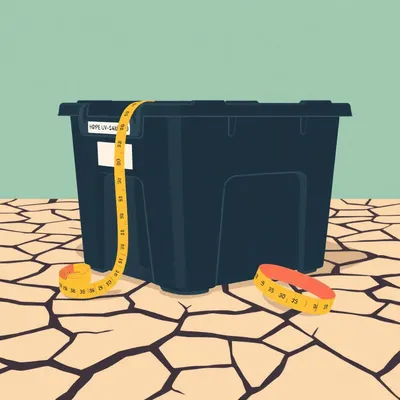
And rubbish chutes typically have openings of twelve to eighteen inches. That's not a lot of clearance. You're stuffing a bag through a narrow aperture, it drops anywhere from one to twenty-plus floors, and it hits the bottom of a communal bin or compactor. The bag needs to survive that impact without snagging on the way down. Most cheap bags can't do it.
I'm trying to picture the physics here. The bag is falling, what, maybe three meters per second by the time it hits bottom if it's a ten-floor drop? And it's not a clean fall — it's bouncing off the sides of the chute, which are probably not perfectly smooth. Every point of contact is a potential tear point.
And those chute walls accumulate residue over time. Years of garbage bags scraping past leave a film — oils, decomposed organic matter, whatever seeped out of torn bags before. That film creates friction. A thin bag snags on that rough, sticky surface and rips open. It's not just the impact at the bottom; the entire journey is hostile.
Let's unpack what's actually inside that bin — and what we could replace it with.
The core tension here is that plastic bin liners are a daily single-use plastic we rarely question. They're brittle in Israel's heat — and I've said before, UV degradation turns plastic into shrapnel, but even indoor heat cycling weakens the polymer chains over time. You buy a roll of bags, they sit in a cupboard through a Tel Aviv August, and by the time you use them they've lost tensile strength.
Which is why Daniel's only found one brand that works. The rest are essentially pre-failed. And that's the thing — his real problem isn't the concept of bags, it's that the local market is flooded with bags that can't do the job.
So let's define the problem properly. Plastic bin liners enable bag-and-toss disposal. You fill the bin, you tie the bag, you drop it down the chute. The bag is both container and transport mechanism. If we remove the bag, we need something else to perform both functions.
In Israel's single-stream waste system, everything goes into one bin. No recycling separation at the household level. All waste goes to landfill or incineration. There's no municipal composting infrastructure for food waste.
That's a critical detail. In a country with wet-dry separation, you could potentially run a linerless bin for dry waste and only use liners for food scraps. But when everything is mixed, your bin is getting wet, sticky, and organic every single day.
The obvious first question is: what are the alternatives? Let's look at the options, and why most of them fall short.
Option one: no liner at all. Just a bare bin, washed after each use.
Which sounds admirably zero-waste until you think about what's going into that bin. Coffee grounds, vegetable peels, chicken bones, whatever's left on a toddler's plate. In a single-stream system, that's all landing directly on the bin surface.
In an Israeli summer? You've got maybe twelve hours before that bin becomes a biohazard. The smell alone would be punishing. So you're washing it daily — at the kitchen sink, using hot water and detergent. If you're in a rental with a shared chute, you're not hosing it down outside. You're doing this where you wash your dishes.
Which is a classic rebound effect. You eliminate the plastic waste, but you create water waste, detergent waste, and a sanitation problem. And you're doing this every single day.
There's a case study worth mentioning here. I read about a Tel Aviv family that tried exactly this — stainless steel bin, no liner, washed daily. Their routine involved rinsing at the sink, using bleach weekly, and accepting significantly higher water use. They stuck with it, but they described it as a lifestyle commitment, not a convenience.
That's the word, isn't it? The chute is a convenience technology. It's designed around disposable bags. Remove the bag, and you're now carrying a dirty bin to the sink every day instead of tying a bag and dropping it down a hole.
What about lining the bin with newspaper? That's the old-school method — you wrap your wet waste in old newspaper, and the paper absorbs some of the moisture.
I've seen that suggested in zero-waste forums. The problem is that newspaper ink is soy-based now, which is better than the old petroleum-based inks, but it's still not something you want breaking down against a bin surface. And wet newspaper tears just as easily as a cheap plastic bag — maybe more easily. You're not solving the structural problem; you're just changing materials.
You're adding a step. Now you have to save newspapers, wrap your waste, and then still deal with a bin that's collecting whatever seeps through. It's a partial solution that creates its own friction.
Option two: reusable cloth or silicone liners. The idea is you empty the waste into the chute, then wash the liner and reuse it.
Let's talk cloth first. DIY cloth liners made from old bedsheets — this is a thing in zero-waste circles. You sew a bag to fit your bin, you use it, you empty it, you wash it.
Here's where the material science gets ugly. It absorbs moisture from food waste, it absorbs oils, it absorbs odors. After one use with wet waste, that cloth liner is saturated with whatever was in your bin. To sanitize it properly, you need hot water washing — at least sixty degrees Celsius — with detergent. Every single time.
You're doing that wash separately, presumably, because you don't want to throw a bin liner covered in chicken juice in with your regular laundry.
So now you're running dedicated wash cycles for your bin liners. The energy and water cost of hot-water washing, plus detergent, starts to look comparable to the environmental cost of a plastic bag — especially if you're reusing thicker bags multiple times, which we'll get to.
Let's be honest about the practical reality. You empty that cloth liner into the chute, and there's always residue. A bit of rice stuck to the fabric, a coffee ground that won't shake loose. So you're standing in the chute room, trying to manually pick bits of wet waste off a cloth bag before you carry it back upstairs. That's not a minor inconvenience — that's a genuinely unpleasant task that you're now doing every single day.
What about silicone?
Silicone liners are heavy and rigid. They don't drape — they hold their shape. That's fine for a bin that sits in your kitchen, but for a chute? You need to be able to scrunch the top of the bag, push it through a twelve-to-eighteen-inch opening, and have it fall freely without snagging. A silicone liner is going to fight you on every part of that.
Even if you manage to get it through, you're then carrying an empty silicone liner back upstairs — one that's been inside a communal bin, potentially touching other people's waste. You're going to want to wash that before you bring it back into your kitchen.
Which brings us to the chute-specific constraint that really matters. With a disposable bag, you tie it, drop it, and walk away. With any reusable liner, you empty the waste into the chute, but you keep the liner. That means you're standing at the chute room, shaking out a dirty bag, then carrying it back to your apartment to wash. You've just eliminated the core convenience the chute provides.
The chute is a one-way system. It's designed for things that go down and don't come back. A reusable liner reverses that flow, and suddenly the chute isn't saving you time anymore.
Option three: compostable bags. This is the one that sounds like the perfect solution on paper. Bags made from plant starches, like BioBag, that are certified compostable. You use them like regular plastic bags, but they break down in composting conditions.
Here's the catch Daniel already hinted at. Israel doesn't have municipal composting. The waste goes to landfill or incineration.
The conditions in a landfill are not the same as industrial composting. BioBag and similar products require industrial composting at fifty-five degrees Celsius for sixty days. That's a specific, controlled process. In a landfill, waste is compacted, oxygen is limited, and temperatures don't reach those levels consistently. The bag may not break down at all — or worse, it may break down anaerobically and release methane, which is about twenty-eight times more potent as a greenhouse gas than carbon dioxide.
A compostable bag in a landfill can actually be worse than a conventional plastic bag, from a climate perspective.
And that's the misconception that drives me up the wall. People see the word "compostable" and assume it means "will harmlessly disappear." It doesn't. It means "will break down under specific conditions that probably don't exist where you're sending it.
There's also the practical issue. Compostable bags tend to be weaker than conventional plastic. They start breaking down when exposed to moisture — which is the point, but it also means they can fail in your bin before you even get to the chute. If Daniel's already having trouble with brittle plastic bags tearing, a compostable bag is going to be worse, not better.
I've actually tested this. I had a roll of compostable bags that sat in a cupboard through one Israeli summer — not even in direct sun, just ambient heat. When I went to use them, the seams had started to separate. They hadn't even been used yet, and they were already failing. That's the moisture sensitivity at work — ambient humidity was enough to start the degradation process.
They're degrading before you use them, they're weaker than plastic during use, and they might not degrade where they end up. That's three strikes.
The Simplehuman system is worth mentioning here as a point of comparison. Simplehuman makes bins with custom-fit liners — they're designed to fit perfectly, no overhang, no slipping. But those liners are still single-use plastic. They're just better-fitting single-use plastic. The company doesn't offer a reusable option. They've optimized for convenience and aesthetics, not waste reduction.
Which tells you something about where the market is. If a premium brand like Simplehuman hasn't developed a reusable liner, it's not because they haven't thought about it. It's because the engineering problem is hard.
Even if we find a technical alternative, the real world throws up some messy second-order problems.
Let's talk about what happens when you ditch liners entirely in a single-stream system. Food waste goes directly into the bin. In Israel's climate, that food waste is rotting within hours. Without a liner, the bin itself becomes a contamination surface. You're now sanitizing a bin daily — and not just rinsing it, but actually cleaning it to a standard where you're comfortable with food waste touching it again tomorrow.
Here's the clinical angle. As a retired pediatrician, I think about this in terms of pathogen transfer. A bin that holds food waste is a bacterial breeding ground. If you're washing that bin in your kitchen sink, you need to then sanitize the sink. You've just moved the contamination from the bin to the sink, and now you're cleaning two surfaces instead of one.
That's a point I hadn't fully considered. It's not just the bin — it's everything the bin touches. The sink, the counter on the way to the sink, your hands, the tap handle you touched with contaminated hands. The contamination radius expands.
In a hospital setting, we call that cross-contamination, and we design entire protocols around preventing it. In a home kitchen, most people aren't thinking about it at all. They rinse the bin, maybe wipe it with a sponge — and now that sponge is contaminated. It's a cascade.
There's also the water math. A typical kitchen tap flows at about six to eight liters per minute. If you're spending two minutes washing a bin every day, that's twelve to sixteen liters of water daily — over four thousand liters a year. In a water-scarce country like Israel, that's not trivial.
That water has to be heated, which means energy. The rebound effect is real — you're trading plastic waste for water waste and energy waste. Which trade is better? It depends on your local context, but it's not obviously the water-intensive option.
This is where the framing shifts. Daniel's real problem isn't "how do I eliminate plastic bags." It's "how do I stop my bags from tearing in the chute." Those are different problems with different solutions.
And the most practical solution might be: use thicker, more durable plastic liners, and reuse them multiple times before disposal.
Which sounds counterintuitive if you're coming from a zero-waste mindset. But if you're using one thick bag three times instead of three thin bags once each, you've reduced your plastic consumption by two-thirds. And you haven't created new water or energy costs.
Industrial-grade bags are a different product category entirely. They're made from low-density polyethylene with greater wall thickness — typically two to three mils instead of the zero-point-seven to one mil you get in consumer bags. They're designed for construction waste, medical waste, that kind of thing. They don't tear easily, they don't degrade in heat the same way, and they can handle the chute drop.
The trade-off is cost. A heavy-duty bag might cost three or four times what a cheap bag costs. But if you're reusing it three times, the per-use cost is comparable — and you're not dealing with the frustration of bags tearing.
Sustainability has to be sustainable for the person doing it. If your alternative creates more work, more mess, and more stress, you're going to abandon it. That's not a moral failing — it's human nature. The most sustainable choice is the one you can actually sustain.
There's an analogy I keep coming back to here. It's like the difference between a cheap disposable razor and a safety razor. The cheap razor gives you a worse shave and you throw it away after three uses. The safety razor costs more upfront, the blades last longer, and you're producing a fraction of the waste. But you have to learn to use it properly, and you have to be willing to maintain it. Most people choose the disposable because it's easier, even though it's worse in every long-term measure.
That's a good parallel. And in both cases, the market pushes you toward the disposable option because it's more profitable for the manufacturer. They want you buying cheap bags every week, not one heavy-duty bag every month.
Let me bring in a comparison that I think is useful here. Japan has a concept called mottainai — it roughly translates to "don't waste." In Japanese households, bins tend to be smaller, waste is disposed of more frequently, and there's less reliance on liners. But Japan also has wet-dry separation, sophisticated incineration infrastructure, and a cultural practice around waste that's been built over generations.
That's the infrastructure point. Japan's system makes linerless bins more viable because food waste is separated and collected frequently. Israel's single-stream system does the opposite — it makes liners more necessary because everything is mixed and rotting together.
Infrastructure dictates possibility. You can't import Japan's waste habits without importing Japan's waste infrastructure. The individual choice exists inside a system that constrains it.
This is the broader insight I think Daniel's question opens up. We tend to frame waste reduction as a matter of individual virtue — if you care enough, you'll find a way to eliminate plastic. But the infrastructure you live with sets the boundaries of what's practical. In Israel's single-stream system, the most sustainable choice might be optimizing the consumable rather than eliminating it.
Where does that leave us? Let's get practical.
First, for chute users specifically: use thick, durable plastic liners. Glad ForceFlex Plus is the American benchmark, but in Israel you're looking for local industrial-grade equivalents — bags marketed for construction or heavy commercial use. The key spec is wall thickness. Look for at least two mils. These bags can be reused two or three times before disposal — empty them, wipe the interior if needed, and reuse.
Second, consider separating your waste strategy by type. Dry waste — paper, packaging, clean plastics — can go in a linerless bin that gets rinsed occasionally. Wet waste — food scraps, anything organic, diapers — needs a liner. In a single-stream system, you're still putting both in the same chute, but you're only using liners for the fraction that actually requires them.
That's a fifty-percent reduction right there, without any change in routine beyond having two small bins instead of one large one. And if you're reusing those liners two or three times for the wet waste, you're down to maybe twenty percent of your original plastic consumption.
Third, test any reusable solution against your chute opening. If the liner snags, or if it forces you to carry waste down the stairs instead of using the chute, the convenience loss is real. You've replaced a thirty-second task with a five-minute one. Over a year, that's about twenty-seven hours of additional waste management. That's not nothing.
The clinical reality check: if you're handling food waste without a liner, you need a sanitation protocol. Hot water, detergent, and a dedicated brush that you don't use for anything else. If you're not willing to do that every day — and most people aren't — then a reusable system for wet waste isn't for you.
I want to underline that point about the dedicated brush. Most people have one scrub brush or sponge that they use for everything. If that sponge touches your unlined food-waste bin and then touches a plate you eat off, you've created a direct contamination pathway. You need a separate tool — maybe color-coded — that lives near the bin and never touches anything else.
That's exactly the kind of protocol hospitals use. Color-coded cleaning tools for different areas. It sounds excessive for a home kitchen, but when you're dealing with unlined food waste, the microbial risk is real. I've seen kitchen sponges that cultured more bacterial colonies than some hospital surfaces I've tested.
That's horrifying.
And it's why I'm cautious about any system that increases the number of surfaces that come into contact with rotting organic matter. A plastic liner contains that. When you remove the liner, you've just expanded the contamination zone.
The broader takeaway here is that reducing plastic bag consumption by fifty to eighty percent through thicker, reused bags is better than attempting a hundred percent elimination, failing, and reverting to single-use. Perfect is the enemy of good.
That's the thing about sustainability discourse — it often frames anything short of total elimination as a failure. But the math doesn't support that. If a million households cut their bin liner use by two-thirds, that's a massive reduction in plastic waste. It's just not as satisfying as a "zero waste" sticker on your bin.
There's also the market reality Daniel's living in. He's found exactly one brand that works. That tells you something about what's available locally. The Israeli consumer bag market is optimized for price, not durability. Most people buy the cheapest bags, those bags tear, and they buy more. It's a cycle that benefits the manufacturer, not the user.
Which is why looking outside the consumer category — to industrial suppliers, to restaurant supply stores — might be the real hack here. Those bags aren't sold in supermarket aisles, but they exist, and they're designed for exactly the kind of abuse a chute delivers.
Let me pull on something you said earlier about the chute being a one-way system. That's not just a practical constraint — it's a design philosophy. The chute assumes disposability. It was invented in an era when "throw it away" was the solution, not the problem. And now we're trying to retrofit sustainability onto infrastructure that was never designed for it.
That's the tension at the heart of this whole question. Daniel's chute is a genuine quality-of-life improvement — he said it transformed their lives more than any other convenience. That's real. But it also locks him into certain waste habits. The chute doesn't work with reusable liners. It works with bags you can drop and forget.
The question becomes: do you optimize for the chute, or do you optimize for waste reduction? And the answer might be that you can do both — just not perfectly.
Thicker bags, reused. Dry waste separated out. Wet waste lined. That's not an elegant zero-waste solution. It's a pragmatic one. But it works with the infrastructure you actually have, not the infrastructure you wish you had.
One thing we haven't touched on: Israel's waste infrastructure is evolving. There are planned recycling reforms that would introduce wet-dry separation at the household level. If and when that happens, the calculus changes completely. A linerless bin for dry waste becomes much more viable when food waste has its own stream.
If food waste gets its own stream with regular collection, you might be able to use compostable bags that actually end up in a composting facility. That's the future where the zero-waste alternatives start making sense. We're just not there yet.
The open question is: as that infrastructure evolves, does the chute evolve with it? Does the building add a second chute for wet waste? Does the chute become obsolete? Or do we keep optimizing around it?
The rubbish chute is a marvel of convenience. It's also a piece of infrastructure that assumes a linear economy — make, use, dispose. Living with a chute means living with that assumption, even as we try to bend it toward something more circular.
The most sustainable choice is the one you can actually sustain. And for Daniel, in his rental with his chute and his single bin, that might mean thicker plastic, used twice. It's not poetry. But it works.
If our listeners have their own bin liner hacks — especially if you're dealing with a chute — we want to hear them. What's worked, what's failed spectacularly, what's the one brand in your country that actually survives the drop?
We'll share the best ones in a future episode. This has been My Weird Prompts. Thanks to our producer Hilbert Flumingtop for making this show happen. If you enjoyed this, leave us a review wherever you listen — it helps more people find the show.
And now: Hilbert's daily fun fact.
Hilbert: In the eighteen forties, British colonists in Mauritius imported a species of South American toad to control sugarcane beetles. The toads ignored the beetles, devoured everything else they could fit in their mouths, and became an ecological menace that persists to this day.
...right.