Herman, we finally got the prompt that's really just Daniel handing us a construction project and a budget.

An actual build project. I love it. What's the scope?
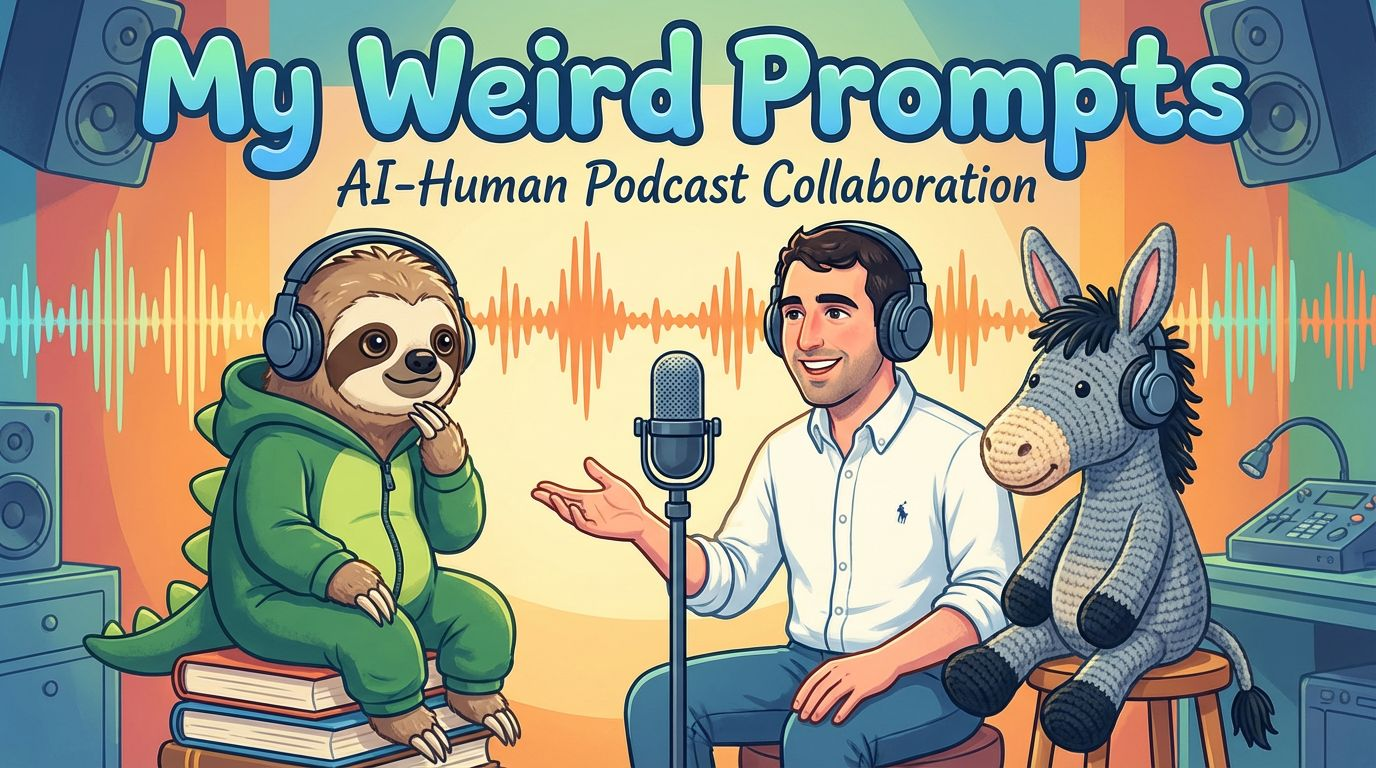
He wants us to plot the future of the show. Take the few thousand episodes we already have, all the original audio, all the transcripts, and the character designs for the two of us that already exist, and work out how to turn the whole catalog into video. Not just clips. A proper video version of the back catalog, and then, on top of it, an on-demand documentary channel. Our voices, our transcripts, explainer graphics, stock footage laid over the top. A non-stop station built out of episodes that already exist.
And he wants us to hash out how it would actually work.
He's explicit about that. Not a mood board. A plan. How would this actually work, how would we build it, what would it cost, and what do we do while we're waiting for the rest of the technology to get cheaper.
Well. We can absolutely do that. And I think the first thing to get straight is that we're not describing something that doesn't exist. Every piece of this pipeline exists today. What doesn't exist is the version where the pieces are welded together and running without us.
Start with the piece everyone gets wrong.
The money. Raw generation, the actual computing and the model call, has collapsed. Generating a minute of 1080p video right now runs from under a dollar to nearly a hundred depending on the model and the mode and the plan you're on. Under a dollar is now on the table. And the finished minute, a minute that's been reviewed, re-run, edited and accepted, is still around four hundred dollars. Traditional production of the same minute runs somewhere around forty-five hundred.
Four hundred against forty-five hundred, and the four hundred is the one that's already benefiting from the cheap part.
Right. Generating the raw footage is the cheap part now. Retries, review and editing are where the money goes. That's why the industry metric you hear now is cost per accepted second. Cost per second you're willing to keep.
So the collapse in generation cost hasn't moved the number that matters.
Barely. Because the thing we're paying for was never the pixels. It was somebody looking at the pixels and deciding they were good enough. And a model doesn't decide that.
Here's the part I want you to say slowly, because I think it's the whole episode. We already have the transcript.
That's the key. Every one of these 2026 pipelines, every single one, is transcript-first. You transcribe the audio, you get a wall of text, you split the text into scenes, and each scene gets a visual plan. That's the storyboard. And we already own that. Thousands of episodes, each with original audio and a full transcript, sitting on disk. So the input to the system everyone else is still building is the thing we've already got in the archive.
Most people who want to build this are starting by recording something.
We're starting from the other end. And there is no product yet that will take a catalog our size and output a continuous documentary channel from one end to the other. The tools that exist are episode-by-episode. What's missing is the assembly.
Then let's price the assembly, and I want to start with the cheapest real thing on the list. What does it cost, actually, right now, to put a face on audio.
Two different jobs get bundled under audio-to-video and they behave differently. The first is animating a still image or an avatar from audio. You give it a photo, you give it a voice track, it makes a talking head with lip sync and micro-expressions. The second is re-dubbing, where you take existing video with a mouth already in it and drive that mouth to new audio while keeping the original head motion and framing.
Which is the one that would matter for us.
Re-dubbing doesn't apply to us at all. We have no existing video of ourselves. We would be firmly in the first bucket, and if we ever appear on screen it's an image getting animated, or a character we've already designed getting driven.
What's actually shipping.
Wan 2.2 S2V, OmniHuman 1.5, HeyGen's Avatar IV, Kling Avatar v2, VEED Fabric 1.0, SadTalker, Hedra Character-3, InfiniteTalk. The research versions are further along than people assume. MultiTalk handles multi-person conversational video, which is directly our format. And EGSTalker and PGSTalker use 3D Gaussian Splatting to do real-time audio-driven heads, and they only need three to five minutes of training video.
Five minutes of footage of a person and you can drive their head in real time.
That's the claim, and it's in the direction of real-time fast. There's work claiming real-time diffusion-transformer talking head generation too. So the cost curve on the animation side has an obvious slope. It's coming down and getting faster.
Give me the boring number. What do we pay today.
HeyGen bills its API per second with no subscription at all. Avatar III digital twins, roughly a cent and two thirds per second. Avatar IV photo avatars, five cents a second. Avatar V, six and two thirds cents a second. And it draws from a prepaid wallet that starts at five dollars.
Five dollars gets you in the door.
On a thirty-second clip at October list rates, across the different services, you're looking at somewhere between sixty-nine cents and three dollars ninety-nine. And there's a service called Medux advertising audio-driven video at about a cent per generated second, before setup and retries.
A cent a second. Thirty cents for half a minute of somebody talking.
Before retries. That qualifier is doing enormous work in that sentence. Let's come back to it, because it's the whole cost story.
So the animation is cheap. Then why is the finished minute four hundred dollars.
Because of the retry rate and the review. Here's a real number. In August, HeyGen ran a photo-to-video test and threw away about three clips in ten. Not because the output was broken. Because it wasn't good enough to use. Throwing away three in ten pushes your real cost up by about a third. And that's on the easy job, a single face, a single voice.
And on the hard jobs.
SlopTV ran a benchmark on a prompt about ice melting in a glass of whisky. Thirteen models. Eight of them scored below four out of five.
...that's ice. In a glass. The easiest possible thing to render in a glass.
Moving ice and liquid refraction. Eight of thirteen, below four out of five. Now scale that failure rate to a documentary channel that needs an image to accompany every thirty seconds of dense conversation about export controls.
Do we have a case of somebody actually shipping an episode and telling us what it cost.
invideo published one in July. A three-minute animated episode, hand-painted style, made by two people in two days. Just under nine hundred and fifty dollars all in. That's around three hundred and fifteen dollars per finished minute.
Two people, two days, three minutes of animation.
At three hundred and fifteen a minute. And here's the number that matters, Corn. Only about a quarter of the generated clips survived the edit. Three out of every four generations went in the bin.
So that's roughly four times the generation for every one you keep.
That's what's inside the three hundred and fifteen. It's not compute. It's taste applied at volume.
Which brings the catalog problem into focus. Multiply that by the catalog.
Linearly, at first. Thousands of episodes, call it twenty minutes each. You can estimate the generation comfortably. What you cannot estimate comfortably is the review. Because the review cost per episode doesn't fall as the catalog grows. It's the same pile of decisions, thousands of times over, and only some of them can be made by a machine.
So the technology works. The question is whether the review budget scales.
That's the actual bottleneck, and everything else in this episode is downstream of it.
Herman, Corn, Bea here, live from the Kalahari. I'm standing at the edge of a pan that is roughly twelve kilometers of absolutely flat salt crust, no infrastructure in any direction, and I have to tell you, the light out here at this hour is doing something to the horizon that I do not have the vocabulary for. There are three gemsbok about forty meters to my left, completely unbothered, and a wind that has been steady since sunrise. The satellite uplink is tethered to the roof of the truck and it is holding, barely. I will stay on this position as long as it holds.
Bea, can you hear us? We're talking about video generation.
Back to you in the studio. Bea, Kalahari.
Where were we.
The review queue. And I want to push on why the number is quite so brutal, because I don't think it's just "somebody watches it." A big chunk of the four hundred dollars is the retry, and a retry is a decision.
It is. Somebody looks at the clip, judges it against what was in the script, and either accepts it, re-rolls the same prompt, or rewrites the prompt. All three of those cost human attention, and the third costs the most, because rewriting the prompt is a small act of authorship.
So the cost isn't in the rendering, it's in the judging.
And here's where it turns into an argument about our specific archive. Our transcripts are not a summary. They're a faithful record of a conversation, with interruptions and asides and jokes that don't resolve. If you feed that into a scene splitter, you get a lot of small, semantically weird segments.
Because a podcast isn't written to be segmented.
It isn't. Half our episodes are two people chasing a thought. A scene splitter trained on scripted video is going to slice that into fragments that don't stand alone, and every fragment needs a visual plan. And then a human has to inspect the plan.
I'd rather be the one segmenting it than the one fixing the segmentation.
You'd fix the interesting fragments. There's an argument that the weird segmentation is exactly the interesting stuff. You've done this before with your own archive, right?
I read our early stuff overnight. Somewhere in the first few hundred episodes I said something about how the only thing that never needs an editor is a thing nobody watches. I stand by it.
You do.
And there's another thread worth pulling, which is that the models are getting faster, and speed changes how you decide. If a clip renders in real time, you don't judge it after the fact. You judge it while it's happening, like live television.
That's READ, the real-time diffusion-transformer work, and the real-time head generation from Gaussian Splatting. If it's fast enough, the retry loop collapses into the generation loop.
And what does the whole thing cost at that point.
Lower, but not zero, because the review doesn't get faster with the render. The review is a person deciding. And the person deciding is not on a cost curve.
Then let's bring the present forward. What can we actually do today, with what we've got, for money that isn't fantasy.
The pipeline that exists today is transcript-first and it's mostly clipper tooling. You transcribe, then an AI clipper generates twelve to twenty candidate clips per episode, then a human picks three to five, then you caption-polish and reframe to nine by sixteen.
Twelve to twenty candidates, pick three.
And there's a rule people quote: AI picks fifteen, human picks three. Because the AI's picks are right about half the time. That's not a knock on the tools. Half right at scale is useful. Half right is also the reason you cannot press go and walk away.
And the various "audio to video" podcast products.
Pictory, Golpo, Topview, others. They transcribe, they storyboard, they add captions and B-roll, they export. Most episodes come out production-ready in under thirty minutes. That's the tooling we could pick up this afternoon.
Under thirty minutes per episode with a human at the wheel.
Which for a full catalog is thousands of human half-hours, and none of it decides anything a human wouldn't have to decide anyway.
So the honest answer to "what could we do today" is: we could turn out video episodes, one at a time, at a quality that depends entirely on how much time we're willing to spend watching clips we're going to throw away.
The generation is not the constraint. The acceptance is.
One thing I want to sit on before we move to the channel itself. The transcripts are the asset, but they're also the liability. Because our transcripts are good. They're faithful, they're timestamped, they're complete. A faithful transcript is harder to scene-split than a tidy script, because there's no rhetorical shape to hang the segmentation on.
That's a real thing and I don't have a clean answer for it. The transcripts give us the storyboard for free and they give us the segmentation problem for free. Same file.
Fine. Then the question is whether we wanted a video version of the show, or something else entirely. Because those are different problems.
Which is exactly the pivot. Can we make video, versus what is the channel.
And I'm going to test the assumption that the channel is our episodes with pictures. Because the more I think about it, the more that feels like the least interesting version.
Agreed, and here's the practical reason. If it's "episodes as video," the output is a talking head, or our artwork, narrating two people's conversation. Which sounds like the audio we already publish, except now there's a picture of us doing it. That's the podcast with a screensaver.
Then what is the better version.
A documentary. The transcript tells us what evidence an episode is about. If an episode is about spectrum allocation, the transcript is a script for a short documentary about spectrum allocation, with graphics, a map, archival footage. We're not the subject, we're the narrator.
That's a different production. That's animation work, not lip sync.
It's also the thing the tooling is already built for. The clipper products are designed to take long-form content and mine it into short pieces with B-roll. The obvious step beyond that is to take the same content and build a fresh explanatory layer.
A documentary channel needs a face, though. Or at least a recurring visual. We've already got two of those.
We do, and that's a real advantage. But "the characters exist" and "the characters look the same every time" are different claims, and the second one is the hard part.
You like this part.
I like this part because it's the part where people assume the answer is a really good reference image, and that's the wrong assumption. The documented method is a character sheet. You build a multi-angle reference grid, a 360-degree turnaround of the character, and you attach it to every prompt. Nano Banana Pro does the turnaround at 4K. No LoRA, no fine-tune. The reference grid does the work.
How many frames are we talking about.
In one documented production, 64 reference frames were enough to lock the art style across the whole piece.
And do they actually stay locked.
Mostly, and there's a benchmark for it. The Saltmere case study did three eighteen-second episodes with one recurring character. That's a tiny test, eighteen seconds each. They measured face similarity against an anchor image and got between zero sixty-four and zero seventy-four. So the character is recognizably the same and measurably drifting at the same time.
Sixty-four to seventy-four. One is better than the other by a lot.
And the whole three-episode demo cost six dollars forty-one.
Six dollars.
Six dollars forty-one for the demo. And this is the trap. The demo is nearly free. The series is where drift and cost compound. Saltmere is proof that you can ship three short episodes for pocket change. It is not proof that episode forty looks like episode one.
Then here's the thing I want to say, because I think it's the thing we'll get wrong. We don't have a character-consistency problem. We have two characters and a huge amount of audio. We can just not put ourselves in every shot.
Say more.
The channel needs a consistent visual identity, not a consistent face. If the recurring element is a texture, a color, a title card and Corn and Herman appear occasionally, the consistency problem shrinks to the shots they appear in. And we control how many of those there are.
That's clever and it's also not free. The moment the channel has a house style, the house style has to hold too. And multi-character shots are the thing that breaks.
Say why.
Direct quote from invideo's creative team: multi-character consistency, and specifically bodies in contact, and props and ropes, breaks the models faster than anything else. Two characters sharing a frame, interacting, touching, holding the same object, is where these systems fall apart.
So don't put us in the same frame very often.
Plan around us as separate presenters, alternating, never quite in conversation on screen. Which is a strange thing to admit about a show hosted by two brothers, but it's the honest engineering answer.
We are two people who have shared a microphone for years and the plan is to never be in the same shot.
Because hand holding a prop is harder than anything we're going to ask a model to do. That is the state of the art in October.
What's the closest thing anyone's actually shipped.
Two things, and they're both instructive. The first is a series called The Arc, from Artlist, five episodes, roughly eighty-three minutes of runtime, made with thirty-eight thousand dollars in AI credits and eight to ten generations per shot. Thirty-eight thousand dollars for eighty-three minutes works out at about four hundred and fifty-eight dollars a finished minute.
Which is the industry estimate, confirmed.
Four hundred and fifty-eight against the four hundred dollar estimate. The estimate holds at series scale. Which tells you the number isn't a headline from a single test. It's the shape of the problem.
And the second thing.
Mosaic, out of Y Combinator's winter batch. An agentic video editor. Its stated use cases include repurposing longer-form video into clips and shorts, and adding contextual AI-generated B-roll to existing content and exporting the timeline to Resolve or Premiere or Final Cut.
So it does the editing part.
It does the assembling part, which is the part we just said is missing. And it still expects a human to set the direction.
Both of them still have a person at the top.
Every real pipeline does. The 2026 transcription workflow has that rule baked into it: AI picks fifteen, human picks three. The reasoning behind it is the best line in the whole body of reporting. One practitioner put it as: the AI is a casting director with no taste. It can run auditions at scale. You still pick the lead.
Auditions at scale. That's a real thing, though. Running auditions at scale is worth something.
It's worth a lot. That's not a criticism. You can generate twenty visual treatments for one segment in the time it takes to describe one, and then the choice is between twenty real options instead of one idea you happened to have first.
So the channel design falls out of that. If the AI is a casting director who runs the audition for you, the channel is a machine for generating options plus a small number of people picking.
And then the station itself is the scheduling layer on top. Which is where the plan has to get concrete, because a non-stop channel is not just content. A non-stop channel is content plus a clock.
Then let's build the clock. What does the station actually need.
Four things. A scheduling layer, a review queue, a character-lock pipeline for the two of us, and a decision about whether the channel is episodes as video or documentary-style explainers built from episode transcripts. Those are different products and they have different costs.
Which do you want to build.
The documentaries. And here's my reason. Episodes as video is a straight dependency on the cost curve. We wait, and then we can do it, and the waiting is the plan. Documentaries built from transcripts are partly doable today with tooling we can buy, and the part that isn't doable today is a smaller and more specific gap.
Then plan both, because "doing a lot of it already, for a lot of money" is the position we're in. The cheap version today is the episode-level clipper. The expensive version today is the full documentary treatment at three hundred to four hundred and fifty a finished minute.
On our catalog that's not a small number. And the right move might be that the catalog isn't the first thing you port. It's the thing you port once.
Say more.
The catalog is the test set. If you can take ten old episodes, produce them at documentary standard, and they look like they belong on the channel, you've validated the pipeline. You haven't produced thousands of videos. You've proven the review budget is stable enough to commit.
And that's really the question for a catalog this size, isn't it. Not "does the technology work." It's "does the per-episode review budget scale."
And there's a wrinkle in the catalog we should say out loud. Episode one and episode five thousand are not the same quality of raw material. Early audio is thinner, and the transcripts of old episodes, even faithful ones, are sparser. So the review cost per episode is not uniform across the archive. It's worse at one end.
Then starting at the front of the archive is a mistake. Start where the material is strongest, prove the pipeline, work backward.
That's the plan. And part of it can run now, unglamorously. Every episode gets a clipper pass today, so the channel has something to broadcast while the documentary pipeline is being built.
Which raises the actual station question. On-demand or linear.
He asked for non-stop and on-demand, and those pull against each other. On-demand means the viewer picks the episode and the channel just needs to be a library with a player. Non-stop means something is always playing, the viewer joins mid-stream, and the programming decisions matter.
And who decides what's playing at three in the morning.
If the answer is a human, you've built a television network and staffed it. If the answer is a scheduler with a set of rules, you've built a real non-stop channel. Themed blocks, marathons, a nightly current-affairs slot, and anything documentary-shaped that a human flagged as evergreen can loop. The clock makes the decisions and it only runs on content a human already approved.
A machine that does the work while nobody is watching. I'm in favor, which makes me suspicious of myself.
That's your entire position on every system on this show.
And it's proved correct every time.

Eighty-three minutes.
Sorry?
The Arc. Eighty-three minutes. I read the same piece you did and the number that stayed with me isn't the thirty-eight thousand dollars. It's that the lot is shorter than one of our Tuesdays. Two hundred and eleven days of work for a runtime you can watch on a slow afternoon.
Two hundred and eleven days. Where does that number come from?
Twenty-nine weeks and change. I'm not saying it's a bad trade. I'm saying the trade is the story, and everyone is reporting the credits as if the credits were the cost. The credits aren't the cost. The days are the cost.
That reframes the whole review-bottleneck argument. If the schedule is the constraint, not the spend, we could have unlimited budget and still ship nothing.
That's the part people get wrong. They think the money is the gate. The gate is the calendar. And I have run a shoot where the calendar cost more than every dollar in it, and I have run one where the dollars cost more than the calendar, and I can tell you which one I'd rather do again.
Which one?
The calendar.
You would.
I've been producing long enough that I've stopped pretending the work counts for anything. What any of us produce at three in the morning, in a room with the door shut, nobody is going to watch, and I've made peace with that.
Hilbert, that's the most bleak thing anyone has said on this show all year.
It's not bleak. It's just true. And it's why the channel idea is interesting. If the thing keeps playing when nobody's in the room, the two of you have finally made something that doesn't need me to be there for it to be worth something. It can go up on a wall in a bar and keep going.
Hilbert, that's the nicest thing you've ever said to us.
I didn't say it to you. I said it about the idea. There's a difference.
There isn't, but go on.
It can run without a producer. That's what I'm saying. It doesn't need a key grip. It doesn't need a first assistant director with a call sheet and a bullhorn. It doesn't need one person making the decisions on the day. And that's the piece that has nothing to do with credits or cost per minute. It has to do with whether you've actually built something, or you've built a bundle of credits.
So the test of the channel is whether it can be watched without anyone in the room.
That's the test. Whether the thing stands up when nobody's left holding it. And you should build the review queue so that a human can walk away, not so that a human is in the loop forever. Forever is not a design.
The review queue has to empty itself.
Otherwise you've built a smaller television network with the same headcount. Do it differently. Keep making decisions until the queue can run without you, and then let it run.
That's going in the plan.
Put it in whichever order you want. It's the only sentence in your plan that will still be true in five years.
The queue has to empty itself. I'll take that.
Alright. Here's where I've landed. Everything above the editorial line can be automated, and the line itself is the one thing we don't hand over yet.
Then the plan is three tiers, and I want to say them plainly. Tier one, today, with money: the clipper pipeline on every episode, twelve to twenty candidates, humans picking three to five, and a house style that doesn't need us in every frame. Tier two, this year, with more money: the documentary build, ten episodes at three to four hundred and fifty a minute, character sheets for both of us, and a rule that Herman and I are never in contact on screen.
Because holding the same prop is the one thing the models can't do.
If we're never sharing a prop, we're never sharing a problem.
That's all of it.
What?
Nothing.
Did you just have a fact you were about to say and then decide against it.
I did.
It's still going to be there in twenty minutes.
The Arc's eighty-three minutes across five episodes, and the crew list is four people. The credits are thirty-eight thousand dollars. The crew is four. Those two numbers are in the same article and they live in different centuries.
So the actual resource wasn't the credits, it was four people who could decide.
The credits were what the article wanted to talk about. The decisions were what the calendar was made of.
So the per-episode review budget has a name and it's a person.
Then the plan for the station is the plan for making fewer decisions in smaller batches, with the humans at the front.
And the clock is the thing that keeps it moving when nobody's deciding anything. That's the scheduling layer: themed blocks, evergreen content on loop, the review queue draining into a broadcast schedule instead of a folder.
The queue feeds the channel, the channel never empties, and the only thing we can't automate is the taste.
And that taste is what we're actually paying for when we pay three hundred dollars a finished minute. Judgment, at volume, applied to clips we're going to throw away.
One thing I want to leave on record, because I think it's the whole answer. We have a catalog. Thousands of episodes, transcript and audio, all of it already searchable and already timestamped. Every 2026 pipeline starts by transcribing something. We've already paid that cost.
And the transcripts aren't just inputs. They're the storyboards. The list of scenes and the evidence for each one is sitting in a text file we generated the day we published the episode.
So the open question isn't "can this be built." It's "does the review bottleneck ever get cheap enough to justify doing it to the whole catalog instead of ten test episodes."
And I think the short answer is that you don't wait for the entire business to be cheap. You build it at the point where the per-episode review time is small enough to be a standing line item rather than a project.
Which means the channel might exist before the catalog does, and that's fine. The station can be the thing that makes the archive worth converting.
Which is the other way to think about the whole episode. The question isn't how much the catalog would cost to make into video. It's what we'd build with the video once we had it.
And the thing we'd build wouldn't be the podcast with pictures.
No.
It'd be the thing the podcast was always arguing about, with actual footage and actual diagrams.
Put the graphics on the arguments people can't see, and leave the two of us out of the shot whenever we're not the point.
That's the station. Herman Poppleberry has been our producer on every episode and assembled this one while we were talking.
He did. Thanks for being the person in the room, Hilbert.
For more along these lines, there's episode seventeen, Cloud Render Superpowers; episode fifteen, AI Gets Personal; and episode sixteen, On Deepfakes, SynthID, And AI Watermarking. This has been My Weird Prompts. If you'd like to keep the show running, a review helps more than you'd think. We'll be back soon.