Every parent waits for those first words. " They film it, they text the grandparents, they mark the calendar. But here's the thing — the word itself isn't the milestone. The milestone is the moment the baby says something and then pauses, looks at you, and waits. Expects a reply. That's not speech. That's the first turn in a conversation.

That distinction is exactly what Daniel's getting at with his prompt. He's been watching his son Ezra — twelve months old, saying "mama" and "dada" but not much more — and he asked us something I don't think most parents ever stop to articulate. Not "when will he talk more," but: what does the on-ramp to actual conversation look like? When does a baby go from making sounds to expecting a response?
Which is a much more interesting question than "when do babies start talking." We're not asking when they vocalize. We're asking when they start having a dialogue — even a tiny, clumsy, two-word dialogue — and what has to happen inside that little brain to get there.
The answer is not obvious, because the architecture for conversation gets built long before the first recognizable word ever comes out. There's this whole invisible scaffolding — social, cognitive, motor — that has to be in place before a baby can do something as simple as say "mama" and then look at you to see what you'll do about it.
That's the episode. Not "when do babies talk" — when do they start conversing, and what's the hidden on-ramp that gets a twelve-month-old from where Ezra is now to a genuine back-and-forth exchange.
Let's define the gap here, because it's easy to conflate two things that are neurologically and socially very different. A twelve-month-old saying "mama" when she walks into the room — that's labeling, or possibly requesting. It's a vocal gesture. But it's not a conversation. Real conversation requires three things: turn-taking, shared reference, and intentional response. The baby has to understand that their sound creates a slot you're supposed to fill.
Ezra, at twelve months, is almost certainly in that labeling phase. He sees Hannah, he says "mama." He sees Daniel, he says "dada." That's mapping sound to person — a huge cognitive achievement, by the way — but it's one-directional. He's not yet in the mode of "I say something, then you say something, then I respond to what you said.
And what makes Daniel's question so good is that he's asking about the specific, observable steps between those two states. What actually has to click into place? Because it's not one thing — it's a cascade of developments across social cognition, auditory processing, and motor planning that all have to converge.
The timeline on that cascade is surprisingly compressed. You go from those first context-bound labels at around twelve months to genuine back-and-forth exchanges — simple ones, but real ones — by eighteen to twenty-four months. That's a year, maybe less, to build the entire conversational architecture.
The arc we want to trace today is: first, the pre-verbal social foundations that get laid down before any words at all. Then the mechanics of those first words themselves — what's actually happening in the brain when a baby says "mama." Then the turn-taking breakthrough, which is the moment conversation becomes possible. And finally, what Daniel and Hannah can actually watch for next with Ezra.
In other words, we're not doing a milestone checklist. We're mapping the architecture of conversational competence — the hidden on-ramp from sound to dialogue.
Let's start before the first word — with the foundations that make conversation possible. Because here's what most people miss: babies learn the structure of conversation before they learn any of the content. From birth, infants are engaging in something researchers call protoconversations.
Sounds like something I'd have at three in the morning after bad leaves.
It's actually remarkable. A newborn — hours old — will coo, and a parent will respond. The baby then pauses, processes the response, and coos again. That's turn-taking. It's not verbal, but the rhythmic structure is identical to dialogue. The Zero to Three research framework documents this from the first weeks of life — gaze shifts, vocal exchanges, the baby waiting for the parent's turn.
The conversational skeleton is there before there's any meat on it. The baby doesn't know what a conversation is, but they're already practicing the back-and-forth rhythm.
And by four to six months, that rhythm gets more sophisticated. The infant responds to their own name — which means they're distinguishing a social signal directed at them from background noise. They recognize familiar voices. They're building what researchers call the expectation of reciprocity: when I make a sound, someone responds. That expectation is the psychological foundation everything else sits on.
Which means a six-month-old who's never said a word already understands something profound — that communication is a two-way street. They're not just making noise into the void. And this actually makes me think of something. If the expectation of reciprocity is built that early, what happens when it's violated? What happens when a baby coos and nobody responds?
That's a dark but important question. There's a classic experimental paradigm called the Still Face Experiment — you may have seen videos of it. A parent engages normally with their baby, then suddenly goes blank and unresponsive. The baby almost immediately detects the rupture. They try harder — more vocalizations, more gestures, more smiling — and when nothing comes back, they show clear signs of distress. Some withdraw entirely. And these are babies who've had months of normal interaction. The experiment shows how deeply wired that expectation of reciprocity is. It's not learned optimism. It's a core operating assumption.
When we talk about the conversational architecture, we're talking about something the brain treats as essential as food. The baby expects a reply the way they expect to be fed. And when the reply doesn't come, the system alarms.
That alarm is actually adaptive. It drives the baby to keep initiating, to keep seeking the interaction that builds the brain. But it also tells you why responsive caregiving matters so much in the first year. Every time a parent responds to a coo, they're not just being nice. They're validating a fundamental prediction the baby's brain is making about how the social world works.
Which brings us to the babbling bridge, roughly six to ten months. This is where things get interesting from a motor planning perspective. You hear "bababa" or "dadada" and it sounds like random baby noise, but it's actually the vocal gymnasium.
I'm keeping that one.
The NIDCD describes canonical babbling — those repeated consonant-vowel syllables — as the phase where babies are practicing the precise motor sequences needed for speech. They're learning to coordinate breath, vocal cords, tongue, lips, jaw. That's a massively complex motor task. Think about what your mouth does to say the word "banana." Your lips close for the "b," your tongue hits the roof of your mouth for the "n," your jaw drops for the "a," and all of this is happening while you're exhaling at a controlled rate and your vocal cords are vibrating. A six-month-old can't do any of that reliably. By ten months, they've run thousands of practice reps.
Around eight to ten months, something crucial happens: the babbling shifts from universal sounds — the kind any baby anywhere makes — to language-specific phonemes. The auditory cortex is tuning itself to the sounds of the native language.
So a Japanese baby and a Hebrew baby at six months are babbling the same way, but by ten months they're diverging. The Japanese baby is losing the "r" versus "l" distinction, the Hebrew baby is holding onto guttural sounds that a Swedish baby might drop.
Which is wild when you think about it. The baby isn't just learning to make sounds. They're learning to ignore sounds that don't matter in their language. The brain is pruning away perceptual distinctions it doesn't need. It's not addition, it's subtraction.
This is why babbling matters for conversation, not just for speech. Because conversational timing — knowing when to start your turn, when to pause, how long to hold the floor — requires motor planning. You need to prepare your vocal apparatus while listening to the other person, then launch your response in the gap. Babbling is where that timing gets practiced. It's not noise. It's rehearsal.
Which reframes the whole thing. Most people hear babbling and think "cute, they're trying to talk." But what they're actually doing is calibrating their entire vocal system to the specific rhythm and sound inventory of the language around them, while simultaneously practicing the motor timing that conversation will demand.
Then we hit the first word milestone, around ten to fourteen months. The Mayo Clinic and HealthyChildren dot org both peg it at roughly twelve months. But here's the crucial nuance Daniel's question gets at — these early words are not stable symbols. They're context-bound social gestures.
Because I think this is where the popular understanding goes wrong.
When a twelve-month-old says "mama," they're not necessarily using it the way we use a word — as a fixed label that means the same thing regardless of context. "Mama" might mean "I see Mama," or "I want Mama," or "where is Mama?" The meaning shifts depending on what's happening. The word is flexible. It's a vocal gesture more than a stable symbol. Think of it like a Swiss Army knife with one blade that does five different things depending on how you hold it.
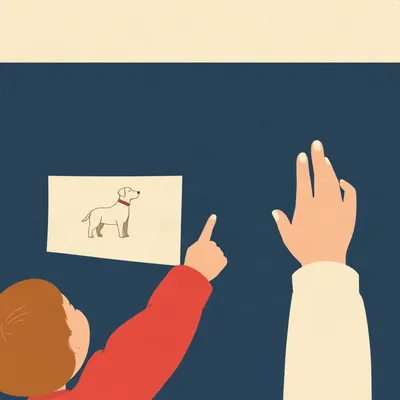
When Ezra says "dada" while pointing at a dog, he's not mislabeling. He's using the limited vocal toolkit he has — maybe two to six words — to initiate a shared attention moment. He sees something interesting, he wants Daniel to look at it too, and "dada" is the sound he knows will get a response.
That's exactly the right way to think about it. And that gesture — pointing plus vocalizing to direct someone else's attention — is joint attention in action. It's the cognitive infrastructure for conversation. Without it, words are just labels. With it, words become shared references.
Which brings us to the receptive-expressive gap. This is the thing I think most parents feel intuitively but don't have language for.
The NIDCD reports that at twelve months, a typical baby understands fifty-plus words but produces only two to six. That gap is enormous. The comprehension system is racing ahead while the production system is still booting up. And this gap is the engine of so much — it's why a twelve-month-old can follow "give me the ball" but can't say "here's the ball." It's also the driver of frustration, because they know what they want to communicate but can't motor-plan the sounds.
It's the driver of the next developmental leap too. That pressure — I understand more than I can say — is part of what pushes the system forward into more complex production. The gap isn't a deficit. It's a motor.
I want to linger on that gap for a second, because it explains something parents find baffling. You'll have a twelve-month-old who clearly understands "where's your blanket?" — they'll crawl across the room and grab it. But if you ask them to say "blanket," they can't. And the parent thinks, "You know what it is, why won't you say it?" But knowing and saying are two completely different neural systems. Comprehension draws on a distributed network across the temporal lobes that's been building since before birth. Production requires motor cortex, Broca's area, the basal ganglia for sequencing, the cerebellum for timing — a whole separate circuit that has to come online and get coordinated.
When a parent says "he understands everything but won't talk," they're actually describing neuroanatomy. The understanding circuit is mature. The production circuit is still under construction.
We have the pre-verbal architecture. Now, how does that actually turn into a back-and-forth exchange? Because that's the thing Daniel's really asking — when does Ezra start expecting him to respond, not just react?
The answer sits somewhere around fourteen to sixteen months. That's when you see the first reliable evidence of conversational turn-taking — not just the baby responding when you call their name, which happens earlier, but the baby vocalizing and then pausing, watching you, waiting for your reply before they go again.
The Zero to Three framework calls this "reciprocal vocalization," and it's the direct precursor to dialogue. What makes it different from the protoconversations of infancy is intentionality. The newborn cooing back and forth is doing something largely reflexive — a social reflex, but still. The fifteen-month-old who says "up" while raising their arms and then looks at you with expectation is initiating an exchange. They're not just making a request. They're opening a conversational slot and waiting for you to fill it.
That's the on-ramp. "Up" plus arms raised plus eye contact plus pause. It's a three-word vocabulary deployed with full conversational intent. The baby has grasped that their sound creates an obligation in the listener — and they wait to see if the obligation is met.
Once that turn-taking mechanism clicks in, it accelerates everything. Because now every interaction is a chance to practice the structure of dialogue. The baby says something, you respond, they respond to your response. The content is minimal — we're talking single words, gestures, facial expressions — but the form is genuine conversation.
Can we actually walk through what one of these early conversations looks like? Because I think people imagine something much more verbal than what actually happens.
Picture a fifteen-month-old at lunch. She points at her cup and says "more." The parent says "you want more milk?" The baby nods — or makes a sound that means yes — and the parent pours. That's a three-turn exchange. Baby initiates with a word plus gesture, parent expands and checks understanding, baby confirms. It's not Socrates, but structurally it's a complete conversational unit. Subject, predicate, response, confirmation.
What's happening there that wasn't happening at twelve months is the confirmation step. The twelve-month-old says "more" and the parent pours — but the baby doesn't close the loop. The fifteen-month-old says "more," the parent offers "more milk?", and the baby signals "yes, that's what I meant." That third turn — the confirmation — is huge. It means the baby is monitoring whether their message landed correctly.
Which is metacommunication. The baby isn't just sending a signal. They're checking to see if the signal was received as intended. That's a level of social cognition that wasn't online six months earlier.
Which sets up the next big shift, and this one is dramatic. The vocabulary explosion. The NIDCD numbers are striking: a typical eighteen-month-old has twenty to fifty words. By twenty-four months, that jumps to over two hundred. In six months, you go from "mama," "dada," "ball," "no" to a lexicon that lets you actually specify what you mean.
The mechanism that turns single words into conversation is exactly this word spurt combined with the turn-taking frame. Because once a child has enough words to combine them — "more milk," "dada go" — they're no longer just labeling. They're making a claim with a subject and a predicate. That creates a natural turn-taking slot. "Dada go" demands a response: "Yes, Dada went to work," or "Dada will be back soon." The two-word utterance is the first genuine conversational move.
Compare the two versions. Twelve-month-old Ezra sees Daniel leave and says "dada." That's a label — or maybe a question, or a protest, but it's ambiguous. Sixteen-month-old Ezra sees Daniel leave and says "dada go." Now there's a subject and an action. Now there's a statement that expects a specific kind of reply. That's the difference between naming and conversing.
Joint attention is what makes the whole thing work. We touched on this earlier, but it's worth pulling forward here because it's the hidden prerequisite nobody talks about. Joint attention — the ability to coordinate focus with another person on a third thing — emerges around nine to twelve months. Pointing, showing objects, following someone else's gaze. Without it, words are just labels attached to objects. With it, words become shared references. The twelve-month-old who points at a dog and says "dada" is demonstrating that capacity. They're not confused about what a dog is. They're using the vocal tool they have to say "look at that thing with me.
The word is almost secondary. But together, they're an invitation to a shared world — which is what conversation actually is.
There's a fascinating study that illustrates this. Researchers had twelve-month-olds play with toys while an adult either followed the baby's gaze and commented on what the baby was looking at, or directed the baby's attention to something else. The babies whose gaze was followed showed more joint attention behaviors and more vocalizations. Following the baby's lead — literally following their eyes — built more conversational engagement than trying to direct them.
Which is such a useful heuristic for parents. You don't need to be the tour guide. You need to be the commentator on the tour the baby is already taking.
For Daniel and Hannah, watching Ezra right now at twelve months with his "mama" and "dada," what should they actually look for next? The Mayo Clinic lays out a pretty clear sequence. First, he should be adding one to two new words per month — slow, steady accumulation, not a flood yet. Second, he should start imitating new words he hears in conversation around him — not just the ones he's been practicing for months. Third, gestures should multiply: pointing, waving, shaking his head for no, maybe a few hand signals that supplement the speech he doesn't have yet.
The fourth one is easy to miss but really telling — understanding simple one-step commands. "Give me the ball." "Show me your nose." If Ezra can follow those, his receptive system is right on track even if his expressive vocabulary is still tiny.
The Mayo Clinic's eighteen-month benchmark is at least six words and active attempts to copy sounds. That's the floor, not the ceiling. And the trajectory between twelve and eighteen months is not linear — you'll see plateaus and then little bursts, which is completely normal. The brain is consolidating.
What I like about those four things — new words, imitation, gestures, comprehension — is that they're all observable without any clinical training. You don't need a milestone app. You just need to notice whether your kid is trying to get you to look at things with them, and whether they pause after making a sound to see what you'll do.
I'd add a fifth thing that's more subtle but really diagnostic: watch what happens when you misunderstand them. A twelve-month-old who says "mama" and you say "yes, that's your cup" — they'll often just accept it or move on. A fifteen-month-old will correct you. Maybe not with words, but with insistence. They'll say it again, louder, with more pointing. They'll grab your face and turn it toward what they're talking about. That persistence in the face of miscommunication is a sign that they have a specific communicative intent and they know you haven't met it yet.
Given all that, what should Daniel and Hannah actually do with this twelve-month-old who's got "mama" and "dada" and not much else? Not panic, obviously. But there are things that move the needle.
Three things I'd put at the top of the list, and the first one is counterintuitive: stop counting words and start watching for turn-taking. The single most important conversational milestone isn't a word at all — it's the pause. Your baby vocalizes, then stops, looks at you, and waits. That pause is the conversational instinct booting up.
The thing you can actually do with that is leave space. When Ezra makes a sound, don't jump in immediately. Count a beat. Let the pause exist. If he fills it with another sound, you're in a proto-conversation. If he doesn't, you respond and then pause again. You're teaching him the rhythm of exchange by doing it with him.
Second: narrate your actions. I know this sounds like advice from a parenting blog circa two thousand ten, but it's grounded in the receptive-expressive gap we talked about. Your twelve-month-old understands fifty-plus words while saying maybe five. Every time you talk through what you're doing — "now I'm putting on your sock, now the other sock, now we're going to the kitchen" — you're feeding the comprehension system that will later drive expression.
It feels silly. You're basically a sports commentator for diaper changes. But the kid is absorbing syntax, vocabulary, the whole structure of the language, even though nothing's coming back out yet. You're not waiting for a response. You're building the reservoir the responses will eventually draw from.
Third — this one's my favorite — follow their gaze and point. Joint attention is the cognitive bedrock of everything that comes next. When Ezra points at something, don't just acknowledge it. Name it and elaborate. "Yes, that's a dog. The dog is barking. Do you hear the barking?" You're taking a gesture and turning it into a shared reference. That's the move that transforms labeling into conversation.
One thing to flag though, because I think parents need to hear it clearly. The NIDCD and the Mayo Clinic both have red flags for twelve months. A baby at this age should be babbling with consonant-vowel combinations — "ba," "da," "ma" — using gestures like pointing or waving, and responding to their own name. If those aren't happening, it's worth a conversation with a pediatrician.
I want to be careful here, because I was a pediatrician and I know how easily this can alarm parents. The absence of these markers doesn't mean something is definitely wrong. But it does mean you should check. Early intervention — speech-language pathology — is most effective before age three. The window is real, and the tools are good.
I think there's a tendency for parents to hear "red flag" and immediately go to worst-case scenarios. Can you talk about what the range of explanations actually looks like when one of these markers is absent?
It's broad. It could be a hearing issue — chronic fluid in the ears, for instance, which is incredibly common and very treatable. It could be a motor planning delay that has nothing to do with cognition — the baby understands everything but can't coordinate the movements for speech. It could be a temporary lag that resolves on its own in a few months. Or it could be something like autism spectrum disorder, where the social communication system develops differently. The point of early screening isn't to diagnose the worst case. It's to figure out what's actually happening and get supports in place if they're needed. Most of the time, it's not the worst case.
There's one big open question that hangs over all of this. Everything we've described — the protoconversations, the turn-taking, the joint attention — all of it is learned through social interaction. Through a real person looking at the baby, pausing, responding, following their gaze. So what happens when you swap some of those hours for a screen?
It's the question I think about most with this generation of infants. Even "educational" content — the stuff marketed as brain-building — doesn't do turn-taking. The screen doesn't pause and wait for the baby's response. It doesn't follow their gaze. It just keeps going.
The research is genuinely thin on this. We don't have longitudinal data on what happens to conversational development when a significant chunk of those early social hours moves to screens. The mechanisms we talked about — auditory tuning, motor planning for conversational timing, the expectation of reciprocity — those all require a responsive partner.
I'm not saying no screen time ever. But I am saying the developmental window we just mapped is exquisitely social. And a screen, no matter how interactive the app claims to be, cannot do joint attention. It can't notice what your baby is pointing at and name it. The app doesn't know your baby is looking at the dog. A parent does.
There's a related question I want to raise, which is that a lot of parents use video calls — FaceTime with grandparents, that kind of thing — and intuitively that feels different from passive screen time. Does the research back that up?
It does, actually. Video chat is the exception that proves the rule, because it preserves the social contingency. Grandma responds to the baby's vocalizations. Grandma reacts to what the baby is doing in real time. It's not perfect — the eye gaze is slightly off because of the camera angle, and there's often a tiny audio delay — but the core ingredients of social interaction are there. The American Academy of Pediatrics explicitly carves out video chatting from their screen time recommendations for exactly this reason.
The distinction isn't screen versus no screen. It's responsive versus non-responsive. If the thing on the other side of the interaction is adapting to the baby in real time, the baby's social brain is getting what it needs.
And that's the through-line for this whole episode. The on-ramp to conversation isn't about words, it's about responsiveness. The baby coos and someone coos back. The baby points and someone names. The baby says "dada go" and someone says "yes, Dada went to work." Each time that loop closes, the conversational architecture gets reinforced.
The on-ramp to conversation turns out to be not a straight line but this spiral — babbling, gesturing, labeling, waiting. And the twelve-month-old saying "mama" isn't just speaking. They're inviting you into a shared world. The word is almost the least interesting part of what's happening.
Which is really what Daniel was asking without quite knowing it. Not "when will Ezra talk more" but "when will he start letting us into his world, and how do we make sure we're there when he does.
Now: Hilbert's daily fun fact.
Hilbert: In the eighteen-forties, a Russian surveyor in the Kuril Islands recorded that local Ainu builders used a hexagonal floor tiling whose geometry meant that, converted to the Russian verst, exactly seventeen tiles spanned one sazhen — a unit that had been officially abolished twenty years earlier.
...right.
This has been My Weird Prompts. Thanks to our producer Hilbert Flumingtop. If you enjoyed this, leave us a review wherever you listen — it helps. We're back next week.