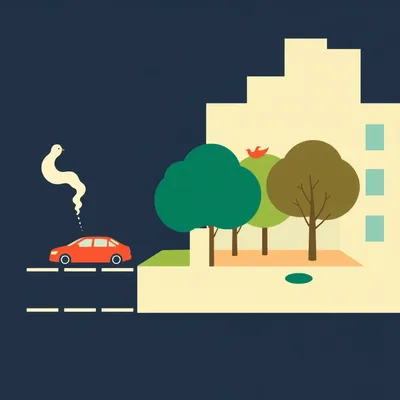
Daniel just published this air quality study — a full year of hourly data, twelve monitoring stations across Jerusalem, controlled against London and New York, deweathered with Random Forest models. The headline finding: Jerusalem's Shabbat nitrogen dioxide drop is roughly four times larger than typical Western weekend drops after you control for weather. But here's the part that got me — standard air quality indexes basically miss it entirely. PM two point five, which in the Levant is dominated by Saharan and Arabian dust, drowns out the nitrogen dioxide signal. You look at the EPA air quality index on Shabbat and it barely budges. The air is genuinely cleaner in a locally meaningful way and the index says nothing happened.

That's the paper's real contribution in my view. It's not just documenting that Shabbat reduces emissions — that part's intuitive. It's demonstrating that our main tools for communicating air quality to the public have a structural blind spot for exactly this kind of intervention. If you're a city planner evaluating whether low-emission zones or congestion charges actually work in a dust-corridor city, and you're looking at standard AQIs, you'll conclude nothing changed. When in fact the combustion-related pollutants collapsed.
Which is a pretty big deal if you're trying to justify the political cost of those policies. You need to be able to point to a number that moved.
And Daniel's custom index — he calls it the Traffic Combustion Index, a mean z-score of nitrogen dioxide, nitric oxide, nitrogen oxides, carbon monoxide, benzene and toluene — that index shows a clean step-change. It drops from minus zero point one on workdays to minus zero point six one on Shabbat, then all the way to minus zero point nine on Yom Kippur. That's a real signal. The standard indexes are giving you noise.
Let's walk through the numbers people actually need to know here. Jerusalem, Shabbat window from candle-lighting to tzeit hakochavim — nitrogen dioxide drops sixty-two percent raw, thirty-four percent after you remove weather effects. Compare that to New York Saturday plus Sunday: thirty-one percent raw, nine percent deweathered. London Saturday plus Sunday: twenty percent raw, eight percent deweathered. So Jerusalem's weather-controlled effect really is about four times the Western weekend.
The mechanism is straightforward once you think about it. Western weekends see partial traffic reduction — maybe twenty-five to thirty percent fewer private cars, but buses still run, trucks still move, construction often continues. Jerusalem on Shabbat in observant areas sees essentially a hundred percent pause. Private cars, zero. Diesel buses — Egged, Superbus, Dan — zero. Construction — and Jerusalem is in a heavy build phase right now with light rail extensions and high-rises going up — zero. Diesel non-road mobile machinery is one of the top three nitrogen dioxide sources in the city. Trucks, freight, sherut taxis — all zero. New York also has weekend heating-oil emissions that Jerusalem simply doesn't have.
That hundred percent pause on diesel buses is bigger than people might realize. Those buses do cold starts on Saturday night after Havdalah, and cold starts are disproportionately dirty. Daniel found nitric oxide drops seventy-eight percent raw during Shabbat — that's cold-start dominated. No Shabbat-morning cold starts.
You see the flip side in the post-Havdalah rebound. The study notes partial rebound with vehicle cold-starts after Shabbat ends. All those engines that sat cold for twenty-five hours firing up at once.
There's a detail in the methodology I want to flag because it's clever. He used halachic windows from Hebcal — candle-lighting to tzeit hakochavim — rather than just calendar Saturday. For Jerusalem at thirty-one point seven six eight three degrees north, that's a forty-minute candle-lighting offset and tzeit hakochavim about forty-two minutes after sunset. Those windows shift week to week. If you just used calendar days you'd be mixing pre-Shabbat and post-Shabbat hours into your Shabbat bucket and blurring the signal.
The internal control is elegant too. East Jerusalem stations — Rockefeller Museum, station five six eight — carry traffic that doesn't observe Shabbat. Those stations show the smallest drops. That validates the mechanism. It's not something else about Saturday — it's specifically the cessation of vehicle activity in observant neighborhoods.
We've established the effect is real and large. Now let's talk about the PM paradox, because this is where it gets counterintuitive.
This was the finding that made me sit up. Raw PM two point five went up twenty percent on Shabbat. If you just looked at raw numbers you'd conclude Shabbat makes particulate pollution worse. But it's pure weather artifact. The Saturdays in the study period happened to coincide with dust events. Once you deweather — control for temperature, humidity, wind, surface pressure, boundary-layer height from ERA five reanalysis via Open-Meteo — the true local signal emerges. PM two point five drops four percent, not rises twenty.
That's a fifty percentage point swing between raw and deweathered. If you're not doing weather correction in a dust-corridor city, your data is basically unusable for policy evaluation.
This is not an esoteric methodological point. Think about what happens if a city implements a low-emission zone, measures raw PM two point five before and after, and happens to get a dustier year after implementation. The raw numbers say the policy failed or even made things worse. Politically, that policy is dead. When in reality it might have cut local combustion particles by fifteen percent — you just can't see it through the dust.
Daniel's combined PM numbers tell the story clearly. Workweek daytime, seven in the morning to ten at night: ninety-nine point four micrograms per cubic meter. Shabbat: eighty-six point six — a thirteen percent drop. Post-Havdalah: seventy-four point six — twenty-five percent down, that's the lagged settling. Yom Kippur: twenty-five point eight. A seventy-four percent collapse. Yom Kippur is the cleanest natural experiment you could ask for.
Observant and non-observant. No internal control population. The combined PM falls seventy-four percent, nitrogen oxides hit the floor, and the EPA air quality index drops to twenty-eight — which is solidly Good. It's the annual validation that yes, when you actually remove the combustion sources, the air cleans up dramatically.
Here's the thing — even on Yom Kippur, the standard AQI is being pulled around by residual dust. Twenty-eight is Good, but if you had a traffic-specific index you'd see an even starker signal. The paper argues that in dust-corridor cities, traffic-specific indices aren't a nice-to-have. They're essential for honest policy evaluation.
Let's talk about the ozone finding because it's the most chemically interesting part. Jerusalem's ozone rise on Shabbat is smaller than Western controls — plus one percent versus plus two to three percent in London and New York. This despite a much larger nitrogen oxide drop. That's the signature of NOx-saturated photochemistry.
Explain that mechanism. I want to make sure I have it right.
In an NOx-saturated urban core, you have so much nitric oxide that it's constantly titrating ozone — NO plus O three goes to NO two plus O two. When you cut NOx a little bit, you reduce that titration, so ozone rises. That's the standard weekend effect in Western cities. But if you cut NOx enough — like Shabbat, and even more so Yom Kippur — you start moving the system out of the titration-dominated regime. The ozone rise actually moderates.
Small NOx cuts make ozone worse, but large enough cuts start to solve the ozone problem too. There's a threshold.
And that has a direct policy implication. If you electrify a vehicle fleet gradually — say ten percent, twenty percent of cars — you're making small NOx cuts in an NOx-saturated core. You might actually worsen ozone. The paper's implication is that traffic electrification without simultaneous NOx control could have a perverse near-term effect on ozone in cities like Jerusalem, Mexico City, Los Angeles, Beijing.
That's the kind of knock-on effect that doesn't make it into the press release about electric vehicle adoption. We're told electrification is unambiguously good for air quality. It mostly is. But the chemistry doesn't care about our narratives.
The Cohen's d effect sizes in the study really drive home the clean split between combustion and non-combustion pollutants. Nitrogen dioxide minus zero point five two — strongest negative effect. Nitrogen oxides minus zero point four three. Nitric oxide minus zero point three four. Carbon monoxide minus zero point three. Toluene minus zero point two, benzene minus zero point one eight — those are BTEX, classic vehicle exhaust markers. Then you flip to the positive side: ozone plus zero point one eight, PM two point five plus zero point one five, PM ten plus zero point seven. Combustion markers all negative, photochemistry and dust all positive. The statistical signature is unambiguous.
That split is why the standard AQI fails. The EPA AQI in Jerusalem goes from sixty-four on workdays to sixty-seven on Shabbat. It barely moves, and in the wrong direction if anything. Because PM two point five dominates seventy-seven to eighty-four percent of the index. The dust signal, which is mostly long-range transport from the Sahara and Arabian deserts on weekly timescales, swamps the local combustion signal. The Canadian Air Quality Health Index shows the same problem — four point seven to four point four, about a seven percent change.
The index is answering a different question than the one a city planner is asking. It's answering "what's the overall health risk from all particulate sources right now?" which is legitimate for public health communication. But it's not answering "did our traffic policy work?" And if you use it to answer that second question, you'll get the wrong answer consistently in any dust-affected city.
Jerusalem is far from the only dust-affected city. The entire Middle East, North Africa, the Sahel, parts of Central Asia, the southwestern United States — anywhere downwind of deserts, standard AQIs have this same structural blind spot.
Tel Aviv, Dubai, Riyadh, Cairo, Phoenix, Delhi during dust season. Any city where long-range dust transport is a significant fraction of PM two point five on weekly timescales.
Let's talk about the methodology for a minute because the deweathering approach is central to the whole analysis and it's worth understanding what was actually done.
Twelve Jerusalem monitoring stations, hourly data, covering April twenty-eighth twenty twenty-five to April twenty-eighth twenty twenty-six. That's about seven million data points. Fifty Shabbatot, nine Yom Tov days, one Yom Kippur. Random Forest deweathering with temperature, humidity, wind speed and direction, surface pressure, and boundary-layer height from ERA five reanalysis accessed through Open-Meteo.
The key methodological choice — hour-of-day and day-of-week were deliberately excluded from the weather model.
Because if you include day-of-week, the model would learn that Saturdays are different and would partially deweather the Shabbat signal itself. You'd be throwing the baby out with the bathwater. By excluding hour-of-day and day-of-week, you preserve the Shabbat signal in the residuals. What's left after weather correction is the true local-source variation. The model R-squared ranged from zero point six nine to zero point nine three for Jerusalem — solid predictive power on the weather component.
Weather accounted for about fifty percent of the raw nitrogen dioxide signal. Half the variation you see in the raw numbers is just weather. That's why deweathering matters so much.
The New York and London controls were pulled from OpenAQ with the same methodology. The Western weekend effect — Saturday plus Sunday — is real but much smaller after weather control. New York's raw thirty-one percent nitrogen dioxide drop shrinks to nine percent deweathered. London's raw twenty percent shrinks to eight percent. Those are the numbers you compare Jerusalem's thirty-four percent deweathered to.
The four-times claim holds up. And the mechanism is clear — it's the comprehensiveness of the Shabbat cessation versus the partial Western weekend.
Let's dig into the Friday dynamics because there's an interesting temporal pattern. Friday morning behaves like a weekday — normal traffic, normal emissions. Then you get the erev-Shabbat shopping rush in the afternoon, so there's actually a spike. Then candle-lighting hits and nitrogen oxides drop off a cliff.
The paper mentions this sharp drop at candle-lighting specifically. It's not a gradual weekend wind-down. It's a step function.
Which is methodologically useful. If you're trying to isolate a causal effect, a step-function intervention is much cleaner than a gradual one. You can see the break point in the time series. And then post-Havdalah you get the partial rebound with vehicle cold-starts.
The cold start point is worth emphasizing because it connects to a broader air quality issue that doesn't get enough attention. Cold starts are disproportionately polluting — the catalytic converter hasn't warmed up, the engine is running rich, you get incomplete combustion. In a city where a large fraction of the fleet sits cold for twenty-five hours and then all starts up within a relatively narrow window Saturday night, you get a measurable pollution pulse.
The nitric oxide numbers capture this. Minus seventy-eight percent raw during Shabbat. That's not just fewer cars — that's zero cold starts for twenty-five hours. Nitric oxide has a short atmospheric lifetime, so it tracks very recent emissions. The collapse is immediate and nearly total.
There's something almost philosophical about Shabbat as an air quality intervention. It's not designed as environmental policy — it predates environmental policy by millennia — but it functions as a weekly natural experiment that reveals things about urban air chemistry that are hard to see any other way.
Yom Kippur is the even cleaner version of the experiment. Once a year, you get near-total cessation of all combustion sources for twenty-five hours. The paper's Yom Kippur numbers are striking — combined PM down seventy-four percent, nitrogen oxides at the floor, EPA AQI at twenty-eight. That's your upper bound on what local source control can achieve in Jerusalem. You can't do better than Yom Kippur without controlling the dust, and the dust is mostly not local.
Which brings us to the policy takeaways. The paper lays out several and I think they're worth discussing seriously.
The first and most important is that standard AQIs miss local-source interventions in dust-corridor cities. If you're implementing congestion charges, low-emission zones, fleet electrification — you need a traffic-specific index to evaluate whether they're working. Otherwise you're flying blind.
The second is that the Shabbat effect is reproducible. Fifty Shabbatot over a full year, consistent signal. Yom Kippur provides annual validation. This isn't a fluke — it's a stable feature of Jerusalem's air chemistry.
Third, construction's contribution to nitrogen dioxide and PM ten is underappreciated. The fact that construction pauses completely on Shabbat — and Jerusalem is in a heavy build phase with light rail and high-rise construction — is a meaningful part of the signal. Diesel non-road mobile machinery is a major source that doesn't get as much policy attention as vehicle exhaust.
Fourth, the ozone paradox. Gradual electrification without NOx control could worsen ozone in NOx-saturated urban cores. That's a non-obvious policy implication that should inform how cities sequence their air quality interventions.
The paper also notes some caveats that are worth mentioning. Single weather year — so interannual variability in dust transport could affect the PM numbers. The Shabbat windows use a heuristic two-hour pre-Shabbat and post-Havdalah buffer. No chemical PM speciation — so we can't separate Saharan dust from Arabian dust from local crustal dust. And spring twenty twenty-six had significant Saharan dust events that inflated PM two point five on some Shabbatot.
The spring twenty twenty-six dust was notable. If you were in Jerusalem in March or April, you saw the orange skies. That's exactly the kind of event that would make raw PM numbers useless for policy evaluation without deweathering.
The East Jerusalem internal control deserves a bit more attention. Rockefeller Museum station — station five six eight — sits in an area where traffic continues on Shabbat. It shows the smallest drops across all combustion pollutants. That's exactly what you'd expect if vehicle cessation is the mechanism, and it rules out alternative explanations like "maybe the wind patterns are different on Saturdays" or "maybe the boundary layer behaves differently.
If the effect were meteorological, you'd see it at all stations. You don't. You see it only where traffic actually stops. That's a strong causal inference.
The BTEX markers — benzene and toluene — are particularly informative because they're almost purely vehicle exhaust. Cohen's d of minus zero point one eight and minus zero point two respectively. Weaker than nitrogen dioxide, which makes sense because BTEX has some industrial and evaporative sources that don't fully shut down on Shabbat. But still clearly negative. The combustion fingerprint is consistent across the board.
There's a bigger picture here about how we measure and communicate environmental progress. We've built these aggregate indices to simplify complex data for public consumption — which is a worthy goal — but the aggregation can hide the very interventions that are working. Someone looks at the AQI on Shabbat, sees it's basically the same as Tuesday, and concludes that shutting down traffic doesn't matter. That's the wrong conclusion, and it's the index's fault, not the reader's.
The EPA AQI was designed for American cities where PM two point five is mostly local and industrial. It wasn't designed for dust-corridor cities where a large fraction of PM two point five is long-range natural transport. Applying it in Jerusalem without adjustment is a category error.
It's not just Jerusalem. The same problem applies to any city where natural dust is a significant contributor to PM two point five. The entire Middle East. Parts of Central Asia. The southwestern US. Delhi during pre-monsoon dust season. The list is long.
There's a broader methodological lesson too about deweathering. If you're evaluating any air quality intervention — a low-emission zone, a congestion charge, a coal plant closure — and you're using raw data, you're attributing weather variation to your policy. One dusty month can make a successful policy look like a failure. Random Forest deweathering with ERA five reanalysis data is becoming standard in the atmospheric chemistry literature for exactly this reason.
The fact that this analysis was done with publicly available data — Israeli Ministry of Environmental Protection stations, OpenAQ for international controls, Open-Meteo for weather, Hebcal for halachic times — means it's reproducible. Anyone can run the same analysis for their city if they have monitoring station data.
The code is presumably open. Daniel is an active open source developer, so I'd expect the deweathering pipeline and index construction to be available.
Let's talk about what this means for Jerusalem specifically. The city has serious air quality challenges — it sits in a topographic bowl, it has temperature inversions in winter, it's downwind of both the Sahara and the Arabian deserts, and it's undergoing rapid construction. The Shabbat effect shows that local source control can make a real dent despite all that. It's not hopeless.
The Yom Kippur numbers are the proof of concept. When you actually remove the combustion sources, the air cleans up dramatically — seventy-four percent reduction in combined PM, EPA AQI of twenty-eight. That's the ceiling. The question is how close you can get to that ceiling during the other three hundred sixty-four days of the year through policy.
The ozone finding suggests you need to be smart about how you get there. A gradual, partial electrification that leaves diesel buses and construction equipment running could produce a perverse ozone outcome. You might need to go big — fleet-wide electrification plus construction equipment regulation — to push through the NOx-saturated regime and actually reduce ozone.
That's the titration threshold. You need enough NOx reduction to move the photochemistry out of the regime where nitric oxide is scavenging ozone. Partial measures leave you in the worst of both worlds — still enough NOx to titrate, but less of it, so ozone rises.
The paper's Traffic Combustion Index is an interesting solution to the measurement problem. By taking a mean z-score across six combustion-related pollutants — nitrogen dioxide, nitric oxide, nitrogen oxides, carbon monoxide, benzene, toluene — it isolates the traffic signal from the dust signal. The index drops from minus zero point one to minus zero point six one on Shabbat to minus zero point nine on Yom Kippur. That's a clean, interpretable metric.
It's simple enough that a city could implement it operationally. You don't need exotic instrumentation. All six of those pollutants are already measured at standard air quality monitoring stations. You just need to compute the index and report it alongside the standard AQI.
For listeners who are wondering — the paper was published on Hugging Face, which is an interesting choice for an air quality analysis. But it makes sense given the reproducibility angle. The data, code, and methodology are all in one place.
Now: Hilbert's daily fun fact.
The national animal of Scotland is the unicorn. It has been since the twelfth century, when it was adopted as a symbol of purity and power in Scottish heraldry. Scotland is one of the few countries whose national animal does not actually exist.
What should listeners take away from this practically? First, if you live in Jerusalem or any dust-affected city, understand that the AQI you see on your weather app is mostly telling you about dust, not about local pollution sources. A moderate AQI on Shabbat doesn't mean the traffic reduction didn't work — it means the index can't see it.
Second, if you're involved in environmental policy or advocacy in a dust-corridor city, push for traffic-specific air quality reporting. The data exists. The monitoring stations already measure nitrogen dioxide, nitric oxide, carbon monoxide, benzene, toluene. It's a reporting problem, not a measurement problem.
Third, the deweathering lesson applies broadly. If you see a news story about a city's air quality getting better or worse, ask whether the numbers are raw or weather-corrected. One dusty spring can create a false narrative that lasts years.
Fourth, for the technically inclined, the methodology is replicable. If your city publishes hourly monitoring station data, you can run a similar analysis. OpenAQ has international data. Open-Meteo has weather reanalysis. Hebcal has halachic times if you're looking at Shabbat effects. The tools are all public.
The bigger intellectual contribution here is that natural experiments — Shabbat, Yom Kippur, Ramadan in some contexts, national holidays, pandemic lockdowns — can reveal things about urban systems that are invisible during normal operations. When a city effectively shuts down for twenty-five hours every week, you get fifty data points a year on what happens when you remove traffic. That's a research opportunity most cities don't have, and this paper makes the most of it.
The four-times-Western-weekend finding is the headline, but I think the methodological contribution is actually more important. Demonstrating that standard AQIs have a structural blind spot for local-source interventions in dust-corridor cities — and providing a straightforward fix — that's broadly applicable beyond Jerusalem.
It's a reminder that aggregate indices always hide something. The choice of what to aggregate and how to weight it is a choice about what matters. The EPA decided PM two point five matters most for health, which is defensible. But that choice also means the index can't tell you whether your traffic policy is working. There's no free lunch in index design.
The paper is called "Jerusalem Shabbat Air Quality Analysis" — it's up on Hugging Face. Daniel did the heavy lifting on this one, and it's a useful contribution to the literature on urban air quality in dust-affected regions.
Thanks to our producer Hilbert Flumingtop for putting this episode together. This has been My Weird Prompts. You can find every episode at myweirdprompts dot com. We'll be back with another one soon.