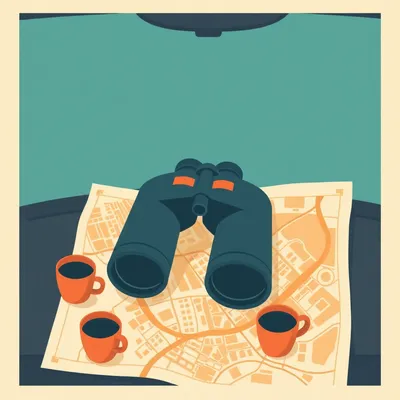
Daniel's been talking to someone in the industry. A fellow who asked to be identified only as Jacob. And Jacob's claim is that commercial real estate developers — the people putting up towers and logistics parks and apartment blocks — are recruiting informants on rival construction sites. Not analysts, not consultants. People on the ground. Operators running excavators, pour crews, site supervisors. The theory being that public disclosures don't tell you much about a rival's actual pipeline, so you go find someone who sees it with their own eyes every morning. Daniel wants to know how that recruitment actually works, what the inducements look like, and whether there's a counter-espionage layer now sitting on top of concrete pours.

The JCB spy. I've been turning this over since Daniel's note came in, because there's a version of this that's real and documented, and a version that's mostly narrative. The documented version is worse for the companies involved.
Worse how?
The spy isn't usually the man on the excavator. The spy is the former employee who still has a login that never got revoked. The cases that actually make it to court run through insiders with system access — tender folders, pricing models, margin sheets. The Shadforth case in Queensland is the cleanest recent one. Two former staffers, one of them had adjusted an internal link so it never expired. From July twenty twenty-one until May twenty twenty-five, they had unfettered access to what the prosecutor called the entire business blueprint. Tenders, pipe infrastructure, pricing, profit margins, markups.
So the recruitment isn't a cold approach to a stranger in a hard hat. It's a former colleague at a rival firm, leaning on an old relationship.
That's the pattern. The Shadforth thing started with an anonymous letter. One of the men had left Shadforth in twenty eighteen for a competitor, and the allegation was he'd been passing Shadforth material to three separate line managers at his new company. The inducement there is partly career advancement — you bring useful intelligence, you position yourself. Cash gets layered on top in other cases.
What kind of cash?
The clearest numbers come from adjacent sectors. James Hardie paid people ten to twelve dollars an hour to sit outside CertainTeed plants counting trucks. Binoculars, a laptop, a cell phone. One monitor was in place for three or four years, got vacation time and insurance. The stated purpose was market share intelligence — if CertainTeed is shipping too much material, Hardie knows it needs to defend its market share.
Ten dollars an hour. That's the entire espionage budget for a multinational building products company.
And then at the other end you've got the Deel and Rippling affair from last year, where the admitted spy was paid over five thousand dollars a month, got a six thousand dollar award in November, and was told by the CEO to be like James Bond. So the range is ten dollars an hour on one side, five grand a month on the other.
The James Bond instruction feels like it should come with a different pay grade.
It came with a confession eventually. The man said he was getting sick of concealing the lie, that he realized he was harming himself and his family to protect Deel. That's the human cost that never makes it into the market share spreadsheet.
So let me push on the original question, because Daniel's informant specifically said construction workers. JCB operators. Is there any documented case of a developer recruiting rank-and-file site labor?
I couldn't find one. Not in open news, not in court records, not anywhere. The documented cases are insiders with credentials, or paid external monitors sitting across the street with binoculars. The JCB operator as paid spy appears to be the story's hook rather than a practice with a paper trail.
Which makes sense if you think about the information asymmetry. The man on the excavator knows what's in the ground in front of him. He doesn't know the tender price, the margin, the financing structure, or which subcontractor is about to be replaced. The valuable intelligence sits in the office, not the trench.
And that's where the Seoul case gets interesting, because it's analog espionage in the bidding room. Apgujeong District Five, a huge reconstruction project. A representative of one firm allegedly used a spy pen — a hidden camera in a ballpoint pen — to photograph a rival's proprietary bid strategies and pricing during document review. The contractor selection got halted in April. So the tactic migrates to whatever the weakest link is. If the bids are on paper in a room, someone photographs the paper. If the bids are on a server, someone keeps a login alive.
A spy pen. The last time I saw one of those it was in a catalog next to a teddy bear camera and a modified kippah.
Your private investigator supply catalog phase.
It was a dark afternoon. But the point stands — this equipment is not exotic. It's consumer-grade, openly sold, and the only thing that makes it espionage is intent.
Right. And the intent in construction is usually tender pricing. The Shadforth documents were accessed sometimes hours before a project submission was due. Competitors' bids later came in as little as a thousand dollars under Shadforth's on multi-million dollar tenders.
A thousand dollars. That's the entire margin of victory on a project worth tens of millions.
And that's the detail that makes the whole thing feel less like a movie and more like a spreadsheet. The spy doesn't need to steal the whole company. He needs to know where the other guy's number is going to land, so his own bid can land just under it.
Which brings us to the question Daniel actually asked about counter-espionage. Are there men now running counter-espionage operations while managing concrete pours?
Not in the way the question imagines. There's no job posting for site superintendent with counter-intelligence duties. What's actually happened is the intelligence function has professionalized into services. Drone companies flying active development sites on regular cadences, delivering LiDAR and photogrammetry within twenty four hours of each flight. They market it as an independent layer of oversight. And on the digital side, there are AI agents that scrape municipal permit portals daily, evaluate project scale and zoning implications, and send a weekly digest. The pitch is literally solving what they call the two hundred unit surprise problem.
The two hundred unit surprise problem.
A developer wakes up and discovers a rival has permitted a two hundred unit building across the street. The AI scraper is supposed to catch that the week it's filed, not the month the crane goes up.
So the counter-espionage is not a guy in a trench coat watching the site for spies. It's a drone and a permit scraper. The defense against espionage is just better, faster, legal intelligence.
And that's the part I find interesting. The James Hardie model — a man with binoculars at ten dollars an hour — looks archaic next to a weekly WhatsApp digest from an AI agent. The legal substitute is displacing the human spy because it's cheaper, it's faster, and it doesn't leave a witness.
It also doesn't generate a criminal case. The Shadforth prosecution ended with fines of fifteen thousand dollars for one man, seventy five hundred for another, eighteen hundred for a consultant. Six people charged with about ninety offenses. And the company's director said the message sent hasn't been strong enough to protect businesses like his.
Ray Shadforth. His line was that business has had a betrayal of trust. And the thing he kept coming back to was the missing link of proving loss. Over a hundred contracts missed, worth hundreds of millions of dollars over four years. But police couldn't prove causation to the required threshold. Even with thirty two hundred files stolen and bids undercut by a thousand dollars, the court couldn't draw a clean line from the theft to the loss.
That's the systemic problem. Espionage prosecutions fail on causation. You can prove the files were taken. You cannot prove the rival won the bid because of the files. There's always a plausible alternative — better pricing, better relationships, better timing.
And the spy knows that. The risk-reward calculation is not subtle. The inducements are modest, the detection is unlikely, and even when detected, the penalty is often a fine smaller than the value of a single tender.
So the real story Daniel's informant is pointing at — maybe without knowing it — is that the weakest link is not the man on the JCB. It's the former employee with a live login, and the bid room with a paper document, and the permit portal that nobody is watching.
The permit portal angle is worth sitting with for a second, because it flips the whole premise. The information Daniel's informant says is not forthcoming from public disclosures — construction status, project scale, timing — is actually sitting in municipal permit filings. It's public. It's just unstructured, scattered across dozens of portals, and nobody has time to read all of them. The AI scraper doesn't steal anything. It just reads faster than a human can.
So the question is whether espionage is even necessary when the public record is that rich.
For some things. Tender pricing is not in the permit filing. Margins are not in the permit filing. The permit tells you what and where and roughly when. The tender tells you how much and at what profit. The valuable secret is still the number.
And the number lives in the server, not the site.
Which is why the Oracle and Procore dispute is the logical endpoint. Oracle accuses Procore of obtaining Oracle data through a former employee in twenty twenty one. The court records now show file transfers. That's not a construction site at all. That's construction software companies fighting over who walked out the door with what.
The industry's own tools became the vector.
The industry digitized, and the secrets moved from the safe in the site office to the cloud. The spy moved with them. The man on the JCB got left behind.
Let me ask the question Daniel didn't ask but is implied. If the documented cases are all insiders and digital theft, why does the JCB spy story persist?
Because it's intuitive. Everyone has seen a construction site. Everyone understands that the people there know things the public doesn't. The leap to paid informant is small and dramatic. It's the same reason people believe the mafia controls waste management — there's a grain of truth about information asymmetry, and the narrative fills in the rest.
The grain of truth is that site workers do talk. They talk to suppliers, to subcontractors, to friends at rival firms. The information flows informally all the time. The question is whether anyone is paying for it in a structured way.
And the answer, from everything I can find, is that the structured payments go to people with system access, not people with hard hats. The unstructured flow is real but it's not espionage. It's gossip.
Gossip with a hard hat on.
Gossip with a hard hat on, and occasionally someone buys a round of drinks and listens carefully.
So what does a developer actually do if they want the intelligence legally?
They hire a drone company. GeoForge is one of the names in this space — drone LiDAR, photogrammetry, site intelligence. The pitch is flying active development sites on regular cadences and delivering data within twenty four hours. That gets you progress, site activity, material staging. You can see whether a rival is actually pouring concrete or just moving dirt around for show.
And the permit scraper gets you the pipeline before ground breaks.
The Struere agent scrapes municipal permit portals daily, evaluates project scale and zoning implications, and sends a weekly digest. The whole pitch is competitive threat level assessment. It's the two hundred unit surprise problem solved with a scheduled script instead of a paid informant.
So the counter-espionage layer Daniel asked about is really just the same tools pointed inward. A developer uses drones and permit scraping to watch rivals, and the same services to monitor their own sites for unauthorized observation.
The drone company markets it as oversight. Independent verification that your contractor is doing what they said. But the same flight data could tell a rival exactly how far along you are. The tool doesn't care who's paying for the picture.
Which is the recurring theme in all of this. The technology is neutral. The intent is what makes it espionage or oversight.
And the law is still catching up. The Shadforth case shows the gap. Thirty two hundred files stolen, and the penalty is a fifteen thousand dollar fine. The prosecutor called it sabotage from within. The director called it a betrayal of trust. But the court could only prove what it could prove.
The missing link of proving loss. That phrase should be on a plaque somewhere.
It's the entire problem with corporate espionage prosecution in one sentence. You can show the theft. You can show the bid came in a thousand dollars under. You cannot show the bid came in a thousand dollars under because of the theft. The law demands causation, and causation is the one thing the spy is careful not to leave behind.
So the rational developer looks at this and thinks, the legal tools are cheaper and safer than the illegal ones.
And the irrational developer thinks, I need the number, and the number is in the server, and I know a guy who used to work there.
The guy who used to work there is the recruitment pipeline. Daniel's informant had it half right. The recruitment happens, but it happens through former colleagues, not through cold approaches on site.
The Shadforth case is the template. A man leaves the company. He goes to a competitor. He keeps a login alive, or he knows someone who did. The new employer sees the value. The old employer never revokes the access. Four years later, someone sends an anonymous letter.
And the inducement structure is career advancement first, cash second. The man who brings useful intelligence gets promoted. The cash is almost incidental.
Except in the Deel case, where the cash was five thousand a month plus bonuses and a James Bond instruction. That's a different model. That's a dedicated spy, not a former employee with a grudge.
A dedicated spy with a confession.
He said he was getting sick of concealing the lie. That he was harming himself and his family to protect Deel. The interesting thing is that he confessed, not that he spied. The spying is common. The confession is rare.
Because most of them never get caught, and the ones who do never talk.
The Shadforth case only came to light because of an anonymous letter. Someone on the inside sent it. The whole thing ran for four years before that letter arrived.
So the counter-espionage, such as it is, is mostly the anonymous letter.
And the exit interview that nobody takes seriously. And the IT department that never revoked the login. The counter-espionage is hygiene. Revoke access when someone leaves. Audit who's downloading what. Watch for the login that never expires.
The login that never expires is the whole story. One man adjusted an internal link so it never expired. That single act of negligence — or complicity — enabled four years of theft.
It's the unglamorous truth behind every espionage story. The spy doesn't break in. He walks through a door that was left open.
Daniel's informant Jacob presumably knows this. He's in the industry. But the story he told Daniel is the JCB version, not the server version.
Which might mean Jacob is closer to the site than the office. The people on site tell each other the JCB spy story because it's the version that makes sense from where they're standing. The people in the office know the real action is in the tender folder.
The information asymmetry cuts both ways. The site workers know what's physically happening. The office workers know what's financially happening. The spy wants the financial information, and that's in the office.
And the legal intelligence tools want the physical information, and that's visible from the air and the permit portal. So the JCB operator is the one person whose knowledge is least valuable to a rival.
Unless the rival wants to know whether the concrete pour actually happened on schedule.
Which a drone can tell you for less than the cost of one week of the JCB operator's silence.
So the entire premise collapses under its own economics. The spy on the JCB is the most expensive and least valuable source.
The most expensive, least valuable, and most likely to talk to his mates at the pub. The insider with a login is cheaper, quieter, and has access to the number.
Which brings us to the counter-espionage question one more time. Daniel asked whether there are men running counter-espionage operations while managing concrete pours. The honest answer is no. The function has been absorbed into data services and IT hygiene.
And the closest thing to a counter-espionage professional is the drone operator who notices an unauthorized flight over the site, or the IT manager who flags an unusual download pattern. Neither of them is managing a concrete pour.
The concrete pour manager is busy managing the concrete pour.
And if he's also running counter-espionage, he's not doing either job well.
So where does that leave Daniel's informant? Is Jacob wrong?
Jacob is describing a real anxiety with a fictional mechanism. The anxiety is that rivals know more than they should. The mechanism — paid JCB operators — is the story the industry tells itself to explain the anxiety. The actual mechanism is more boring and more damaging.
The boring version is the one to worry about. A man with a login he shouldn't have, downloading tenders hours before submission.
And the Seoul spy pen shows the boring version has an analog twin. A man with a pen camera in a document review room, photographing paper bids. The mechanism adapts to the medium. Paper gets photographed. Servers get downloaded.
The spy pen is almost charming in its simplicity. It's the kind of thing you'd see in a nineteen seventies thriller, and it shut down a contractor selection in Seoul in April.
The fact that it still works is the point. The weakest link is never the technology. It's the human being in the room with the document.
And the human being with the login. And the human being who never revokes the access. The technology just records what the humans already failed to protect.
So the answer to Daniel's three questions, in order. How do developers recruit spies? Through former colleagues and existing relationships, not cold approaches. What inducements do they offer? Career advancement, cash, and occasionally a James Bond instruction. Are there counter-espionage operations alongside concrete pours? No. The counter-espionage is IT hygiene and legal intelligence services.
That's the clean version. The messy version is that the industry runs on informal information flows that nobody calls espionage until a prosecutor does.
And the prosecutor only gets involved when there's an anonymous letter.
The anonymous letter is the real counter-espionage weapon. It's low-tech, deniable, and it works.
It worked in Queensland. Four years of theft, ended by a letter.
Which raises the question of who sent it. Somebody inside the competitor. Somebody who knew what was happening and decided to end it.
The letter writer is the counter-espionage operative Daniel was asking about. Not a professional. Just someone with a conscience and a stamp.
A conscience and a stamp. That's the entire counter-intelligence apparatus of the construction industry.
And it's probably more effective than the drone.
The drone tells you what's happening. The letter tells you who did it.
The drone is prevention. The letter is prosecution.
And the login hygiene is the prevention that actually matters. Revoke the access. Audit the downloads. Watch the link that never expires.
The link that never expires. One man adjusted it, and it stayed open for four years. That's the whole story of corporate espionage in one detail.
It's also the story of every data breach ever. The door was open.
The door was open, and the guy who walked through it used to work there, and nobody thought to check.
So Daniel's informant Jacob is right that the industry has an espionage problem. He's wrong about where it lives.
It lives in the server, not the JCB. And the counter-espionage lives in the IT department, not the site office.
And the legal intelligence lives in the drone and the permit scraper, which are the tools that are actually displacing the paid informant.
The paid informant was always a stopgap. The legal tools are better, cheaper, and they don't go to prison.
They also don't send anonymous letters.
That's a feature, not a bug.
For the developer, yes. For the prosecutor, less so.
The prosecutor needs the letter. The developer needs the drone. The spy needs the login. And the JCB operator just needs to pour the concrete.
The JCB operator is the only one in this story who's actually doing his job.
And he's the one Daniel's informant identified as the spy.
Which tells you something about how the industry sees its own workers.
It sees them as potential informants because it can't imagine them as anything else.
That's a grim sentence.
It's a grim industry. The Shadforth director said he felt a betrayal of trust. That's the emotional core of all of this. The spy is always someone who was trusted.
The former employee. The colleague at the rival firm. The man in the document review room. The trust is the vector.
The betrayal is the business model.
The next time someone tells you about a spy on a JCB, ask them where the server is.
Who used to work there.
Whether the login ever expired.
That's the real story.
Let's hear from Hilbert. He's been quiet back there.
I think he's been waiting to tell us something about a construction site from the early two thousands.
Hilbert: I was on a site in Phoenix in two thousand three. I was delivering porta-potties. The foreman used to pay me twenty bucks a week to tell him what I saw at the competitor's site across the road. I saw a lot of porta-potties.
What did you tell him?
Hilbert: How many trucks went in, how many porta-potties they had, whether the concrete pump was set up. He had a whiteboard in the site office. Tracked it all. Twenty bucks a week, cash.
That's the James Hardie model. Ten dollars an hour, binoculars, a laptop. You were the laptop.
Hilbert: I was the porta-potty man with a notebook. The foreman got promoted about a year later. I think the whiteboard helped.
The JCB spy is real, he just drives a porta-potty truck.
Hilbert: The porta-potty man sees everything. Nobody looks at him twice. He's there to empty the tank. But he counts the trucks while he's doing it.
The inducement was twenty dollars a week.
Hilbert: A free porta-potty for my mother's church picnic every summer. That was worth more than the twenty.
The church picnic angle. That's the detail that makes it real.
Hilbert: The foreman's brother-in-law ran the rival site. That's how he knew what to ask about. The brother-in-law would mention something at a family dinner, and the foreman would put it on the whiteboard.
The real espionage was the family dinner, and you were just the confirmation.
Hilbert: I was the porta-potty man who counted trucks. The family dinner was the actual intelligence operation.
The counter-espionage was nobody suspecting the porta-potty man.
Hilbert: Nobody ever suspects the porta-potty man. That's the whole point.
The legal tools would have replaced you in a week. A drone over the site tells the foreman how many trucks went in without the twenty bucks.
Hilbert: The drone doesn't empty the tank.
That's the counter-argument to legal intelligence.
Hilbert: The drone sees the trucks. The porta-potty man hears the arguments. The foreman got more from me about which subcontractors were fighting than he ever did from the truck count.
The human layer. That's what the permit scraper can't replace.
Hilbert: The permit scraper tells you when the permit was filed. It doesn't tell you that the electrician walked off the job because the site manager called his wife a name.
That's the intelligence that actually moves a project.
Hilbert: That's the intelligence that got the foreman promoted.
The JCB spy story has a kernel of truth. The site worker sees things. The porta-potty man sees more.
Hilbert: The porta-potty man sees everything and says nothing, except to the foreman for twenty bucks.
A church picnic porta-potty.
Hilbert: That was the real contract.
I keep coming back to the Shadforth case. The prosecution couldn't prove loss because the causation chain was too long. But your foreman's whiteboard was the causation chain. He saw the trucks, he adjusted his bid, he won the job.
Hilbert: He never got caught because nobody was looking for a porta-potty man.
The legal tools would have caught him. A drone flight log would have shown the rival's trucks. But nobody was flying drones in two thousand three.
Hilbert: Nobody was flying drones and nobody was watching the porta-potty man.
The real lesson is that the espionage adapts to the detection. When the detection is a drone, the spy moves to the permit portal. When the detection is an IT audit, the spy moves to the family dinner.
Hilbert: The family dinner was always the best source.
The porta-potty man was always the best confirmation.
Hilbert: Twenty bucks a week and a free porta-potty. I'd do it again.
The inducement structure in this industry is not what Daniel's informant thinks. It's not offshore accounts and James Bond instructions. It's twenty bucks and a church picnic.
Hilbert: And a whiteboard.
The whiteboard is the counter-espionage. It's the analyst's tool. The foreman was running his own intelligence operation with a whiteboard and a porta-potty man.
Hilbert: He was a better analyst than most people in the industry today.
Because he knew the difference between a truck count and an argument. The truck count is data. The argument is intelligence.
Hilbert: The drone gives you data. The porta-potty man gives you intelligence.
The permit scraper gives you data. The family dinner gives you intelligence.
Hilbert: The family dinner is where the real deals happen.
The answer to Daniel's question about counter-espionage is that it's not a profession. It's a whiteboard and a porta-potty man and a family dinner. The tools change, but the mechanism is always the same.
Hilbert: The mechanism is a man who sees something and tells someone for a small inducement.
The counter-espionage is a man who notices the pattern and writes an anonymous letter.
Hilbert: I never wrote the letter. I was the pattern.
You were the pattern that nobody noticed because you were emptying a tank.
Hilbert: That's the job. You empty the tank and you count the trucks and you take the twenty bucks.
You never tell anyone except the foreman.
Hilbert: The foreman was the only one who asked.
That's the recruitment. A foreman who notices the porta-potty man sees everything and asks the right question.
Hilbert: Offers the right inducement.
A church picnic porta-potty.
Hilbert: My mother still talks about that porta-potty.
The most common wrong belief about this topic is that construction site espionage is about stealing secrets from the site itself. It's not. The valuable intelligence is in the tender folder and the pricing model, and the spy is usually a former employee with a live login. The site worker — the JCB operator, the porta-potty man — is at most a confirmation source for things that are mostly visible from the air or the permit portal anyway.
The counter-espionage is not a man in a trench coat. It's a revoked login and an anonymous letter.
The boring version is the real one.
The boring version is always the real one. That's what makes it boring.
One thing I'm left wondering is whether the legal intelligence tools will eventually kill the informal espionage entirely, or just push it further into the family dinners and the porta-potty routes where nobody is looking.
The family dinner is hard to automate.
That's the open question. The drone can't sit at the family dinner.
But the porta-potty man can.
Thanks to Hilbert Flumingtop for producing this episode.
This has been My Weird Prompts. Email us at show at my weird prompts dot com.
We'll be back soon.